CFZ Watcher of the Skies

Friday, 30 October 2015

Advances in genetic studies of birds are changing ornithology research

Date:October 21, 2015

Source:Central Ornithology Publication Office

How do birds evolve over generations? How do different bird populations diverge into new species? Ornithologists have been asking these questions since the days of Darwin, but rapid advances in genetic sequencing techniques in the last few years have brought answers more in reach than ever. A Review forthcoming inThe Auk: Ornithological Advancesdescribes some of the newest and most exciting developments in the field of "high-throughput sequencing," a collection of techniques for studying broad regions of a genome rather than individual genes.

High-throughput sequencing has been dropping in cost and complexity; once only available to large research consortiums, these methods are now feasible for smaller labs that were previously limited to working with individual genes or with mitochondrial DNA. "It's like going from seeing with a few light sensitive cells that can only detect the difference between night and day to a fully formed eye that can see all of the stars in the night sky," says David Toews of the Cornell Lab of Ornithology, the lead author of the Review.

Because high-throughput sequencing data looks at many genes instead of just a few, it makes it easier to identify very subtle genetic differences between populations, such as the genetics underlying small differences in plumage patterns between different subspecies of Wilson's Warbler. It can also provide a fresh look at the genetic changes that occur in "hybrid zones," where the ranges of closely related species overlap and members of the species breed freely with each other, such as where Black-capped and Carolina Chickadees meet in Pennsylvania. The process of one species splitting into two, such as what may be happening with the coastal and inland subspecies of Swainson's Thrush, is another intriguing area for study.

Continued ...
CFZ Watcher of the Skies at 10/30/2015 11:06:00 am No comments:
Share

Study finds migration strategy predicts stopover ecology in shorebirds


For migratory birds, how long you stop and how much you eat depends on how long your next flight is

Date:October 22, 2015

Source:De Gruyter Open

As anyone who has ever taken a long car trip knows, frequent rest and refueling stops are needed to make it to the destination. For migratory birds, this is the case as well, only they fuel up on food during their rest stops and put on large amounts of fat in the process. However, not all bird species have the same migration strategy, that is, in terms of their stopping times and eating rates. Some birds stop and feed for weeks at a time, and some do so for brief periods of one or two days. Now, a new study from online journal Animal Migration, has uncovered one of the reasons for this difference, and it has to do with the length of the next flight.

In the article, published now fully in open access by De Gruyter Open, Jessica Henkel and Caz Taylor, from Tulane University in New Orleans, LA, studied three species of migratory shorebirds (semipalmated sandpipers, western sandpipers, and dunlins), which all naturally differ in migration strategy during their spring migration in North America. One makes a series of short flights with multiple stops in between, one has the opposite behavior, with one or two very long flights northward, and only stops once or twice, and the third species is somewhere in the middle.

By capturing birds from all three species at sites along the northern Gulf of Mexico, and measuring their stopover times and refueling rates, the authors found that the long-distance migrants tended to stay longer at the refueling sites, and they gained weight faster than the short-distance birds. The birds that only make short flights tended to have shorter visits at the same sites, and did not gain as much weight.

continued ...
CFZ Watcher of the Skies at 10/30/2015 11:05:00 am No comments:
Share

China’s Boom Has Hurt Wetlands, Threatens Extinction of Rare Birds

October 22, 2015


Huahu Lake, in the Ruoergai wetland, Sichuan province.

The destruction of China’s wetlands, which are critical stopping points for birds migrating as far away as the Arctic or the South Pacific, threatens mass extinctions of species across East Asia, new research has found.

Besides providing shelter and breeding grounds for birds and other wildlife, wetlands provide crucial supplies of fresh water and act as a barrier against storm surges and tidal flooding, events that are expected to become increasingly common because of climate change.

The Coastal Wetland Conservation Blueprint report, a joint effort by the Paulson Institute, China’s forestry ministry, and the Chinese Academy of sciences, says shrinking habitats are forcing migratory birds into smaller areas.

The report makes recommendations, based on survey outcomes, for 180 key reserves along the coast, including the 11 most important habitats for migratory birds, and calls upon the government to protect these immediately.

“I can’t say I feel confident, but the door to saving these wetlands is not yet closed and we have to seize this opportunity,” said Spike Millington, chief executive of the East Asian-Australasian Flyway Partnership, which contributed to the report.

Red on ...
CFZ Watcher of the Skies at 10/30/2015 11:05:00 am No comments:
Share

Yellow-throated bulbul, Verditer Fly catcher spotted in Ballari

There is some exciting news for birdwatchers and nature lovers. A yellow-throated bulbul was spotted in the city recently.’

Endangered species
Yellow-throated bulbul is a highly endangered species. It is sighted only in a few pockets in south India with scrub habitats on steep rocky hills. Hampi, surrounded by rocky terrain and scrubs, is one of them.

The beautiful bird was photographed by Pavan Yerragudi, an amateur birdwatcher, during his visit to the Ballari Fort on Thursday.

First time in Ballari
“Spotting a bird, for the first time in a city, is exciting news for bird watchers. The bird was endemic to Hampi and its surroundings. It [spotting it in Ballari] shows that they can adapt if given space,” S.K. Arun, a leading surgeon and district wildlife warden told The Hindu .

A day earlier, Pavan was also lucky to not only spot but also photograph Verditer Flycatcher, a migratory bird from the Himalayas, at the cultural complex in the city.

http://www.thehindu.com/news/national/karnataka/yellowthroated-bulbul-verditer-fly-catcher-spotted-in-ballari/article7801842.ece
CFZ Watcher of the Skies at 10/30/2015 11:05:00 am No comments:
Share

Thursday, 29 October 2015

Why the Dodo Deserves a New Reputation


Armed with 3-D scanning technology, one researcher is out to reinvent our perception of a long-extinct bird.

The Dodo specimen housed at the Durban Natural
 Science Museum is one of only two complete 
skeletons known to scientists. 
Photo: Durban Natural Science Museum

According to the dictionary, a “dodo” is either a dull-witted, slow-reacting person, or a clumsy, extinct bird—and the first definition rose out of the second. But to Leon Claessens, a Dutch paleontologist at the College of the Holy Cross in Massachusetts, the Dodo is “a very complex, dynamic animal,” that deserves a little more respect—and maybe a better PR agent.

Evidence found by Claessens and his team may just be enough to shatter the stereotype. The researchers spent the past five years examining every inch of the only two complete Dodo skeletons known to scientists. By studying the way the muscles and tendons attached to the bird’s bones, they’ve realized that the 3-foot-tall, 40-pound avian was much more sleekly proportioned and graceful than previously imagined. They also discovered kneecaps on the birds, which could mean it had better mobility on the ground.


http://www.audubon.org/news/why-dodo-deserves-new-reputation
CFZ Watcher of the Skies at 10/29/2015 12:47:00 pm No comments:
Share

San Francisco Bay: Bird populations doubled since 2003 in vast salt pond restoration area

By Paul Rogers

progers@mercurynews.com


POSTED: 10/22/2015 03:08:44 PM 

In a clear sign that the largest wetlands restoration project on the West Coast is already improving the health of San Francisco Bay, bird populations have doubled over the past 13 years on thousands acres of former industrial salt-evaporation ponds that ring the bay's southern shoreline, scientists reported Thursday.

The overall population of ducks and shorebirds in that area, which is about the size of Manhattan, has increased from roughly 100,000 in 2002 to 200,000 today, researchers doing detailed counts every winter found.

"It shows that what's been done so far appears to be working. It's really great," said Susan De La Cruz, a wildlife biologist in Vallejo with the U.S. Geological Survey who has conducted much of the research.

In a landmark deal in 2003, Minneapolis-based Cargill Salt sold 15,100 acres of its bayfront salt ponds, which stretch from Hayward to San Jose to Redwood City, to state and federal agencies for $100 million. That sale also included an additional 1,400 acres near Napa.

Continued ...
CFZ Watcher of the Skies at 10/29/2015 12:40:00 pm No comments:
Share

Breeding Woodcock in decline

Birdwatch news team
Posted on: 24 Oct 2015

Results from the British Trust for Ornithology’s (BTO) Woodcock Survey show that numbers of the British breeding population of this enigmatic wader have fallen by nearly one third since 2003.

The survey was undertaken in 2013 by the BTO and Game and Wildlife Conservation Trust (GWCT). It provides the most recent breeding population estimate, as well as an assessment of breeding range change, since the first survey in 2003.

Woodcock’s breeding population was estimated at 55,241 males, representing a 29 per cent decline since 2003. The percentage of wooded survey squares occupied by the species decreased from 47 per cent in 2003 to 37 per cent in 2013. Annual counts from occupied sites monitored between 2003 and 2013 also indicate a decrease in abundance of 40 per cent during the 10-year period.

Woodcock is currently Amber listed as a Species of Conservation Concern, resulting from recent moderate declines in Europe and Russia. However, the scale of these changes is uncertain due to a lack of accurate data because of the nocturnal habits and cryptic behaviour of the bird.


Continued ...
CFZ Watcher of the Skies at 10/29/2015 12:40:00 pm No comments:
Share

Whither our feathered friends? Concrete jungle pushing out Lahore’s birds


LAHORE: As Lahore’s green cover slowly gives way to concrete structures and urban development, the city’s birds must find a place to go. And though there have been no surveys on the migration pattern or population of birds in Lahore, Dr Uzma Khan of the WWF-Pakistan, says it doesn’t take much to notice that Lahore’s ecosystem has suffered badly over the past decade. 

Khan, director of biodiversity at the WWF, says the last survey of the ecosystem was conducted when the government cut trees along the Lahore Canal to widen the road. “The ecosystem changes with increasing urbanisation and yet there has been no assessment of bird migration in the city.”

The old endemic trees of the city’s gardens, once a popular haunt of fruit bats and several resident bird species and many summer, winter and transit migrants, are now limited to a few sites including Lawrence Garden and the Punjab University’s New Campus, she says.

On the other hand, the population of scavenger birds, including mynahs, crows and kites, is on the rise. The birds live off human waste and sometimes feed on the young of smaller birds. “This, too, creates an imbalance in the ecosystem.”

She says Lahore was once home to several species that feed on fruit – including the grey hornbill, green pigeons, woodpeckers, barbets and parakeets. “Now you can rarely spot them.” The Indian roller and kingfisher birds can be spotted in former agricultural, recently urbanised, areas, she says. “Piling on concrete in such areas cannot bode well for the birds.”


Continued ...
CFZ Watcher of the Skies at 10/29/2015 12:40:00 pm No comments:
Share

Wednesday, 28 October 2015

Nigeria: Bird From Germany Lands in Kebbi Fisherman's Net

By Garba Muhammad

Birnin Kebbi — A bird from the Animal Research Centre, Germany, landed in the net of a fisherman in Zaria Kala-Kala, Koko-Besse Local Government Area of Kebbi State.

Manager, State Livestock Investigation and Breading Centre, Dr Yakubu Dominic, while displaying the bird to journalists yesterday in Birnin Kebbi, said, "some days ago, a fisherman came to us with the bird that carries some identification mark which indicates that it may have flown to Nigeria from Germany. He got trapped in the fisherman's net while trying to drink water".

He said the bird was quarantined and samples taken have been sent to Vom for further investigation.

"The bird could be carrying the Bird-flu virus. That is why we quarantined it and sent blood sample to Vom," Dominic said.

The manager added that the bird belongs to the Eagle family adding, "You know that they are carnivorous; they eat flesh. So, we feed it with fish or meat. We are not surprised that a bird flew in from Germany, because some time ago, we found a bird that flew in from Finland".

Continued ...
CFZ Watcher of the Skies at 10/28/2015 11:00:00 am No comments:
Share

Little yellow bird sets twitcher hearts aflutter in Kakadu National Park

The sighting of a rare, little yellow bird has excited bird watchers and rangers in Kakadu National Park.

Yelllow Chat (Epthianura crocea).jpgThe numbers of yellow chat, once common on many Top End flood plains, have dwindled because of a loss of habitat resulting from the introduction of exotic plant species, grazing by cattle and buffalo, and degradation by feral pigs.

Assisting park rangers in the search for the bird was ornithologist Chris Sanderson who said the endangered yellow chat was in "serious trouble".

"They're a subspecies that's only found in the Northern Territory so they're a fairly iconic bird in the Kakadu area and for the people of the Northern Territory," he said.

The search for the illusive yellow chat centred around finding a shrub which proved to be almost as elusive as the bird itself.

Read on ...
CFZ Watcher of the Skies at 10/28/2015 10:59:00 am No comments:
Share

'Killer kookaburra confirmed': Man spots terrifying native Australian bird on his roof - which then started pecking at his window

Reddit user posted a picture of a frightening native bird sitting on his roof
The bird is said to have been pecking on the man's kitchen window
According to Birdlife Australia, kookaburra sightings have dropped by 40 per cent

By ALISHA BUAYA FOR DAILY MAIL AUSTRALIA

PUBLISHED: 06:17, 22 October 2015 | UPDATED: 08:33, 22 October 2015

A menacing kookaburra with beady, black eyes has terrified a couple by perching on the roof their home.

Reddit user, impr0mtu, shared a photo of a native Australian Kookaburra sitting on his roof, captioning the photo as 'the kookaburra on my roof frightens me...'

'Worst thing is, about an hour later he started pecking at the kitchen window whilst my wife and I were cooking. Killer Kookaburra confirmed,' impr0mtu's said in the post.

Reddit users have joked that the ice epidemic is to blame for the iconic bird's intense stare 

The light-hearted poke at the native Australian bird generated a range of hilarious comments.

'Kookaburra sits in the old gum tree, merrily plotting your death. Laugh Kookaburra, Laugh Kookaburra, maniacal your laugh seems to be,' user AussieEquiv wrote with the classic Australian nursery rhyme in mind.

'The Ice epidemic has spread to our native animals. This is the start of Emu Wars II', user beyondtherange commented.

However user TidusLovesYuna defended the Australian icon saying: 'maybe he or she just wants to be friends.'

'I looked up "sinister" in Oxford Online Dictionary and that image appeared... Channelling the spirit of Alfred Hitchcock,' Reddit user fewdforthort said. 

A report by Birdwildlife Australia found that Kookaburra sightings have dropped by 40 per cent across the south east of Australia - particularly in Melbourne, Sydney, Brisbane and Adelaide.

'We've known for some time that many rare bird populations are declining, but we were not aware of the decline of these very common and iconic Australian birds,' Birdlife Australia chief executive Paul Sullivan said. 

Read more: 
CFZ Watcher of the Skies at 10/28/2015 10:59:00 am No comments:
Share

Tuesday, 27 October 2015

Russ crow refuses to leave saviour who cared for him after falling from tree

22:57, 21 OCT 2015
UPDATED 22:58, 21 OCT 2015
BY PAUL BYRNE

The bird - named after actor Russell Crowe - was taken under Warren Home's wing three months ago but the 53-year-old now says he's a 'prisoner in his own home'

An injured crow is refusing to leave the rescuer who took him under his wing.

Russ, named after Aussie actor Russell Crowe, gets in a flap whenever he is left alone.

Warren Home has been caring for the young bird ever since it fell from a nest three months ago.

But when he tried to hand him over to a sanctuary, Russ went berserk.

Warren, 52, said: “There is an aviary about eight miles from here and I tried get them to take it off my hands, but after four hours they were on the phone begging me to take it back.

“I could hear it screaming down the phone and apparently it had been like that since it left.

“The fella said the bird was going mad and he was scared it might hurt itself. It was obviously distressed but as soon as it came back to my house it calmed down immediately.

Continued ...
CFZ Watcher of the Skies at 10/27/2015 08:44:00 am No comments:
Share

Northumberland bird project to benefit from Bamburgh Castle gift shop's plastic bag charge

The national scheme to cut back on plastic carrier bags will provide a boost for barn owls in Northumberland.

Bamburgh Castle’s gift shop is exempt from the directive to charge 5p for the bags because it falls below the employee number trigger.

But the castle has opted to charge – with the money raised being donated to the Northumberland Coast Barn Owl Project.

This new initiative aims to boost barn owl numbers on the Northumberland coastline.

Francis Watson Armstrong, owner of Bamburgh Castle, said: “Far from being a feather-brained scheme, we were very keen at Bamburgh to support a project that protects and conserves the majestic barn owl – my favourite national bird species.

“Although the Government’s scheme of charging for plastic bags does not apply to our gift shop, we feel strongly that the principle of reducing the number of plastic bags in circulation is an excellent and very valid one.

“We decided that the barn owl project could benefit from Bamburgh’s bag tax which will see all the money raised after tax being donated to the scheme.

The barn owl project is being run by the Northumberland Coast Area of Outstanding Natural Beauty (AONB) Partnership and the Alnwick Wildlife Group.

Continued ...
CFZ Watcher of the Skies at 10/27/2015 08:44:00 am No comments:
Share

Quarry site to become bird haven

A Western Bay of Plenty quarry site is set to be transformed into a conservation sanctuary aimed at becoming home for more of New Zealand's native wildlife.

The Department of Conservation has reclaimed the 400 hectares of land at the top of No3 Rd, Te Puke, after permitting it out for quarry use in recent years.

It was now calling for public submissions on the proposal to change the land designation from a stewardship area to sanctuary area.

Partnerships ranger Mark Anderson said DoC hoped to bring the land back to an area of ecological integrity fit for habitat for New Zealand's native wildlife, flora and fauna.

Mr Anderson said the land bordered with a Western Bay catchment area already hosting kiwi. It was hoped that, by bringing the land into a lush conservation area, it would increase the living area for the endangered bird.


Continued ...
CFZ Watcher of the Skies at 10/27/2015 08:44:00 am No comments:
Share

Monday, 26 October 2015

Secret nocturnal lives of wood thrushes

Date:October 21, 2015
Source:Central Ornithology Publication Office

We know surprisingly little about what songbirds do after the sun goes down, but past studies have provided tantalizing hints that many forest birds roost for the night in different habitat from where they spend the day. For a study forthcoming in The Auk: Ornithological Advances, Vitek Jirinec of the College of William and Mary and his colleagues captured and radio-tagged Wood Thrushes (Hylocichla mustelina) to track their movements during both day and night. Their results, the first broad description of roosting ecology for a migratory North American songbird during breeding season, show that the birds often move out of their daytime ranges to sleep, seeking dense areas of vegetation where they're safe from predators.

Jirinec and his colleagues tracked 47 birds on the coastal plain of southeastern Virginia during the breeding seasons of 2013 and 2014, including 37 males and 10 of their mates. They found that males were not faithful to particular roosting spots, regularly moving from night to night, and overall one third of the roosting locations were completely outside the birds' daytime ranges. Remote sensing data showed that those nighttime roosts were located in areas with higher-than-average canopy density, and the researchers suggest that the birds could have been making these commutes in order to roost in safer sleeping spots, where they would be well-hidden from predators.

Read on ...
CFZ Watcher of the Skies at 10/26/2015 12:24:00 pm No comments:
Share

BirdLife Partners commit to saving Africa’s vultures


By Shaun Hurrell, Thu, 22/10/2015 - 13:11

“I can’t imagine Africa’s skies devoid of vultures,” said BirdLife South Africa’s Chief Executive, Mark Anderson, when he chaired a crucial meeting last week to take action against this currently ill-fated family of birds.

And it is not just the skies - you do not want to imagine how the land will look (and smell) if Africa is devoid of vultures, nature’s unique and thorough waste and carcass ‘clean-up crew’ that halts the spread of disease for free.

You see, vultures are in drastic decline in Africa and it is high-time the world fully-appreciated the severity of this problem for not only the birds themselves, but the health of the people of the continent (and their livelihoods - given the economic value of carcass removal by vultures).

“Africans, who derive direct benefits from having their vultures in their skies, must take the lead in mitigating threats to African vultures,”

said Dr Kabelo Senyatso, Director of BirdLife Botswana and current Chairman of the BirdLife Council for African Partnership.

As such, BirdLife Partner NGOs across Africa join forces and commit to playing a leading role in efforts to save the continent’s vultures. This is the conclusion of a workshop on African vultures held at the BirdLife Council for Africa Partnership Meeting in Senchi, Ghana, on 13 October 2015. The energy and warm air in that meeting room gave a real uplift towards getting vulture populations soaring once again in Africa.

Continued ...
CFZ Watcher of the Skies at 10/26/2015 12:23:00 pm No comments:
Share

Growing up without parents makes endangered birds more flexible

Date:October 21, 2015

Source:Central Ornithology Publication Office

This is it, kids: official permission to stop listening to what your parents tell you--but only if you're a bird. Many animal parents spend time teaching their young about how to find food and avoid danger, and this usually gives a big boost to their offspring. In a Commentary forthcoming in The Condor: Ornithological Applications, however, Vladimir Dinets of Louisiana State University makes the case that when environmental conditions change, relying on their parents' way of doing things can actually hinder, not help, young cranes.

Only one remaining population of Whooping Cranes is completely descended from wild birds raised by their parents. On both their breeding grounds in Canada and their wintering grounds in Texas, they're very picky about what habitat they use, sticking to a certain type of wetland, and each generation teaches its young to do the same; historically, this type of habitat must be where they've had the most success. However, when captive-reared Whooping Cranes, free of their parents' hang-ups, were released in Louisiana, they moved into a wide variety of human-modified habitats like agricultural fields and suburban ponds, and their flexibility has helped them succeed.

Continued ...
CFZ Watcher of the Skies at 10/26/2015 12:23:00 pm No comments:
Share

Sunday, 25 October 2015

Uncovered: European roller's route between Africa, Europe

Date:October 20, 2015
Source:Plataforma SINC

Its blue and brown-coloured plumage is undoubtedly the most distinctive feature of the European roller, a threatened migratory bird. Up until now, little was known about this bird's migration patterns and wintering. For the first time, scientists from nine countries reveal the routes between the southern part of Africa and Europe taken by a considerable part of this species which is currently in a fragile state of conservation. Researchers have been able to uncover this information with the help of geolocators and satellite transmissions.

It breeds in Europe, crosses the Mediterranean via different routes, rests in Sub-Saharan Africa and winters in the southern part of Africa. Each year, the European roller (Coracias garrulus) covers close to ten thousand kilometres to breed and to winter over a route that was practically unknown up until now.

A team of scientists from nine countries (Spain, United Kingdom, Portugal, France, Austria, Switzerland, Montenegro, Lithuania and Cyprus) utilised data obtained from geolocators, satellite transmissions and bird ringing to examine the migration and wintering of this bird throughout a large part of the area where it is located. The results are published in the 'Diversity and Distributions' journal.

Thanks to this research, scientists have been able to ''uncover migration routes, resting areas and wintering grounds in addition to the degree of migratory connectivity in different populations of this species,'' explains Deseada Parejo, a researcher for the department of Anatomy, Cellular Biology and Zoology at the University of Extremadura (Spain) and co-author of the study.

Continued ...
CFZ Watcher of the Skies at 10/25/2015 11:27:00 am No comments:
Share

How chickens walk holds clues to how they spread disease

Date:October 19, 2015
Source:Medical College of Georgia at Georgia Regents University

Plotting on a grid just how a chicken walks may one day give farmers more insight into how best to protect their flock from non-airborne pathogens that can also hurt their profit.

"What this mathematical model tells you at this minute is how a chicken walks, meaning its pattern, how it moves around a pen," said Dr. Arni S.R. Srinivasa Rao, a mathematical modeler in the Department of Biostatistics and Epidemiology at the Medical College of Georgia at Georgia Regents University.

"It's a first step in learning more about how they spread infection and how best to address that," said Rao, corresponding author of a study in Mathematical Methods in the Applied Sciences.

While the resulting complex series of letters, numbers and symbols Rao has developed are likely a mystery to non-math aficionados, they basically show, not the gait, but the walk patterns of the chicken in a pen. Laid out on a grid, the paths chickens take from say the corner of the pen to the food bowl and back, look like a colorful albeit confusing racetrack. But by plotting the patterns and multiplying them by the number of chickens in a pen, the mathematical model may help clarify quite literally how many ways/times chickens cross each other's path -- and re-cross their own -- and the likelihood of disease spread that results.

Continued ...
CFZ Watcher of the Skies at 10/25/2015 11:25:00 am No comments:
Share

Friday, 23 October 2015

New species find in Central Otago confirms link between Australian and South American shorebirds

Date:October 20, 2015
Source:Taylor & Francis

It is commonly known that birds evolved from dinosaurs. But what happened next? Today, shorebirds (otherwise known as waders) live in a wide variety of environments worldwide, from the Himalayas to Antarctica. With their long legs, shorebirds have long been a subject of evolutionary discussion, but where did they originate and how did they diverge into so many habitats across the globe? Due to a poor fossil record, these questions remain largely unanswered. However, a new article published in Journal of Systematic Palaeontology sheds new light on this mystery.

A new piece in this evolutionary puzzle has been presented by an international team of New Zealand and Australian-based scientists, including researchers at Canterbury Museum, who have confirmed that a 19-16 million-year-old shorebird fossil, discovered in Central Otago, New Zealand, belongs to a group of small birds including the Australian Plains-wanderer and the South American Seedsnipes.

The new species, Hakawai melvillei, is named after a 'mystery bird' in Māori mythology and in honour of New Zealand-based ornithologist and ecologist David Melville.

Continued ...
CFZ Watcher of the Skies at 10/23/2015 11:23:00 am No comments:
Share

European birdwatchers unravel how birds respond to climate change


October 21, 2015

New details on how birds respond to climate change have been revealed by volunteer bird watchers all over Europe. The information they've gathered shows birds respond to changing conditions in different seasons of the year. While some species benefit from these changes, birds that are adapted to colder regions stand to lose. This knowledge can help predict future bird communities in Europe and focus the effort to tackle the effects of climate change on the most vulnerable species.

For example, the study found warmer winters benefit resident birds, such as the Short-toed treecreeper and the Collared Dove, with more productive spring times benefiting short-distance migrants such as the Goldfinch and the Woodlark. Warmer or more productive periods complemented the early or peak breeding season for these birds.

The results are based on an incredibly large dataset from 18 different countries collected by volunteers and published in Global Change Biology led by the Center for Macroecology, Evolution and Climate at the University of Copenhagen, together with BirdLife International and the European Bird Census Council.

Read more at: 

CFZ Watcher of the Skies at 10/23/2015 11:20:00 am No comments:
Share

Thursday, 22 October 2015

Once in a generation bird arrives back in Britain


HISTORY has repeated itself for delighted twitchers after a long lost bird arrived 30 years to the day it was last spotted in Britain.
By STUART WINTER
PUBLISHED: 00:00, Fri, Oct 16, 2015 | UPDATED: 16:33, Fri, Oct 16, 2015

Small greenish bird with yellow face and black cap, perched on a diagonal branchAs the birding community was remembering the previous time a diminutive Wilson's warbler was found on a Cornish headland in 1985, news broke that another one had made landfall.

Dazzling yellow Wilson's warblers are North American songbirds that nest in the vast forests of Canada and spend their winters in Mexico and neighbouring states.

Amazingly, one young bird, weighing little more than a 10p piece, crossed the Atlantic and made landfall near the northernmost tip of the Isle of Lewis in the Outer Hebrides.

Fortunately for the birdwatching community, the warbler touched down after its epic non-stop flight in a garden next-door to one of the country's best known ornithologists, Tony Marr.

Tony, who just happened to be hosting a visit from another of the country's leading ornithologists, Roy Dennis, explained how a spot of casual after-lunch birdwatching in a neighbouring garden turned into a history making occasion.

He said: "As we reached the gate into the field behind my neighbour's house, we paused to check the line of bushes which constitutes the shelter belt around his house on this very windy island.

"At 2.20 pm a small bird flew towards us. 'Looks like a goldcrest flying towards us', I said to Roy, as a colourful passerine flew in to the top of a small Sitka spruce near the gate. We both raised our binoculars as the bird landed in the tree. 'Oh ****!' I exclaimed. 'It's a Wilson's Warbler', with which Roy immediately agreed.

Continued ...
CFZ Watcher of the Skies at 10/22/2015 11:01:00 am No comments:
Share

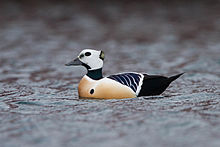
Threatened sea duck may be reintroduced in southwest Alaska

By DAN JOLING | Associated Press – Sat, Oct 17, 2015

ANCHORAGE, Alaska (AP) — A colorful, threatened sea duck whose numbers plummeted in Alaska may be reintroduced to the southwest corner of the state.

Steller's Eider (Polysticta stelleri) (13667966664).jpgFederal wildlife officials are taking public testimony on possible environmental effects of a plan to move breeding pairs of Steller's eiders to the Yukon-Kuskokwim Delta, where the birds once thrived.

Only 11 nests have been found there in the past 18 years. The birds' declining numbers on the delta figured heavily in a 1997 federal decision to declare the species threatened.

The U.S. Fish and Wildlife Service proposal calls for the release of Steller's eiders raised in captivity at the Alaska SeaLife Center in Seward. The agency says it's unlikely a subpopulation of Steller's eiders will re-establish itself without the introduction of captive birds.

Wild Steller's eiders continue to breed on tundra near coastlines in Arctic Russia and on Alaska's North Slope near Barrow, the northernmost community in the United States. The Alaska population is the only one listed under the Endangered Species Act.

Continued ...
CFZ Watcher of the Skies at 10/22/2015 11:00:00 am No comments:
Share

Wednesday, 21 October 2015

Vulture's genes help it thrive on rotting flesh

Scavenger found to have genetic traits that account for a stalwart stomach and powerful immune system that let it carry on eating carrion

By Reuters

6:29AM BST 21 Oct 2015

A Eurasian black vulture Photo: Alamy
A diet of putrid rotting flesh may not be your cup of tea, but to the cinereous vulture, found across southern Europe and Asia, it is positively delightful. This tough bird, it turns out, is genetically wired to thrive on the stuff.

Researchers on Tuesday said they have sequenced the genome of this big scavenger, also called the Eurasian black vulture, identifying genetic traits that account for a stalwart stomach and powerful immune system that let it carry on eating carrion.

They pinpointed genetic features related to gastric acid secretion that help explain this vulture's ability to digest carcasses and other features linked to its immune system defense against microbial and viral infections from decomposing flesh.

"It is known that they are all but immune to botulism and that they can happily eat the flesh of an animal coated in Bacillus anthracis that causes anthrax," said geneticist Jong Bhak of South Korea's Ulsan National Institute of Science and Technology.

"They also are known to take infected food with rabies, hog cholera and numerous other diseases that would be lethal to most other scavengers."

Continued ...
CFZ Watcher of the Skies at 10/21/2015 11:38:00 am No comments:
Share

'Bird hunting' ban affects relations with Arabs: Pak

ANI | Karachi October 18, 2015 Last Updated at 10:59 IST

The Pakistan Government has filed a review petition in the Supreme Court to reconsider its judgment on the ban over hunting a bird named 'houbara bustard' by foreign dignitaries, as it is affecting the country's relation with the Arab states.

According to the Dawn, the Ministry of Foreign Affairs in the petition pleaded that the matter concerns the foreign relations as falconry has been a significant part of its relations with Middle Eastern countries.

The petition stated that permits to hunt the bird were given only after following a strict procedure, issued by the Foreign Ministry

On August 19, Pakistan's apex court had ordered both federal and provincial governments to deny the grant of licences and permits to hunt the endangered bird.

Falconry is not a sport but has been recognized as a cultural heritage of Arabs by the UNESCO, the petition added.

Continued ...
CFZ Watcher of the Skies at 10/21/2015 11:04:00 am No comments:
Share

The miraculous reasons woodpeckers can slam their faces into trees all day and never get brain damage

Right now, over 200 species of woodpeckers around the world are slamming their faces into the side of a tree without a second thought of what this kind of behavior will do to their brains.

While this action would be entirely unnatural and extremely dangerous for humans, head banging is a crucial skill woodpeckers use to get food and make shelter.

Luckily for their tiny bird brains, woodpeckers are built for these types of powerful impacts.

Their brains, skulls, beaks, eyes, and even their bodies are specially designed to make the woodpecker nature's perfect head-banging machine.

Continued ...
CFZ Watcher of the Skies at 10/21/2015 11:04:00 am No comments:
Share

Tuesday, 20 October 2015

Winter is coming – but is Caper the swan?


Staff at Slimbridge wildfowl sanctuary are anxiously awaiting Caper the swan's 23rd winter visit, after a 2,500 mile annual journey from Siberia.

By Patrick Sawer

10:00PM BST 17 Oct 2015
It has survived the sort of hazard that each year claims the lives of dozens of his fellow travellers; from the threat of colliding with deadly power lines to being shot by hunters on the ground.

Now the eyes of those who follow his progress from the Siberia wastes are once again trained on the horizon, anxiously awaiting his return to his traditional winter home in south west England.

For most of the past quarter of a century, at the close of each autumn, Caper the swan has migrated from the depths of the Russian Arctic tundra to the wetlands of the Slimbridge wildfowl sanctuary in Gloucestershire, clocking up a total of more than 135,000 miles.

And staff at Slimbridge, who are conducting one of the longest-running studies of bird migration patterns, are now anxiously awaiting Caper’s 23rd winter visit.

Continued ...
CFZ Watcher of the Skies at 10/20/2015 11:24:00 am No comments:
Share

Experimental farm practices aid bird recovery


Birdwatch News Archive

Posted on: 18 Oct 2015
Many bird species reliant on agricultural landscapes have been declining sharply since the 1970s, but experiments on RSPB farms show how these trends could be reversed.

With many species of farmland bird – including iconic songbirds such as Skylark and Yellowhammer – losing more than half of their British breeding pairs over the last four decades (coinciding with a period of rapid and intense agricultural change), extreme concerns have been raised about these species' futures. Both the Game and Wildlife Conservation Trust (GWCT) and the RSPB have conducted a wealth of peer-reviewed research into the causes of the declines and how to manage them.

A new study by the two organisations published in the journal Bird Study has revealed that implementing such management solutions has brought about the rapid recovery of a broad range of songbirds at each charity’s demonstration farm. The study was performed at two farms, 42 miles apart in eastern England: GWCT’s 292-hectare Loddington Farm, in Leicestershire; and the RSPB’s 181-hectare Hope Farm, in Cambridgeshire.

Providing safe nesting sites and access to food has allowed farmland bird numbers to double or even treble in just five to 10 years. The recovery in bird abundance at these sites has been in stark contrast to the continuing declines seen in the surrounding countryside. This suggests that a greater roll out of wildlife-friendly farming measures should lead to a recovery in farmland birds in the wider countryside.

At the Leicestershire site, where predators occurred at a high density, the recovery of species such as thrushes and finches – which make open ‘cup-like’ nests – required predator management as well as habitat improvement in order to boost numbers. In comparison, at the Cambridgeshire site, where the density of predators was low, farmland bird recovery was achieved solely by habitat management. Predator density is probably a function of landscape type, this being wooded with mixed farmland in Leicestershire, but open, flat and mainly arable in Cambridgeshire.

Previous studies have found no evidence that crows and Magpies limit songbird numbers across the country as whole, but that they may do so locally. Further research is needed to understand how typical the Leicestershire and Cambridgeshire situations are compared to the rest of the country.

Read more ...
CFZ Watcher of the Skies at 10/20/2015 11:24:00 am No comments:
Share

Monday, 19 October 2015

Man who tried to smuggle birds in PVC tubes gets 9 weeks jail

ASIAONE

Saturday, Oct 17, 2015

SINGAPORE - He wanted to import nine live birds into Singapore, so 43-year-old Leong Kay Cheong stuffed the birds into customised polyvinyl chloride (PVC) tubes and wrapped them up in aluminium foil and black trash bags.

On Friday, the Singaporean was sentenced to nine weeks in jail for illegally importing the birds, and will also serve a concurrent three-week sentence for animal cruelty.

The birds were found inside Leong's luggage at Changi Airport in April 2014. He had arrived on a flight from Ho Chi Minh, Vietnam.

The Agri-Food & Veterinary Authority of Singapore (AVA) identified three of the birds as White-Rumped Shama birds (Copsychus malabaricus), and six of the birds as Melodious Laughing Thrush birds (Garrulax canorus), which is protected under the Convention on International Trade in Endangered Species (CITES).

- See more at:
CFZ Watcher of the Skies at 10/19/2015 11:02:00 am No comments:
Share

Murmuration of 1,000 clay starlings 'flown' across Bristol Downs

17 October 2015 

A flock of 1,000 clay starlings on wooden poles has been "flown" across the Downs in Bristol.

The Bristol Murmuration was sculpted by people from Henleaze, Stoke Bishop and Westbury-on-Trym to highlight the dramatic decline of the species.

Zoe Camron, the artist leading the project, said the "wonderful array" of birds included "very exotic-looking starlings" as well as green finches.

The murmuration will be on display on Durdham Downs until 25 October.

Once a common garden bird, starling numbers have fallen dramatically since the 1970s.

Despite the declining population, thousands of the birds can be spotted each winter flying together and creating mesmerising patterns called 'murmurations'.

Continued ...
CFZ Watcher of the Skies at 10/19/2015 11:01:00 am No comments:
Share

Sunday, 18 October 2015

Birdlife Malta seriously concerned at opening of trapping season

BY GOZO NEWS · OCTOBER 17, 2015
In a statement issued today in reaction to government's publication of two legal notices opening a trapping season for finches and another for golden plover and song thrush, Birdlife Malta said it is very disappointed at the Government's decision and insistence of opening another trapping season when the European Court of Justice will soon be deliberating over Malta's defiance. BLM has called on Environment Commissioner Karmenu Vella to take immediate action to safeguard migrating wild birds.

BLM said the Government's defiance is an indication of the lack of appreciation in protecting migrating birds, and of its political commitment to respect the treaty signed by Malta when it became an EU member state. A treaty which explicitly banned bird trapping after 2008.

Continued ...
CFZ Watcher of the Skies at 10/18/2015 03:13:00 pm No comments:
Share

Hen harriers tagged to better understand the threats they face

As a part of the RSPB’s Hen Harrier LIFE+ Project hen harriers have been electronically tagged enabling conservationists, and researchers to gain a better understanding of the threats these rarest and most threatened birds of prey face.

The tags transmit locations of the harriers on a regular basis, and members of the public along with scientists will be able to follow the movements of two individuals on a new website launched earlier this week. However, there will be a two week delay in the position information that will be available to the general public for security reasons.


Continued ...
CFZ Watcher of the Skies at 10/18/2015 03:13:00 pm No comments:
Share

Friday, 16 October 2015

New species find in Central Otago

Thursday, 15 October 2015, 10:01 am
Press Release: Canterbury Museum


New species find in Central Otago confirms link between Australian and South American shorebirds

A new species of shorebird, dating from a time when New Zealand was covered in subtropical forests and crocodiles roamed parts of the South Island, has been found near St Bathans in Central Otago.

An international team of New Zealand and Australian-based scientists, including Canterbury Museum researchers, have confirmed that the 19 - 16 million-year-old shorebird fossils belong to a group which had been thought to only comprise the Australian Plains-wanderer and the South American seedsnipes.

The new species, Hakawai melvillei, has been named after New Zealand ornithologist David Melville to honour his efforts in the conservation of migratory shorebirds.

Lead author and Canterbury Museum researcher, Dr Vanesa De Pietri, says that the team were excited to discover that the fossil shorebird was not a typical wader, but more like an ancestral Plains-wanderer, with some seedsnipe-like features. The Plains-wanderer and seedsnipes are unusual shorebirds as they have adapted well to living on the land.

“We’re happy to have found a fossil bird that provides a key morphological link between the two groups. The discovery of Hakawai melvillei has confirmed our thinking that the ancestors of the Plains-wanderer and seedsnipes were wading birds, like most other shorebirds,” she says. “It has also confirmed previous research I’ve undertaken, with colleagues, that the Plains-wanderer and seedsnipes evolved their terrestrial habits independently.”

Continued ...

CFZ Watcher of the Skies at 10/16/2015 12:45:00 pm No comments:
Share

Two more convictions for illegal bird trapping in Malta

BY GOZO NEWS · OCTOBER 14, 2015

This morning a bird trapper was fined 2400 Euros and lost his hunting and trapping licence for 3 years after being found guilty by the court of illegally trapping finches inside the Majistral nature & history park this spring.

Another man from Zurrieq was fined 1200 Euros and had both of his licences suspended for a period of 2 years for illegal finch trapping in the spring of 2014.

Both cases were reported to the police by CABS and they also provided the court with video evidence of the illegal trapping they had observed.

Source ...
CFZ Watcher of the Skies at 10/16/2015 12:42:00 pm No comments:
Share

Thursday, 15 October 2015

Birders compile 500-page labour of love

For four years, a band of 600 birders roamed the wilds of northern England carrying out the biggest bird survey of its kind for a quarter of a century. The result - the Northumbria Bird Atlas - is a 512-page doorstopper. But what motivated the twitchers to take on the mammoth task?

Armed with cameras, and out in all weathers, they checked every rustle in a bush or chirp in a tree.

They recorded almost 200 bird species from the River Tyne to the River Tweed, clocking up 10,000 hours and covering almost 2,900 sq miles (7,510 sq km).

During the long years of counting, bird club member Tim Dean achieved the birders' equivalent of the Holy Grail when he snapped a squacco heron in Morpeth in 2010.

It has only ever been spotted three times in the county - once in 1874 when it it was mistaken for an owl and shot dead.

Continued ...
CFZ Watcher of the Skies at 10/15/2015 12:41:00 pm No comments:
Share

Rare bird sighting ups better ecosystem hope

Freny Fernandes,TNN | Oct 15, 2015, 01.19 PM IST


THANE: The news of a rare sighting of the Oriental Darter bird at Bhandup pumping station on Wednesday morning has been received with great joy by environmental lists in and around the city.

The number of Oriental Darters or snake birds, a near-threatened species of migratory birds, has been declining over the years because of increasing pollution levels and this sighting comes as a ray of hope for the eco-system here, say green activists. 

"The Oriental Darter birds are water birds distributed along the coastal wetlands. They thrive in clean and unpolluted water where there is plenty of fish as they are a majorly fish eating species," said Kishor Dudhe, a research analyst at the Bombay Natural History Society (BNHS). 

"Over the years, the high level of pollution in water bodies has made the visibility under water low as well as affected the quantity of fish, thus affecting the birds that feed on them That is why the International Union for Conservation of Nature (IUCN) has put the Oriental Darter species in the near-threatened category," he added. 

This rare bird was spotted by Avinash Bhagat, a member of Thane-based Pary avaran Dakshata Manch who recently co-authored a book on the birds of Thane creek along with a group of 35 students of Thane's Lokpuram School during a nature trail at Bhandup pumping station on Wednesday morning. 


Continued ...
CFZ Watcher of the Skies at 10/15/2015 12:39:00 pm No comments:
Share
‹
›
Home
View web version

Contributors

  • CFZ Watcher of the Skies
  • Jon Downes
Powered by Blogger.