As regular CFZ-watchers will know, for some time Corinna has been doing a column for Animals & Men and a regular segment on On The Track... particularly about out-of-place birds and rare vagrants. There seem to be more and more bird stories from all over the world hitting the news these days so, to make room for them all - and to give them all equal and worthy coverage - she has set up this new blog to cover all things feathery and Fortean.
Showing posts with label A&M. Show all posts

Sunday, 28 June 2020

Mysterious Australian Night Parrots may not see in the dead of night


Australia's most elusive bird, the Night Parrot, may not be much better at seeing in the dark than other parrots active during the day
Date: June 9, 2020
Source: Flinders University
Australia's most elusive bird, the Night Parrot, may not be much better at seeing in the dark than other parrots active during the day.
An international study, co-led by Flinders University's Dr Vera Weisbecker, has revealed the critically endangered parrot's visual system is not as well-adapted to life in the dark as would be expected for a nocturnal bird, raising concerns it might be adversely impacted by fencing in the Australian outback.
"Night Parrots must be able to find their way at night -- to find food, avoid obstacles while flying, and escape predators," says Dr Weisbecker.
"We therefore expect their visual system to show adaptations for seeing in the dark, similar to other nocturnal birds -- New Zealand's Kakapo parrot and owls with enlarged eyes for example. However, we found that this wasn't the case."


Spectacular bird's-eye view? Hummingbirds see diverse colors humans can only imagine


Team trains wild hummingbirds to discriminate UV color combinations
Date: June 15, 2020
Source: Princeton University
To find food, dazzle mates, escape predators and navigate diverse terrain, birds rely on their excellent color vision.
"Humans are color-blind compared to birds and many other animals," said Mary Caswell Stoddard, an assistant professor in the Princeton University Department of Ecology and Evolutionary Biology. Humans have three types of color-sensitive cones in their eyes -- attuned to red, green and blue light -- but birds have a fourth type, sensitive to ultraviolet light. "Not only does having a fourth color cone type extend the range of bird-visible colors into the UV, it potentially allows birds to perceive combination colors like ultraviolet+green and ultraviolet+red -- but this has been hard to test," said Stoddard.
To investigate how birds perceive their colorful world, Stoddard and her research team established a new field system for exploring bird color vision in a natural setting. Working at the Rocky Mountain Biological Laboratory (RMBL) in Gothic, Colorado, the researchers trained wild broad-tailed hummingbirds (Selasphorus platycercus) to participate in color vision experiments.
"Most detailed perceptual experiments on birds are performed in the lab, but we risk missing the bigger picture of how birds really use color vision in their daily lives," Stoddard said. "Hummingbirds are perfect for studying color vision in the wild. These sugar fiends have evolved to respond to flower colors that advertise a nectar reward, so they can learn color associations rapidly and with little training."
Stoddard's team was particularly interested in "nonspectral" color combinations, which involve hues from widely separated parts of the color spectrum, as opposed to blends of neighboring colors like teal (blue-green) or yellow (green-red). For humans, purple is the clearest example of a nonspectral color. Technically, purple is not in the rainbow: it arises when our blue (short-wave) and red (long-wave) cones are stimulated, but not green (medium-wave) cones.
While humans have just one nonspectral color -- purple, birds can theoretically see up to five: purple, ultraviolet+red, ultraviolet+green, ultraviolet+yellow and ultraviolet+purple.
Stoddard and her colleagues designed a series of experiments to test whether hummingbirds can see these nonspectral colors. Their results appear June 15 in the Proceedings of the National Academy of Sciences.

Thursday, 14 May 2020

Birdwatchers report rare sighting of Garganey duck on Arran

12th May


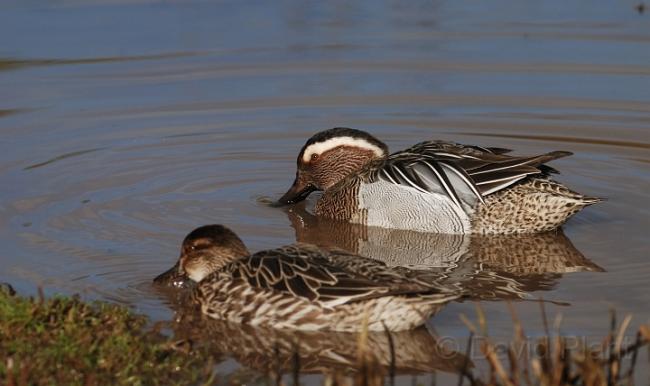
Garganey Duck Male and Female

A pair of Garganey ducks have been spotted on the Isle of Arran for only the second time.

Arran Birding, who record all sightings of unusual birds on the island, reported the sighting of a male and a female on Sunday, May 3.


They said the birds were spotted on Sliddery Shore amongst Teal, a duck more common to the area.

According to Arran Birding the last time Garganeys were seen on the island was back in May 2012.

Garganeys are native to Europe and Asia, but it’s rare to see them in the UK with most breeding pairs confined to East Anglia.

The RSPB describes the Garganey as being: “Smaller than a mallard and slightly bigger than a teal. The male is most easily recognised with a broad white stripe over the eye.”

Monday, 11 May 2020

Cranes make comeback in Britain's wetlands

By Roger HarrabinBBC environment analyst

22 April 2020

The graceful crane - the tallest bird in the UK - is making a comeback into Britain’s wetlands thanks to re-introduction and habitat restoration.

It was absent as a breeding bird for 400 years because of wetland drainage and widespread hunting.

Now, an estimated 200 of them are dispersed in Wales, Scotland, the Fens, Suffolk and Gloucestershire.

Their recovery has been glacially slow – in 2019 there’s thought to be just one more breeding pair than 2018.

But the RSPB says population modelling suggests that number will swell much faster soon, as fecundity of the surviving birds improves with age and second generation chicks reach breeding age.

Adult cranes stand at around 1.2m (4ft) and are fabled for their complex “display“ behaviour, where they perform bows, pirouettes and bobs.

Monday, 30 March 2020

Coronavirus: Police send home twitchers searching for rare bird


26 March 2020

Birdwatchers who flocked to a beauty spot in Gloucestershire to catch a glimpse of a rare bird have been sent home, police have said.

About 15 twitchers from across England congregated at an undisclosed spot in Cleeve Common, near Cheltenham, after the ring ouzel was reportedly spotted.

Ignoring the government's advice, the group had travelled from as far as Birmingham to see the bird.

The RSPB said it was "totally unacceptable" in the current situation.

Following the government crackdown on social distancing, people are being asked to stay at home, not travel unnecessarily and not gather in groups of more than two people.

'Go home'

Police said 10 cars and 15 people had set themselves up next to one another with long-sighted cameras and binoculars.

Wildlife crime officer PC Nick Westmacott said: "All of their details were obtained, and they were politely told to go home.

"On checking where they had travelled from, they had come from Birmingham, Swindon, Gloucester, Cheltenham and some from local Cotswold areas.

Friday, 6 March 2020

UK raptor persecution on the rise

19/02/2020


The RSPB's Investigations team has revealed that rates of raptor persecution are showing no signs of slowing down across the UK.

In fact, the organisation revealed this week that 2018 saw a shocking 67 incidents of bird of prey persecution confirmed in England alone – equalling the previous highest in the country, which was noted in 2007.

For the UK as a whole, 2013 and 2007 are the worst years on record, with 128 confirmed raptor persecution incidents each. However, it is important to note this is only the number actually exposed, and has very little bearing on the actual number of birds of prey targeted in the year as detection rates are very low.

For Scotland, at a glance, the signs appear encouraging. However, there is mounting evidence that, rather than decreasing, crimes are simply becoming more covert. Following the enactment of vicarious liability legislation and the increased use of satellite tags to monitor raptors, there has been a reduction in poisoning incidents, presumably because such crimes and their victims were becoming increasingly detectable. Sadly raptor population surveys repeatedly show no evidence of an overall fall in persecution levels in Scotland, or indeed the rest of the UK.

Thursday, 5 March 2020

Sub-Antarctic-dwelling king penguin spotted unusually far north at Port Davey, Tasmania


Posted 19 Feb 2020, 6:23am

A second king penguin has been spotted on mainland Tasmania, with one wildlife officer calling the sighting especially rare "unless you're on a tourist ship going to Antarctica".

Key points:
A king penguin was spotted by kayakers on a beach at Port Davey in Tasmania's far south-west
The species is usually seen 1,500km further south in Sub-Antarctic regions such as Macquarie Island
It is the second such unusual sighting this year, but a wildlife officer says it is no cause for concern

The penguin was spotted by kayakers at Port Davey in Tasmania's far south-west.

Wildlife officer Julie McInnes said it was a different penguin to the bird spotted at Seven Mile Beach near Hobart last month.

Dr McInnes said it was unusual to have two king penguins sighted in one year.

"This is a really rare thing for people to see, unless you're on a tourist ship going to Antarctica," Dr McInnes told ABC Radio Hobart.

The birds usually call Macquarie Island, about 1,500 kilometres from Tasmania, home.

"Given the remote location of the second bird, there may be a number of birds that come ashore over the years which are not seen or reported," Dr McInnes said.

She said "vagrant" juvenile penguins were known to come ashore away from their colonies from time to time.

"They can disperse quite a way," she said.

Frozen bird discovered in Siberia is 46,000 years old


February 21, 2020 | 10:27am

When miners first unearthed a bird from permafrost in Siberia, it was so well-preserved that they might have thought the poor creature had perished just the day before.

But radiocarbon dating and genetic analysis later revealed that the frozen specimen was actually a 46,000-year-old horned lark.

The bird was discovered by fossil ivory hunters near the village of Belaya Gora in northeastern Siberia. They then brought it to scientists Nicolas Dussex, Love Dalén and their team of experts at the Swedish Museum of Natural History, who confirmed the bird’s classification.

Their research was published in the journal Communications Biology on Friday.

“This finding implies that the climatic changes that took place at the end of the last Ice Age led to formation of new subspecies,” Dalén told CNN, suggesting that the icy avian corpse might be the ancestor of two of today’s lark species, including one type found in northern Russia and the other in the Mongolian steppe.

Chris Packham criticises anti-bird netting on Cambridge University trees

28th February

By Press Association 2020

Chris Packham

Chris Packham has branded Cambridge University’s move to cover a row of trees with nets to stop birds from nesting as “absolutely outrageous”, with activists from Extinction Rebellion responding by tearing some of the netting down.

The conservationist’s social media post was prompted by photographs of the trees, with their branches completely encased in netting, on the university’s West Campus.

He wrote: “Seriously? I thought we’d been through this last year! This is absolutely outrageous!”


Seriously ? I thought we'd been through this last year ! This is absolutely outrageous ! @Natures_Voice @WildlifeTrusts https://twitter.com/birdman1066/status/1232988999981129728 …


The Cambridge branch of Extinction Rebellion described the netting as “appalling” and demanded that it be removed.

It later posted photos of activists tearing down some of the netting under cover of darkness, adding: “We’ve freed some of the Cambridge Uni trees from their nets.”

The RSPB has previously said it is concerned by the use of netting on trees, hedges and bushes to prevent birds from nesting.

It is campaigning for laws to be introduced which would commit governments to ensure the recovery of nature, meaning such practices would come under greater scrutiny.


"Under cover of darkness on Thursday night, Extinction Rebellion Cambridge activists removed some of the netting, and discovered one willow had also been filled with foam to stop birds nesting in its holes."


It is an offence to disturb nesting birds once they have arrived, but the practice of installing netting to keep them away is legal.

A Cambridge University spokesman said: “Trees near the Whittle Laboratory have had nets put over them to discourage birds from nesting in them, so they will not be disturbed by work to expand the lab.

“The netting will be checked for wildlife three times a day.”


Monday, 2 March 2020

Protection for Antipodean albatross

FEBRUARY 24, 2020 9:29 AM AEDT

Australia has helped secure international agreement to protect the endangered Antipodean albatross on its 100,000km annual migration between New Zealand, Australia and Chile.

In India overnight, 130 countries agreed to further protections for the Antipodean albatross at the Conference of Parties on the Convention on the Conservation of Migratory Species of Wild Animals.

Each year, these majestic seabirds lay their eggs on breeding islands in the subantarctic waters south of New Zealand before heading off over winter to search for sparse feed supplies of cuttlefish in places like the NSW South Coast.

With as few as 9050 breeding pairs remaining, it was vital that the international community acted to protect the Antipodean albatross.

This is a tremendous outcome that will help reduce instances of the albatross being inadvertently caught by fishing vessels in coastal waters and the high sea, so that these birds can migrate safely.

Australia, New Zealand and Chile proposed the protections to prevent the further decline of the species, which without our help is in danger of being extinct within 20 years.

Sunday, 1 March 2020

Tufted Puffin in the Faroe Islands – a Western Palearctic fourth

31/01/2020

At around 2 pm on the afternoon of Friday 17 January 2020, Faroe Islands resident Helgi Fossdal was hunting for food off Slættanes in Vestmannasund, a strait separating the Faroese islands of Streymoy and Vágar.

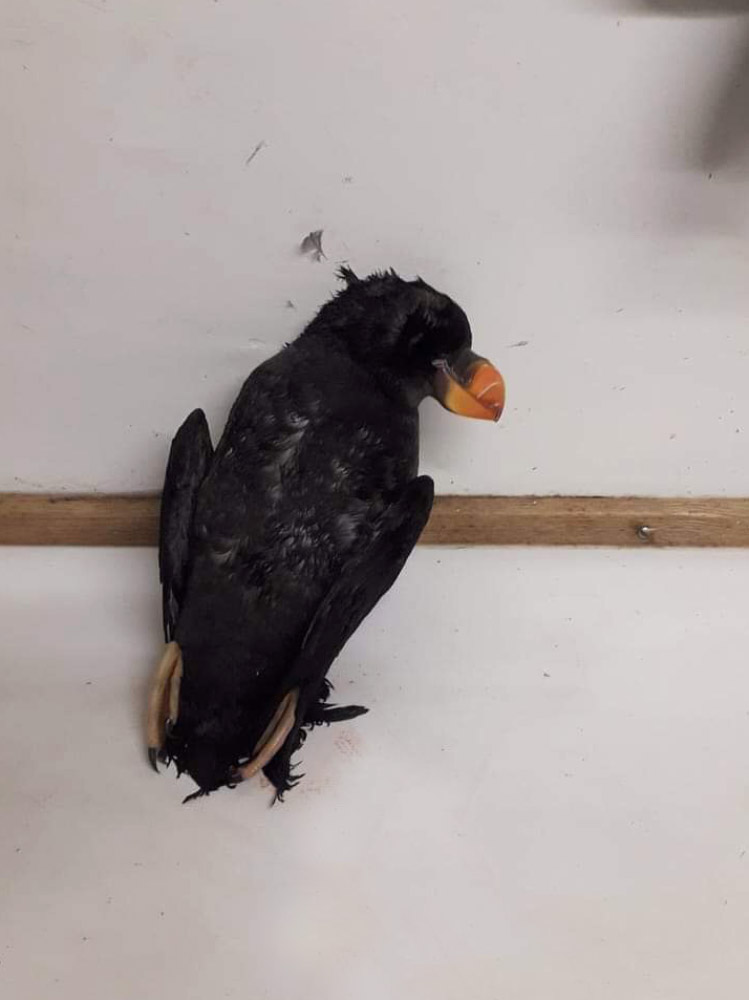
Spotting what he assumed to be a Guillemot, and knowing that the date fell within the legal hunting season for auks in the Faroe Islands, Helgi shot the bird to take home for dinner. However, on retrieving the corpse, he quickly realised it wasn't that species and in fact something quite different. Helgi described the bird as having the all-dark body of a European Shag, yet evidently displaying the bill and head of a Puffin, and crucially took some photos of the mystery bird when he arrived back at home that evening.

It was only some days later on 26 January that the identification was realised, when the images were sent to Anthony Oates, who correctly diagnosed the bird and circulated the images online. The mystery auk was indeed a puffin, but in fact a Tufted Puffin – a species native to the North Pacific and seen only three times previously in the Western Palearctic. The skin was then donated to the Faroe Islands natural history museum.


Tufted Puffin, Slættanes, Faroe Islands, 17 January 2020 (Helgi Fossdal).

The three previous accepted Western Palearctic records are as follows:
Adult at Laholmsbukten, Sweden, on 1 and 8 June 1994;
Adult at Oare Marshes, Kent, England, on 16 September 2009 (read more here);
Adult at Bear Island, Svalbard, on 14 July 2019.

There is a fourth previous record of a bird photographed at sea off Land's End, Cornwall, on 20 May 2016, although this bird was never submitted to the BBRC and therefore does not appear in any official listings. Read more about that bird here.


Acknowledgements

With thanks to Jens L Thomsen for his assistance and contribution to this summary.

Thursday, 27 February 2020

21 new species added to Indonesian bird collection


Arya Dipa

The Jakarta Post
Bandung / Mon, February 17, 2020 / 06:34 pm

Twenty-one new species have been added to the list of bird species endemic to Indonesia as of the beginning of 2020, bringing the country's total to 1,794 bird species.

Achmad Ridha, a research and communication officer at nonprofit bird conservation organization Burung Indonesia, said that the additional species included seven newly described bird species - including the Alor myzomela (Myzomela prawiradilagae) and the spectacled flowerpecker (Dicaeum dayakorum) - as well as 14 species that were split off from previously discovered species.

The Alor myzomela was announced as a new species in Oct. 2019. The bird is endemic to Alor Island, East Nusa Tenggara, and lives in a terrain 900 to 1,270 meters above sea level.

Meanwhile, the new Latin name given to the spectacled flowerpecker honors the Dayak people of Kalimantan, who have extensive knowledge about the flora and fauna of their native regions.

Other new species include the Peleng fantail, the Peleng leaf warbler, the Taliabu bush warbler, the Taliabu myzomela and the Taliabu leaf warbler. Three of the species are endemic to Peleng Island, Central Sulawesi, while the two other species are endemic to Taliabu Island, North Maluku.

Thursday, 20 February 2020

Rüppell's Vulture breeding with Griffon Vulture at two Spanish sites


New evidence suggests two cases of a Rüppell's Vulture breeding with a Griffon Vulture in Spain. In two different Griffon Vulture breeding colonies in Spain, one pair was observed copulating, and in the other, an adult Rüppell's Vulture was collecting nesting material.

Rüppell's Vulture
The Rüppell's Vulture (Gyps rueppelli) is an African species whose distribution range is located in the equatorial and eastern areas of the continent. It resembles our Griffon Vulture (Gyps fulvus), especially the juveniles and immature birds, being slightly smaller in size. The IUCN's Red List of Threatened Species considers it Critically Endangered, which is the last category before global extinction, due to the rapid declines of several populations across Africa.

its declining state is mostly due to the successive and frequent mass poisonings in Africa, which are driving several species of African vultures to extinction. The Vulture Multi-species Action Plan (Vulture MsAP), co-developed by us here at the Vulture Conservation Foundation, and endorsed by the Convention for Migratory Species (CMS), concludes that poison is the biggest threat to vultures worldwide, and a significant part of this global action plan for vultures focuses on the actions needed to fight this threat. Unfortunately, experts foresee a rather bleak future in the short term if poisoning events keep occurring at this rate.

Rüppell's Vulture in Europe
In consequence, Rüppell's Vultures are becoming alarmingly scarce in Africa but, surprisingly, they are increasingly seen in Europe. This is probably due to increased mixings of individuals of this species with wintering juvenile Griffon Vultures in West Africa. A percentage of Europe's growing population of Griffon Vultures winters in the Sahel zone of West Africa, where it will encounter some Rüppell's Vultures. When European Griffons start their migration north, they probably drag some African vultures with them, and with plenty of food in Europe, they are beginning to call our continent home. The species was recently added to Andalucía's list of vultures, making it Europe's 5th vulture species and one of the most threatened bird species in Spain.

Hooded Merganser rescued from Ipswich cosmetics shop


30/01/2020

A drake Hooded Merganser has been escorted out of a high street shop in central Ipswich.

The exotic duck had to be removed from a cosmetics store on Tavern Street on Wednesday [28 January] by local security.

The yellow-ringed bird is well known in Suffolk, having arrived on the Blyth Estuary at Blythburgh in late October 2018, where it remained for several weeks before relocating to Ipswich in 2019. It has lingered around the town since then and has become a popular attraction, usually being seen either in Christchurch Park or along the River Orwell.

The Kiko Milano store contacted Ipswich Central at 09:30 to report that a 'pigeon' was loose in the shop and needed to be rescued.

Street rangers from Ipswich Central arrived at the scene shortly after, only to find that it was in fact the Hooded Merganser, which had made its way almost 1 km down the high street to the cosmetics chain's store and then somehow found its way inside.

Friday, 14 February 2020

Very rare black-throated thrush brings flocks of birdwatchers to Grimsby


Sightings of a black-throated thrush, a bird rarely seen in the UK, has brought dozens of twitchers from across the UK to the town

Corey Bedford Live News Reporter
14:43, 2 FEB 2020

Rare black-throated thrush spotted in Grimsby

Birdwatchers have flocked to Grimsby after a black throated thrush was spotted on the grounds of the Grimsby Institute

Enthusiastic twitchers have travelled from across the UK to see a rare bird that has arrived in Grimsby.

A black-throated thrush has been spotted on the campus of the Grimsby Institute, which has caused quite a stir in the bird-watching community.

The birds are native to Asia, but are occasionally seen elsewhere as vagrant birds, which is when a bird strays far outside its expected breeding, wintering, or migrating range.

Sightings of the black-throated thrush in the UK are incredibly rare, with some bird watchers saying they only appear here once or twice a year.

One twitcher said: "You get a maximum of about two sightings a year in the UK, so it's a very rare occurence.

"We all have apps on our phone such as Bird Guide, which can let you know when a rare bird is spotted somewhere in the UK.

"I've only travelled from Hull, myself, but I have seen people from all over the UK coming to see it, they've been coming and going all morning."

The bird is currently on the green area in front of the Grimsby Institute, and has been hopping from tree to tree throughout the day.

A black-throated thrush can be recognised by its black bill with yellow base, grey plumage, and black tail.

Their breeding range extends from very Eastern Europe to Western Siberia and north-west Mongolia.


Wednesday, 12 February 2020

Lucky ducks: Once thought extinct, rare pochards take steps toward recovery


by Edward Carver on 6 February 2020

12 Madagascar pochard (Aythya innotata) ducklings were born in the wild in November.

Conservationists had introduced 21 young adult pochards to Lake Sofia in northern Madagascar in December 2018, but did not expect them to reproduce so quickly.

The pochard was once common in Madagascar’s highlands, but the population declined rapidly in the mid-20th century. Only a single pochard was spotted from 1970 until 2006.

The new crop of ducklings marks a victory for conservation groups that have been working to save the species since then. However, the pochard’s future remains precarious due in part to a lack of food, with its total population measurable in the dozens.

One of the world’s rarest birds, once thought to be extinct, successfully bred in the wild late last year. The crop of ducklings marks a victory for conservation groups that have been working for more than a decade to save the species.

In November, conservationists celebrated the appearance of 12 Madagascar pochard (Aythya innotata) ducklings on Lake Sofia in northern Madagascar. They had introduced a set of young adult pochards there in December 2018 but did not expect them to reproduce so quickly. Diving ducks normally don’t breed until they are 2 years old.

“We were very surprised and excited to have chicks just one year after introducing the ducks,” Felix Razafindrajao, a wetlands manager for Durrell Wildlife Conservation Trust, a group based on Jersey in the British Isles, told Mongabay. In addition to the 12 ducklings, which came in two broods, there are also eight pochard eggs in the marshes that should hatch in the next few weeks, he said.


Monday, 10 February 2020

Tripura organises its first-ever "Hornbill Festival"

08 FEBRUARY 2020 Last Updated at 6:36 PM | SOURCE: IANS

Agartala, Feb 8 (IANS) The two-day first Hornbill Festival of Tripura began on Saturday with the aim to conserve the striking forest bird "Hornbill" and to boost the livelihood of the people through tourism.

Tripura Chief Minister Biplab Kumar Deb inaugurated the state''s first-ever Hornbill Festival at the famous Barmura hill (in western Tripura), one of the biggest hill ranges of Tripura which was last month renamed as "Hathai Kotor", or "big hill" in the tribal language "Kokborok".

The "Hornbill" festival, named after the Indian Hornbill, the large and colourful forest bird which is displayed in the folklore of most of the tribals in northeast India, usually takes place in the first week of December every year since 2000 at Naga heritage village Kisama, about 12 km from Nagaland capital Kohima.

Deb said that with the conservation of the "Hornbill" bird, eco-tourism would flourish enhancing the livelihood of the local tribals, inhabitants of the Barmura hill.

Sunday, 9 February 2020

Lucky ducks: Once thought extinct, rare pochards take steps toward recovery

by Edward Carver on 6 February 2020

  • 12 Madagascar pochard (Aythya innotata) ducklings were born in the wild in November.
  • Conservationists had introduced 21 young adult pochards to Lake Sofia in northern Madagascar in December 2018, but did not expect them to reproduce so quickly.
  • The pochard was once common in Madagascar’s highlands, but the population declined rapidly in the mid-20th century. Only a single pochard was spotted from 1970 until 2006.
  • The new crop of ducklings marks a victory for conservation groups that have been working to save the species since then. However, the pochard’s future remains precarious due in part to a lack of food, with its total population measurable in the dozens.

One of the world’s rarest birds, once thought to be extinct, successfully bred in the wild late last year. The crop of ducklings marks a victory for conservation groups that have been working for more than a decade to save the species.

In November, conservationists celebrated the appearance of 12 Madagascar pochard (Aythya innotata) ducklings on Lake Sofia in northern Madagascar. They had introduced a set of young adult pochards there in December 2018 but did not expect them to reproduce so quickly. Diving ducks normally don’t breed until they are 2 years old.

“We were very surprised and excited to have chicks just one year after introducing the ducks,” Felix Razafindrajao, a wetlands manager for Durrell Wildlife Conservation Trust, a group based on Jersey in the British Isles, told Mongabay. In addition to the 12 ducklings, which came in two broods, there are also eight pochard eggs in the marshes that should hatch in the next few weeks, he said.

Read more

'Rare bird sighted in Chilika after 1997'

BHUBANESWAR: An unusual bird sighting at the Chilika Lake prompted a bird watcher to embark on a frantic quest for its identity. This, in turn, which was taken up by other bird lovers and was threatening to become a thriller, before a 32-year-old photograph came to the rescue and helped crack the mystery. 

The winged guest, in turned out, is an Australian stilt and its sighting in Chilika's famed Mangalajodi is the first ever, bird watchers claim. The Australian stilt, which is also called the pied stilt (Himantopus leucocephalus), was spotted by a local bird guide, Madhu Behera, on Saturday morning.

"I captured a few photos of the bird but could not identify it. It looked like the black-winged stilt but was morphologically different, having a ridge of black feathers in the upper part of the neck," said Behera, who is part of the Mangalajodi Conservation and Tourism Trust. 

Behera immediately dusted off his copy of the 'Bird Atlas of Chilika', published by the Bombay Natural History Society (https://timesofindia.indiatimes.com/topic/Bombay-Natural-History-Society) (BNHS) and the Chilika Development Authority (CDA), but found no mention of the bird in the Chilika region. "None of the other popular bird guide books and field guides showed any bird that looked like the one I saw. Finally, I found a photo resembling the bird I saw in 'A Field Guide to Birds of Chilika', written by Odia ornithologist Uday Narayan Dev," Behera explained. 

When Behera reached out to fellow enthusiasts, they confirmed that what he had seen was indeed the Australian stilt. Noted wildlife photographers and bird experts like Siba Prasad Parida, Gahar Abedin (https://timesofindia.indiatimes.com/topic/GaharAbedin) and Shakti Prasanna Nanda concurred with the finding. 

The photo that ended the confusion was clicked in 1987. Dev, whose book helped Behera when others had failed, recalled that he had seen the Australian stilt in the Nalabana area of Chilika (another stretch of the vast lagoon that is a favourite of birds). "Australian stilt sightings in Nalabana were reported till 1997, but stopped afterwards" Dev said. Siba Prasad Parida, an associate professor of zoology at Centurion University who has participated in all the bird censuses at Chilka since 2002, hailed the sighting. "This indicates that the weather and the food in Mangalajodi favours the bird," he said.

Friday, 7 February 2020

Suffolk Little Owl 'too fat to fly'


29/01/2020

A Little Owl, unceremoniously rescued from a Suffolk ditch as it was unable to fly, has been declared "extremely obese" by the Suffolk Owl Sanctuary.

The soggy owl was found in a ditch in the county in early January and, in these circumstances, wildlife rescue centres generally find that birds are carrying injuries, or occasionally have become waterlogged.

However, Suffolk Owl Sanctuary was surprised to find that it was in fact extremely overweight. Upon assessing the owl, a female, it weighed in at a rather chunky 245 g – roughly a third heavier than a healthy adult female Little Owl. It was unable to fly due to the large fatty deposits around its body.

It is extremely unusual for wild birds to get into this condition naturally, so the vets decided to investigate some obvious scenarios – the first being that it was possibly an escaped aviary bird. There was no indication of rings or chip identification, and asking around in the local area also didn't produce any leads.

They therefore decided to observe the rotund bird over a period of time for signs of a captive history – familiarity with 'artificial' foods used in aviaries, such as bright yellow chicks, can be a telltale sign. However, the owl didn't show any hints of previous confinement and has readily taken 'wild' food types, such as dark mice.