As regular CFZ-watchers will know, for some time Corinna has been doing a column for Animals & Men and a regular segment on On The Track... particularly about out-of-place birds and rare vagrants. There seem to be more and more bird stories from all over the world hitting the news these days so, to make room for them all - and to give them all equal and worthy coverage - she has set up this new blog to cover all things feathery and Fortean.
Showing posts with label rare vagrant. Show all posts

Monday, 16 November 2015

Is it a bird? Is it a plane? Just what are these men braving the rain to see?

 12:33 Tuesday 10 November 2015 11:00 Monday 09 November 2015

Well actually it is a bird. They’ve all been gathering in Chesterfield hoping to catch a glimpse of an extremely rare bird never spotted in Derbyshire before, which is calling the Crooked Spire home.
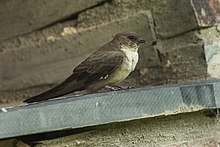
Eurasian Crag-Martin - Estremadurai 1779 (16772419967).jpgThe feathered visitor is the rarest bird the county has seen since an albatross in the fifties.

Bird watcher Roy Frost spotted the rare Crag Martin, which usually lives in Southern Europe, around the Chesterfield landmark yesterday (Sunday).

Roy, joint county bird recorder for Derbyshire, said the Crag Martin has never been spotted in Derbyshire before.

He said the bird has only been seen in the UK 13 times ever.

Roy, who has recently written a book called The Birds of Derbyshire, said: “You would normally see this bird in France, Spain, Italy and other places in Southern Europe.

“For it to be in Chesterfield is really exciting. It’s never been seen in Derbyshire before so a lot of people are going up to the Crooked Spire to see it for themselves.”

He added: “It’s difficult to say why this bird has come to Chesterfield. I can only guess that it’s been blown off course with the strong winds recently.

Thursday, 22 October 2015

Once in a generation bird arrives back in Britain


HISTORY has repeated itself for delighted twitchers after a long lost bird arrived 30 years to the day it was last spotted in Britain.
PUBLISHED: 00:00, Fri, Oct 16, 2015 | UPDATED: 16:33, Fri, Oct 16, 2015

Small greenish bird with yellow face and black cap, perched on a diagonal branchAs the birding community was remembering the previous time a diminutive Wilson's warbler was found on a Cornish headland in 1985, news broke that another one had made landfall.

Dazzling yellow Wilson's warblers are North American songbirds that nest in the vast forests of Canada and spend their winters in Mexico and neighbouring states.

Amazingly, one young bird, weighing little more than a 10p piece, crossed the Atlantic and made landfall near the northernmost tip of the Isle of Lewis in the Outer Hebrides.

Fortunately for the birdwatching community, the warbler touched down after its epic non-stop flight in a garden next-door to one of the country's best known ornithologists, Tony Marr.

Tony, who just happened to be hosting a visit from another of the country's leading ornithologists, Roy Dennis, explained how a spot of casual after-lunch birdwatching in a neighbouring garden turned into a history making occasion.

He said: "As we reached the gate into the field behind my neighbour's house, we paused to check the line of bushes which constitutes the shelter belt around his house on this very windy island.

"At 2.20 pm a small bird flew towards us. 'Looks like a goldcrest flying towards us', I said to Roy, as a colourful passerine flew in to the top of a small Sitka spruce near the gate. We both raised our binoculars as the bird landed in the tree. 'Oh ****!' I exclaimed. 'It's a Wilson's Warbler', with which Roy immediately agreed.

Monday, 28 September 2015

Park employees spot yellow-throated warbler in Alaska

Posted: Saturday, September 26, 2015 1:39 pm

Associated Press

JUNEAU, Alaska - When two National Park Service interpreters stopped to watch a bird outside their offices in Glacier Bay, they didn't realize it was the first time the species had been spotted in Alaska.

Interpreters Steve Schaller and Emma Johnson were looking at a yellow-throated warbler, reported The Juneau Empire (http://bit.ly/1KC3IqG).

"When we first spotted it, it sort of looked like a yellow-rumped warbler, but then we started to notice its behavior was different, and it had a longer beak," Schaller said. "We started realizing that this was something new."

It's surprising to hear about the species in Alaska: The yellow-throated warbler usually spends summers in the Midwest and winters as far south as Cuba and the Dominican Republic.

Sunday, 27 September 2015

Ultra rare North American bird makes spectacular arrival in Britain

THE birdwatching world has gone into a frenzy thanks an ultra rare bird's arrival on Britain's shores.

By STUART WINTER, NATURE EDITOR 
Acadian Flycatcher.jpg
PUBLISHED: 19:36, Tue, Sep 22, 2015 | UPDATED: 19:59, Tue, Sep 22, 2015

Suspected to be an Acadian flycatcher from North America, the historic landing on the beach at Dungeness in Kent is about to spark the biggest mass gathering of twitchers in years.

Thousands of twitchers are expected to descend on the south easterly tip of the country overnight to catch a sight of the small robin-sized bird that should, by rights, be basking in the tropical forests of Panama or Colombia.

Somehow it has been caught up in a fast-moving Atlantic weather system that has taken it from its nesting grounds in eastern USA to the famous gravel headland overlooking the English Channel.

Dungeness is renowned for its huge nuclear plant as well as being the backdrop of music videos and atmospheric crime dramas.

Continued ...

Sunday, 9 August 2015

Birders have RARE shot to spot Tree Pipit on Table Mountain

2015-08-07 10:54 - Louzel Lombard

Cape Town - SANParks has agreed to open the Perdekloof picnic site, usually closed in winter for a short time in a bid to make the most of a rare Tree Pipit seen in the area. 

Perdekloof picnic site will be opened to the general public on Friday, 7 August, from 09:00 to 14:00 only.

On Monday, 3 August, SANParks got exciting news of an odd bird - possibly the rare Tree Pipit - photographed at Perdekloof Picnic Site near Cape Point in Table Mountain National Park. 

Although the photos taken on the day (not the photo seen below) were not of the greatest quality, SANPark said, "The bird looks very much like a Tree Pipit."


Friday, 15 May 2015

1,000 people drawn to North Norfolk after rare bird spotted


10:21Friday 15 May 2015

An estimated 1,000 people descended on the North Norfolk coast after a rare bird was spotted in the sand dunes.

Carduelis citrinella.jpgWithin hours of the citril finch being discovered in Burnham Overy on Sunday, 500 people were on the beach.
Normally Citril Finches are found in alpine areas of Europe so the sighting of this male bird proved to be a big draw for bird watchers from across the country.

This is the first sighting of a citril finch in mainland Britain.

The RSPB’s area manager Rob Lucking estimates that the 1,000 people visited the Titchwell reserve during Sunday and Monday.

He said: “It caused a lot of excitement.

“I have seen one in France but never thought I would see on in Norfolk.

Thursday, 29 January 2015

Stunning rare North American bird spotted in Aberdeenshire

A stunning rare bird, hailing from the Arctic, has been spotted in Aberdeenshire.

The King Eider was spotted off St Combs on WednesdayThe beautiful drake King Eider was found off St Combs in Aberdeenshire, on Wednesday.
Described as one of North America’s most spectacular species, the King Eider forms large flocks during spring migration, sometimes exceeding 10,000 individuals, however, this duck appears to have been split from the flock.

Elsewhere a Ridgway’s Cackling Goose was spotted at Castle Kennedy near Stranraer in Dumfries and Galloway.

The rare goose is native to North America. It breeds in northern Canada and Alaska in a variety of tundra habitats.

Friday, 2 January 2015

Arrival of rare golden eagle in south Delta generates stir in birding community

BY LARRY PYNN, VANCOUVER SUN JANUARY 1, 2015

A golden eagle — a rare visitor to a region known for its bald eagles — had birders all aflutter on New Year’s Day in south Delta.

“I have been here a couple of days for this guy,” said Vancouver’s Michelle Lamberson, taking her place in a line of photographers along 72nd Street near Boundary Bay. “I’ve got some decent shots.”

The juvenile bird sat like an ornament atop a large poplar tree on the edge of a golf course about 75 metres from the roadside.

Lamberson, who is director of flexible learning special projects at the University of B.C. and a birder for eight years, added: “I’ve not seen one in the Lower Mainland before. Bald eagles don’t like them.”

Mark Wynja, a birder for more than 40 years who works in a bird-supply shop in Vancouver, said the golden eagle rules the roost along the Boundary Bay foreshore. He watched as the raptor flew into a stand of red alders and scattered four bald eagles from their perches, although they later returned.

“He tends to be the dominant bird,” he said. “He’s tougher than a bald eagle, which is a glorified scavenger.”

Wednesday, 30 July 2014

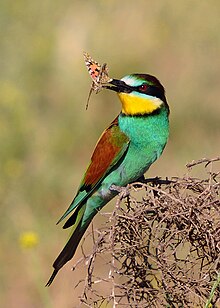
Rare bee-eaters nest on the Isle of Wight for first time on record

A pair of colourful and rare bee-eaters, normally to be found in southern continental Europe, has set up home on National Trust land on the Isle of Wight.
Şahlûr.jpg
It is only the third record of the bird breeding successfully in the UK in the last century, the last being in 2002 in a quarry in County Durham. Two young successfully fledged. Before that, two pairs were recorded raising seven young in a Sussex sand-pit in 1955.

The latest bee-eaters, were discovered on the Isle of Wight in mid-July, having set up home in the sandy hills of the Wydcombe Estate in the south of the island.

They chose a small valley where the soft ground, rolling landscape and access to a stream provides ideal conditions for their nest burrow.

Ian Ridett, a National Trust Isle of Wight Ranger, said: “We have set up a 24-hour surveillance operation around the site to protect these rare visitors, as any unhatched eggs could be a potential target for egg thieves.

Monday, 7 July 2014

Arthur blows rare bird into southern Nova Scotia

Walking along the side of a windswept sand dune at Mavillette Beach on Saturday morning, apparently dazed and confused, was a rare bird.

The dominant feature of this black and white visitor was a slender, two-tone red and black needle-sharp bill some 10 centimetres in length.

He didn't want to fly until someone came a little too close and forced him to lift off and circle around, only to land a few metres away.

Most agree the bird is a black skimmer, likely exhausted after being blown to Digby County from Florida or the Carolinas, where the birds would be breeding just about now.

The bottom of a black skimmer's beak is longer than the top, says the All About Birds website. The bird will skim low over the water with its beak open, hoping to trap small fish, according to the site, operated by Cornell University.

Saturday, 5 July 2014

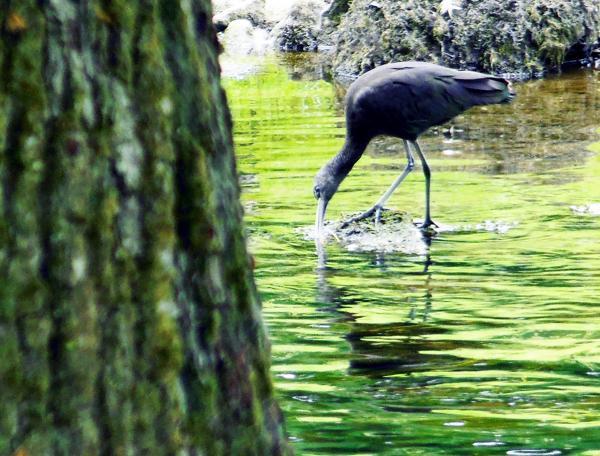
PICTURE: Rare bird turns up for a wade in South Lakeland water after Greece and Turkey turns too hot

Updated 9:09am Thursday 3rd July 2014 in NewsBy Katie Dickinson, Reporter
AN exotic visitor to the River Bela has been attracting birdwatchers from Cumbria, Lancashire and beyond.

The rare glossy ibis was first spotted just south of Milnthorpe on June 17 and has been sighted most days since.

An RSPB spokesperson said the wading bird was ‘a fairly rare sighting but not unheard of’ in the UK.

The glossy ibis would normally be in Greece or Turkey at this time of year after spending the winter in north Africa.

There have been around ten sightings across the UK so far this year.

Wednesday, 26 September 2012

Magnolia Warbler a Mega North American Stunning Rare Bird! on Fair Isle!


Late in the day I got a call from Jason from his cellphone standing on the edge of a cliff in the North West of Fair Isle. "Tommy I have an American Warbler! I don't know what it is? I've got photos and will be able to ID it later but can you look in your American bird books?" Jason describes the bird over the phone. 

See pictures and read more:  http://fair-isle.blogspot.co.uk/2012/09/magnolia-warbler-mega-north-american.html

More information on the magnolia warbler (Setophaga magnolia ):

http://www.allaboutbirds.org/guide/Magnolia_Warbler/id

http://blx1.bto.org/birdfacts/results/bob17500.htm

Friday, 21 September 2012

Rare Alaskan bird spotted in area


A RARE visitor winged in to Wombwell last week - and quickly gained an admiring audience.
An American Golden Plover, that rarely makes its way to England’s shores, was spotted at Old Moor RSPB Centre on Wednesday.
It is believed the hurricane that swept across the States, and subsequent weather disruption, was responsible for the appearance of the North American bird, that was identified as a moulting adult.
A spokesman for Old Moor said the bird has been sighted just eight times at the reserve since 1950.
The breed usually flies from its homeground in Alaska, down the east coast of America to the south for the winter.
The plover rested for one day at Old Moor. The spokesman said: “As the bird was blown here, so way off course, we feel it might end up somewhere like Spain now. It caused quite a bit of interest here.”

More information on the American golden plover (Pluvialis dominica):