As regular CFZ-watchers will know, for some time Corinna has been doing a column for Animals & Men and a regular segment on On The Track... particularly about out-of-place birds and rare vagrants. There seem to be more and more bird stories from all over the world hitting the news these days so, to make room for them all - and to give them all equal and worthy coverage - she has set up this new blog to cover all things feathery and Fortean.
Showing posts with label rat eradication. Show all posts

Friday, 29 September 2017

Rare birds return as isles cull black rats


Mike Merritt
September 22 2017, 12:01am, The Times

Storm petrels have been recorded calling for the first time on a chain of Hebridean islands after thousands of black rats were cleared as part of a £1 million eradication scheme to save seabirds.

The characteristic “churring” of the endangered birds was heard this summer from their breeding burrows, an encouraging sign that the project’s conservation work is paying off in the Shiant Isles and the birds may be nesting.

The EU-funded project by RSPB Scotland, Scottish Natural Heritage, and the Nicolson family — the private owners of the islands — began in 2014 to provide safe breeding grounds for Scotland’s globally threatened seabird populations on the Shiants, in the Minch, five miles off the coast of Harris.


Wednesday, 9 November 2016

Rare birds thriving on Scilly Isles after scheme rids islands of rats


Number of nesting Manx shearwaters almost triples in three years after a project, backed by Prince Charles, sucessfully kills off the rats that eat the birds’ chicks and eggs

Hazel Southam
Friday 21 October 2016 11.56 BST Last modified on Friday 21 October 2016 17.00 BST


A scheme to kill rats on two of the Isles of Scilly, backed by Prince Charles, has led to a resurgence in rare sea birds.

The number of Manx shearwaters has risen to 73 nesting pairs this year, the highest in living memory and almost triple the number of nesting birds just three years ago. The birds appear to be breeding successfully, with 30 chicks spotted on the popular holiday islands. Another species of rare ground-nesting birds, storm petrels, have also returned to the Scillies. 

The Manx shearwater shares the burrows of rabbits on the tussocky slopes of the Scilly Islands of St Agnes and Gugh, while the storm petrel nests in cracks in rocks, beneath the local pub. But this made them vulnerable to rats, which ate both their eggs and chicks. 

There is archeological evidence of Manx shearwaters on the islands dating back to 2,000 BC. By the 13th century, they were so common that they were used as currency. Annual rents were paid in 30 ‘pufons’ (either puffins or Manx shearwaters) to the Duchy of Cornwall. 

But it was the rats rather than the Duchy that caused the birds’ decline. It is thought that brown rats arrived on the islands in the 17th century, from the many shipwrecks that dot the coast of the Scillies.

By 2014 there were only 24 nesting pairs of Manx shearwaters left and a chick had not survived in some 100 years. 

In 2013 the 84 islanders worked together to eradicate the rats under a £750,000 scheme backed by Prince Charles. Farmers cleaned out sheds and barns. New, sturdy refuse bins were supplied to every household. And islanders started taking waste to the local tip just once a week. 

All 11 children at the school on St Agnes were taught about rats, storm petrels and shearwaters. 

Monday, 26 January 2015

Rare pipits return following rat eradication on South Georgia

The world's most southerly song bird, the South Georgia Pipit, is fighting back from extinction thanks to work carried out by an 18-strong international team to eradicate rats from its island home in Antarctica.

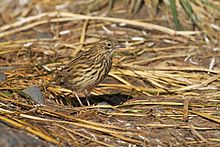
Anthus antarcticus -South Georgia, British overseas territory-8.jpgJust as the final phase of the world’s largest rodent eradication project was being undertaken by UK charity, the South Georgia Heritage Trust (SGHT), news came that a nest of five South Georgia Pipit chicks had been found in an area previously overrun by rats.

The South Georgia Pipit is only found on South Georgia and its numbers had been decimated by the invasive rat populations on the island. Its survival as a species was under threat before the eradication work began.

The discovery of the pipit nest was made at Schlieper Bay near the western end of the island by a former member of the rat eradication team, Sally Poncet, an expert on South Georgia’s wildlife and this year a recipient of the Polar Medal in recognition of service to the United Kingdom in the field of polar research.

Poncet was a member of what has been nicknamed Team Rat during its Phase 1 operations. She discovered the nest while on a Cheesemans’ Ecology Safaris expedition (in collaboration with the Government of South Georgia) to survey Wandering Albatrosses.


Saturday, 9 November 2013

Isles of Scilly rat eradication to 'save seabirds' begins

A project aimed at protecting internationally important seabird populations on two of the Isles of Scilly by killing more than 3,000 brown rats, is under way.

The islands, which are located off Cornwall, are home to breeding populations of 14 seabird species and approximately 20,000 birds.

Eradication experts from New Zealand and the UK have been contracted to carry out the work.

"Among many challenges our seabirds face, the greatest threat on land is predation of eggs and chicks by brown rats," said Jaclyn Pearson from the Isles of Scilly Seabird Recovery Project.

"The brown rats were accidently introduced to islands from shipwrecks in the 18th Century," she added.

'Intensive baiting'
The project is part of a 25-year programme to protect "internationally important" seabird numbers, including those of Manx shearwaters and storm petrels, and is costing more than £755,000.

The rodents will be poisoned on St Agnes and Gugh by Wildlife Management International Limited (WMIL).