As regular CFZ-watchers will know, for some time Corinna has been doing a column for Animals & Men and a regular segment on On The Track... particularly about out-of-place birds and rare vagrants. There seem to be more and more bird stories from all over the world hitting the news these days so, to make room for them all - and to give them all equal and worthy coverage - she has set up this new blog to cover all things feathery and Fortean.
Showing posts with label state bird. Show all posts

Wednesday, 24 July 2019

After 12 years, western tragopans to fly back into the wild


Two pairs of the western tragopan, fitted with high-frequency radio collars, will be released at Daranghati wildlife sanctuary from the nearby pheasantry in Sarahan, 160 km from Shimla, by the year-end.
CHANDIGARH Updated: Jul 13, 2019 10:09 IST
Twelve years after launching a conservation programme to breed the western tragopan, Himachal Pradesh’s state bird, the wildlife wing has met success and will be releasing four pheasants from captivity into their natural habitat.
Two pairs of the western tragopan, fitted with high-frequency radio collars, will be released at Daranghati wildlife sanctuary from the nearby pheasantry in Sarahan, 160 km from Shimla, by the year-end.
This was decided at a recent wing of the state forest department’s wildlife wing.
The radio collars will help conservationists study and monitor the birds after their release from the lone breeding centre for the western tragopan, which is found in the northwest Himalayas, including Jammu and Kashmir and Uttarakhand besides Himachal Pradesh. The species inhabits the high-altitude temperate forests at elevations between 2,400 and 3,200 metres.
“This is for the first time that the western tragopan bred successfully in the wildlife department’s pheasantry will be released into the wild,” says Savita, the principal chief conservator of the forest wildlife department.
Wildlife experts attribute the fall in numbers of tragopans to habitat degradation, hunting and extensive grazing of the forest by livestock.
“Himachal Pradesh is an important range-state for western tragopans, where it is distributed in sizeable populations in all three catchment areas of the Beas, Sutlej and Ravi,” says chief conservator, wildlife (south), Sushil Kapta.
The bird, locally known as Jujurana, is also the national bird of Nepal. The Himachal Pradesh government declared it the state bird in 2007.
Western tragopan belongs to the family phasianidae, which includes peafowl and red jungle fowl.


Wednesday, 3 April 2019

State Bird Of J&K Is Under Threat From Stray Dogs


BY  ATHAR PARVAIZ • • Mar 20, 2019 • 688
The black-necked crane, the state bird of Jammu and Kashmir, is under threat from feral dogs that damage the bird eggs and chicks.
Basic knowledge about the importance and activities of Black-necked crane among people in the cold desert of Ladakh is so widespread that Chartses, local name for mating dance of this long-legged bird, is an important feature of every cultural programme or local festival. Ladakhis, particularly those living in Changthang region, consider black-necked crane not only culturally important, but a spiritual creature as well.  
They believe that sighting the giant bird is a sign of good luck. Many monasteries in Ladakh have even paintings of black-necked crane along with other spiritual paintings. 
“Black-necked crane is highly revered by the people of Ladakh. It is embedded in our culture and its dance (Chartses) is performed by Ladakhis in every cultural event and festival,” said Jigmat Takpa, former forest conservator of Ladakh. 
“Its drawings are found in our monasteries as the bird is considered very auspicious and the symbol of Ladakh’s unique ecology. Ladakhis feel proud about the fact that its only breeding ground in India, is in Ladakh,” Takpa added.  
Black-necked crane lives on high altitudes in Tibetan plateau, India and Bhutan, the only species of the crane family choosing such habitats. These birds build their nests in open environments which makes them vulnerable to predators. Both male and female are almost of similar size though the male is slightly bigger than the female. They have whitish bodies, long slender black legs and long black necks with a red crown adorning their heads. 
According to IUCN, black-necked crane is classified as Vulnerable because it has a single small population that is in decline owing to the loss and degradation of wetlands, and changing agricultural practices in both its breeding and wintering grounds. 
In Ladakh Himalayas, says WWF-India, the major threat to the successful breeding of black-necked crane is the damage caused to the eggs and chicks of the bird by feral dogs. According to WWF-India, “these dogs are owned both by armed forces as well as by the local nomads. Another threat to the bird is the loss of habitat.” 
The canine hazard 
The beautiful creature, also the state bird of mountainous state of Jammu & Kashmir, is under severe threat from human-kind’s trusted friends – dogs. “If there is any single biggest threat to the survival of black-necked crane these days, it is from the feral dogs,” said Takpa. “The dogs are even attacking the humans. How can these poor creatures escape from their wrath?” 


Thursday, 31 January 2019

Protecting the pelican: Plans rise to restore Louisiana state bird habitat


BATON ROUGE, La. (LOCAL 33) (FOX 44) - Louisiana wildlife officials are helming a $19 million project to save their state bird's breeding space from shrinking coastlines.
Subsidence and coastal erosion have dwindled the brown pelican habitat on Queen Bess Island to roughly six acres. Officials with the state's Department of Wildlife and Fisheries, along with the Coastal Protection and Restoration Authority, hope to restore damaged rookeries using settlement funds from the 2010 Deepwater Horizon Oil Spill.
"Those birds need a little more room to spread out," said Todd Baker, a state biologist aiding the reconstruction project. "Hopefully we can provide that for them."
The project would add 30 acres for pelicans to nest, with another 7 acres for terns and skimmers. Biologists say the grounds must be high enough for eggs to stay above water — and low enough to hide from predators.
Construction is slated to cost $17 million. Roughly $2 million have already gone toward design. The project would be the first of its kind for the state.
"Louisiana has never gone out and purposely restored a rookery for the purpose of restoring a rookery," Baker said. "It will teach us a lot about how we're going to do projects in the future, not just for brown pelicans but a whole suite of colonial waterbirds."
The eroding Gulf Coast hardly marks the first threat in the brown pelican's history. In 1961, brown pelicans stopped hatching in Louisiana, after heavy use of the pesticide DDT made eggshells too thin to incubate. By 1963, the birds disappeared from Louisiana marshes.
State officials started reviving the pelican population in 1968. They shipped chicks from Florida and brought them fish twice a day until they got old enough to fly. In 1971, the birds returned to Queen Bess and laid 11 nests, from which the population gradually rose. Brown pelicans were removed from the federal endangered species list in 2009.

Wednesday, 29 August 2018

Ladakh’s revered bird is under threat from human’s best friend – dogs


by Athar Parvaiz on 22 August 2018
The black-necked crane, the state bird of Jammu and Kashmir, is under threat from feral dogs that damage the bird eggs and chicks.
Another threat to the bird is the loss of habitat owing to the loss and degradation of wetlands and changing agricultural practices in both its breeding and wintering grounds.
Dog attacks on wildlife are a threat to species survival in India and researchers suggest responsible dog ownership, control of free-ranging behaviour to reduce interactions with wildlife and dog population management based on scientific research and techniques.
The dance of Chartses, a mating jig of the black-necked crane, is an important feature of every cultural programme or festival in Ladakh where the bird is revered among the people. Ladakhis, particularly those living in Changthang region, consider the black-necked crane not only culturally important, but a spiritual creature as well. Many monasteries have paintings of the crane along with other spiritual paintings.
They believe that sighting the giant bird is a sign of good luck.
But the beautiful creature, also the state bird of the mountainous Jammu & Kashmir, is under severe threat from humankind’s trusted friends – dogs. In Ladakh Himalayas the major threat to the successful breeding of black-necked crane is the damage caused to the eggs and chicks of the bird by feral dogs, according to World Wildlife Fund (WWF) India who claimed that “these dogs are owned both by armed forces as well as by the local nomads.”
Another threat to the bird is the loss of habitat. According to IUCN, the black-necked crane is classified as vulnerable because it has a single small population that is declining owing to the loss and degradation of wetlands and changing agricultural practices in both its breeding and wintering grounds.

Friday, 25 May 2018

Chhatbir zoo seeks state bird baaz in India, abroad


 The Chhatbir Zoo in Punjab is set to welcome a new inhabitant — the majestic northern goshawk, ‘baj’ or ‘baaz’ in Punjabi, the state bird, that has not been sighted in the region for a long time. 

Published: 13th May 2018 09:13 AM  |   Last Updated: 13th May 2018 09:13 AM  |  A+A A-

CHANDIGARH: The Chhatbir Zoo in Punjab is set to welcome a new inhabitant — the majestic northern goshawk, ‘baj’ or ‘baaz’ in Punjabi, the state bird, that has not been sighted in the region for a long time. 

The development follows the wildlife department’s hunt for the bird spotted in the portraits of Guru Gobind Singh, the tenth Guru of Sikhs, across the Middle East and Eastern Europe countries. Speaking to The Sunday Standard, Chief Wildlife Warden, Punjab, Dr Kuldeep Kumar admits that the state does not currently have the bird in captivity anywhere.

“We have taken permission from the Ministry of Environment and Forest and Central Zoo Authority to rescue a baaz from the wild. The bird has earlier been sighted on the foot hills of Himachal Pradesh and Uttarakhand, but we haven’t heard of any recent sighting. We are also trying to locate baaz in other parts of the country, chances of which seem bleak,” he says. 

“If we do not find the bird here (India) then we will have to get it from Middle East or Eastern European countries. We plan to get three to four pairs of the bird as the founder population to then facilitate breeding here. The infrastructure at the zoo has already been renovated for the new member,’’ says Kumar.


Wednesday, 8 June 2016

Please don't feed Hawaii's rare state bird, the nene, and don't run over it either


By Jay Jones

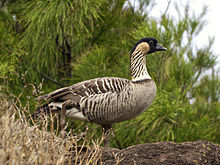
Hawaii’s nene is one of the rarest geese you’ll ever see. In the early 1950s, only 30 of the endangered birds remained in the Hawaiian Islands, their only natural habitat.

Branta sandvicensis LC399.jpgThe state bird has bounced back since then, but now faces a new threat: motorists.

Park rangers on Hawaii Island are warning drivers to make way for nene right now, when the young fledglings are most vulnerable. 

The plea comes from Hawaii Volcanoes National Park after two nenes just 6 months old were killed last month by an unknown driver.

Two adult nene can be seen in underbrush near Crater Rim Drive in Hawaii Volcanoes National Park. (Kathleen Misajon/National Park Service)

The endangered nene become more active, and therefore more visible, in late spring as fledglings, under the watchful eyes of their parents, test their wings.

The young birds can unpredictably land on roadways, according to wildlife biologist Kathleen Misajon, who manages the park’s Nene Recovery Program.

“Nene crossing” signs are posted in various parts of the national park to urge drivers to use caution. Visitors shouldn’t approach them or try to feed them either.

Read on … 

Wednesday, 1 June 2016

Delhi's State bird remains forgotten


The house sparrow is struggling to find a home in Delhi today, four years after it was declared the official State bird. Numbers of the once-ubiquitous small bird have declined over the years to a point that a sparrow sighting has become a happy but rare occasion.

The then Delhi Chief Minister Sheila Dikshit had in 2012 named the sparrow the State bird, after experts lobbied for the move in order to raise awareness and numbers.

Mohammed Dilawar, the president of the Nature Forever Society, had launched a campaign to save the sparrow in 2011 and given Ms. Dikshit a memorandum asking for the tag of the State bird for the sparrow.

“There has been a decline in sparrow population in the past decade, and not just in India. Sparrows are found near human habitation, not forests. It is important that urban habitats of sparrows are conserved,” said Mr. Dilawar.

While experts say sparrow population has been decreasing, there are no exact numbers. Mr. Dilawar said a common bird monitoring programme had been initiated, but it did not reach a critical mass to establish a trend. Data for at least five to six years will be needed to gauge the changes.

The Delhi Parks and Garden Society, which answers to the Delhi government’s Environment and Forest Department, conducts a bird count, but does not have details for individual species.

“We have managed to increase the total green cover in Delhi over the past few years and have been encouraging RWAs to plant sparrow-friendly plants. We have started seeing results in some areas,” said Dr. S.D. Singh, the CEO of the society.

He added that flocks of sparrows are seen at the society’s plant nursery near Millennium Bus Depot.

The former Chief Minister, who spearheaded the campaign to improve sparrow numbers, told The Hindu that the Aam Aadmi Party government has not done enough to carry on the programme.

Friday, 18 September 2015

Telangana Bans Display of State Bird Palapitta during Dasara

By Express News Service

Published: 17th September 2015 04:21 AM

Last Updated: 17th September 2015 04:31 AM

HYDERABAD: The Telangana government has banned the display of the State bird, Palapitta at temples during Dasara festival. In a recent notice issued to all temples across the state, the Endowment Commissioner warned of strict action against defaulters.

In Telangana, Palapittas are believed to bring luck when seen on the eve of Dasara festival. Every year, innumerous birds would be captured by poachers and displayed at temples. Often, the birds would be treated inhumanly in this process.

In a press release, the Humane Society of India, an organisation that works for protection of animals, stated that poachers typically capture the birds a month before the festival. They tie the legs of birds with a thread, trim their wings and stick them with glue to prevent them from flying. The birds are usually starved till the day of Dasara and kept in small cages for public viewing. Most of these birds die in captivity or immediately after being released.

Monday, 14 September 2015

Palapitta, the state bird of four states at risk of being illegally captured by poachers for Dusshera

Summary: The society said poachers and traders take advantage of the common belief that the sighting of Palapittas is a lucky omen during the Hindu festival of Dusshera. The birds are usually starved up till the day of Dusshera and kept in small cages for public viewing, the society explained. These birds are often sold or placed outside temples for viewing during Dusshera.

HYDERABAD: The Humane Society International/India has urged the Telangana government officials to crack down on the cruel capture and trade of the Palapitta (also known as the Indian roller or blue jay). The society said poachers and traders take advantage of the common belief that the sighting of Palapittas is a lucky omen during the Hindu festival of Dusshera. Poachers typically capture the birds a month before the festival, tie their legs with thread, trim their wings and stick them with glue to prevent them from flying. The birds are usually starved up till the day of Dusshera and kept in small cages for public viewing, the society explained. Most of these birds die in captivity or immediately after being released. In response to a letter sent by HSI/India, Telangana`s Department of Animal Husbandry called on the state`s Director General of Police, State Forest Department and State Animal Welfare Board to work in tandem and take necessary actions to strictly monitor the illegal capture and trade of Palapitta, which is the state bird of Telangana. 


Monday, 29 June 2015

Prairie music vanishing: Populations of North Dakota's state bird in serious decline

May 31, 2015 12:00 pm • Kim Fundingsland Minot Daily News

Their song is one of the most unique and recognizable in the bird world. They are the state bird of North Dakota and similarly honored in five other states. And they are vanishing from the landscape.

The western meadowlark no longer makes common appearances atop fence posts where they have perched for decades, almost always emitting their unmistakable flute-like call. It is a sound like none other heard on the prairie.

So distinctive is the call of the western meadowlark that it would be hard to find anyone who grew up in North Dakota who couldn't recognize the melodious and lengthy tune of the colorful bird. Now, sadly, the remarkably pure sound is becoming rarer and rarer each year. It is a lasting and disturbing trend that increases the possibility that a growing number of North Dakota residents may be denied hearing what just a few short years ago seemed common for anyone spending time outdoors in the Peace Garden State.

"Western meadowlarks have declined significantly in the last 10 to 15 years. Our breeding survey data shows that," said Ron Martin of Minot. "That's the iconic sound of the North Dakota prairie."

Martin is a long-time birder who has earned regional and national recognition for his expertise. He has participated in numerous surveys, including regularly covering five of 44 standardized observation routes in North Dakota under the supervision of the U.S. Geological Survey.

Saturday, 15 November 2014

Sighting of Shaheen falcons in Sikar excites bird watchers


Anindo Dey | Nov 15, 2014, 03.27 AM IST

JAIPUR: In what can be music to the ears of ornithologists in the state, a pair of Peregrine or Shaheen falcon, the state bird of Pakistan, was recently sighted in the ancient village of Harsh in Sikar. The sighting of a pair is though not the only of its kind but is said to be a rare one.

A large, crow-sized falcon, with a blue-grey back, the Shaheen falcon can fly at up to 322 km/h (200 mph) making it the fastest animal in the world. The Shaheen falcon is migratory in nature but the sighting of the pair has sparked interest amongst bird lovers, who are keeping a close watch on it as to whether the pair mates there.

"Harsh is a religious place of the Chauhans and is famous for the temple of lord Shiva. The village was plundered by the Mughals and though it was restored but not to its original glory. The village is at a height of 2,400 feet and offers a good aerial view, making it a haunt for various birds of prey," said Rajpal Singh, member state wildlife board.

Wednesday, 17 September 2014

Global warming: Could Idaho lose its mountain bluebird?

Idaho Statesman
September 10, 2014 


The Legislature adopted Sialia arctcia as the state bird in 1931. The bird is 6 to 7 inches long and is a member of the thrush family.

JOE JASZEWSKI — jjaszewski@idahostatesman.com


What's the problem? Global warming threatens survival of more than half of all bird species in the U.S. and Canada, National Audubon Society scientists claim. Among them is the mountain bluebird, Idaho's state bird.
Why? Increased dryness caused by warming temperatures will alter the habitat ranges of birds in nearly every state, forcing them to migrate to unfamiliar areas, where they will have to adapt or possibly perish.

How credible is the threat? The report has a blind spot: It cannot reliably say that many of the species will not simply adapt in their current habitat or thrive elsewhere. Still, "it's a wake-up call," said John Fitzpatrick, executive director of the Cornell Lab of Ornithology.

Here's the entire story from The Washington Post's Darryl Fears:

Read more here: http://www.idahostatesman.com/2014/09/10/3367271/global-warming-could-idaho-lose.html#storylink=cpy


Sunday, 29 June 2014

State bird added to priority list

The North Dakota Game and Fish Department has added the state bird, the western meadowlark, to the state’s updated 2014 Conservation Priority List.

NDGF Conservation Section Supervisor Steve Dyke said the majority of the species on the list — which has grown to 112 this year, up from 100 on the original 2005 list — are suffering population declines because of a statewide decrease in habitat. Wetlands and grasslands have been lost due to increased agricultural production and less participation in the Conservation Reserve Program. CRP land is land that has been pulled or protected from agriculture production by landowners who sign multi-year contracts with the U.S. Department of Agriculture’s Farm Service Agency and receive payments for letting those acres go fallow.

Saturday, 21 June 2014

Five-year plan ready to save state bird sarus

LUCKNOW: The first-ever 'total' count of state bird sarus held in 2010 showed it is making a slow comeback to its native state, notching the figure of 12,246 cranes in UP.

Grus antigone Luc viatour.jpg
But after that, conservation efforts to ensure survival of sarus more or less fizzled out. Now, forest department, in consultation with organisations working for the cause of sarus conservation, has prepared a five-year action plan to save the state bird.
"The department will do the pan-UP Sarus census at the end of this month," said PCCF (wildlife), Rupak De. The action plan calls for Sarus census twice a year.

UP is the biggest Sarus-supporting state in the country. In 2010, seven divisions of UP forests were found sheltering more than 500 cranes. Census showed concentration of sarus population in all districts, protected areas and in sanctuaries of UP.


Thursday, 20 February 2014

Chhattisgarh's state bird Bastar Hill Mynah back from the brink

Rashmi Drolia, TNN | Feb 16, 2014, 12.32PM IST

99382_260_190RAIPUR: There is some good news for bird enthusiasts. Chhattisgarh's state bird, Bastar Hill Mynah, was on the verge of extinction — now, its flock is increasing. A group of 150 whistling birds were spotted at Netanar, on fringes of Kanger Valley National Park, about 27km from Jagdalpur in Bastar, claim wild enthusiasts.
Chhattisgarh wildlife society president AMK Bharos told TOI, "Earlier, frequent sightings of Hill Mynah couldn't be done as they were on the brink of extinction. Now, there is a possibility of increase in their numbers."

He said like other winged creatures, Mynahs also move from one place to another in search of food. With climatic changes, they migrate to parts of neighbouring Odisha. "One can't capture them or restrain them at a place for conservation. State wildlife society has written to the forest department to locate trees on which mimic birds feed like those of ficus trees. Earmarking these trees would certainly help in Mynah's conservation."

Wednesday, 17 October 2012

India bid to save house sparrow


Authorities in the Indian capital, Delhi, have adopted the house sparrow as the "state bird" in a bid to halt any further decline in their numbers.

"We will take steps to ensure that the sparrow returns, feels safe, and is able to live peacefully in the city," Chief Minister Shiela Dikshit said.

The house sparrow is fast disappearing from India's rapidly-growing cities.

Experts say that a number of factors like high pollution and a growing use of insecticides are to blame.

"Their numbers have gone down drastically, specially in the cities. Sparrows don't like to build their nests in high-rise buildings. They prefer old-style construction where there are lots of nesting spaces," Sajeev TK of the Bombay Natural History Society's Delhi centre told the BBC.

"Also, because of pollution and use of insecticides, they are no longer able to find soft-bodied worms to feed their chicks," he said.

Experts say the humble sparrow is also being pushed out by bigger and more aggressive birds as food in the cities becomes scarcer.

Bird lovers and wildlife officials say that an aggressive awareness campaign can still save the sparrow and children would have to be at the heart of any effort to bring it back home.

"People need to be made aware that the sparrow shares the space with us in the cities. And children need to be encouraged to feed them," says Ranjit Lal, an avid bird watcher who writes on wildlife issues.

"Sparrows are smart birds, if they find food, they will return."

Saturday, 6 October 2012

House Sparrow declared Delhi's state bird

The humble House Sparrow has become the 'state bird' of Delhi, Chief Minister Sheila Dikshit, who is the brain behind the decision, announced today.

Dikshit, know for her environment-friendly initiatives, said the government has issued a notification declaring the House Sparrow as the state bird.

Expressing concern over dwindling number of house sparrows in the city, Dikshit had proposed in August to make it state bird, hoping that its new status would help to conserve it.

"The bird has disappeared in the city due to fast urbanisation in Delhi. The sparrows fly within a radius of two-three kilometres. We will have to create an atmosphere conducive to the habitat of sparrows in the city," Dikshit said, releasing a poster on house sparrow at a function today.

The Chief Minister exhorted Delhiites to care for the environment and said everybody has to contribute to make the city more green in order to provide habitat to the birds and other wildlife in city forests.

A street play was presented by a group of school children calling for conservation and protection of natural resources and environment.

The Chief Minister also praised 2,000 school eco-clubs for their constructive role in spreading awareness about conservation of environment.

http://www.business-standard.com/generalnews/news/house-sparrow-declared-delhis-state-bird/64909/

Wednesday, 19 September 2012

Egrets' nests sighted in Etawah wetlands

Photo: from Wikipedia

KANPUR: Bird watchers have reason to cheer as six nests of the state bird sarus containing three chicks and two eggs have been sighted by forest department personnel, ornithologists and wildlife activists in the wetlands of Etawah district.

The nests of the bird, Sarus (Grus Antigone), were spotted by volunteers of the Society for Conservation of Nature in the wetlands in Bandha area of the district. SCON members, along with a team of forest department, visited the spot and took pictures of the Sarus nests, eggs and chicks.

Society secretary Rajiv Chauhan told TOI: "At one such nesting site situated among the tall weeds, an adult sarus was found guarding its single egg from predators. The bird, known for ferocious attacks on anyone trying to steal its eggs, was behaving as per its nature. When a team tried to click some photos, it attacked the lensmen several times before making a loud call that signals danger."

Read on:  http://articles.timesofindia.indiatimes.com/2012-09-18/kanpur/33924848_1_sarus-nests-grus-antigone-small-vertebrates-and-invertebrates

More information on Sarus Crane (Grus antigone):

Tuesday, 18 September 2012

State bird nearing extinction

GURGAON: The population of the black partridge (black teetar), Haryana's state bird, is decreasing owing to massive urbanization in Gurgaon, according to district forest officials.

Till a decade ago sighting the black teetar in the region was easy but now the bird has almost disappeared because of the changing habitat and rapidly changing demographic complexion. Even though there are no exact figures of the population of the bird in the district, the officials claimed that hardly any black partridge has been sighted for quite a long time.

"The city has become a concrete jungle. The commercial development taking place in Gurgaon has gradually deprived the bird of its natural habitat." said Kulvendra Singh, DFO Gurgaon.

The black partridge has always been a tourist attraction and once upon a time was in abundance in the Sultanpur Bird Santuary, Basai and Dadri wetlands. But now the bird is not seen much in these areas.

In 1979, the Haryana government had declared the black partridge as the state bird but unfortunately the authorities did little to save the bird.