As regular CFZ-watchers will know, for some time Corinna has been doing a column for Animals & Men and a regular segment on On The Track... particularly about out-of-place birds and rare vagrants. There seem to be more and more bird stories from all over the world hitting the news these days so, to make room for them all - and to give them all equal and worthy coverage - she has set up this new blog to cover all things feathery and Fortean.
Showing posts with label South Korea. Show all posts

Friday, 13 March 2020

Repurposed Oyster Farm Bags Offer New Real Estate for Migratory Birds

As development and rising seas diminish roosting sites, shell-filled bags provide “islands” to rest and refuel

By Priyanka Runwal on March 4, 2020
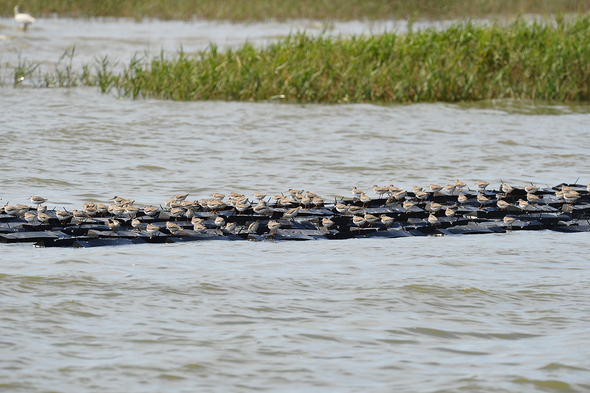

Terek sandpipers on a floating roost in the Geum Estuary in South Korea. Credit: Hong-Tae Jeon and Young-Min Moon


Standing atop a 16-foot-high seawall on South Korea’s western coast, Chris Purnell and his colleagues slide mesh bags stuffed with empty oyster shells down onto the sandy mudflats of the Geum Estuary. They then clip the heavy bags to ropes and drag them into the gently lapping waters that run into the Yellow Sea.

Purnell’s aim is for these bags, attached to foam floats and lashed together in clusters up to 80 feet wide, to act as artificial roosting sites for the tens of thousands of migratory shorebirds that traverse the East Asian-Australasian Flyway. Coastal development has deprived these travelers of crucial resting spots, leading to drastic shorebird declines in key stopover areas like this one. “We’re hoping this could be a rapid-response intervention,” says Purnell, wetland birds program manager at Birdlife Australia, a nonprofit conservation organization.


Sunday, 30 June 2019

Endangered bird returns to South Korea 40 years after extinction


Rare wader is designated a national monument that features in popular children’s song
Wednesday 22 May 2019 18:48 

The endangered crested ibis has reportedly been reintroduced to South Korea 40 years after it went extinct in the Asian country. 
Forty of the rare wading birds were bred in captivity before being released into the wild at Upo Wetland in South Gyeongsang province, southeast of Seoul, the Yonhap news agency reported.  
The last time a crested ibis was spotted on the Korean peninsula is believed to have been in 1979 when it was spotted in the demilitarised zone separating the south from North Korea.
The bird used to be a common sight until pesticide use reportedly damaged its food sources. 
A designated national monument in South Korea, it is also seen in China and Japan.
The captive population in South Korea has now reached 363, according to the Agence France-Presse news agency.
The breeding programme began with a birds donated by Beijing.
In South Korea the crested ibis is linked to an eponymous popular children’s song, composed when Japan ruled the country.


Monday, 31 December 2018

Asia’s rarest seabird could be easier to spot in the future


28 Nov 2018
Researchers celebrate breeding success in South Korea for the Chinese Crested Tern – a bird once thought extinct. Decoy model birds have helped bolster the new colony, and the species has been spotted in Japan for the first time.
Trying to spot a Chinese Crested Tern amongst a colony of similar-looking Greater Crested can be likened to playing a high-pressure game of ‘Where’s Wally?’, in which rather than simply completing a fun puzzle-book by spotting a man in a red-striped jumper, the fate of an entire species relies on your attentive eyes.
So when, about three years ago, we reported a momentous discovery in the conservation of Asia’s rarest seabird, the Chinese Crested Tern Thalasseus bernsteini, we were very excited by what it could mean. Korean researchers had spotted five adults and one chick amidst a colony of Black-tailed Gulls on an uninhabited rocky island (Chilsando), 7 km off the southwest coast of South Korea. This was extra special because Chinese Crested Tern was feared extinct until 2000 when breeding birds were rediscovered on the Matsu Islands of Chinese Taiwan, and hadn’t been seen on the eastern side of the Yellow Sea for almost 100 years. Yunkyoung Lee, Researcher from the National Institute of Ecology (South Korea), remembers the moment well: 
“When I realised that we were looking at Chinese Crested Terns, I felt a thrill throughout my whole body”, she says. “Their slender appearance with black caps and white backs was eye-catching in the crowded colony of Black-tailed Gulls Larus crassirostris, which have white rounded heads and grey backs. However, in the field, we did not know immediately what they were. We had never seen this species before, let alone ever anticipated that they would lay eggs in Korea.”