As regular CFZ-watchers will know, for some time Corinna has been doing a column for Animals & Men and a regular segment on On The Track... particularly about out-of-place birds and rare vagrants. There seem to be more and more bird stories from all over the world hitting the news these days so, to make room for them all - and to give them all equal and worthy coverage - she has set up this new blog to cover all things feathery and Fortean.
Showing posts with label South America. Show all posts

Sunday, 1 March 2020

Protecting the Canada Warbler at both ends of its epic journey


The Canada Warbler migrates more than 10,000 kilometres a year, from Canada and the United States to the forests of South America. Find out how our Colombian Partner is using a local grassroots approach to support an Americas-wide action plan to protect the species.

Each year, one of the biggest wonders of the natural world occurs: bird migration. You may be surprised to learn that of the 11,000+ species of birds that exist, one in five is considered migratory. Some of these species make really incredible trips. The Canada Warbler Cardellina canadensis flies more than 10,000 kilometres every year from Canada and the United States to the humid cloud forests of South America, coming to rest across Colombia, Ecuador, Venezuela and northern Peru.

Eliana Fierro, a biologist at Asociación Calidris (BirdLife in Colombia), explains that the threats facing this tiny voyager are different at each end of its journey: “[At their breeding sites], agrochemicals are harming the insects they feed on. While here in their wintering area, the main problem is deforestation. When these birds arrive in South America, they rely on forests 500 – 2000 meters above sea level. But often they arrive to find that there is no forest anymore.”

Because of its wide distribution, all efforts to protect the Canada Warbler must cross borders. From 2004 – 2017, around 30 organisations from all over the Americas joined forces to develop the Canada Warbler Full Life Cycle Action Plan, bringing together research on threats the species faces in each country. Fierro explains: “The plan first started at the breeding sites, coordinated by Nature Canada and Birdlife. Then we decided to include the wintering grounds, and the construction of the complete cycle action plan for the species began.” As part of this process, Asociación Calidris became the Species Guardian in Colombia.

Their first step focused on raising awareness of the species; not only among birdwatchers, but also among the owners of farms that host the species every year. "We are currently working in the Western Cordillera in two very specific locations: Dapa [in the village of Chicoral] and Villa Carmelo," explains Eliana Fierro. Chicoral village is located at the highest part of the Bitaco district in the municipality of La Cumbre. Whereas Valle del Cauca can be found on the Pacific slope of the Western mountain range.

Wednesday, 7 August 2019

More than 10 years conserving natural grasslands

By Emilia Ulloa


In the southern cone of South America lies a beautiful and unique stretch of lowlands, covered in rolling prairie grasses and rich in wildlife. These are the Pampas. Named for the Quechua word ‘pampa’ which loosely translates to ‘plains’ the pampas cover an area close to a million kilometers, extending across parts of Argentina, Uruguay, Paraguay and Brazil. 

This region serves as a habitat to around 600 native birds, and is a stopover point for thousands more migratory birds which traverse the territory along journeys that can be up to 15 thousand kilometers long. The plant-life in the area provides crucial sustenance and refuge to these migrating birds, while also serving as vital breeding areas for endemic birds such as the Saffron-cowled blackbird (Xanthopsar flavus) and the Black-and-White Monjita (Xolmis dominicanus). In addition to supporting an incredible amount of wildlife, the pampas also provides sustenance to thousands of people who live in the region. 

Despite this, the area is in danger of disappearing completely, along with all the unique wildlife it supports. The principle threats to the pampas are the intensifications of agriculture, ranching, and urban development. In fact, 95% of the pampas are private property, and are being used for the cultivation, primarily of soya, corn and wheat. These monocultures in turn leach the soil of its nutrients and leave it open to the risk of erosion.


Wednesday, 17 July 2019

Chasing the elusive Magellanic Woodpecker


JULY 10, 2019


University of North Texas Ph.D. candidate, Amy Wynia, traveled more than 6,000 miles to Navarino Island in southern-most Chile to explore the forests in search of the Magellanic Woodpecker (Campephilus magellanicus), the largest woodpecker in South America. While Wynia went to the ends of the earth to collect information for her Ph.D. dissertation, she also went because she really loves woodpeckers.

"The first time I actually held a woodpecker… that moment of me connecting with that bird in my hand and feeling those stiff tail feathers, it really stuck with me," said Wynia, a student and researcher in UNT's Sub-Antarctic Biocultural Conservation Program. "I've captured lots of birds in my time but the woodpecker was one bird that just really impressed me."

Less than 700 miles north of Antarctica, Wynia spent some of her days attempting to detect, capture and band the Campephilus magellanicus to study the bird population. She captured 52 woodpeckers in her time there but said it wasn't easy.

"We use large, special nets that are specifically designed to safely and humanely capture birds. But, these birds have very sharp bills and claws designed to rend and tear bark. And, as the birds and banding work is too delicate to wear gloves, I often went home bleeding," she said.


Friday, 1 February 2019

South America's industrial scale bird trade revealed in shocking new report


South Africa was the world’s leading exporter of South American parrots between 2000 and 2013 after Amazon countries “abandoned the possibility of legally and competitively producing and exporting their wildlife,” finds a new study into bird trade in Latin America.
Bird’s-eye view: Lessons from 50 years of bird trade regulation & conservation in Amazon countries, provides a comprehensive overview of bird trade in Brazil, Colombia, Ecuador, Guyana, Peru, and Suriname, including regulations and the bird trade’s impact as a conservation tool on species and habitats.
The trade of birds and their products from the region has a long history: since the mid-19th Century, many tonnes of feathers and bird skins—mainly hummingbirds and tanagers, were exported to fashion markets in Europe and North America. This demand led to the killing of millions of birds over many decades. For example in a brief period before World War I, one London merchant imported 400,000 hummingbirds and 360,000 other birds from Brazil, while in 1932, some 25,000 hummingbirds were hunted in Pará State and sent to Italy to adorn chocolate boxes. Hundreds of thousands of live birds were later exported as pets from across South America after the mid-1950s when commercial airline connections, mainly through Miami, became routinely available.
After decades of intensive exploitation and massive declines in many bird populations, in 1967, Brazil became the first country in South America legally to ban the commercial sale of wild animals, replacing demand through captive breeding programmes as an economic alternative with low conservation impacts on wild populations. With Brazil’s national wildlife trade ban installed, illegal wildlife trade was simultaneously initiated in South America.
In subsequent decades, hundreds of thousands of birds were captured to supply international trade, many of them laundered through those countries where exports were still legal (i.e. Argentina, Bolivia and Paraguay). In the 1980s, up to 10,000 Hyacinth Macaws were captured, many ending up in captive breeding facilities where production costs were lower than in Brazil. Wild populations were seriously depleted, although there have been important recoveries in Brazil thanks to sustained conservation efforts. While range countries struggle to prevent the extinction of this emblematic species, the Philippines has become the world’s main legal exporter of Hyacinth Macaws.

Monday, 7 January 2019

Female penguins are getting stranded along the South American coast


January 7, 2019, Cell Press

Every year, thousands of Magellanic penguins are stranded along the South American coast—from northern Argentina to southern Brazil—1,000 kilometers away from their breeding ground in northern Patagonia. Now researchers reporting in Current Biology on January 7 have new evidence to explain the observation that the stranded birds are most often female: female penguins venture farther north than males do, where they are apparently more likely to run into trouble.

"Anthropogenic threats have been considered to threaten wintering Magellanic penguins along the coasts of northern Argentina, Uruguay, and southern Brazil; these include water pollution caused by oil development and marine transport as well as fishery-associated hazards, such as bycatch and depletion of prey species," says Takashi Yamamoto of the Institute of Statistical Mathematics in Tokyo. "Our results suggest that the northward spatial expansion likely increases the probability to suffer these risks, and particularly so in females."

Researchers knew that penguins stranded along the South American coast were three times as likely to be females. The question was: why?

While data were lacking, there wasn't any evidence to suggest that males and females split up for the winter. Now, Yamamoto and his colleagues find that in fact they do. The researchers recorded the migratory and diving behavior of 14 Magellanic penguins (eight males and six females) during the non-breeding period in 2017 using LAT 2500 geolocators (Lotek Wireless, Inc.).


Read more at: 

Friday, 24 November 2017

Bird diversity is breathtaking in Peru


Good Birding
Tony Greenfield / Contributing Writer
NOVEMBER 16, 2017 11:28 AM

The fall monsoon is underway on the Sunshine Coast with torrents of rain, falling leaves and declining temperatures. I have just returned to the above from a trip to the southern hemisphere where the seasons are reversed.

I was in Peru, both in the Amazon and the Andes, where seasons are more defined as wet and dry periods rather than by temperature. November in Peru is a good month to visit as it precedes the rainy season which begins in December.

From a climate perspective, it is questionable whether there is any good time to visit the Peruvian Amazon as it is hot and humid beyond belief. It is the first time I have ever stood or sat perfectly still and yet sweated profusely. After visiting the Amazon, a day later we were in the Andes at 4,400m (about 14,000 feet) in cloud and drizzle and wind, and I was really cold. The switch from heat to cold was difficult to comprehend. 


Monday, 10 October 2016

How natural selection acted on one penguin species over the past quarter century

Date: September 24, 2016
Source: University of Washington

Biologists of all stripes attest to evolution, but have debated its details since Darwin's day. Since changes arise and take hold slowly over many generations, it is daunting to track this process in real time for long-lived creatures.

"We know that evolution occurs -- that species change," said Dee Boersma, a University of Washington professor of biology. "But to see this process in long-lived animals you have to look at generations of individuals, track how traits are inherited and detect selection at work."

Boersma studies one particularly intriguing long-lived species, the Magellanic penguins of South America. She has spent 34 years gathering information about their lifespan, reproduction and behavior at Punta Tombo, a stretch of Argentine coast that serves as their largest breeding site. Boersma and her colleagues combed through 28 years' worth of penguin data to search for signs that natural selection -- one of the main drivers of evolution -- may be acting on certain penguin traits. As they report in a paper published Sept. 21 in The Auk: Ornithological Advances, selection is indeed at work at Punta Tombo.

"This is the first decades-long study to measure selection in penguins, and only the second one for birds overall," said lead author Laura Koehn, a graduate student in the UW School of Aquatic and Fishery Sciences who worked with Boersma as an undergraduate.


Sunday, 29 May 2016

The Search Is On For South America's ‘Lost Birds'


By Daniel Lebbin May 25, 2016

High in the Santa Marta Mountains of Colombia in early 2015, two guards from Fundación ProAves' El Dorado Reserve found the Blue-bearded Helmetcrest, a hummingbird nobody had seen for 69 years. The rediscovery of such lost birds is not as infrequent as one might guess. Finding them, as other ABC-funded expeditions have done in the past with the Pale-headed Brush Finch and other birds, can be vital to their conservation. It's hard to protect birds if you don't know where they live.

The International Union for Conservation of Nature currently ranks at least 24 species in the Americas as threatened even though the species have no known individuals in the wild nor surviving in captivity. Most of these species should probably be considered extinct. But some may still persist, living in areas that are difficult to search and where few people go.

To untangle this mystery and determine if the birds are still out there—and therefore deserving of our conservation attention—ABC is mobilizing resources and partners to conduct searches for some of South America's lost birds. We're starting with three: the Tachira Antpitta, the Turquoise-throated Puffleg, and the Kinglet Calyptura.


Thursday, 28 April 2016

Old world bird in a new world rainforest

Date: April 27, 2016
Source:  Central Ornithology Publication Office

Sapayoa aenigma, Nusagandi, Panama.jpgThe Sapayoa, a rainforest bird from Central and South America, is an evolutionary enigma--genetic analysis shows that its closest relatives are bird species living across the ocean in Asia and Africa. Now, new research in The Auk: Ornithological Advances demonstrates for the first time that its natural history links it to its evolutionary relatives thousands of miles away.

How the Sapayoa ended up so far from other members of its lineage remains a mystery, and little is known about its reproductive biology or social behavior. However, new field work in Panama by Sarah Dzielski and Benjamin Van Doren of Cornell University and their colleagues reveals that Sapayoas consistently build nests that hang over the water along ravine-bottom streams. One of the active nests they observed was attended by a family group comprised of an adult male and female and two immature males, all four of which brought food to the two chicks. The researchers were surprised by the social behavior they observed, which included mounting between individuals of the same sex, possibly to establish dominance and maintain social cohesion.

These are the first extended observations of Sapayoa breeding behavior, and they provide hints at how this unusual bird is connected with its roots. Many of the Sapayoa's Old World relatives are cooperative breeders, getting help from family groups, and the pear-shaped hanging nest also is consistent with Old World "suboscines," the group of birds to which Sapayoas belong.

Tuesday, 18 August 2015

Deceptive woodpecker uses mimicry to avoid competition


Date: August 11, 2015

Source: Central Ornithology Publication Office

Summary: Birds of a feather may flock together, but that doesn't mean they share a genetic background. Though birds were first classified into groups primarily based on appearance, research demonstrates that this method isn't necessarily accurate: in a group of very similar-looking South American woodpecker species, genetic analysis has now shown one to be only a distant cousin of the others, in an intriguing case of visual mimicry.

Sunday, 12 April 2015

Exceptionally preserved fossil gives voice to ancient terror bird

Date:
April 9, 2015

Source:
Society of Vertebrate Paleontology

Summary:
A new species of South American fossil terror bird called Llallawavis scagliai or, 'Scaglia's Magnificent Bird' is shedding light on the diversity of the group and how these giant extinct predators interacted with their environment. The new species is the most complete terror bird ever discovered, with more than 90 percent of the skeleton exquisitely preserved.


Thursday, 2 April 2015

New South American Bird Species Discovered in Old Museum Drawer

A group of tropical passerines adds another member to its ranks (sort of).

Jesse GreenspanPublished Mar 31, 2015

For 70 years, the small brown-and-gray songbirds stashed in a drawer at the Smithsonian were a mystery that no one thought to question. Their labels read White-crowned Tapaculos, a species native to mountain forests across equatorial South America. But as scientists recently discovered, the birds are actually an entirely unique species.

Perija Tapaculo (Scytalopus perijanus) is a
newly identified species found in the humid
 mountains and elfin forests of northwestern
 Venezuela and northern Colombia.
Photo: Andres Cuervo/Flickr Creative Commons
This species, which is named the Perijá Tapaculo, after the mountain range in which it lives, is the newest member of a group of tropical, New World songbirds that forage for insects near the ground. It’s a perilous practice (“tapaculo” essentially means “cover your ass” in Spanish) that leaves them vulnerable to predation. A few species sport bright colors and patterns, but the majority are somber in shade—hence the ambiguity. Of the 50 known species of tapaculos, 10 have been discovered within the last 20 years, thanks to DNA analysis and vocalizations.

“The recognition of the new tapaculo in the Perijás is welcome and exciting news, but it's not totally unexpected,” says Kenn Kaufman, birding expert and Audubon field editor.

The tale of the Perijá Tapaculo’s discovery began in 1941, when ornithologist Melbourne Carriker Jr. collected 27 tapaculo specimens in the Andes on the Colombia-Venezuela border. Carriker sent his bounty to the Smithsonian, where they were recorded as White-crowned Tapaculos, and forgotten. Additional specimens from the area were added to the collection from 1951 to 1978, but they too gathered dust, Jose Avendaño and colleagues report in The Auk: Ornithological Advances.

Thursday, 12 March 2015

New species of tapaculo in South America

Date:
March 11, 2015

Source:
Central Ornithology Publication Office

Summary:
After being misidentified and sitting in a museum drawer for more than seventy years, a group of bird specimens collected in Colombia and Venezuela has been determined to represent a previously unknown species, now dubbed the Perijá Tapaculo (Scytalopus perijanus).

Wednesday, 8 October 2014

In Peru's Blood Festival, It's The Condor Versus The Bull

By EDITOR

Originally published on Wed August 13, 2014 2:52 pm


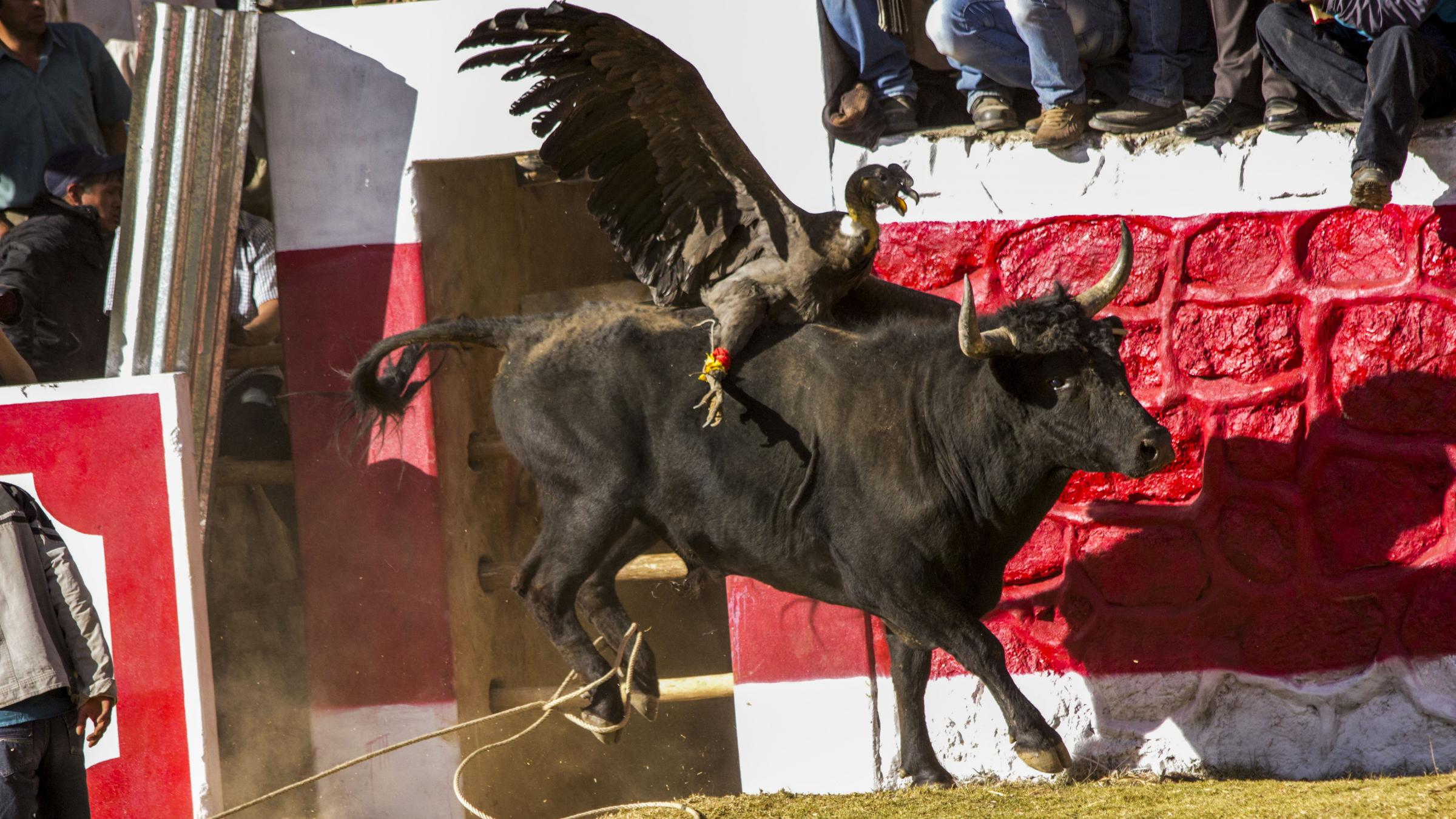
In Peru's annual Blood Festival, a condor is tied to the back of a bull and tries to gouge its eyes, while the bull attempts to shake off the giant bird. The event is popular in many parts of the country, but conservationists say this threatens a bird already at risk.

The Peruvian Blood Festival is a striking spectacle, with a giant condor strapped to the back of an enraged bull in front of a roaring crowd. For many Peruvians, it is a symbolic re-enactment of their liberation from Spanish rule. For conservationists, it is yet another threat to one of the world's largest birds.

To prepare for this annual event, known as the Yawar Fiesta, residents in the small village of Coyllurqui climb into the surrounding cliffs to trap a condor. It may then be held for weeks. But when it's time for the battle, the condor is given alcohol to drink and lashed to the back of a half-ton bull in an arena. The beast then tries to shake off the condor, while the huge bird attempts to gouge out the bull's eyes.

These Andean people believe the condor is a symbol of the Inca nation, and the bull represents the might of the Spanish conquistadors. Though they predominately identify themselves as Christians, villagers see the condor as an Andean god that has come down from the heavens to fight for their freedom.

There's a lot at stake during the battle. If any harm should come to the condor, the villagers believe it's a bad omen for the year — and the dwindling condor population suffers another setback.

Friday, 4 July 2014

Flower's bellows organ blasts pollen at bird pollinators

Date:
July 3, 2014

Source:
Cell Press

Summary:
A small tree or shrub found in mountainous Central and South American rainforests has a most unusual relationship with the birds that pollinate its flowers, according to a new study. The plant known as Axinaea offers up its male reproductive organs as a tempting and nutritious food source for the birds. As the birds seize those bulbous stamens with their beaks, they are blasted with pollen by the flowers' complex 'bellows' organs.


Sunday, 15 June 2014

Going Wild: Cha Cha, Carlos the Toco Toucans

Published 11:48 PM HADT Jun 13, 2014

HONOLULU —Toco Toucans are best known as the fruit-eating bird on Fruit Loops boxes, but there's something else in their diet that's turning heads.

The birds hail from South America and have a sharp chirp.
Ramphastos toco -Birdworld, Farnham, Surrey, England-8a.jpg
"They have a really beautiful red-yellow-orange bill and a shark contrast between black and white," said James Breeden, a zoo keeper.

Beneath the colorful surfaces there's a darker side. Birds like Cha Cha and Carlos eat much more than fruit loops.
"A lot of people don't know that the beak is also used for reaching down into bird nests to grab chicks, so a lot of people think that these birds are only fruit eaters. But, they also eat other bird species," said Breeden.

Over the years, their beaks have adapted in shape to what they eat; adding more space with little weight.

"One of the modifications of a Toco Toucan is to have a really hollow beak, so it would look much like a honeycomb," said Breeden.

Keepers say the lighter they are, the easier it is for them to fly away with food.


Monday, 27 January 2014

Old bird, New World: Did the South American hoatzins originate in Europe?

Date: January 22, 2014

Source: Senckenberg Research Institute and Natural History Museum

Summary: The oldest fossil discoveries from France show that hoatzins once existed in Europe.


The oldest fossil discoveries from France show that hoatzins once existed in Europe.

Where did hoatzins come from? These unusual birds, only one species of which exists in South America today, originated in the Old World. Studies of the oldest known fossils of Hoatzin ancestors have now shown that these birds existed around 34 million years ago in Europe. Paleornithologists at the Senckenberg Gesellschaft für Naturforschung and Flinders University in Adelaide published their findings this week in the specialist journal Naturwissenschaften.


Tuesday, 31 December 2013

Birds outsmart wasps to feed young

(Phys.org) —A species of bird found in Central and South America is able to supply its young with a steady diet of wasp larvae, evading stings from defending workers by using physical, not chemical tactics as previously thought, Simon Fraser University biologists have found.

The team, led by SFU biological sciences student Sean McCann, spent months at a field station in South America observing the behaviour of the Red-Throated Caracaras, which preys on social wasps despite the wasps' often fierce defense of their nests. Their findings are published today in the journal PLOS ONE.

"Researchers had previously thought that the birds must produce powerful wasp-repellant chemicals that allow them to take nests without getting stung, but the hypothesis has never been tested," says McCann.

Tuesday, 17 December 2013

Discovery offers Ecuador Amazon parrot 11th hour hope

Ecuador Amazon parrot (Image: Chester Zoo)A South American parrot has been reclassified as a species in its own right, which could help save the bird from becoming extinct in the wild.

Until now, the Ecuador Amazon parrot was considered to be part of a group not seen as a conservation priority.
It is estimated that only 600 of the birds remain in the wild, which need two habitats - mangroves and dry forests - in order to survive.

The reclassification was based on years of work by a researcher at Chester Zoo.

Friday, 1 November 2013

Five Rare South American Bird Species Given U.S. Endangered Status

SAN FRANCISCO— In response to decades-old listing petitions and a series of lawsuits by the Center for Biological Diversity, the U.S. Fish and Wildlife Service today designated four rare bird species from Colombia (the blue-billed curassow, brown-banded antpitta, Cauca guan and gorgeted wood-quail) and one Ecuadorian hummingbird species (Esmeraldas woodstar) as endangered under the U.S. Endangered Species Act.

“Protecting these vulnerable tropical birds under the Endangered Species Act will give them a better shot at survival and attract attention to the urgent need to protect their remaining forest homes,” said Jeff Miller, a Center conservation advocate. “Tropical deforestation is threatening to drive so many of the planet’s most amazing birds extinct.”

A campaign to protect scores of the world’s most imperiled bird species began in the 1980s, when worried ornithologists began submitting Endangered Species Act petitions to protect more than 70 international bird species. Although the Fish and Wildlife Service had determined by 1994 that most of the species warranted protection, the agency never responded to the listing petitions. After a quarter-century, legal protection had been provided for only a handful of the species, and at least five of the 73 had gone extinct.

The Center filed lawsuits in 2004 and 2006 that jump-started the foreign-species listing program. The Service then determined that more than 50 of the bird species warranted listing. So far 36 of the bird species have been protected as endangered or threatened.

Listing international species under the U.S. Endangered Species Act restricts buying and selling of the imperiled animals, increases conservation funding and attention, and can add scrutiny to development projects proposed by U.S. government and multilateral lending agencies — such as the World Bank — that would destroy or alter habitat.