As regular CFZ-watchers will know, for some time Corinna has been doing a column for Animals & Men and a regular segment on On The Track... particularly about out-of-place birds and rare vagrants. There seem to be more and more bird stories from all over the world hitting the news these days so, to make room for them all - and to give them all equal and worthy coverage - she has set up this new blog to cover all things feathery and Fortean.
Showing posts with label North Island brown kiwi. Show all posts

Sunday, 26 April 2015

Conservationists turn tiny New Zealand island into bold wildlife experiment

Big things are happening on Rotoroa, a new sanctuary for endangered species that aims to create a whole new ecosystem


Tuesday 21 April 2015 22.00 BSTLast modified on Wednesday 22 April 201517.25 BST
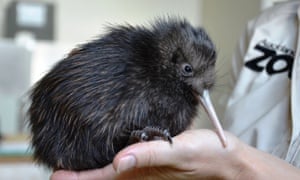
Auckland Zoo conservationist holds the first
North Island brown kiwi chick to be released
 on Rotoroa Island. Photograph: Auckland Zoo
Rotoroa Island, off the coast of New Zealand is tiny, at just 82 hectares (200 acres), but don’t let its diminutiveness fool you: big things are happening here. Over the past few years the island has become the site of a quiet, but grand, conservation experiment. What would happen if you populated an island with a whole suite of endangered species, some of which were never found there to begin with? And what would happen if you didn’t fence the island off and keep pesky humans out, but let people – school groups even – tramp through the grounds? 

Across most of our planet, truly wild, unmanaged places are a thing of the past.Onnie Byers

“We are deliberately aiming not to recreate an ecosystem, but to create an ecosystem anew,” says Jonathan Wilcken, the director of Auckland zoo. “We don’t frankly care very much whether those species existed on Rotoroa Island.”

Wilcken’s words – a shot across the bow of traditional conservation – marks just how radical and interesting the experiment on Rotoroa Island has become. The zoo has partnered with the island’s private mangers, the Rotoroa Island Trust, to conduct this wild endeavour: creating a new, managed ecosystem on a patch of land rising from the North Island’s Hauraki Gulf. 

Wilcken adds: “Nor do we care very much if the species could sustain themselves if we weren’t there to manage them.” 

Sunday, 10 February 2013

Rare bird born at the Toledo Zoo


Feb 07, 2013 (Menafn - The Blade - McClatchy-Tribune Information Services via COMTEX) --One of the Toledo Zoo's newest residents is a female North Island brown kiwi chick.

The chick hatched Jan. 12 in the zoo's Avian Breeding Center (ABC), an off-exhibit facility dedicated to breeding rare and endangered birds.

Photo: Wikipedia
Eight zoos in the U.S. and 17 zoos worldwide exhibit the animals, according to Toledo Zoo officials, and few zoos outside New Zealand have successfully hatched kiwi. Through an international species survival plan, zoos worldwide are working together to preserve this species, which is endangered with decreasing populations in the wild.

The Columbus Zoo provided the Toledo Zoo with a fertilized egg in December, 2012, and aviary staff from both zoos worked together throughout the 73-day incubation. Kiwi chicks have the longest incubation period of any bird species, followed by an unusually long hatching process which often lasts several days (the zoo's kiwi chick took five days to complete hatching).

Public exhibit details have not been finalized but the chick is expected to be a part of the Wild Walkabout exhibit, scheduled to open May 24 which will feature the animals of Australia and surrounding regions.

Kiwi are nocturnal, flightless birds native to New Zealand. In the wild, kiwi were once widespread in New Zealand, but today populations are isolated and fragmented. According to information from the International Union for Conservation of Nature and Natural Resources (IUCN), wild kiwi populations are estimated between 25,000 and 30,000 birds, with declines of 90 percent or more over the last century.

Some kiwi characteristics seem more mammal-like than bird-like. They have a keen sense of smell (rare among birds), good hearing and whiskery feathers around their face. They are also the only bird with nostrils at the end of their beak, and females lay the largest egg of any bird in the world, in relation to their size.