As regular CFZ-watchers will know, for some time Corinna has been doing a column for Animals & Men and a regular segment on On The Track... particularly about out-of-place birds and rare vagrants. There seem to be more and more bird stories from all over the world hitting the news these days so, to make room for them all - and to give them all equal and worthy coverage - she has set up this new blog to cover all things feathery and Fortean.
Showing posts with label masked booby. Show all posts

Wednesday, 15 May 2019

2 rare bird species spotted in southern Iran


April 27, 2019
TEHRAN – Two rare species of rock bunting and masked booby have been spotted for the first time in Bandar Genaveh, southern Bushehr province, Mohammad Tolideh, chief of Bushehr department of environment has announced.
The rock bunting is a passerine bird in the bunting family Emberizidae, which breeds in northwest Africa, southern Europe east to central Asia, and the Himalayas. It is partially migratory, with northern populations wintering further south, mainly within the breeding range of the resident southern populations. It is a rare wanderer to western Europe.
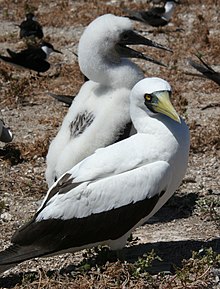
The masked booby is a large seabird of the booby family, Sulidae. They breed on islands in tropical oceans, except in the eastern Atlantic. The masked booby is a fairly sedentary bird, wintering at sea, but rarely seen far away from the breeding colonies.
These birds have been identified by two groups of environmentalists and nature photographers, who have captured photos of them and published on Iran Bird Records Committee website, he further explained.
Rock bunting and masked booby had been seen before only in the provinces of Hormozgan and Sistan-Baluchestan, he added, IRNA reported on Saturday.
FB/MQ/MG


Wednesday, 30 May 2018

Rare masked booby sighted off Southern California coast, hundreds of miles from natural home


PUBLISHED: May 15, 2018 at 5:41 am | UPDATED: May 15, 2018 at 5:43 am

DANA POINT — As Mark Tyson watched a flock of seagulls chase a larger white bird, he knew the latter was something he had never seen before. And, he thought, if he was right, the large seabird was hundreds, if not thousands, of miles outside of its typical range.

On Sunday, May 13, Tyson, a naturalist on Capt. Dave’s Dolphin and Whale Watching Safari, was out on a whale-watch trip four miles off Strand Beach when he spotted a group of common dolphins feeding on fish. Seagulls were hovering above hoping to share in some of the spoils when Tyson, of San Juan Capistrano, caught a glimpse of the unusual seabird.

“I realized I’d never seen that type of bird before,” he said. “It was a masked booby, which is extremely rare here. Every time the seagulls would dive down for a fish, you’d see the booby on the water and he would immediately be chased with the fish he caught.”

A masked booby, with a body typically three inches larger than that of a California seagull, is most commonly found in tropical oceans. It’s territory is below the 30th parallel near Baja and in the Southern Hemisphere.

Continued  

Monday, 13 June 2016

Masked Booby makes first appearance in Tubbataha in 20 years


Published June 6, 2016 7:26pm
By AMADO BAJARIAS JR.

Masked booby with chick.JPGOn May 11, 2016, in the grey early morning light on a remote coralline isle in the middle of the Sulu Sea, a group of researchers and marine park rangers saw an animal that no one has seen in the area for more than 20 years.

First sighting of Masked Booby in Tubbataha after 20 years

It was a Masked Booby (Sula dactylatra), a large and strikingly plumaged seabird, that was last seen on Bird Islet in the North Atoll of the Tubbataha Reefs Natural Park (TRNP), Palawan, in 1995.

The Masked Booby, which is the biggest and heaviest of the six surviving booby species in the bird family Sulidae, was observed on the mornings of May 11 and 12 by a survey team led by environment and natural resources management specialist Arne Jensen, who has studied the seabirds in Tubbataha for more than 25 years and is chief consultant of the Tubbataha Management Office on the management of seabirds.

The team was on Bird Islet, which is about 170 kilometers southeast of Puerto Princesa, to conduct a census of seabirds and their breeding areas in TRNP. The team has held several surveys over the past years but this is the first time that it has recorded the Masked Booby.

The Wild Bird Club of the Philippines Checklist of Birds of the Philippines 2016 declares the Masked Booby as “Extirpated,” with the last sighting of a resident bird from “North Islet, Tubbataha Reefs, Palawan (1995).” The checklist notes one sub-adult documented “off Babuyan Islands, Cagayan (2003).” With the Philippine population believed to be gone, any new sighting is presumed to be of individuals that have strayed from abroad.

The team observed the lone Masked Booby standing and walking among Brown Booby (Sula leucogaster) and Greater Crested Tern (Thalasseus bergii), which, along with Brown Noddy (Anous stolidus), Black Noddy (Anous minutus), Sooty Tern (Onychoprion fuscatus), and Red-footed Booby (Sula sula), roost and nest in dense colonies on the uninhabited islet.