As regular CFZ-watchers will know, for some time Corinna has been doing a column for Animals & Men and a regular segment on On The Track... particularly about out-of-place birds and rare vagrants. There seem to be more and more bird stories from all over the world hitting the news these days so, to make room for them all - and to give them all equal and worthy coverage - she has set up this new blog to cover all things feathery and Fortean.
Showing posts with label kea. Show all posts

Wednesday, 4 March 2020

New Zealand birds show humanlike ability to make predictions

By Virginia Morell Mar. 3, 2020 , 11:15 AM

Whether it’s calculating your risk of catching the new coronavirus or gauging the chance of rain on your upcoming beach vacation, you use a mix of statistical, physical, and social information to make a decision. So do New Zealand parrots known as keas, scientists report today. It’s the first time this cognitive ability has been demonstrated outside of apes, and it may have implications for understanding how intelligence evolved.

“It’s a neat study,” says Karl Berg, an ornithologist and parrot expert at the University of Texas Rio Grande Valley, Brownsville, who was not involved with this research.

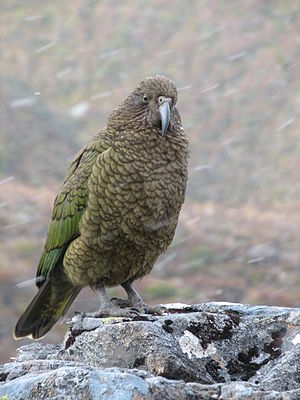
Keas already had a reputation in New Zealand—and it wasn’t a great one. The olive-brown, crow-size birds can wield their curved beaks like knives—and did so on early settlers’ sheep, slicing through wool and muscle to reach the fat along their spines. These days, they’re notorious for slashing through backpacks for food and ripping windshield wipers off cars.

To see whether keas’ intelligence extended beyond being mischievous, Amalia Bastos, a doctoral candidate in comparative psychology at the University of Auckland, and colleagues turned to six captive keas at a wildlife reserve near Christchurch, New Zealand. The researchers taught the birds that a black token always led to a tasty food pellet, whereas an orange one never did. When the scientists placed two transparent jars containing a mix of tokens next to the keas and removed a token with a closed hand, the birds were more likely to pick hands dipped into jars that contained more black than orange tokens, even if the ratio was as close as 63 to 57.

That experiment combined with other tests “provide conclusive evidence” that keas are capable of “true statistical inference,” the scientists report in today’s issue of Nature Communications.

The researchers also showed the keas two jars that each contained an equal number of black and orange tokens. But the experimenter could only reach the tokens located above a solid barrier. Most of the kea correctly chose hands that had reached into the jar with the greatest ratio of black tokens above that divider, showing that they based their predictions solely on physical information—the number and relative quantities of tokens above the barrier.

Wednesday, 21 August 2019

Kea heroically rescued from West Coast crevasse

Tom Kitchin 20:00, Aug 19 2019


A glacier guiding crew saved a kea from death after it was stuck in an icy crevasse on the West Coast for three days.

The rescuers tried to use ropes, ladders and ice to save the native bird, but it took a backpack to bring it to safety.

Fox Glacier Guiding senior guide Kelsey Porter said her colleagues heard a kea squawking near a popular feature on the glacier on August 6.

"[They] tried to do a rescue that first day they saw it, but time was a bit limited 'cause they had to fly [a helicopter] off the glacier," she said.

"One of the guides lowered down into the crevasse and tried to reach for it, but the crevasse was too narrow for him to fit."

The crevasse was about seven metres deep and about 30 centimetres wide.

Continued

Wednesday, 3 October 2018

NZSki to donate 250K to save New Zealand’s endangered Kea


Friday, 14 September 2018, 10:52 am
Press Release: NZSki
14 September 2018.

This Conservation Week, NZSki kicks off a new five-year commitment to spend more than a quarter of a million dollars helping protect birds native to the alpine areas it works across, spearheaded by $50,000 worth of funds and donation support in partnership with the Kea Conservation Trust (KCT).
NZSki currently operates environmental programmes at The Remarkables and Coronet Peak ski fields both in Queenstown, and Mt Hutt in Canterbury, with this the next step to increase its conservation efforts.
NZSki’s commitment will focus on three key areas including working closely with the Trust to find and protect kea – a Nationally Endangered species, educate visitors and locals on kea conservation, and protect and enrich the natural habitat for kea, as well as other native birds such as the falcon which is more common at Coronet Peak.
The company has been awarded platinum partnership status with Kea Conservation Trust in recognition of the donation, fundraising and additional support it’s set to provide every year until 2023.
The total amount toward bird conservation in five years will be well in excess of $250 000.
NZSki CEO Paul Anderson says this is an important step in their continued conservation efforts.

Friday, 26 January 2018

Roadcone-moving kea get gym to distract them away from traffic


A partnership between the Department of Conservation (DOC), Downers NZ, University of Canterbury and the Kea Conservation Trust has enabled a kea gym to be built near the Homer Tunnel in Fiordland National Park.

A kea gym offers the birds several objects they can play with or take apart to distract them from danger or causing damage.

DOC partnerships ranger Sue Streatfield said the idea to establish a gym at Homer Tunnel in Fiordland came after rangers were looking for a way to get kea away from the road.

On regular visits to Homer Tunnel, rangers would find kea wandering all over the road as traffic waited to go through the one-way tunnel to Milford Sound.

Continued  

Sunday, 14 January 2018

Kea upgraded to endangered status as predators, climate change destroy habitat


Wed, Dec 13

New Zealand's beloved Bird of the Year - the kea - could soon be no more, according to an international study.
NZ's Bird of the Year - the kea - added to global list of endangered species
Forest and Bird estimate less than 7000 kea remain.
Source: 1 NEWS

The national bird has been upgraded from 'vulnerable' to 'endangered' in BirdLife International's reassessment of birds' threat statuses for the International Union for the Conservation of Nature.

Forest and Bird chief conservation adviser Kevin Hackwell says, "Every year, kea nests are destroyed by introduced predators like rats, stoats, possums, and feral cats."

"Kea who don't regularly interact with people really benefit from large-scale aerial predator control," he says.

It follows a study which found only two per cent of kea nests were successful.

The success rate improved following the use of biodegradable 1080 by the Department of Conservation, increasing the kea nests' survival to 27 per cent in 2015.

"However, those kea that are fed by tourists and some locals tend to try novel foods, and sadly, they are particularly susceptible to eating the poison baits used to kill predators," Mr Hackwell says.


Thursday, 26 October 2017

New Zealand bird of the year: playful alpine parrot kea soars to victory


The world’s only mountain parrot whose cheeky antics divide Kiwis, beats kererū and kākāpō to coveted crown


Monday 23 October 2017 23.56 BSTLast modified on Tuesday 24 October 2017 00.52 BST

The kea, the world’s only alpine parrot, has been crowned New Zealand bird of the year, with thousands more votes cast for the species than there are surviving individuals.

New Zealand’s annual bird of the year competition hit new heights this year with more than 50,000 votes cast from around the country and the world. The competition is in its 13th year, and pits the country’s rare and endangered birds against one another. No bird has won twice.

The kea – a highly intelligent and inquisitive olive green mountain parrot that lives only in the Southern Alps – received 7,311 votes, streets ahead of the native wood pigeon, the kererū, which came second with 4,572 votes, followed by the kākāpō with 2,554 votes.

There are 168 bird species in New Zealand and about a third are threatened with extinction, with dozens more on the endangered list. Some species have dwindled to a few hundred individuals tucked away in isolated pockets of the country.

Friday, 23 September 2016

New Zealand kea, the world's only alpine parrot, faces extinction


Kea on rock while snowing.jpgThe intelligent, playful birds are under threat from non-native predators and also from farmers who see them as pests


Eleanor Ainge Roy

Wednesday 21 September 2016 02.01 BST Last modified on Wednesday 21 September 2016 22.00 BST

The world’s only alpine parrot is at threat of extinction in New Zealand as numbers plummet in the face of threats from non-native predators and human development.

The kea is the world’s only mountain-dwelling parrot and also one of the most intelligent species of bird known for their playfulness and novelty-seeking nature.

The birds, which are considered a pest by many New Zealanders, are only found in the mountains of the South Island in a vast habitat of some 3.5 million hectares.

Conservationists have begun raising the alarm after years of “crashing” population numbers, with the wild kea population estimated to be as low as 1,000-5,000.
 
Recent studies from the Kea Conservation Trust have found two-thirds of all chicks never reach fledgling stage, as their nests are ground-dwelling and they are eaten by stoats, rats and possums (which the NZ government has pledged to exterminate by 2050).

“Kea are one of the most maligned of New Zealand birds, as well as one of our most loved,” said Tamsin Orr-Walker, chair of the Kea Conservation Trust.

“One of the most interesting things about kea is they are one of the few wild species that seek out humans. That is really rare, and it is that inquisitive nature that is getting them into trouble because a lot of the ways humans interact with them is endangering their survival.”

Orr-Walker said the threat to Kea was three-pronged – from introduced species, lead-poisoning from old-fashioned alpine dwellings such as huts and shearing sheds, and from their interactions with humans. 
 

Thursday, 5 February 2015

Kea thriving at Wellington Zoo

Press Release: Wellington Zoo

5 February 2015

Kea thriving at Wellington Zoo

200 years ago, Kea, the world’s only alpine parrot and endemic to New Zealand, numbered in the hundreds of thousands. But from the late 1800s high-country sheep farmers saw them as a threat to their flocks, and a bounty was placed on their heads and a price tag on their beaks. Due to ongoing persecution and threats from introduced predators, their wild population is now vulnerable, and their conservation status was updated to ‘nationally endangered’ in 2013, with only an estimated few thousand birds remaining today.

Most city-dwelling New Zealanders have never encountered a Kea up close. But lovers of these fascinating native birds can still get up close to Kea on the other side of the Cook Strait – by paying a visit to the family that reside at Wellington Zoo.

“We care for five Kea at Wellington Zoo – a pair of adults and three healthy young chicks, hatched in November last year. The chicks have been staying in their nest box, closely guarded by their mother. Now that they’ve fledged, they’ve started to venture out and visitors can see them,” said Philip Wisker, Wellington Zoo Bird Keeper.

Sunday, 1 June 2014

Repellent aims to keep sheep off kea's menu

By: Alex Mason, New Zealand News | Sunday May 25 2014 15:13

Sheep are being doused in a kea repellent, to stop the native bird eating them alive.

The Kea Conservation Trust is trialling the repellent for a second time on a high-country farm near Queenstown.

Trust chair Tamsin Orr-Walker says it makes the endangered birds nauseous, and will hopefully stop them from pecking into a sheep's fleece and flesh to get to the animal's high-energy fat.

She says kea strike is a major problem in the high country.

"And it's the reason why there was a bounty on kea for about 100 years, which meant that 150,000 of them were killed during that period of time."

She says the repellent should stop this, and mend the relationship between farmers and the bird.

"It's trying to sort-of also break that cycle of people thinking of kea as a pest by actually taking a proactive stance and doing this research."

Monday, 7 October 2013

Naughty kea caught, banished from camp

A band of kea have been kicked out of a Christian campground in Kaiteriteri for continuing bad behaviour.

Four kea from a mob of seven were caught with net guns on Thursday and shifted to the Rainbow ski field area in Nelson Lakes.

Last month the Department of Conservation shifted six of the birds causing chaos in the beach settlement to Canaan Downs on Takaka Hill but they returned to their disorderly ways at the Bethany Park camp within days.

Department of Conservation kea expert and Kea Conservation Trust worker Corey Mosen said the birds usually dispersed on their own, but the campground was "too entertaining" to ignore.

He thought their home territory was located in native bush slightly uphill from the motor camp.

"They were just coming into the campground and chewing on anything that got left outside.

"They were upsetting everyone."

Mr Mosen hoped better food sources at Rainbow, and the 150km distance from the camp, might convince them to stay in their new home.

"There's a lot of nice beech forest there that will hopefully keep them occupied."

Each bird was tagged before release, and one male had a transmitter attached so DOC could track him. The kea were not too upset by their capture or removal.

"They're quite chilled out for a bird, they didn't really mind being in a box. When we let them go they just slowly popped out and mucked around for a while before flying away."

Friday, 8 February 2013

Bird snatches cash from man's camper


ARTHUR'S PASS, New Zealand, Feb. 4 (UPI) -- A Scottish tourist in New Zealand said a kea bird stole more than $1,000 cash from his camper while he was taking pictures at a rest stop.

Peter Leach said he stopped Wednesday at a rest stop in Arthur's Pass to take pictures of the scenery and he was snapping pictures of an unusual bird when a couple approached him with some distressing news, The Timaru Herald reported Monday.

"A Canadian couple walked by and said: 'We've just seen that bird take something out of your campervan,'" Leach said. "It took all the money I had. I was left with $40 (U.S. $33.83) in my pocket."

Leach said the bird made off with a small cloth bag containing $1,099.41. He said the bird apparently snatched it from his dashboard.

The tourist said he filed a police report in hope of getting his insurance company to replace the cash.

"The man I dealt with was very serious for the first few questions," Leach said of his police interview. "Then he said, 'Do you mind if I just stop to laugh?'"