As regular CFZ-watchers will know, for some time Corinna has been doing a column for Animals & Men and a regular segment on On The Track... particularly about out-of-place birds and rare vagrants. There seem to be more and more bird stories from all over the world hitting the news these days so, to make room for them all - and to give them all equal and worthy coverage - she has set up this new blog to cover all things feathery and Fortean.
Showing posts with label Florida. Show all posts

Thursday, 12 March 2020

Florida birds nest on rooftops instead of beaches now because of people, dogs, predators

Tyler Treadway Treasure Coast Newspapers
Published 6:00 AM EST Mar 4, 2020

Seabirds and shorebirds should start nesting on Florida beaches soon, but these days, they're more likely to be settling on rooftops.

Even those unnatural habitats are getting harder for the birds to find.

"There's just been too much loss of beach habitat and interruption from people, their dogs and predators for the birds to keep nesting on beaches," said David Simpson of Fellsmere, owner of Birding with David Simpson, a company offering guided birding tours and classes.

Birds that nest in colonies — least terns, black skimmers and American oystercatchers — and those that nest alone, such as Wilson's plovers, used to nest on beaches throughout the Treasure Coast. Now, beachgoers are unlikely to see nesting birds, except in a few sites.

Turns out, the beachgoers and their pets are a big part of the reason.

Most beach-nesting birds lay their eggs in shallow depressions in the sand, "not much more than dimples on the beach," said Ricardo Zambrano, a biologist for the Florida Fish and Wildlife Conservation Commission.

The nests don't provide much protection, and the birds seem to know it. Often, a single encounter with a perceived predator is enough for the birds to abandon a nest or colony of nests, leaving eggs and chicks behind.

"Least terns are very sensitive to intruders," Simpson said. "They'll just up and leave."

Wednesday, 19 February 2020

Radar captures huge bird migration over Florida


A huge swarm of birds migrating is nothing unusual - flocks can fly thousands of miles undetected.

But in a rare event on Monday, US National Weather Service radar captured birds migrating from South America over Florida.

Atmospheric conditions caused the systems to detect the birds, which took hours to fly over the Key West station.

The group measured at least 90 miles (145km) in radius, according to meteorologists.

In 2017 a swarm of migrating Printed Lady butterflies was detected by radar over Colorado, but the phenomenon is rare.

A GIF produced by the Weather Service shows the migrating birds in green and yellow, and rain depicted in blue.

Friday, 31 May 2019

Museum volunteers discover new species of extinct heron at North Florida fossil site


by Halle Marchese • May 16, 2019
When the bones of an ancient heron were unearthed at a North Florida fossil site, the find wasn’t made by researchers but by two Florida Museum of Natural History volunteers.
A previously unknown genus and species, the heron has been named Taphophoyx hodgei (TAFF’-oh-foy-ks HAHJ’-ee-eye) in honor of landowner Eddie Hodge, who has allowed Florida Museum researchers and volunteers to excavate the site on his property near Williston since his granddaughter first discovered fossils there in 2015.
Nearly 700 volunteers have worked at the Montbrook fossil site, collectively digging more than 12,000 hours.
“You couldn’t have a better group of people,” Hodge said. “There’s a lot of negativity when we get home and turn on the television, but it does you good to be out here seeing volunteers get excited and be positive about something.”

Sunday, 19 May 2019

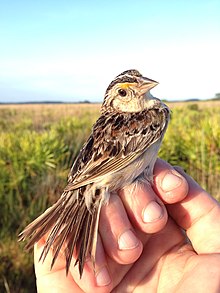
Highly endangered Florida grasshopper sparrows reared in captivity are released


MAY 13, 2019

by Kevin Spear, Orlando Sentinel
Three of the rarest birds in Florida took an extraordinary adventure this week, slipping out of a large pen into the freedom of an expansive, treeless prairie south of Orlando.
The year-old Florida grasshopper sparrows were hatched and raised in captivity, and designated as pioneers in a perilous bid to save their kind from oblivion.
Staffers of the Florida Fish and Wildlife Conservation Commission, the U.S. Fish and Wildlife Service and other organizations lined a dirt road Monday, observing the pen in the far distance as a pair of biologists removed panels from the enclosure.
Then, with a light breeze, clouds of love bugs and an air of worry and optimism, the group waited quietly for an hour for the secretive birds to make their move.
"One flew out," came a text message, followed a short while later by a text suggesting the other two had fled, as they are programmed to do, by running unseen through shrubs and grass.

Thursday, 25 April 2019

Florida Man Attacked, Killed By 'World's Most Dangerous Bird'


Apr 16, 2019, 09:22am
A large flightless bird killed a Florida breeder with its long claws in a “tragic accident” after the man fell in its enclosure
A 75-year-old Florida man was mortally wounded in an attack on Friday morning by a large flightless bird that he kept. He was taken to the UF Health Shands Hospital by paramedics, where he later died from his injuries. The man, Marvin Hajos, lived north of Gainesville in a rural part of Alachua county, according to local newspapers.
“My understanding is that the gentleman was in the vicinity of the bird and at some point, fell,” Deputy Chief Jeff Taylor told the Gainesville Sun.
“When he fell, he was attacked,” Mr. Taylor said, adding that the incident appeared to be a “tragic accident”.
According to a report by CNN, the first emergency call was made by Mr. Hajos, the bird’s owner, whilst a second call was received shortly afterward from another person on the property. It is not yet known what Mr. Hajos did to motivate the attack.
The attacker was identified as a southern cassowary, Casuarius casuarius, a large flightless bird that is native to tropical rain forests in northeastern Australia, New Guinea, and on several nearby island archipelagoes of Indonesia. The birds can weigh as much as 58.5 kg (130 pounds) and adults stand between 1.5 and 2.0m (5 and 6.5 feet) tall. Amongst living birds, only ostriches are larger.
Both sexes of cassowaries are clad in glossy funereal black plumage, and have featherless bright blue heads and necks accentuated with red wattles. Females are larger and more colorful than males. The birds’ colors intensify during courtship, territorial disputes and when they are threatened. Curiously, their skin is a uniformly bright blue color, even under their feathers.


Wednesday, 27 March 2019

Man sparks outrage after posting footage of him attacking a federally protected pelican - which could see him charged with animal cruelty


Hunter Hardesty appeared to attack a federally protected pelican in Key West
Hardesty posted footage on his Facebook page with many condemning him
He jumps into water on top of the pelican and is seen holding him and laughing
The pelican then snaps at his face, manages to break free and then flies away
The Davidsonville, Maryland man could now face animal cruelty charges
PUBLISHED: 13:51, 10 March 2019 | UPDATED: 21:52, 10 March 2019
A man could be charged after a video showed him attacking a protected pelican in Key West, Florida
Hunter Hardesty from Davidsonville, Maryland posted footage on his Facebook page with many people condemning him for his actions. 
The video, posted on March 7,  starts and shows Hardesty appearing to lean over a harbor’s edge holding out something in his hand. 
The pelican floats closer and Hardesty appears to jump into the water on top of the pelican, causing both to sink beneath the water’s surface.
Hardesty then grabs the large bird with two hands while others not pictured on camera can be heard laughing.
 A woman in the background tells him: 'If you don't get out of there right now I'm going to call security. Knock this party off right now.'
The bird appears visibly distressed and as Hardesty holds on to him, as his friends laugh from a jetty.
The pelican then snaps at the man with is beak before flying off to another area.  
Social media users Many blasted at the stunt on Hardesty’s Facebook page, branding it cruel and stating they had reported him to Florida law enforcement.
A post from Hardesty on Friday read:  'The book blowin up on a Friday !! Sheesh.'
Dennis John Deevy Jr wrote:  'We need to get a petition to have this MF charged.'


Wednesday, 20 March 2019

Florida Songbird Trafficking Increase Leads To New State Rule


By JESSICA MESZAROS • FEB 26, 2019
State wildlife officials are drafting a rule to protect Florida’s native songbirds from illegal trapping. Officers are seeing an increase in bird trafficking for the pet industry.
It's illegal to capture songbirds, but wildlife officials say it's hard to make a case when they catch people with empty traps.
"What this rule would do is it would regulate the use, placement, possession and transport of the traps themselves," said  Craig Faulhaber, an avian conservation coordinator for the Florida Fish and Wildlife Conservation Commission.
"And that'll allow our law enforcement officers, if they find traps in the wild, they'll be able to confiscate those traps and help to make cases based on those traps rather than having to wait and hope to find a bird that's already caught in the trap."
He said illegally trapping and selling native songbirds is big business and fairly profitable.
"We think that the numbers are increasing and the process is spreading and so we want to take this opportunity to try and address the problem now," said Faulhaber.

Friday, 1 February 2019

Hawk duo has sent more than a dozen hotel guests to the hospital


January 15, 2019 | 10:18am
 It’s a real-life version of Alfred Hitchcock’s “The Birds.”
An attacking pair of hawks hiding out in the parking lot of a Florida hotel have sent more than a dozen people to the hospital, according to a report.
One of the birds “just swooped down and attacked my head,” Cyndi Mara told News 13 in describing the terrifying incident that took place last week.
“[It] jarred me, and I looked up and saw a bird flying away,” Mara said. “I went inside, touched my head, washed my hands, and they were bloody.”
The hawk attack happened in the parking lot of a Holiday Inn in Brevard County where several similar attacks have occurred, according to the news outlet.
The culprits are a breeding pair of hawks that have built a nest in a nearby tree, News 13 reported.
A wildlife trapper said the hawks have already attacked 14 people, who were all hospitalized, including one man who needed 17 stitches.
“The Holiday Inn here, safety of their guests is their No. 1 priority,” James Dean of the animal removal service On Point Wildlife Removal said, according to the news outlet. “And that’s the reason we got on it quickly like we did.”
The trapper has destroyed the hawks’ nest, but on Monday afternoon at least one of the birds was spotted flying around nearby, the report said.
According to News 13, the red-tailed hawks are protected under federal law, but the trapper said he has permission from the Florida Fish and Wildlife Conservation Commission to capture and release the birds into a wildlife conservation area.


Wednesday, 27 June 2018

Miami's Wild Parrots Are Being Poached, and There's No Law to Protect Them


MOLLY MINTA | JUNE 5, 2018 | 8:00AM

Every morning for the past 25 years, a flock of blue and gold macaws has flown into Daria Feinstein’s backyard in Coral Gables. They swoop between surrounding homes and over boats docked on the nearby canal to perch on Feinstein’s royal palms and poincianas or maybe have a bite to eat on the artificial nests she’s set up for them.

In 2010, one of Feinstein’s favorite wild parrots, Scruffy — an old blue and gold macaw she named for the bird's frayed feathers — began showing up in her yard with a youngster she named Fuzzy for a fluff of red fuzz on his head.

 “He was a character,” Feinstein says of Fuzzy. The baby would always disobey Scruffy and swoop down to eat before he was given the signal. “I was afraid he’d never get airborne because he’d eat so much.”

A year later, Fuzzy disappeared. Feinstein thought perhaps he’d grown up and found a mate in a different place. "But," she says, “one by one, more birds just kept disappearing.”

Feinstein began to hear similar reports from fellow members of the Bird Lovers Club, a nonprofit dedicated to South Florida’s avian population. A professor at the University of Miami told her someone came on campus with a net gun and took six birds. One of the other feeders in her neighborhood said the macaws were flying at night. “Parrots don’t fly after nightfall,” Feinstein says. “Something scared them.”

Feinstein realized the parrots were being poached. Since 2010, she says, the number of blue and gold macaws in her neighborhood has gone from 44 to 12 because of legal poaching. Parrots can sell for thousands of dollars each on local and national websites, which is significant motivation for poachers.


Wednesday, 9 May 2018

3-in-1: This osprey caught a shark that was eating a fish


3-in-1: This osprey caught a shark that was eating a fish

BY EARTH TOUCH NEWS APRIL 24 2018

Wildlife photography requires a keen eye, an intimate knowledge of your equipment, and – sometimes – a healthy dose of good fortunate. Florida photographer Doc Jon recently snapped a few images of an osprey soaring above Madiera Beach only to realise when reviewing his photos at a later stage that the raptor was clutching a shark in its talons. The shark meanwhile – in a scene that resembled some kind of weird avian-piscine matryoshka doll – had its jaws firmly clasped around a fish.

Jon uploaded the incredible images to his Facebook page where they quickly gained a lot of interest. “When I got home and opened [the photos], my first thought was 'Woah! That’s a shark in his talons!'" Jon told WFLA about his reaction to realising what he had captured. "But then I saw the fish and I literally laughed and said, 'No way!' I couldn't believe it."

The waters around Florida are home to a number of shark species and it’s unclear from the photo evidence exactly which one this osprey plucked out of the Floridian fish buffet. It appears to be a juvenile, though, which can make the identification process a bit tricky.


Thursday, 26 April 2018

Sick sea birds are showing up on central Florida beaches


Posted: Apr 13, 2018 11:17 AMUpdated: Apr 13, 2018 4:21 PM GDT

 (WESH) Scores of rare sea birds are washing up on central Florida beaches, starving and near death.

Northern Gannets are rarely seen in Brevard County, but they migrate far off the coast, heading to their breeding grounds on the coastal cliffs of Maine and Canada.

In a tragedy that's not been seen there in more than 15 years, many are not making it.

"They are usually very exhausted, very thin, and it's just touch and go whether they're going to make it or not," said Tracy Frampton at the Florida Wildlife Hospital.

Since late March, Frampton says the hospital has received a total of 85 birds.

In a few cases, the Northern Gannets have regained their strength, and can be released to resume their migration.

Biologists aren't sure why so many haven't been able to find or catch the fish they need to survive.

Read more: 
http://bit.ly/2qsx8Ve

Source  

Sunday, 8 April 2018

Pet owner issued written warning because of a barking bird


7:08 PM, Apr 2, 2018

CAPE CORAL, Fla - A Lee county woman received a surprise when she opened her mailbox over the weekend. Cheryl Kasper opened up a letter from Lee County Domestic Animal Services for nuisance barking.

"I'm pretty upset because I'm looking at the potential of a $500 fine," Kasper said. "The county wants me to come in with all the paperwork on the dogs."

Kasper plans to comply with the letter, but she said her Congo African Grey is the one behind the barks.

"Zazu picked up on the barking. He was looking for something to pick up next and barking was the next natural thing," Kasper said.

Lee County Domestic Animal Services issued Kasper a letter over the weekend. Karen Fordiani told 4 In Your Corner they send out over a hundred letters a month for nuisance barking.

Monday, 19 March 2018

Surprising Origin of American Flamingos Discovered

Scientists have long wondered whether the bright pink birds are native to Florida.


PUBLISHED MARCH 10, 2018

Few of us Floridians are native to the state. Even our emblematic flamingos were widely thought to be escapees from captivity—until now.

A new study sheds new light on a long-standing controversy by suggesting flamingos are indeed true residents of the Sunshine State.

There are six species of flamingo, and the American, or greater, flamingois found in Florida. The bird also lives in the Caribbean, Mexico, and South America.

Continued 

Sunday, 4 March 2018

Are flamingos returning to Florida?


Date:  February 21, 2018
Source:  American Ornithological Society Publications Office

Summary:
Flamingos are a Florida cultural icon, and sightings in the state have been on the rise in recent decades. However, whether they're truly native to the US or only arrive via escape from captivity has long been subject to debate, making developing a plan for managing Florida's flamingo population challenging. A new study reviews the evidence and provides a fresh argument that the birds should be considered part of the Sunshine State's native fauna.


Friday, 12 January 2018

The rarest bird: Florida's grasshopper sparrow may go extinct in 2018


Published: December 27, 2017

Get ready to say goodbye to Florida’s rarest bird, the grasshopper sparrow. Federal officials say 2018 is the year we’ll learn whether the species will disappear from the wild. The odds are not looking good.

"There’s a significant chance that the birds might go extinct," said Larry Williams, who supervises the South Florida office of the U.S. Fish and Wildlife Service.

The grasshopper sparrow is generally regarded as the most endangered bird in the continental United States. If it goes extinct in spite of the $1 million spent to save it in recent years, it would be the first American bird in three decades to disappear.

The number living in the wild has dropped dramatically in recent years, due in part to a disease that has zoomed through their dwindling population. Last year biologists found 74 males and 40 females remaining in the Central Florida prairies where the birds nest. This year they found just 53 males and 22 females.

"This is probably the last year that we’ll have the birds in the landscape," said Paul Reillo, founding director of the Rare Species Conservatory Foundation at Florida International University.


Wednesday, 25 January 2017

Magnificent frigate bird may face bleak future


Magnificent frigate birds breed in only one place in Florida.

From time to time, beachgoers along Brevard and Volusia may look high in the sky and spot a very large bird with a distinctive "V" in each wing and a split tail.

It's an aerial virtuoso, the magnificent frigate bird, and Florida expert Ken Meyer fears they are in for tough times unless the species can expand where it breeds and thrives.

"They are declining in population," he said, explaining there are several sources of trouble for the birds, including the disappearance of fish that they hunt.

Already under assault, their single, low-lying nesting site in Florida is vulnerable to drowning because of "climate change and sea-level rise," Meyer said.

Frigate birds have wingspans of more than 7 feet and spend their lives soaring over coastlines and oceans in voyages that last days and nights without touching land. 

Their feathers are not waterproofed with a coat of oil, as with many other birds, and landing on ocean waters can be lethal.

Despite their size, they are agile enough to snatch flying fish in midflight and quick enough to harass gulls into surrendering fish they had caught.

Florida has a small population of frigate birds that nests each year; their home is a group of islands at the end of the Florida Keys called the Dry Tortugas.

Sunday, 22 May 2016

Rare Central Florida sparrows hatch in captivity


An emergency effort to prevent extinction of Florida grasshopper sparrows, found only in Central Florida, includes attempts to breed them in captivity. The first four birds hatched this week.

Contact Reporter Orlando Sentinel

Adult Florida grasshopper sparrow.jpg
Florida grasshopper sparrow chicks defy long odds
One of the nation's most endangered birds, a rare sparrow found only Central Florida, took a step away from potential extinction this week with the unprecedented hatching of four chicks in captivity.

"It's a historic breakthrough," said Ken Warren of the U.S. Fish and Wildlife Service, referring to the largely unexpected births of Florida grasshopper sparrows.

The parents were among three males and four females taken as chicks last year from treeless prairies south of Orlando, where only about 100 males have been tracked and the number of secretive females remains unknown.

Federal approval to capture the birds came after years of biologists agonizing over how to stop a plunge in the bird's population for reasons still not explained.

The seven were taken to Rare Species Conservatory Foundation in Palm Beach County, which specializes in rearing birds and animals on the edge of extinction.

"This is a very small group to be starting out with, and to be able to find a compatible pair of birds that are unrelated and happen to get along and happen to build a nest and happen to successfully hatch chicks – these are really long odds," said Paul Reillo, foundation director.

Reillo said he had expected many false starts instead of success in the pair's first nesting attempt.

He said the parents began to show signs of "sexual proclivity" early this spring and laid the first egg on April 26.

The first hatching was early Monday morning, with the others later in the morning, that afternoon and Tuesday morning.

Reillo estimated that each chick weighs less than 2 grams, or less than half of the weight of a nickel.