As regular CFZ-watchers will know, for some time Corinna has been doing a column for Animals & Men and a regular segment on On The Track... particularly about out-of-place birds and rare vagrants. There seem to be more and more bird stories from all over the world hitting the news these days so, to make room for them all - and to give them all equal and worthy coverage - she has set up this new blog to cover all things feathery and Fortean.
Showing posts with label Surrey. Show all posts

Monday, 25 February 2019

Rare bird is a heathland triumph


Monday, 28 January 2019 - Environment
SURREY Wildlife Trust’s management of Whitmoor Common, the largest area of open heathland in the Guildford area, has been awarded the highest standard for heathland management by Natural England.
The Dartford warbler, an indicator species for biodiversity, and the window-winged caddis fly are just two species to benefit from the rare lowland heathland, which is now in favourable condition.
The success of Surrey Wildlife Trust’s management at Whitmoor Common has improved the ecology of three-quarters of the 183-hectare reserve. Landscape scale scrub clearance by contractors in winter, cattle grazing, the Trust’s volunteer work, specialist conservation work and support from Whitmoor Common Association have all contributed to the ecological improvements.
Katy Fielding, Surrey Wildlife Trust liaison officer at Whitmoor Common, said: “Lowland heathland is rarer than rainforest and Britain holds 20 per cent of this resource in Europe, so we have a real responsibility to look after it.
“Our hard work building up the mosaic of habitats and micro habitats, together with the diversity in age and structure of gorse, heather and woodland is creating the optimum conditions for wildlife.’

Have you spotted an unusual duck at the Memorial Park in Fleetwood?


CLAIRE LARK Email Published: 13:32 Wednesday 23 January 2019
The duck pond at Fleetwood's Memorial Park has a new resident and although he's not too unusual, he has caused quite a stir. Nestled among the family of Mallards is the Muscovy duck who took up residence a few weeks ago, and he seems to have settled in well to his new environment.
Readers had been trying to identify what type of duck it was so we contacted Fylde Bird Club to find out more. A spokesman from the club said: "Yes the duck is certainly a Muscovy Duck. It is not too unusual a sighting however.
Muscovy Ducks are not native to Britain but over the years lots of individuals have either escaped from private collections or been released onto park lakes where they tend to thrive, hence they can regularly be seen across the country. For example there are often at least two in Stanley Park.
"Fleetwood does have a good track record of producing rare or interesting birds however, as well as boasting a great selection of habitats and birds that can be found all year round." Native to Mexico, Central, and South America, Muscovy are large, heavy birds with short legs, broad wings and a horizontal carriage.
They’re excellent fliers too. They are also the only breed of domestic duck that is not descended from the wild Mallard but belongs to a group known as the greater wood duck.

Tuesday, 29 March 2016

Rare 'butcher bird' spotted at Surrey Wildlife Trust reserve in Camberley

13:33, 12 MAR 2016
UPDATED 13:34, 12 MAR 2016

The Great Grey Shrike, a bird of prey that stores its kills, will have twitchers flocking to Poors Allotment

A Great Grey Shrike, a rare and elusive bird of prey which winters in the UK in small numbers, has been spotted at Surrey Wildlife Trust's Poors Allotment nature reserve near Camberley

A rare bird of prey has been spotted hunting in a Surrey Wildlife Trust (SWT) nature reserve near Camberley .

The Great Grey Shrike was identified at Poors Allotment by eagle-eyed SWT officer James Herd, who said it was his first sighting of the bird during his seven years working in heathland management.

“It’s an incredibly rare bird and it’s very difficult to get a glimpse, so I was really lucky to witness it,” he said.

Rare natural sightings in Surrey
Not much bigger than a blackbird, the Great Grey Shrike hunts small mammals, lizards and beetles and will even kill other birds as big as greenfinches. It then stores its catch in a bush or tree, to devour later.

“It’s known as the butcher bird, because it has this unusual behaviour of keeping its prey in a makeshift larder,” said Mr Herd “Sometimes, it even impales mammals or birds on a thorn for safekeeping.”

Only 200 Great Grey Shrikes visit the UK every year between October and May, travelling from Europe, Asia and north Africa.

'Vital habitat'
Mr Herd explained that Poors Allotment offers the perfect habitat for the species, a relatively quiet heathland with a good food source and plenty of high perches so the bird can look out for prey.

Historically, this species has also been known to visit the trust’s reserves at Chobham Common and Ash Ranges, he said.

“SWT works hard to preserve this type of heathland habitat, which is vital for these birds,” he added. “If we lost these habitats, the shrike would have nowhere to live in winter.”
The few Great Grey Shrikes wintering in the UK will soon migrate back to their breeding grounds in Scandinavia.

In the meantime, however, birdwatchers may be lucky enough to see one perched on a fence post or high in a tree on heathland, farmland or in scrub.

SWT has appealed for anyone who spots or photographs this rare bird to record the sighting at www.surreywildlifetrust.org/SBIC


Wednesday, 16 September 2015

Red kites in Surrey: Where YOU have seen the threatened bird

11:37, 16 SEPTEMBER 2015

The bird of prey which was almost wiped out in the UK is now nesting in the county


Your sightings of the once almost-extinct bird stretch from Leatherhead to Farnham, raising hope for its future.

The animals are distinctive because of their forked tail and striking chestnut colour. With a 2m-long wingspan, they are incredibly agile and can soar aloft for hours at a time.

Kites were saved after a conservation project in the Chilterns during the 1990s, when 60 breeding pairs were introduced in and around Oxford and numbers swelled as they established themselves.

Get Surrey reader Debra Izatt said on Facebook: "I've seen two over the last month in Compton, soaring over the fields at Loseley.

Friday, 1 August 2014

Extinct birds arrive at Surrey animal park

The Great Bustard (the heaviest flying animal alive today) was once very much part of the British wildlife but sadly this spectacular bird was hunted to extinction in this country by the 1840's.
When close to hatching, the eggs were checked three times a day, and as soon one started to hatch it was moved to a special unit with high humidity.


Continued

Tuesday, 8 April 2014

Dogs 'running wild' on nature reserve spark Twitter complaints

Posted on: 02 Apr 2014


The problem of dogs off the leash on some RSPB reserves has been highlighted after numerous local Surrey birders began complaining on Twitter.

A dogs-on-leads policy, or even a seasonal ban from some areas to protect wildlife, could be the way forwards at the RSPB’s Farnham Heath nature reserve after yet more complaints from visitors about dogs 'running wild'. A number of people complained on Twitter about out-of-control dogs, flushing a rare bird from a drinking pond and leaving dog mess behind, after visiting reserve in Surrey last weekend.

“I am not anti-dog, I just think there should be places for wildlife and places for dogs,” tweeted one visitor, while another added: “Maybe dogs should have to be on a lead, as they are disturbing the birds.”

Sunday, 2 March 2014

BIRD RESCUE: Jail bird's bid for freedom ends in a tangle

Last updated Wed 26 Feb 2014

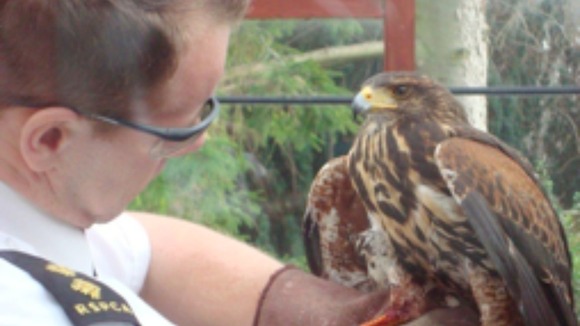
The RSPCA were called to the rescue after a Harris hawk made a bid for freedom from her home in a prison in Surrey, only to get tangled in a tree.

The bird of prey was spotted by a member of the public 20 feet high in a garden in Box Ridge Avenue, Purley, Surrey last Monday.