As regular CFZ-watchers will know, for some time Corinna has been doing a column for Animals & Men and a regular segment on On The Track... particularly about out-of-place birds and rare vagrants. There seem to be more and more bird stories from all over the world hitting the news these days so, to make room for them all - and to give them all equal and worthy coverage - she has set up this new blog to cover all things feathery and Fortean.
Showing posts with label griffon vulture. Show all posts

Friday, 28 February 2020

Mass poisoning causes a heavy blow to the largest colony of Griffon Vultures in mainland Greece

We are devastated to report that eleven Griffon Vultures fell victim to poisoning in the area of Klisoura Gorge in Greece. Unfortunately, nine vultures died from the incident, and two are alive but currently in recovery.
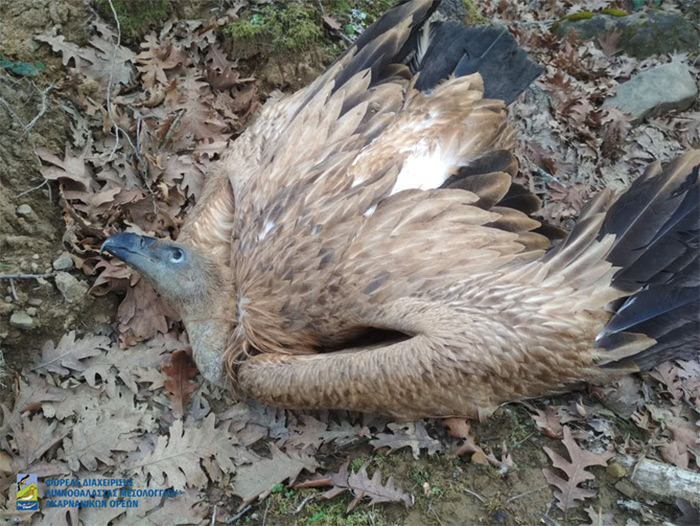
A total of eleven Griffon Vultures, a protected and critically endangered species in Greece, have been found poisoned in Klisoura Canyon in the Messolonghi-Etoliko Lagoon National Park a few days ago. This is the most severe poisoning case recorded in the country, after the one in the Strait of Nestos in 2012, and the largest confirmed case for Griffon Vultures.

The Messolonghi Management Body and HOS/BirdLife Greece discovered the carcasses of the nine Griffon Vultures. Executives from the Management Body of the Hunting Association of Messolonghi recovered the other two Griffon Vultures, which are currently alive and are being treated at ANIMA, gradually showing signs of recovery from poisoning. The dead vultures will be sent to the Athens Veterinary Foundations Centre for toxicological analysis, and to help avoid further poisoning.

Concerns about the fate of the rest of the vultures in the area are high and the danger of the local vulture population collapsing remains. The Griffon Vulture colony of Klisoura and Akarnania, are the only ones left in Western Greece and the largest remaining in the mainland.

Thursday, 20 February 2020

Rüppell's Vulture breeding with Griffon Vulture at two Spanish sites


New evidence suggests two cases of a Rüppell's Vulture breeding with a Griffon Vulture in Spain. In two different Griffon Vulture breeding colonies in Spain, one pair was observed copulating, and in the other, an adult Rüppell's Vulture was collecting nesting material.

Rüppell's Vulture
The Rüppell's Vulture (Gyps rueppelli) is an African species whose distribution range is located in the equatorial and eastern areas of the continent. It resembles our Griffon Vulture (Gyps fulvus), especially the juveniles and immature birds, being slightly smaller in size. The IUCN's Red List of Threatened Species considers it Critically Endangered, which is the last category before global extinction, due to the rapid declines of several populations across Africa.

its declining state is mostly due to the successive and frequent mass poisonings in Africa, which are driving several species of African vultures to extinction. The Vulture Multi-species Action Plan (Vulture MsAP), co-developed by us here at the Vulture Conservation Foundation, and endorsed by the Convention for Migratory Species (CMS), concludes that poison is the biggest threat to vultures worldwide, and a significant part of this global action plan for vultures focuses on the actions needed to fight this threat. Unfortunately, experts foresee a rather bleak future in the short term if poisoning events keep occurring at this rate.

Rüppell's Vulture in Europe
In consequence, Rüppell's Vultures are becoming alarmingly scarce in Africa but, surprisingly, they are increasingly seen in Europe. This is probably due to increased mixings of individuals of this species with wintering juvenile Griffon Vultures in West Africa. A percentage of Europe's growing population of Griffon Vultures winters in the Sahel zone of West Africa, where it will encounter some Rüppell's Vultures. When European Griffons start their migration north, they probably drag some African vultures with them, and with plenty of food in Europe, they are beginning to call our continent home. The species was recently added to Andalucía's list of vultures, making it Europe's 5th vulture species and one of the most threatened bird species in Spain.

Wednesday, 8 May 2019

Accidental ‘spy’: vulture arrested for espionage


SANAA, APRIL 25, 2019 22:37 IST
UPDATED: APRIL 25, 2019 22:37 IST
Yemeni fighters mistook GPS tracker on a bird for an undercover device sent by Huthi rebels
Griffon vulture Nelson crossed into war-torn Yemen in search of food but ended up in the hands of Yemeni fighters — and temporarily in jail for suspected espionage.
The sand-coloured bird came down in the country’s city of Taez, an unusual move for a young vulture that can soar for long distances across continents in search of food and moderate weather.
Nelson, approximately two years old, embarked on his journey in September 2018 from Bulgaria, where his wing was tagged and equipped with a satellite transmitter by the Fund for Wild Fauna and Flora (FWFF).
But he seemed to have lost his way, eventually coming down into Taez — under siege by Huthi rebels but controlled by pro-government forces, who mistook Nelson’s satellite transmitter for an espionage device and detained the bird.
Forces loyal to the government believed that the GPS tracker attached to the bird may have been a spy device for the rebels.
Hisham al-Hoot, who represents the FWFF in Yemen, travelled from the rebel-held capital Sanaa to Taez to plead with local officials to release the helpless animal.


Thursday, 28 December 2017

Rare Griffon vulture found dead, shot at


DECEMBER 5TH, 2017 

Although it was shot at, authorities on Tuesday were carrying out tests to determine the exact cause of death of one of the few Griffon vultures on the island whose carcass was found at Zapalo beach in Episkopi, Limassol.

Conservation group BirdLife Cyprus said an x-ray showed the presence of pellets but a necropsy was also underway to confirm whether it was a shooting that killed the bird or if it died of poisoning, the most frequent cause of death of vultures in Cyprus.

BirdLife said preliminary tests showed the bird most probably died from the shooting but more tests were underway to check for evidence of poisoning.

“This x-ray alone, however, paints a gloomy picture for the species,” BirdLife said. “Why was it even shot at? With only around 20 vultures left on the island, each death comes at a great cost for the species’ survival.”

Wednesday, 20 May 2015

Griffon vultures are exposed to high concentrations of lead in their diets


Date: May 19, 2015

Source: Plataforma SINC

Summary: Because of their position on the food chain and their dietary habits, Griffon vultures from the Iberian Peninsula are exposed to accumulation of heavy metals in their tissues. A study reveals that, due to their diets, wild populations of Griffon vultures in Catalonia show the presence of a high amount of lead, which affects their immune systems and reproductive function.

Sunday, 12 May 2013

Why Vultures Devoured Hiker's Body in Minutes

Marc Lallanilla, Life's Little Mysteries Assistant Editor
Date: 07 May 2013 Time: 11:07 AM ET

A flock of vultures devoured the body of a woman just minutes after she fell to her death while hiking in the Pyrenees Mountains in France.

The woman, 52, had been hiking with two friends when she fell about 1,000 feet (300 meters) down the side of a steep mountain. Police believed she died from injuries sustained during the fall, the Daily Mail reports.

Vultures are known to be able to sniff out the gaseous chemicals emanating from a dead body more than a mile away.


"When we first went out in the helicopter looking for the body, we saw numerous vultures, without realizing what they were doing," said Maj. Didier Pericou, of the local police, as quoted in the Daily Mail.

But by the time the police reached the body, there was little left to recover.

"There were only bones, clothes and shoes left on the ground," Pericou said. "They took 40 to 50 minutes to eat the body."

The Griffon vultures (Gyps fulvus) that consumed the body have been under considerable stress, as their primary source of food — the carcasses of cattle or other livestock — are no longer available throughout much of Europe.