As regular CFZ-watchers will know, for some time Corinna has been doing a column for Animals & Men and a regular segment on On The Track... particularly about out-of-place birds and rare vagrants. There seem to be more and more bird stories from all over the world hitting the news these days so, to make room for them all - and to give them all equal and worthy coverage - she has set up this new blog to cover all things feathery and Fortean.
Showing posts with label Northumberland. Show all posts

Wednesday, 24 July 2019

Ovington residents oppose anti-bird netting


06/07/2019
Villagers in Ovington, Northumberland, are challenging a developer that has erected bird netting. The nets went up last November in the village, covering a large hedgerow along Post Office Lane, forcing the local parish council to register a number of objections.
Last November Malcolm Buttery, of Stockton, applied for planning permission to build a detached dwelling and garage, with the nets placed during the spring of this year. Ovington Parish Council said: "Ovington Parish Council and many residents of Ovington village are strongly opposed to the hedgerow netting which has now been in place for approximately four months. 
"There is no evidence of the netting in Ovington being monitored. It has also been poorly maintained and the netting does not fully enclose the hedge.” The parish council has written to both the applicant's ecological consultants and the county council to express its concern. The proposed development has led to 26 objections.
The developments in Ovington are the latest in a run of anti-bird netting incidents, including cases in Somerset and Cumbria.

Friday, 28 September 2018

A rare visitor to nature reserve


Published: 14:00 Friday 14 September 2018
There was great excitement when the Hauxley Bird Ringing Group caught an Arctic warbler on Northumberland Wildlife Trust’s Hauxley Nature Reserve – especially as there are only about five records in the UK each year. Arctic warblers breed in the far north of Fennoscandia and northern Asia. It is believed that the birds that reach Britain will most likely have bred in eastern Russia before migrating to South East Asia in the autumn – so this one was well off course. The ringers visit the Hauxley reserve each spring and autumn and are part of The Constant Effort Sites Scheme, the first national standardised ringing programme that is supported by the British Trust for Ornithology and the Joint Nature Conservation Committee.

Source: 

Wednesday, 29 August 2018

Record-breaking numbers of UK's rarest seabird return to island after near extinction


118 pairs of roseate terns successfully raise chicks off coast of Northumberland after nearly being wiped out in 1970s
Josh Gabbatiss Science Correspondent 

Record numbers of roseate terns have nested off the coast of Northumberland, raising hopes for this once critically endangered bird.
Populations of these terns crashed as low as 16 breeding pairs in the 1970s due to demand for their beautiful plumage, which was used to make hats.
Though still considered the country’s rarest seabird, roseate tern numbers have bounced back thanks to a concerted effort by conservationists, and this year saw 118 pairs raising chicks on Coquet Island.
The small island, just a kilometre from the mainland, is host to the last sizeable breeding population of the tern – which was once widespread across the whole of the UK.
Their success there has been largely the result of a scheme to create rows of “terrace houses” for the birds to live in, which recreate the crevices that the terns like to lay their eggs in.
The RSPB constructed these special nest boxes on the island in 2000 when the population still only numbered 34 pairs, and since then numbers have consistently climbed.
“For the past three years we’ve been consistently attracting more than 100 pairs of roseate terns to the island, who have fledged more than a 100 chicks each year,” said Paul Morrison, warden at RSPB Coquet Island.


Breeding Roseate Terns return to Wales
RSPB Cymru have announced that two Roseate Tern chicks were born at The Skerries this summer – with one chick having successfully flown the nest for the first time since 2006.
Funding provided by the EU Roseate Tern Recovery Project allowed for a two-week extension on the islands’ wardening season, along with newly designed nest boxes being placed strategically around the islands. The wardens also placed lures playing Roseate Tern calls and hand-made decoys with the aim of attracting passing Roseate Terns to the colony.
Once widespread across Wales, Roseate Terns nearly became extinct in the 19th century because their plumage was prized for fashionable hats. Sadly, Roseate Terns continue to face many challenges, including food shortages, eroding nesting habitat and predation. To address this challenge, 2015 saw the launch of an ambitious five year EU-funded Roseate Tern LIFE Recovery Project bringing together conservationists from the RSPB, BirdWatch Ireland and North Wales Wildlife Trust on the three breeding colonies (two in Ireland and one in the UK). The project is also focused on creating further Roseate Tern-friendly sites across the UK and Ireland in the hopes of re-establishing thriving colonies.
Currently in 2018, there are only 116 breeding pairs of Roseate Terns in the UK, restricted to just Coquet Island in England. With their incredibly pale plumage with slight rosy flush and long tail streamers, they are considered the most elegant of the five breeding terns to visit our shores. These endangered birds migrate each spring from western Africa to breed at only a handful of colonies in the UK and Ireland.

Monday, 25 September 2017

Booming population of migrating birds on Northumberland coast


Published: 07:00 Friday 08 September 2017


A tiny bird is booming in population thanks to conservation efforts on a stretch of the north Northumberland coast recently bought by the National Trust. More than 500 Arctic terns and five internationally-threatened little terns have fledged thanks to rangers camping out on 24-hour watch against predators, such as stoats and foxes. In the previous year, just two Arctic terns and five little terns, vulnerable to high tides and marine pollution, managed to take flight. The National Trust has been carrying out the extensive conservation efforts for decades to keep the birds going on the north Northumberland coast, but this summer, the charity acquired 200 acres of land at Tughall Mill for £1.5million to ensure its vital conservation work can continue. Only around 1,800 breeding pairs of Arctic terns return to the Long Nanny from Antarctica each year, between May and July. The Arctic tern hit headlines last year after one from the Farne Islands clocked up 59,650 miles in one migration, more than twice the circumference of the planet.

Read more at: 

Friday, 18 August 2017

Hen harriers at risk of extinction have rallied in Northumberland

Dean Kirby
Monday August 7th 2017 

Hen harriers fighting for survival have rallied despite fears they are on the brink of extinction in England. Ten chicks have hatched in Northumberland, according to conservationists who say three out of five nesting pairs in the county produced young this year. i told in June how hen harrier numbers have fallen by 204 pairs in the last 12 years to just 545 – a decline of more than 27 per cent – with just a handful of territorial pairs now remaining in England. Hen harriers are still facing an uphill battle to re-establish themselves in the uplands of England. Andrew Miller, chairman of the NHHPP The RSPB has warned that the iconic bird is under “severe threat” from extinction, with illegal killing a “significant factor” behind the diminished numbers. 

The Northumberland Hen Harrier Protection Partnership said the arrival of the chicks was a positive step in efforts to re-establish them. After another very poor season for hen harriers elsewhere in England, with no successful breeding attempts. Andrew Miller, head of programmes and conservation at Northumberland National Park and chairman of the partnership, said: “Hen harriers are still facing an uphill battle to re-establish themselves in the uplands of England. ”However, with the positive support of all our partners including landowners, ten young birds have successfully fledged. Working together and using the latest scientific techniques is also increasing our knowledge of this amazing species.“ Hen harriers were driven to extinction in mainland Britain during the 19th century. Despite making a comeback, the species has remained rare, with a breeding population under 1,000 pairs making it vulnerable.

Monday, 3 July 2017

Rare bird spotted in Northumberland

James Willoughby

A rare bird has been spotted in Northumberland. The Eurasian Golden Oriole has been seen in The Alnwick Garden. 

The blackbird-sized male has an unmistakable bright yellow body with black wings. The Golden Oriole is very secretive and difficult to see. It mainly arrives in England in mid May and stays until August and is typically restricted to spots on the south or east coast. Most often seen at dawn, it flies in an undulating fashion and in a high canopy location. 

Fiona Mitcheson, from The Alnwick Garden, said: “We are all tremendously excited that the rare Golden Oriole, with its distinctive yellow body, has been spotted. The Alnwick Garden prides itself on the stunning habitat it provides for birds of all species.”

Source

Friday, 7 April 2017

Rogue rat which threatened rare bird colony flushed out after snubbing pork pies and chocolate


The RSPB was concerned it would cause devastation to roseate tern colony on Coquet Island
5th April 2017

By Mike Kelly

An elusive rat which stalked the North East island sanctuary of an endangered species of bird has been caught and killed just days before the breeding season begins there.

For three months staff from the Royal Society for the Protection of Birds which manages Coquet Island have been searching with increasing anxiety for the rodent which despite their best efforts had evaded capture.

Sited half a mile off the Northumberland coast near Amble, it is the home of Britain’s last colony of roseate terns as well as being a nesting place for puffins.

If it hadn’t been caught it is feared the rat which feeds off eggs could have devastated the colony.

It is the first time a rodent had been reported to be seen on the island.

After being detected in January, the island’s RSPB warden there, Paul Morrison, installed traps with a number of different baits including pork pies, fish, pate and even Cadbury’s Dairy Milk chocolate, but all to no avail.


Read on

Wednesday, 7 December 2016

Eyebrowed thrush - rare sighting sparks twitcher stampede to Northumberland

Student Ross Moore spotted it first and when he posted pictures of it online birdwatchers flocked to the region

Student Ross Moore took a walk around a Northumberland beauty spot – and sparked a birding stampede.

Ross, who has just taken up wildlife photography, was walking around Bolam Lake Country Park on Friday afternoon with his parents when he photographed a bird perched in a nearby hawthorn tree.

His father Andrew trained his binoculars on the tree and concluded that it was a bird he had never seen before.

When they returned to the family home in Prudhoe, they identified it as an eyebrowed thrush, which breeds in Siberia and migrates for the winter to south East Asia.

Once Ross posted his pictures online, it sparked an internet surge from birders across the country.

“Everything went into meltdown, and it started to sink in about what I had stumbled across,,” said Ross.

It turned out to be the first eyebrowed thrush to be seen in Northumberland and only the 24th to be recorded in the UK, with the last bird accessible to spotters being back in 1995.


Read on

Sunday, 6 November 2016

Help save Northumberland’s sea duck


Bird protection charity, the RSPB, is calling for more help for Northumberland’s iconic eider duck, 1,300 years after St Cuthbert introduced the first laws to safeguard its future.

Also known as Cuddy’s duck – after St Cuthbert – it is believed eiders inspired the saint to create the world’s first conservation legislation in the eighth century, apparently decreeing that no one should eat or disturb those nesting on the Northumberland coast. 

More than a millennium later, eiders remain a cause for conservation concern. They are declining throughout Europe as a result of hunting, pollution and disturbance. 

Early this year, the Government designated the stretch of sea between Whitley Bay and Alnwick in Northumberland as the Coquet to St Mary’s Marine Conservation Zone (MCZ), which will form part of a network of protected areas around England’s seas. However, as it currently stands, the nationally important population of eiders that live within this zone all year round will not be covered by the new legislation. 

Now the RSPB is calling on Thérèse Coffey, Minister for Environment, to add eiders as a feature to the MCZ, which means that protection and management for birds can be put into place. They need people to show they care about the future of this integral part of Northumberland culture by writing to their MP and getting them to tell the Minister why this bird needs to be protected.


Friday, 8 July 2016

Unlikely brood of four chicks gives boost to Osprey conservation

Wednesday, July 6, 2016, 07:00 by 
Emily Beament, Press Association


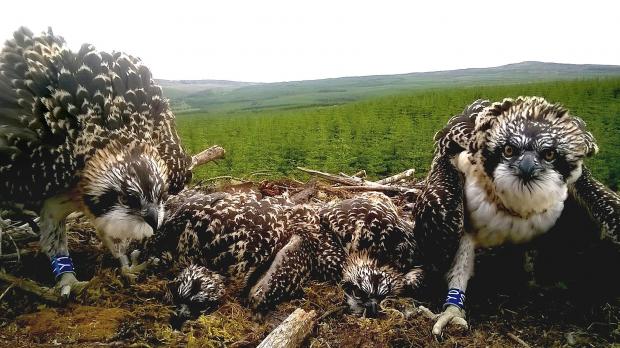
An "awesome foursome" of osprey chicks have been reared in a single nest, in what conservationists say is a rare event for the bird of prey.

The chances of four chicks hatching in the nest at KielderWater and Forest Park, Northumberland, were put at 100 to one - but their arrival was part of a successful year for theKielder Osprey Project, experts said.

The Forestry Commission's wildlife team is ringing at least 10 five- to six-week-old osprey chicks, which already have a wingspan of around a metre, before they fledge, as well as making health and other checks.

The four youngsters sharing a single nest - a new site which uses a platform set up by the Forestry Commission team for the birds of prey to breed on - were the first to be ringed and are in very good health for such a large brood.

One chick is being fitted with a tiny satellite tracker to help wildlife experts monitor the birds more effectively.

The fish-eating bird of prey migrates from Africa to breed in the UK each summer and has an "amber" conservation listing because of historical declines due to persecution and low breeding numbers.

It vanished as breeding bird in England in 1847 and in Scotland by 1916. But, in the 1950s, it recolonised Scotland where there are now about 200 pairs.

Birds have also recolonised or been reintroduced to parts of England, such as the Lake District and Rutland Water in the East Midlands.

The species only returned to Kielder, England's largest working forest and the biggest man-made lake in northern Europe, in 2009 after an absence of more than 200 years, the Forestry Commission said.

Friday, 10 June 2016

Tiny sea bird makes longest-ever known annual migration from Antarctica to Northumberland


00:00, 7 JUN 2016
BY TOM WHITE

The Arctic tern weighs less than an iPhone yet covered a massive 96,000km on its journey to its winter home before returning to the UK

A tiny sea bird has made the longest ever known annual migration, which saw it fly from Northumberland to Antarctica and back.

The record breaking Arctic tern, which weighs less than an iPhone, covered a mammoth 96,000km in its journey down to its winter home in the Weddell Sea before returning to the Farne Islands.

It was part of a study carried out by scientists at Newcastle University for BBC’s Springwatch, which mapped for the first time the annual migration of the terns.

Last year, 29 birds were fitted with geolocators by the researchers and have now returned to the islands to breed.

The previous record had been held by an Arctic tern that covered 91,000km on its flight from the Netherlands.

Dr Richard Bevan, from Newcastle University’s School of Biology, said: “It’s really quite humbling to see these tiny birds return when you consider the huge distances they’ve had to travel and how they’ve battled to survive.

“So far we’ve managed to catch 16 of our tagged birds from last year and we’ve seen at least another four birds with our geolocators attached.


Wednesday, 27 April 2016

Volunteers needed to protect rare seabirds in Northumberland

Paul Larkin
11:23Tuesday 12 April 2016

A Northumberland bird protection scheme is looking for volunteers to help vulnerable nesting shorebirds this summer.

The plea has come from the Northumberland Little Tern Project which protects endangered little terns, ringed plovers and oystercatchers.

Little terns spend their winter on the west coast of Africa and return to our coastline at the end of April. These rare birds nest on the beach along with other shorebirds and are very susceptible to disturbance.

In Northumberland, little terns are predominantly found on the National Trust Long Nanny site at Beadnell beach and Natural England’s Lindisfarne National Nature Reserve (NNR), which stretches from Budle Bay to Berwick.

The Northumberland Little Tern Project is a partnership between the National Trust, Natural England, RSPB and the Northumberland Coast Area of Outstanding Natural Beauty, which provides additional funding to the sites that Natural England and the National Trust have been protecting for many years. With this support, extra seasonal staff help protect the sites, provide new information signs and additional fencing to enclose nesting areas.
Chantal Macleod-Nolan, EU LIFE Little Tern Project co-ordinator, said: “Last year, we had a really good outcome with 44 pairs of little terns nesting on the Northumberland coast and 52 chicks fledging by the end of the season.

"The terns had a difficult summer with high tides, human disturbance and persistent predators, and only persevered due to the continued efforts of nine staff and a team of 20 dedicated volunteers working around the clock across both sites. Without this hard-working team, we wouldn’t be able to protect these birds and as a result, volunteer recruitment is crucial to the little tern’s breeding success again this summer.”

Volunteers are essential for the protection of our breeding shorebirds, as engaging beach-users about the significance of the fenced off areas and the importance for dog-walkers to keep their dogs on leads makes a huge difference to the breeding success of these small visitors. The observational research data collected by these volunteers also contributes to a wider national shorebird protection scheme, with the information used to further the protection of these sensitive birds.

Monday, 15 June 2015

s this bird actually flying upside down? Get your head around this confusing image

BY SUSIE BEEVER

Sea bird captured performing amazing new trick - but all is not what it seems


Ross Parry / SWNS Headscratcher: Which way round is this tern flying?


It's a confusing picture sure to make heads turn.

This sea bird appears to have mastered the amazing art of flying upside down.

The image was snapped by landscape photographer Roger Coan who was at first left scratching his head.

The tern has its wings clearly facing down, but it's head pointing up.

Roger eventually realised the picture is simply a trick of the eye.

He said: "I didn't realise until I got home I had taken the picture.

"I had gone out on a boat trip around an island off the Northumberland coast that was known for having a large bird population.

Friday, 9 January 2015

Police fund cash helps Northumberland seabird colony

An island’s rare seabird colony will be given extra protection thanks to a fund set upby Northumbria Police and Crime Commissioner Vera Baird.

Situated a mile off the coast of Amble in Northumberland, Coquet Island is home to tens of thousands of breeding seabirds during spring and summer, including the UK’s only colony of roseate terns.

Roseate terns, one of the UK's rarest seabirdsAs a result, the RSPB reserve is designated as a wildlife sanctuary and landing is prohibited without consent.

The Police Commissioner’s Community Fund has awarded a grant of £2,000 to help protect the island from wildlife crime.

The RSPB will use the grant to upgrade the island’s outdated CCTV system so wardening staff can monitor the nesting colonies effectively for illegal activity such as egg theft and disturbance of roseate terns.

Sunday, 23 November 2014

Fish and chips harming eider ducks - wildlife expert

3 November 2014 Last updated at 04:40

Eider ducks in Northumberland's coastal areas are being harmed by people feeding them fish and chips, a wildlife expert has warned.

Chris Watson says people living or visiting the area often wrongly believe eiders are tame as they are "friendly".

He told BBC Radio Four's Broadcasting House the sea birds may seem to enjoy the food but it damages their eggs.

The Northumberland coast is recognised as a haven for wild birds, including colonies of eiders.

Mr Watson, whose work as a nature sound recordist includes documentaries with Sir David Attenborough, said: "Normally eider ducks eat shellfish not fish and chips - [which is] lacking calcium so the eggs are failing.

"There's a problem because they are such attractive, friendly birds to feed, and yet the food that we are giving them - bread and things like that - is actually causing a dietary problem."

The RSPB says eiders are the UK's heaviest ducks and the fastest flying. As well as the Northumberland coast, they are resident off Scotland and Northern Ireland.

Sunday, 15 June 2014

Piano-playing puffins entertain on RSPB's Coquet Island

There is more to life for puffins on a Northumberland island than catching fish and hatching eggs.

For starters, there is chance to join the musical band called The Puffets.

Staff on the RSPB Coquet Island reserve, off Amble, provide the puffins with entertainment opportunities and the birds do the rest.

The team has rigged up an electronic piano, which the puffins play by jumping on the keys.

“They run up and down the keyboard and produce a jazzy kind of music,” says Dr Paul Morrison, island site manager. The piano-playing puffins have been filmed by species protection assistant Matt Butler.

Paul, assistant warden Wesley Davies and research student Kaye Lowes have also laid on a child’s drum kit, bought at a car boot sale, which can be played by the birds tugging at strings.


Continued

Tuesday, 22 April 2014

BIRD RESCUE: Pensioner knits tank top sweaters for group of hens

Hen, jumpersNot only have these hens been saved from the dinner plate this Easter, they have also been given snazzy jumpers to wear.
The birds were moved to Armstrong House sheltered housing complex in Northumberland to keep the elderly residents company.
One of the pensioners loved them so much she decided to knit them colourful sweaters.

Tuesday, 11 February 2014

Christmas continues in Cramlington after blackbird lays eggs in tree


Cramlington Town Council can not take down their Christmas tree because a bird has laid three eggs in it

A Northumberland town council has been left stumped after a blackbird took up residence in their Christmas tree.

The 12 days of Christmas may be long gone but the message appears to have missed the squatter in Cramlington which laid its eggs just before the tree was due to be taken down.

The bird and her three eggs have left council officials at a loss after they were discovered just as staff were about the remove the tree from outside Concordia Leisure Centre in theNorthumberland town.

After consulting the RSPB, the town council has been forced to tell irritated residents that there is nothing they can do about the tree.

Tuesday, 14 January 2014

Rare albino blackbird spotted in Northumberland town centre

This rare fellow has taken up residence in a Northumberland town centre.

The unusual albino blackbird was spotted by chance in Haltwhistle by bird enthusiast couple Tony and Ursula Messner as they parked up to do their weekly food shop.

The feathered visitor was seen near the Co-op, in the town, earlier this week.

Albino blackbirds tend not to survive very long because they are born weaker and are more at risk from predators.

Sunday, 1 December 2013

Kielder osprey spotted in West Africa for 'first time'

An osprey which fledged from its Northumberland nest has been seen for the "first time ever" in West Africa, the Forestry Commission said.

The bird of prey, which left its nest in Kielder Forest in 2012, was spotted in the skies of the Todde area of Northern Senegal.

It is the first time a Kielder bird has been seen at a migration destination.