As regular CFZ-watchers will know, for some time Corinna has been doing a column for Animals & Men and a regular segment on On The Track... particularly about out-of-place birds and rare vagrants. There seem to be more and more bird stories from all over the world hitting the news these days so, to make room for them all - and to give them all equal and worthy coverage - she has set up this new blog to cover all things feathery and Fortean.
Showing posts with label Lake Natron. Show all posts

Tuesday, 8 October 2013

The bird mummies of Natron: Lake's waters petrify animals that fall in

The Rift Valley's Lake Natron is the chosen mating ground of the endangered lesser flamingo. The long-legged waterfowl may flourish, but to any other living creature, Lake Natron is hell on earth. The lake's steeply alkaline waters are a graveyard for thousands of small birds. Wildlife photographer Nick Brandt used the corpses littering the Tanzanian lake shores as posed models for a haunting new series of photographs. 
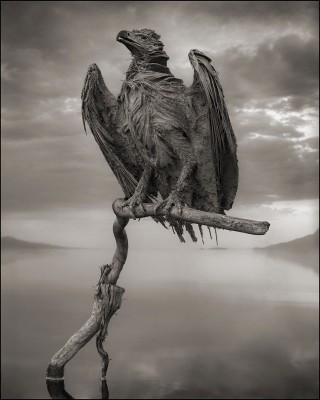
Natron is usually a toasty 80 degrees Fahrenheit and blood-red from bacteria, the only living things that can survive its deadly alkalinity. Lately, it's earned a reputation for washing up the bodies of small animals on its shores, each wrapped in a delicate crusty shroud.

Brandt was captivated by startlingly well-preserved bodies of bats, flamingos, eagles and swallows, and created a whole series of photographs to document the eerie phenomenon. 

"I unexpectedly found the creatures — all manner of birds and bats — washed up along the shoreline of Lake Natron in Northern Tanzania," Brandt told NBC News in an email. "I took these creatures as I found them on the shoreline, and then placed them in 'living' positions, bringing them back to 'life.'"

Wednesday, 14 November 2012

Major flamingo breeding event begins on Lake Natron


Many thousands of lesser flamingos have flocked to Tanzania's Lake Natron to begin nesting.
Early reports suggest that this could become the most significant breeding event since 2007.
But the flamingos' breeding success will depend on a combination of environmental factors.

The gathering is one of nature's "fantastic spectacles", said Sarah Ward, of the University of Southampton.

Three-quarters of the world population of lesser flamingos (Hoenicopterus minor) live in East Africa and use Lake Natron as their nesting site.

"Large breeding events involving over a million [lesser] flamingos are not unusual if conditions at Lake Natron are suitable and if the flamingos are in good health," explained Ms Ward, a PhD research student studying the relationship between East African lakes and lesser flamingo populations at the university's Institute of Complex Systems Simulation (ICSS) and geography departments.