As regular CFZ-watchers will know, for some time Corinna has been doing a column for Animals & Men and a regular segment on On The Track... particularly about out-of-place birds and rare vagrants. There seem to be more and more bird stories from all over the world hitting the news these days so, to make room for them all - and to give them all equal and worthy coverage - she has set up this new blog to cover all things feathery and Fortean.
Showing posts with label Andes. Show all posts

Friday, 5 July 2019

Andean hummingbirds take different evolutionary paths to high altitudes


JULY 1, 2019

Scientists have found that multiple hummingbird species have adapted to life at high altitudes in the Andes through distinct genetic mutations that nonetheless affect the same biochemical pathways. This suggests that while the details of molecular adaptation may differ at the amino acid and protein levels, there is predictability in evolution at the level of biochemical pathways.
The transition from living at low elevations to high elevations, such as those found in the Andes, Himalayas, and Tibetan Plateau, comes with many challenges. Extremely high elevations are associated with colder temperatures, increased exposure to ultraviolet radiation, and a lack of oxygen, which is 40% less abundant above 4,000 m than at sea level. Organisms that live at these elevations have developed specific adaptations that allow them to cope with these difficulties. For example, genetic analyses of humans living in the Andes and on the Tibetan Plateau have revealed changes in specific genes that enable them to deal with limited oxygen environments. However, it remains unclear whether such changes are generally predictable across different species or populations, or whether there is some flexibility in what changes occur. In a new article in Genome Biology and Evolution (Lim et al. 2019), a group of researchers from Stony Brook University, the University of New Mexico, and the Swiss Federal Research Institute set out to answer this question.

Monday, 29 May 2017

Too sexy for these feathers


I'm too sexy for these feathers. So says the male club-winged manakin. The clumsy but sweet singing resident of the Andes mountains is a textbook example of runaway sexual selection. That means the small bird species has rapidly evolved a certain ornamental trait that attracts the opposite sex but harms its chances of survival. In the case of the club-winged manakin, it has "selected" an elaborate mating song over the ability to fly well. The song is produced by their sophisticated "spoon-and-washboard" wings. The wings have extra wide bones, with special ligaments, that beat up to 100 times per second. Their "spoon" feathers rub over ridged "washboard" feathers to produce 14 sounds per oscillation, or 1400 sounds per minute. While this makes for an amazing song—one that drives the females crazy—it requires their wing bones to be malformed and solid instead of hollow. Which unfortunately means they can barely fly. 


Tuesday, 2 February 2016

High hopes for threatened Andean birds


JANUARY 25, 2016

Generous support for the Conservation Leadership Programme (CLP) from Fondation Segré Conservation Fund at Fauna & Flora International (FFI) is already creating valuable opportunities for an already thriving global network of CLP alumni to share their skills through the Learning Exchange Programme, as a recent example from Colombia illustrates.

It is well over two decades since Professor Stuart Marsden cut his conservation teeth as a member of a CLP-funded project team from Manchester Metropolitan University studying some of the restricted-range bird species on the Indonesian island of Sumba. Today, he is Professor of Conservation Ecology at that very same institution. In July 2015, courtesy of CLP’s Learning Exchange Programme, Stuart found himself in Colombia, passing on some of the knowledge and tricks of the trade that he has acquired in the intervening 22 years. The young conservationists hoping to benefit from his experience in project planning, field survey techniques and analysis were Eliana Fierro-Calderon and Diana Eusse-González, who currently work for Asociación Calidris, a Colombian NGO engaged in bird conservation.

Recipients of a CLP grant in 2008, Eliana and her team won a multi-year Follow-up Award in 2014 to extend their research across two of the world’s most important avian hotspots. The Colombian Inter-Andean Slopes and Chocó Endemic Bird Areas were the intended focus of their ‘Promoting conservation of threatened bird species in western Colombia’ project.

Although it was not originally envisaged as part of the formal mentoring process, the local team soon picked up useful tips from Stuart on how to prioritise when deciding what to include in the study. His first contribution was a lesson in pragmatism. In view of their budget and time constraints, he suggested that Eliana and her team limit the geographical scope of the study to one of these two locations, in order to maximise their time in the field, increase the frequency of site visits, and cut down on transportation costs.


Sunday, 12 April 2015

A revealing new look at the secretive black tinamou

Date:
April 9, 2015

Source:
Central Ornithology Publication Office

Summary:
One of the world's least-known birds, the black tinamou, is finally coming to light thanks to the persistence of a small group of researchers. A study presents new ecological information as well as some of the first video and sound recordings of this elusive species.

The Black Tinamou is a chicken-sized bird found in the foothills of the eastern Andes, where it lives in tall, dense primary forest. It is extremely difficult to observe due to its secretive habitats and cryptic coloration. For their study, Negret and his colleagues focused on the southern Colombia subspecies, doing daily censuses in Alto Fragua Indi Wasi National Park, recording vocalizations, and setting up camera traps to capture images and video.


Continued ...

Sunday, 27 April 2014

In Chile’s high Andes, a search for a rare bird among the spectacular wildlife


By Charles Lane, Published: April 25 


For three days, we had roamed Chile’s Lauca National Park searching for wildlife, and our efforts had been abundantly rewarded with sightings of soaring condors, graceful vicuñas and cute chinchillas. 

Even so, I felt disappointed as I stood at the foot of Guallatiri Volcano, just outside the park boundaries, and watched puffs of cottony smoke rise from its snow-covered peak.

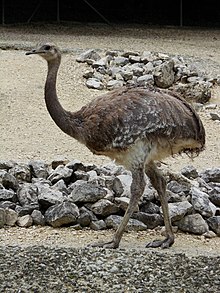
Our South American safari was almost over, and I hadn’t glimpsed the creature at the top of my must-see list: a rare flightless bird known in the indigenous Aymara tongue as the suri, and in modern ornithological parlance as Darwin’s rhea.

The latter appellation memorializes the great naturalist who identified — and ate — one of the ostrichlike beasts during his second voyage aboard the HMS Beagle. Only a few hundred remain in the wilds of northern Chile, although that’s not Charles Darwin’s fault. Subsequent generations of hunters reduced the suri’s numbers; farmers and miners encroached on its habitat.

Saturday, 24 August 2013

Andean Condors released into wild after poisoning scare

Endangered Condors have been released back into the wild high up in Chile's Andes.


It comes after a poisoning scare in the area which saw more than a dozen of the large birds mysteriously crash to the ground earlier this month.

Denise Hammick reports.

Sunday, 30 September 2012

Symbiotic survival of rare birds and rain forests

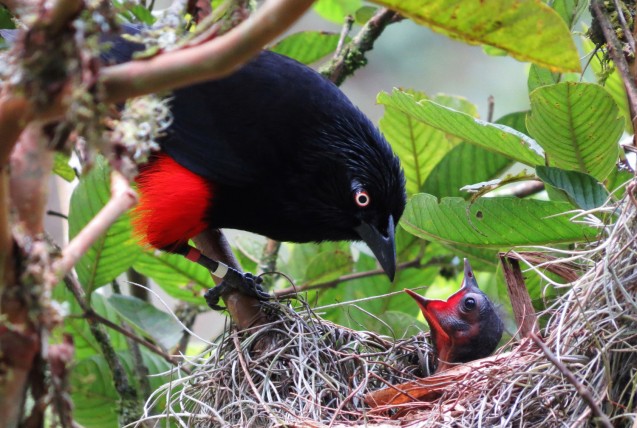
On the coast of Ecuador, along the Pacific Ocean, on the western side of the Andes Mountains, lies the Choco rain forest. Here, Jordan Karubian, his students and local residents, whom he’s enlisted as “environmental ambassadors,” study an endangered species of bird — the long-wattled umbrellabird.
Karubian, an assistant professor of ecology and evolutionary biology at Tulane University, is looking at how the long-wattled umbrellabird eats the fruits of rain forest trees and disperses their seeds. “The trees depend upon that dispersal in order to propagate and replace themselves,” says Karubian.

He is researching the mating habits, seed-dispersal activities and migratory patterns of birds in Ecuador, Australia, Papua New Guinea and the Gulf South of the United States.

The birds that Karubian studies dwell in fragile ecosystems that are in peril. And he has discovered that to have a lasting impact on protecting the birds and their habitats from disappearance, he must do more than function as a traditional researcher.
Continued: http://tulane.edu/news/newwave/092812_karubian.cfm