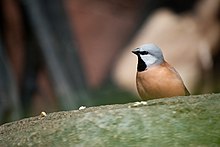
As regular CFZ-watchers will know, for some time Corinna has been doing a column for Animals & Men and a regular segment on On The Track... particularly about out-of-place birds and rare vagrants. There seem to be more and more bird stories from all over the world hitting the news these days so, to make room for them all - and to give them all equal and worthy coverage - she has set up this new blog to cover all things feathery and Fortean.
Showing posts with label black-throated finch. Show all posts

Sunday, 17 March 2019

Endangered birds threatening to derail the $2billion Adani coal mine are being bred in homes and sold online for $30


The endangered bird at centre of mine debate is being bred in private homes 
Breeder said it could be the solution to protecting the endangered species 
Adani hit out at draft review of their plans to protect the black-throated finch  
PUBLISHED: 01:36, 21 February 2019 | UPDATED: 01:38, 21 February 2019
The endangered bird threatening to halt construction of the Adani coal mine is being bred in homes and sold for as little as $30.
Breeders believe it could be a solution to protecting the endangered black-throated finch from extinction after it lost most of its natural habitat through farm land expansion.
Gordon Doutre, 57, who has been a finch breeder for half a century, told The Australian he truly believes breeders can save the bird from extinction. 
'I think the black-throated finch problem could be easily fixed because there are quite a few breeders out there who breed it and would take the opportunity to put them back into the wild,' he said. 
'If we harness aviculture societies to breed up these birds and then donate them to acclimatisation aviaries, then we could release them back into the wild. It's a sure winner.' 

Thursday, 3 January 2019

Adani 'conservation area' for endangered finch sits on proposed Clive Palmer mine

Exclusive: environmental group calls plan to protect black-throated finch an ‘elaborate hoax’


Sat 29 Dec 2018 19.00 GMTLast modified on Sun 30 Dec 2018 11.43 GMT

Adani has set aside a “conservation area” for the endangered black-throated finch at the same site earmarked for the massive Clive Palmer-backed Alpha North coalmine.

The environmental group Lock the Gate said the land-use conflict meant the Adani plan to protect the black-throated finch – which is one of two crucial management plans for the Carmichael mine yet to be approved by the Queensland government – amounted to an “elaborate hoax”.

But Adani’s response suggested the Indian company could seek to block elements of the neighbouring Alpha North coalmine, or prompt a court battle, to safeguard its own project.

“We will not allow the conservation area for the black-throated finch to be compromised,” Adani said in a statement to Guardian Australia.

Adani owns the relevant pastoral land – effectively the property at surface level. Palmer’s Waratah Coal has several exploration permits for the coal resource underneath, and has applied for a mining lease.

The Waratah Coal plan for Alpha North includes a series of open-cut and underground mines, planned to produce 80m tonnes of coal a year from two separate areas. A 20,000ha section Adani plans to use for a conservation area roughly corresponds to Alpha North plans for four longwall underground mines.


Sunday, 8 May 2016

Black-Throated Finch Extinct in New South Wales


A few of these rare birds still exist in neighboring Queensland, but planned coal mines could push them over the edge

By John R. Platt on April 28, 2016

Australia’s bird-lovers just got some bad news. The New South Wales Scientific Committee has identified the southern black-throated finch (Poephila cincta cincta) as a likely extinction within the state. The tiny, 15-gram bird hasn’t been seen in NSW since 1994. Its disappearance has been blamed on a mix of habitat loss, invasive plants, altered fire regimes, agriculture, mining and invasive rabbits.

We don’t need to completely mourn this bird yet, as it still barely holds on outside of NSW. “The subspecies does still occur in limited numbers in the far north of its range in Queensland so it is not entirely extinct,” reports Mark Eldridge, chair of the NSW Scientific Committee, “but it is not doing well.”

That might be an understatement. Agriculture has already reduced black-throated finch habitat in Queensland by at least 80 percent, and it’s about to shrink even more. Six coal mines planned for central Queensland could wipe out half of the bird’s remaining habitat, according to a paper published earlier this year in PLOS One. Habitats affected by the mines’ construction would include some of the primary grasslands the birds need as ground-based seed eaters. Conservationists hope to use the rare birds to block the mines, but so far there hasn’t been much progress.

Looking elsewhere, the northern subspecies of black-throated finch (P.c. atropygialis) appears to doing quite well is not currently considered to be at risk. They may even carry some of the southern subspecies’ genes, as the two groups were known to hybridize in the past. That won’t be enough to save the southern black-throated finch from extinction, but at least some small part of them might survive inside of their cousins to the north.


Thursday, 21 April 2016

Extinct status as black-throated finch no longer takes flight in NSW

Posted Fri at 11:05pm

A little bird is no longer taking flight in New South Wales, with scientific officials now declaring it extinct.

The southern species of the black-throated finch has been given the status, while a different species of the bird is still seen in Queensland.

The bird weighs about 15 grams and has a large head and a short, thick, black conical bill.
It also has a black bib, black rump and white upper tail.

Some of these birds that are reliant on grasses, like the black-throated finch, do find it hard to compete (with mining and agriculture).

The New South Wales Scientific Committee said the southern sub-species used to be widespread and abundant in the Northern Tableland and Northwest Slopes regions, from the Queensland border south to the Upper Hunter Valley.

There have only been three sightings of the bird since 1990.

Hunter Bird Observers Club president Allan Richardson said its extinction status was devastating.

"It's very, very sad; many of our threatened species are declining in their ranges," he said.
"There are not very many of our threatened species that are doing very well, so it is inevitable that as things continue, we may see some of those birds not exist in some areas."
Grazing, cropping, mining and wild rabbits have been blamed for the bird's extinction in New South Wales.


Wednesday, 9 March 2016

Coalmines could wipe out threatened black-throated finch habitat – study

Proposed mines in Queensland, including Adani’s huge Carmichael project, will destroy so much habitat the damage cannot be ‘offset’, researchers say

Thursday 3 March 2016 07.58 GMT
Last modified on Thursday 3 March 201608.00 GMT

Proposed coalmines in Queensland, including the huge Adani Carmichael project, would destroy the majority of the remaining habitat of the threatened black-throated finch, according to research.

Australia on the spot over Adani mine and funding of Attenborough reef series
Compensating for the loss of habitat – which Adani has been given federal government approval to do with “biodiversity offsetting” – was not possible since the best remaining habitat would be impacted by the Carmichael mine, the study by researchers at James Cook University in Townsville found.

In addition, about 60% of the remaining habitat for the finch was already covered by mining or exploration licenses.

The bird, which was recently declared extinct in New South Wales and has lost 80% of its habitat globally, is already the centre of a federal case in which the Australian Conservation Foundation has challenged environment minister Greg Hunt’s approval of the mine. It argues that he failed to adequately consider advice about the mine’s impact on the finch.
Approving the Carmichael mine, Hunt said it “would not have any unacceptable impacts on listed threatened species,” because they would either be avoided, mitigated or compensated for (offset).


Saturday, 25 April 2015

Carmichael mine may push rare bird to extinction, scientists warn Greg Hunt

Scientists say clearing the largest remaining habitat of the black-throated finch to make way for coalmines will have ‘irreversible consequences’


Friday 24 April 2015 06.43 BSTLast modified on Friday 24 April 201508.31 BST
The creation of Australia’s largest mine will have “serious detrimental and irreversible consequences” for the endangered black-throated finch and may even push it to extinction, a recovery team for the species has advised Greg Hunt, the federal environment minister.


Poephila cincta -Baltimore Aquarium, Baltimore, Maryland, USA-8a.jpgThe black-throated finch recovery team, comprised of scientists from the CSIRO and James Cook University as well as representatives from Townsville council, have written to Hunt and the Queensland government to warn of the impact of the $16.5bn Carmichael mine, set to be situated in the Galilee Basin region.


The letter states that there are only two remaining habitats where significant populations of black-throated finches remain, with the largest of these areas to be cleared to make way for the network of open-cut and underground mines that will make up the 455 sq km Carmichael project.


The clearing of 87 sq km of prime finch habitat will pose a “serious risk” to the future of the species, the recovery team warns, while plans to mitigate the threat are “inadequate”.


Sunday, 9 March 2014

RARE BIRDS: Greenpeace calls for Galilee Basin halt until threat to rare birds is assessed

Indian coal company Adani accused of ‘flouting environmental laws’ in its plans to clear habitat of black-throated finch


theguardian.com, Tuesday 4 March 2014 06.53 GMT

The federal environment minister, Greg Hunt, must demand a coal company halt plans to conduct seismic surveys in the Galilee Basin, Greenpeace has said, so the government can make an environmental assessment of “substantial threats” to an endangered species of finch.
Indian coal company Adani Mining Pty Ltd is planning on conducting the surveys at the site of its proposed Carmichael coalmine in the Galilee Basin, Queensland, and Greenpeace has accused Adani of “flouting environmental laws” by not referring the project to the federal government for assessment.

The surveys are likely to involve mass clearance of vegetation and trees in almost 4,000 hectares of black-throated finch habitat, Greenpeace said, and will have a “significant impact” on the species. The finch is listed as endangered under federal and state law.

It said the mining company was taking advantage of a grey area within the law which appears to have allowed Adani to make its own decision on whether or not its activities require reporting.

“If you’re going to undertake an activity of any kind that might have impact on endangered native species, you’re required to notify the federal Environmental Department … so that they can decide whether or not a full environmental assessment is needed,” Louise Matthiesson, Queensland campaigner for Greenpeace Australia Pacific, told Guardian Australia.

“Adani haven’t done that. They said they don’t think they’d need to because the activity won’t have a significant impact on the finch,” she said.