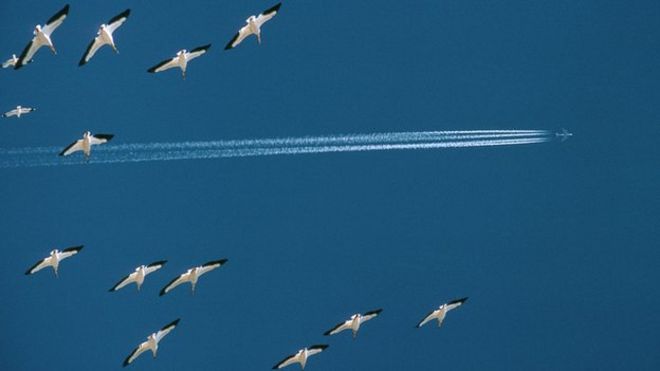
As regular CFZ-watchers will know, for some time Corinna has been doing a column for Animals & Men and a regular segment on On The Track... particularly about out-of-place birds and rare vagrants. There seem to be more and more bird stories from all over the world hitting the news these days so, to make room for them all - and to give them all equal and worthy coverage - she has set up this new blog to cover all things feathery and Fortean.
Showing posts with label bird strikes. Show all posts

Friday, 19 October 2018

Researcher using bird's eye view to reduce building strikes


September 20, 2018 by Paul Mayne, University of Western Ontario
Brandon Samuels plans to set up cameras this January in hopes of catching footage of birds crashing into windows across campus. Honestly, he really is a nice guy – it's for science.
The Neuroscience Ph.D. student is working on ways to help mitigate the number of birds colliding with large glass structures on campus – and beyond – by better understanding the visual perspective of the birds prior to impact.
"We don't know what a bird is looking at when it's flying," said Samuels, who recently completed his masters at Western. "There is a statistical way of looking at how many birds collide – where and when. But I'm interested from the perspective of morphology. I want to look at it from the bird's eyes – how they see, how their vision contributes to being able to see or not see an obstacle.
"Bird vision is very different from species to species. You have owls with huge eyes on the front their head and you have little birds with eyes on the sides of their head. You would imagine they see the world quite differently."
There are a number of reasons that may cause a bird to fly into a window. They could be trying to pass through an area as if it was not there. Maybe they cannot distinguish the actual natural landscape from what is reflected on building surfaces. Maybe they cannot navigate in open spaces when taller structures reflect the blue of the sky.
"Unlike a downtown core, Western's campus has a lot of green space, which is lovely. We enjoy it; the birds enjoy it. But when you have glass like this, mixed in with trees and green cover, that's where the risk really lies."


Friday, 12 October 2018

Millions of birds die in collisions each year, but lights could change that


Red and blue LED lights could be the key to preventing bird strikes
Date:  September 26, 2018
Source:  Purdue University
Millions of birds die each year in collisions with planes, and airports have used everything from fireworks to herding dogs to scare them away. Some methods have been relatively successful, but they're useless after the plane takes off. Researchers at Purdue University may have just found a solution.
Red and blue LED lights lead some birds in the opposite direction, according to a study published Wednesday in the journal PeerJ.
Lights have been used to try to create "avoidance behavior" in birds before, but literature to support what kinds of light might work was nearly nonexistent. In collaboration with the USDA Animal and Plant Health Inspection Service, the Purdue researchers are starting to uncover some answers.

Friday, 16 February 2018

Raptors guarding Mexico City’s airport to ward off ‘bird strikes’


AFP-JIJI
FEB 2, 2018

MEXICO CITY – Far from the crowds of passengers, lines and passport control, Madison spreads his wings on the side of a runway at Mexico City’s international airport, the busiest in Latin America.

He is one of several peregrine falcons deployed to prevent “bird strikes” — a hazardous collision between birds and planes that can have dangerous and even catastrophic consequences.

In 2009, for instance, a U.S. Airways jet had to ditch in the Hudson River in New York after a flock of birds took out its engines. In January this year, a Mexico-bound KLM flight made an emergency landing after hitting birds on takeoff in the Netherlands.

“It’s dangerous. Birds don’t mix with planes. They can hit a turbine,” Oscar Chavez, a 26-year-old who is one of the biologists handling the falcons, told AFP.

Each day, Madison and another peregrine falcon named Ilse are on duty at the airport, which sees 44 million passengers pass through it each year.

Monday, 14 December 2015

College faculty to carry out study on controlling bird hits

A city college faculty member has come forward to carry out a detailed study on bird activity in and around Tiruchi international airport and suggest scientific measures to control bird hits suffered by flights.

Q. Ashoka Chakkaravarthy from the Department of Foundation Courses of St. Joseph’s College has proposed to carry out the study by adopting certain scientific methodologies.

Mr. Chakkaravarthy has already got in touch with the Tiruchi airport authorities in this regard and conveyed his interest to carry out the study free of cost as a public service.

The scientific study would analyse the activity of birds hovering in and around Tiruchi airport and suggest scientific measures that could be taken to control instances of bird hits suffered by flights.

The Tiruchi international airport had witnessed instances of bird hits suffered by flights in the past.

Interested in wildlife especially micro fauna, Mr. Chakkaravarthy, an ecologist, says the study would be detailed including the identifying the bird species that hovered in airport’s vicinity.

Mr. Chakkaravarthy says he is expecting black kite, pigeon species, egret species, and Indian Pond heron.

However, the study would only reveal regarding the bird species that were found flying in Tiruchi airport and its vicinity.

The study would look into the bird strikes in the past, their timing, the locations, and the species of bird striking aircraft, he said.


Saturday, 2 May 2015

'Airspace reserves' could protect wildlife

By Rebecca MorelleScience Correspondent, BBC News

1 May 2015 

There is a growing conflict between animals and humans in the air

"Airspace reserves" should be created to protect wildlife, scientists say.

They warn that growing numbers of skyscrapers, wind turbines, power lines, planes and drones are threatening billions of flying animals.

Researchers in Argentina and Wales have called for airspace zones where human activity is partially or totally restricted to reduce the aerial conflict.


Sergio Lambertucci, from the University of Comahue and the Argentina Research Council (Conicet), said: "Most of the conservation in reserves and national parks is mainly focussed on the ground or more recently on water. None of them have focussed on the airspace."

Human cost
The skies are becoming increasingly crowded.

Scientists estimate that millions of animals die each year from collisions with tall buildings, power lines and wind turbines.

But the aerial conflict can cause problems for humans too.

The research team, also from Swansea University in Wales, says that bird strikes with planes have killed more than 200 people globally and have damaged thousands of planes.

Tuesday, 17 February 2015

New Indian radar offers aircraft protection against bird hits

IANS | New Delhi 
February 3, 2015 Last Updated at 15:34 IST

A new Indian radar - a global first - offers protection against the menace of aircraft bird hits while another can detect and track unmanned aerial vehicles (UAVs), the company that developed them said Tuesday. The company is eyeing domestic and international markets.

The two radars, among the four indigenously developed, are to be unveiled at the Aero India 2015 exposition at Bengaluru later this month, Sanjay Bhandari, founder chairman and managing director of OIS-Advanced Technology (OIS-AT), told reporters here.

The other two radars are a foliage penetration minefield and IED detection system, and a portable ground surveillance radar system for military and homeland security applications.

Thursday, 11 December 2014

Florida airport cuts down on dangerous bird strikes... by employing adorable border collie who chases fowl seven days a week

One-year-old border collie, Aero, uses herding instincts to chase birds 
Hard-working dog puts in an eight-hour shift seven days a week
Southwest Florida International Airport has used bird dogs since 1999 


PUBLISHED: 10:24, 11 December 2014 | UPDATED: 11:31, 11 December 2014


Birds can pose a real threat to aircraft leaving and arriving into airports. 

So the ingenious folk at Southwest Florida International Airport have employed a very capable new member of staff to take matters into her own paws. 

Meet Aero, a one-year-old border collie, is the fourth in a line of four-legged bird chasers employed by the airport in Fort Myers.

In her day-to-day job, Aero stalks birds on the airfield, using her herding instincts to chase them away from the runway.

'She acts as a natural predator, as opposed to some of the other techniques we use,' said Derek Faulkner, a Lee County Port Authority operations agent who works with Aero.

And the hard-working hound is unafraid of putting the hours in, working an eight-hour shift seven days a week - more than her human counterparts.

Wednesday, 9 July 2014

At D/FW Airport, Wildlife Biologist Strikes -- Before Birds Can


Round the clock, D/FW International Airport employees are scouring the grounds looking for dangerous intruders. Not human terrorists. Those with feathers.

Story on KERA radio

One recent morning, Larry Creel, an airfield operations employee, spots a potential problem, and alerts Cathy Boyles, D/FW’s wildlife biologist.

“We had a multiple bird strike on (runway) 36 right. Six pigeons,” Creel reports. 

This bird strike, like most other strikes, caused little or no damage to the plane. The half-dozen pigeons weren’t so lucky, though. The big concern is that the remaining flock will settle near another flight path.

“What we’re in the process of doing is moving one cannon from the north down to the south,” Creel says.

Boyles hops into a vehicle, radios her team, and heads toward runway 36 right. She wants to take a look at removing vegetation that may have attracted the birds. 

She’s glad to see the propane cannon that's been deployed -- a noise maker -- has caused the pigeons to move. It’s a cylinder that sits on the ground. When a small amount of propane gas is fed into the tube and ignited, it creates an explosive sound that’s blown out of the barrel’s open end.

“It startles them; makes them feel uncomfortable staying here so they’ll move somewhere else,” Boyles explains.

Coyote and deer, too
Boyles’ job is to keep birds and other wildlife -- the occasional coyote or deer -- away from aircraft. 

Tuesday, 12 March 2013

Bird in landing gear causes flight to Fort Lauderdale to be canceled


March 6, 2013 7:32 pm

By Mark Belko / Pittsburgh Post-Gazette

A Spirit Airlines flight from Arnold Palmer Regional Airport in Latrobe to Fort Lauderdale, Fla., was canceled today because of a bird strike.

Flight 727 was scheduled to take off from the airport at 12:30 p.m. but still hadn't left the airport early this evening. In an email, Spirit spokeswoman Misty Pinson said the flight was canceled "as a result of a bird strike" but could provide no other information.

She said Spirit would accommodate passengers by providing an alternate flight to Fort Lauderdale tomorrow morning. "While we understand that this is an inconvenience, the safety of our customers is our top priority," she said.

Ms. Pinson said passengers also have the option of rebooking on another flight or taking a future flight credit or refund.


Read more: http://www.post-gazette.com/stories/local/region/flight-to-fort-lauderdale-canceled-because-of-bird-strike-678152/#ixzz2MruL7qiv

Tuesday, 5 March 2013

Airport removing wetlands to avoid bird strikes


A $900,000-plus project to eliminate 24.07 acres of wetlands from southeast quarter of the Jamestown Regional Airport grounds will help reduce the likelihood of bird strikes on airplanes. “It’s a safety issue. They’re a menace to aircraft,” said Matt Leitner, manager of the JRA.

By: By Kari Lucin, The Jamestown Sun, The Jamestown Sun

A $900,000-plus project to eliminate 24.07 acres of wetlands from southeast quarter of the Jamestown Regional Airport grounds will help reduce the likelihood of bird strikes on airplanes.

“It’s a safety issue. They’re a menace to aircraft,” said Matt Leitner, manager of the JRA.

The wetlands mitigation will remove three wetlands areas in the southeast part of the airport, with the hope that birds will no longer fly across the runway from some wetlands patches in the northeast quarter of the airport.

In compliance with conservation laws, wetlands will be restored near Woodworth to make up for the lost wetlands.

The Federal Aviation Administration will pay for 90 percent of the project, or approximately $825,000. The North Dakota Aeronautics Commission will pay for 5 percent of the project, or approximately $46,000, leaving the Jamestown Regional Airport to pay the other $46,000.
The project, which will not disrupt flights to or from the airport, could be put out for bid as early as February 2014, with construction planned to begin in either 2014 or 2015, said Steve Aldinger, project manager with Interstate Engineering.

The exact date for the start of the project will depend on when funding becomes available, which in turn depends on when Congress releases money to the FAA for it, Aldinger said, adding that the project is fairly high up on the FAA’s list because bird strikes are a safety issue.

The last bird strike at the Jamestown airport occurred on Oct. 23, 2012, when a seagull struck an aircraft on its tail when the plane was in the clouds.

“It didn’t damage the plane, but it was inspected as a precautionary measure,” Leitner said.
The last bird strike before that was in September 2011.

Most bird strikes occur in the fall and spring, when birds are migrating, Leitner said. For the most part, the airport can frighten birds away with sound, either from noisemaking projectiles or from noise cannons.

“We harass them aurally, and if they’re intransigent, we resort to lethal measures, because safety is paramount,” Leitner said.

See more at: 

Wednesday, 20 February 2013

Cadets work to decrease bird strikes


Posted 2/15/2013   Updated 2/15/2013    
by Ray Bowden
Air Force Academy Public Affairs

2/15/2013 - U.S. AIR FORCE ACADEMY, Colo. -- A group of Academy cadets is working to put a dent in bird strikes, directly linked to the deaths of 250 people in 25 years and the cause of more than $700 million in damage to U.S. and military-owned aircraft annually.

"The impetus behind this capstone course is the devastating cost of damage to aircraft from bird strikes," said systems engineering management major Cadet 1st Class Dan Gieck.

Specifically, the group of nine cadets is testing to see if aircraft noise, Canada geese distress calls and flashing landing lights will scare away a type of wild goose that can weigh as much as 18 pounds, effectively turning into a feathery cannonball when struck by an aircraft. The working name of the cadet's system is the Airborne BirdStrike Countermeasure."

"A bird strike is when an aircraft and any type of avian species collide," said Capstone Director Capt. Jeffrey Newcamp. "It can cause aircraft structural damage, you can have a bird ingested into an engine, or it can be just a glancing blow. Bird strikes can end in an incident in which case you can land your aircraft, or in an accident in which case there could be major damage or loss of life."

In particular, Canada geese pose a huge problem for pilots: anyone questioning this need only recall the story of Academy graduate and retired U.S. Airways Capt. Chesley "Sully" Sullenberger, III., Newcamp said.

On Jan. 15, 2009, Sullenberger was piloting an Airbus 320 from New York's LaGuardia Airport when his plane struck a large flock of Canada geese shortly after takeoff.

"He hit a flock of Canada geese and the bird strike dropped both engines off line," Newcamp said.

Sullenberger landed his Airbus in the Hudson River after realizing it would be impossible to land at another airport and saved the lives of all passengers aboard.

The Sullenberger saga serves as the cadets' case study and as the inspiration for the project, Newcamp said.

The test is part of a two-semester capstone design course scheduled to run through April, sponsored by the Massachusetts Institute of Technology Lincoln Laboratory. The testing will take place in two locations on the Academy and in Monument.

"The testing will include a sound element that simulates Airbus 320 (passenger jet) engine noise, and another sound that simulates Canada geese distress calls," Gieck said. "The other element included in the testing is landing lights from an Airbus 320. The Airbus 320 sound and landing lights simulate an actual approaching aircraft." 


Read more:  http://www.usafa.af.mil/news/story.asp?id=123336618

Wednesday, 30 January 2013

Bird hazard study planned at Riverton airport


RIVERTON — The city of Riverton has agreed to pay $73,000 to assess bird hazards at its regional airport.

The city budgeted $133,000 for the review, but all four bids came in under that amount. Loomacres Wildlife Management Inc. of Warnerville, N.Y., submitted the lowest bid. The company, which has an office in Worland, will study migratory patterns year-round to determine if birds pose a danger to aircraft.

Saturday, 26 January 2013

Infrasonic Bird Repellent Shows Promise


January 23, 2013
By Mary Grady, Contributing editor

A nine-month test using infrasound to repel birds has been successful, Technology International Inc., of Louisiana, has reported. Low-frequency sounds, which are not heard by humans, were generated using a rotary woofer, the company said. The sounds "jam the birds' acoustic navigational system … [and] mimic the atmospheric disruptive features of unstable weather conditions that birds instinctively avoid." The sounds don't harm the birds, the company said. The company hopes to use the technology at airports to create bird-free zones, and plans to test a prototype system at an airport soon.

Bird strikes continue to be a major problem for aircraft around the world, causing about a billion dollars in damage each year. The frequencies used in the test are similar to infrasound emitted by thunderstorms, Technology Intl. CEO Abdo Husseiny told New Scientist, which may explain why the birds are averse to the sounds. The system can also be used to create zones that are attractive to birds and establish wildlife sanctuaries in safe areas. Husseiny said the technology could also be used in other settings besides airports, such as urban squares, harbors and wind farms. The equipment should be available commercially in about two years.

Monday, 21 January 2013

Fewer bird strikes at JFK Airport reported


Wildlife collisions with aircraft decreased during the first nine months of 2012 at Kennedy Airport, where two JetBlue flights hit birds last weekend, according to statistics kept by the federal government.

There were 121 reported bird strikes at Kennedy Airport through September 2012. That compares with 194 reported strikes there during the first nine months of 2011, according to the Federal...

Thursday, 17 January 2013

Charlotte airport works to reduce plane, bird hits


CHARLOTTE, N.C. (AP) -- Charlotte Douglas International Airport is working to reduce the number of bird collisions with aircraft.

The Charlotte Observer reported that aircraft collided with wildlife 125 times last year. That's slightly better than the 140 incidents reported in 2011. Almost all of the collisions involved birds.

But officials are concerned because there were only 29 such incidents a decade ago. Part of the increase is because of increased flights and better reporting.

Airport officials patrol each day and will try to compile a census of all local wildlife species.

Airport wildlife expert David Castaneda sometimes uses noise makers to scare away the birds. But he says the best defense is to make the airport property unattractive to the birds.

The Federal Aviation Administration says the airport's program meets federal regulations.

Wednesday, 16 January 2013

JetBlue Flights Suffer Bird Strikes in 2 Consecutive Days


By Dan Hart - Jan 13, 2013 10:09 PM GMT
Two JetBlue Airways Corp. (JBLU) flights suffered bird strikes during takeoff and had to return to New York’s John F. Kennedy International Airport in consecutive days, the company said.

Flight 721 bound for Nassau in the Bahamas took off at 9:59 a.m. today and returned to the airport after striking a bird, said spokeswoman Tamara Bentham. The plane was scheduled to arrive in the Bahamas this afternoon, according to the JetBlue website. Flight 831 bound for Santiago in the Dominican Republic returned to JFK after striking a bird as it took off yesterday afternoon.

“In my experience, this is not a common occurrence for us,” Bentham said. There was no significant damage to either of the planes, she said.

Four years ago this month, Captain Chesley Sullenberger III safely landed a US Airways Group Inc. plane on the water in an incident that became known as the “Miracle on the Hudson.” A flock of geese struck the plane about 90 seconds after takeoff, forcing an emergency landing on the Hudson River. All on board survived.

The New York Post first reported the JetBlue bird strikes.

http://www.bloomberg.com/news/2013-01-13/jetblue-flights-suffer-bird-strikes-in-2-consecutive-days.html

Sunday, 9 December 2012

Jackson Airport mulls how to reduce bird strikes


BY THE ASSOCIATED PRESS • FRIDAY, DECEMBER 07, 2012
Jackson Hole Airport officials are considering creating a new sage grouse breeding ground to draw the large birds away from the runway.

The Jackson Hole News and Guide reports ( http://tinyurl.com/aee2ev8) the airport has recorded 60 bird strikes since 1994, and about half have involved sage grouse, whose dwindling populations have made them a candidate for federal protections. Wyoming Game and Fish Department biologist Joe Bohne says a sage grouse breeding ground, or lek, off the runway's north end is the source of most of the problems.

The airport is trying to craft a new federally required "wildlife hazard management plan" to reduce bird strikes.

Members of the Upper Snake River Basin Sage-Grouse Working Group discussed the airport's strategy Thursday. The plan is not yet concrete.

Information from: Jackson Hole (Wyo.) News And Guide, http://www.jhnewsandguide.com

Tuesday, 27 November 2012

San Jose to permit airport bird shooting

SAN JOSE -- The holidays are hard on birds, at least those with plump, tasty bodies. But bird-kind can be hard on us too, and not just in Hitchcock films. 

For the jet-set, birds pose a deadly threat: Flying into an engine during takeoff or landing, they can send a plane into a fatal plunge. Airlines paint eyes on the engines because apparently birds find a 150,000-pound jetliner scarier if it's looking at them. But they don't always fall for that.

So in a move to make flying a little less fretful for people, San Jose leaders this week will allow airport staffers more ammo in their battle against the birds. For real. The proposed ordinance modification will let airport staffers and contracted biologists shoot at birds to clear them from the airfield.

OK, they plan to fire blanks mostly, just to scare them off. But they'll have permission to load birdshot if their feathered foes don't get the flock out.

"At some point," said Mineta San Jose International Airport spokeswoman Rosemary Barnes, "all those other measures aren't enough."

Actually, airport staffers have already done this. But current city law only lets cops and military types fire guns at the airport, so they want the City Council to approve the change.

"It kind of clears it up administratively so we're in compliance with the municipal code," said Airport Manager Curt Eikerman.


Continued: http://www.mercurynews.com/bay-area-news/ci_22062460/san-jose-permit-airport-bird-shooting

Monday, 5 November 2012

Taking Birds Off The Map


November 3, 2012
The U.S. Pacific Air Forces issued the following news release:

For almost one year now, Airmen 1st Class Marnell Dillingham and Jarrett Dowey have been cruising around the flightline three times a day, armed with a pail of bird scare ammunition and two shotguns. While out there, their role is to scare birds that fly too close to the flightline.

The two 35th Operations Support Squadron Airmen help reduce bird strikes on the flightline. According to Birdstrike Committee USA, these environmental hazards have been the cause of hundreds of deaths and millions of dollars in aircraft damages a year.

"Preventing bird strikes is one of the most important parts of our job," said Dillingham. "If a bird strike happens, it could put our pilots, crew members and passengers in a very dangerous situation. Birds have been known to cause aircraft crashes."

The Federal Aviation Administration receives annual reports recording thousands of wildlife related strikes. Strikes involving military aircraft cause approximately $75 million in damage a year.

In an effort to combat this environmental hazard, the Department of Defense pushes to improve aviation safety programs. One of these programs, the Bird and Wildlife Aircraft Strike Hazard prevention program, requires constant interaction among aviation safety members, air operation shops, pilots and aircrews.

"To ensure the safety of everyone, we coordinate constantly with the aircraft safety office, the supervisor of flying operations and the airfield control tower," said Dillingham.

There are two types of control measures, active control and passive control, said Dowey.

Active control is when pyrotechnic, bioacoustics and depredation methods are used to provide short-term relief. Pyrotechnics use BASH cannons, which produce loud, booming sounds to scare off birds in the flightline area. Bioacoustics, or the broadcast of local bird distress signals, is another way to provide immediate, although short-term, relief. Depredation allows Airmen to scare off birds that roost on the taxi-ways and cannons by shooting at them with shotguns loaded with bird scare cartridges.

Passive control measures involve environmental factors, such as maintaining grass height, smoothing out hills and eliminating forestry. Trees, shrubs and other plants can draw in wildlife for food, shelter and roosting sites for birds, so it's important to eliminate them from aircraft flying area. By smoothing out hills, it maintains the draining of streams in wet areas.


Sunday, 14 October 2012

Nigeria: Tackle Bird Strike Menace At Airports, Nama Urged


Chairman of the Technical and Administrative Review Panel on Domestic Airlines, which recently completed its work, Group Captain John Obakpolor, has called on the Nigerian Airspace Management Agency (NAMA) to urgently limit the incidence of bird strikes at the airports across the nation.

Obakpolor observed that bird strike on aircraft across the world happens on daily basis and urged the management of the agency to be proactive in tackling the menace of bird strike, which, he said, has caused loss of revenue to the affected airlines.

He made this known while addressing a stakeholders' meeting on bird strike and wild animal hazard control in Lagos on Monday at the NAMA's head office, and said it costs an airline over $450,000 to change a blade of an aircraft engine following an injection of birds.

He noted that the birds were now migrating Southwards because of the Autumn season in Europe, urging the bird strike/wild life control staff of the agency to brace up for the challenges ahead, saying that "one deadly strike is enough to turn the aviation industry upside down and that is why I am urging all of you to be proactive in handling this very important job".

Obakpolor further explained that the installation of aircraft birds strike avoidance radar system at Abuja airport, would not stop the problem on its own, pointing out that the air traffic controllers have roles to play in warning the pilots on the movement of the birds in and around the airport.

He equally emphasised the need for data collection as using that would assist the staff in plotting graphs to know the frequency of bird strikes and how it would affect the future plans in tackling bird strikes at the airports.

Managing Director of the Agency, Mr. Nnamdi Udoh, while speaking at the meeting, promised to expose the specialised staff to trainings in line with the culture of the management, just as he stressed the need for seriousness and dedication to duty by the newly transferred staff of the Federal Airports Authority of Nigeria (FAAN).

The stakeholders are expected to come out with operational manual on how to check the incidence of bird strikes and wild life encroachments at the airports.