As regular CFZ-watchers will know, for some time Corinna has been doing a column for Animals & Men and a regular segment on On The Track... particularly about out-of-place birds and rare vagrants. There seem to be more and more bird stories from all over the world hitting the news these days so, to make room for them all - and to give them all equal and worthy coverage - she has set up this new blog to cover all things feathery and Fortean.
Showing posts with label Singapore. Show all posts

Thursday, 28 November 2019

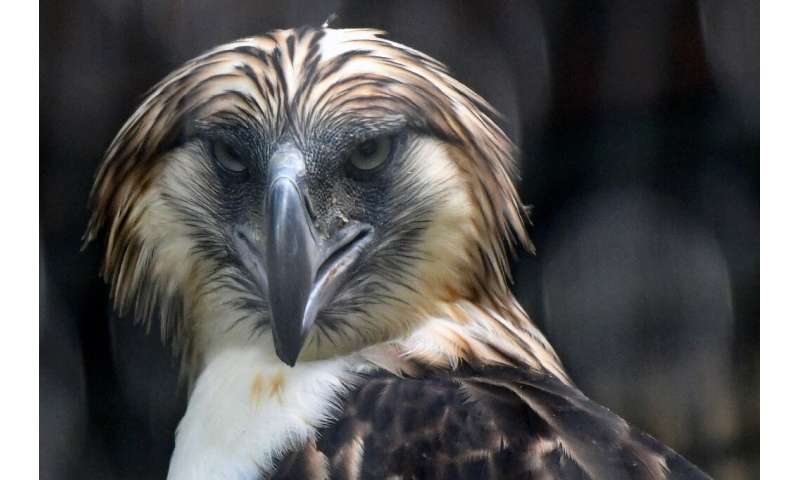
The eagles have landed: Singapore shows off rare Philippine raptors

NOVEMBER 27, 2019


A male Philippine eagle named Geothermica is one of a pair being cared for in Singapore, part of a breeding programme to reverse the dwindling numbers of the feathered giants

Singapore showed off two critically-endangered eagles Wednesday that were loaned from the Philippines as part of a breeding programme to reverse the dwindling numbers of the feathered giants.

Destruction of tropical rainforest and relentless hunting have decimated the population of the Philippine Eagle—one of the world's biggest and most powerful birds whose wingspan can reach 2 metres (7 feet)—with only around 800 believed left in the wild, conservationists say.

The birds, Geothermica and Sambisig, are the first breeding pair ever to be sent outside the Philippines and arrived in Singapore in June on a 10-year loan from Manila.

The creatures are being cared for at the city-state's main aviary and were shown to the media Wednesday, as part of events marking 50 years of diplomatic relations between the countries.

"Any future offspring of the eagles will be returned to the Philippines to contribute to the sustainability of the species' population," said Wildlife Reserves Singapore, which runs the aviary.

The scheme has echoes of China's "panda diplomacy", which sees the Asian giant send the black and white bears to countries as gifts.

Wednesday, 5 June 2019

Singapore’s Jurong Bird Park to house Philippine Eagle pair


by Marje Pelayo   |   Posted on Monday, May 20th, 2019
MANILA, Philippines – The Department of Environment and Natural Resources (DENR) signed on Monday (May 20) a memorandum of agreement with the Wildlife Reserves Singapore (WRS) for the loan of a pair of Philippine eagles.
The eagle pair, named “Geothermica” and “Sambisig”, will stay in Singapore’s Jurong Bird Park in the next 10 years for conservation and breeding of this critically-endangered bird species whose population at present counts to only less than 400 pairs.
According to Environment Secretary Roy Cimatu, the eagle pair will serve as ambassadors for Philippine biodiversity.
“Sending Geothermica and Sambisig to Singapore acts as a biosecurity measure to ensure the survival of the species and as a fallback population in the event of catastrophic events like disease outbreaks or extreme natural calamities taking place in their Philippine habitats,” Cimatu said.
Jurong Bird Park is the largest bird park in Asia.
It houses close to 3,500 birds across 400 species, of which 20 percent is threatened.
The signing of the loan agreement was witnessed by Singapore Ambassador to the Philippines Gerard Ho Wei Hong and Philippine Ambassador to Singapore Joseph del Mar Yap. – Marje Pelayo


Thursday, 7 February 2019

Santa Cruz Ground Doves born in captivity for first time


27/01/2019
Four Santa Cruz Ground Doves have been born in captivity for the first time. The birds – native to the southern Solomon Islands and Vanuatu – hatched at Jurong Bird Park, Singapore, on 31 December. As a result, the park became the first zoological institution in the world to successfully breed this Endangered species.
In August last year, 60 Santa Cruz Ground Doves – thought to be around half the world's entire population – were rescued from poachers in the Solomon Islands. In a terribly unfortunate sequence of events, a volcanic eruption then destroyed about three-quarters of what's generally considered their sole natural habitat on the island of Tinakula.
It's thought the 60 rescued birds, all based at Jurong, are the only assurance colony in the world, with the long-term plan being to repopulate Tinakula. Little historic data in Santa Cruz Ground Dove is available, and Wildlife Reserves Singapore (WRS) commented: "All the information that can be collected from the birds under human care is extremely valuable and may help better understand the species and its needs in the wild."
Jurong Bird Park enjoyed similar success with the Critically Endangered Straw-headed Bulbul. In the past two years, the park has bred four of these birds, with the newest chick arriving in July last year. The first chick hatched in 2017, marking the first time in more than a decade that these songbirds were bred under human care.


Wednesday, 7 November 2018

Great news for Singapore shorebirds: new protected area announced


29 Oct 2018

This month, wetlands containing one of Singapore’s last remaining mangroves have secured protection after years of concerted advocacy. This move will benefit globally threatened birds such as the Chinese Egret and Straw-headed Bulbul.

By Shannon Anstee

Often, when we think of Singapore, we think of urban sprawl with sky-high buildings standing tall in a concrete jungle. However, what we often forget to recognise is how important this city is for migratory birds in the East Asian-Australasian Flyway. Migratory birds can travel from as far North as the Arctic Circle to as far South as Australia and New Zealand. Along the way, these birds rely on stopover sites in China, Vietnam and Singapore in order to rest and feed. These sites are becoming increasingly scarce amidst development and increasing population pressures. As a result, the protection of these natural environments are vital for securing the future and wellbeing of migratory birds.

The Nature Society (Singapore) (NSS - BirdLife Partner) recognises the importance of coastal mudflats within Singapore and has been advocating for their conservation for over three decades. Since the 1980s, they have been regularly monitoring biodiversity and birds in the Kranji - Mandai wetlands and mangroves. They have been working with local conservation groups and researchers at the National University of Singapore to push for its inclusion as a nationally protected area, and recognition as an Important Bird and Biodiversity Area (IBA).

This month, through the hard work and advocacy of NSS and other stakeholders, the Singapore government has announced their intention to gazette an area of over 70 hectares of coastal mudflats and mangroves in the Kranji- Mandai IBA as a new protected area. The announcement was made at the World Migratory Bird Day activities at the Sungei Buloh Wetland Reserve in October 2018. "Although belated, the conservation of Mandai Mangrove and Mudflat is highly laudable on the part of the Singapore government, in consonant with the positive move for nature conservation through the last three decades from Buloh to Ubin to Kranji Marshes - and now Mandai.", expressed Dr. Hua Chew Ho, vice president of the Nature Society (Singapore).

Sunday, 12 August 2018

Rare Shoebill birds return to Jurong Bird Park


SINGAPORE: Good news for bird lovers in Singapore - the Jurong Bird Park has acquired a pair of rare Shoebill birds for the park's Wetlands exhibit.

The birds' arrival will make the Jurong Bird Park the only zoological institution in Southeast Asia where visitors will be able to view the species, Wildlife Reserves Singapore (WRS) - which runs the park - said in a press release on Thursday (Jul 12).

Flown over from Qatar in June, the 11-year-old male and 17-year-old female will join other critically endangered wetland birds in the park.


Thursday, 12 July 2018

Albino kingfisher chick draws birding community to East Coast Park


PUBLISHED
JUL 3, 2018, 10:07 PM SGT

SINGAPORE - A rare albino kingfisher chick is shooting to mini-stardom among the birding community here, after it was spotted last Wednesday (June 27) by wildlife observers at East Coast Park.

While white-collared kingfishers are common in Singapore, the sighting of an albino one was the first for many watchers, said observers.

The bird first flew into the public eye on Facebook pages such as the Nature Society (Singapore) group, and has made regular appearances online since.


Sunday, 27 May 2018

Buzz over sighting of 'extinct' woodpecker at Bukit Timah Nature Reserve


PUBLISHED
MAY 9, 2018, 5:00 AM SGT

Birdwatchers hail reappearance of species here after it was spotted in nature reserve
Environment Correspondent

The great slaty woodpecker is not the most attractive of birds, with its bald head and grey cloak of feathers.

But a rare sighting near the summit of Bukit Timah Nature Reserve last week has got the birding community in Singapore buzzing with excitement.

The reappearance of the woodpecker, thought to be extinct in Singapore due to forest clearance during the Republic's developing years, has been described by veteran birdwatcher Alan OwYong as the greatest ornithological event in Singapore in the last decade.

"Since 1950, the great slaty woodpecker, the largest woodpecker in the world, has disappeared from our forests along with seven other woodpecker species," Mr OwYong, committee member of the Nature Society's (Singapore) Bird Group, told The Straits Times.

"Its reappearance a few days ago was most unexpected, as it is the rarest among the eight species."

Wednesday, 2 May 2018

Deaf 'bird whisperer' forms rare bond with feathered friends


April 24, 2018

'Bird whisperer' Razali Bin Mohamad Habidin checks a salmon-crested cockatoo at Jurong Bird Park in Singapore, where he is deputy head avian keeper

Deaf since childhood, Razali Bin Mohamad Habidin has developed a closer bond with the creatures under his care than any other keeper at Singapore's Jurong Bird Park, where other staff refer to him simply as the "bird whisperer".

Razali, who lost 80 percent of his hearing after falling ill as a baby, started working at the park over two decades ago, and has risen to the position of deputy head avian keeper.

He communicates with the birds through grunts, gestures and body languages and told AFP that he recognises the birds by their "behaviours and personalities".

"All of them are my friends," he added, communicating through a mix of gestures and Malay.

Other staff at the park have dubbed the 48-year-old "the bird whisperer"—after Hollywood film "The Horse Whisperer", starring Robert Redford as a trainer with a gift for understanding horses.

"He has a way of communicating with the birds that very few of us can," said assistant curator Angelin Lim. "Just by a look, he knows whether or not the bird is well."

Communication with his colleagues can be more challenging than with the birds.

Razali leads about a dozen staff and giving them instructions usually involves him making various complex hand gestures, and then reading the lips of his colleagues when they respond.


Friday, 19 January 2018

Hello Maru! Baby penguin takes first public waddle in Jurong Bird Park


The baby king penguin is the first of its kind to be hatched at the bird park in close to a decade.

13 Dec 2017 07:47PM (Updated: 14 Dec 2017 05:54PM)

SINGAPORE: A baby king penguin waddled into view in Singapore's bird park on Wednesday (Dec 13), the first of its kind to be hatched there in close to a decade.

Maru, which means "round" in Japanese, came from parents Zoro and Sora, part of the king penguin colony in the Jurong Bird Park's penguin exhibit, said Wildlife Reserves Singapore in a press release on Wednesday.

To maximise survival chances, keepers retrieved the egg and incubated it until it hatched on Oct 10.


Sunday, 12 November 2017

Jurong Bird Park to become proud hosts of rarest blue macaws


November 4, 2017 18:44 SGT
  
Singapore's Jurong Bird Park is now becoming the home of two of the world's rarest macaw species. The new arrivals -- the Spix's Macaw and the Lear's Macaw, will join the flight of Hyacinth Macaws in the zoological park.

The bird sanctuary in Singapore is going to be the world's only zoological park that can boast of being a home for all three species of blue macaw. The other blue macaw species, the Glaucous Macaw, was last seen in the 1960s and is believed to be extinct.

The conservation state of the other blue macaws is also dire, as the International Union for Conservation of Nature (IUCN) categorises all three bird species as worthy of conservation. The Hyacinth Macaw currently falls under theVulnerable category. The Spix's Macaw, which was last spotted in the wild in 2005, is listed as Critically Endangered, with about 150 still surviving globally.  The Lear's Macaw is also an Endangered species which has about 1,300 individuals in the wild.


Thursday, 6 April 2017

Rare species of birds and butterflies flourishing in heartland and urban parks

Mar 25, 2017, 2:41 pm SGT

Melody Zaccheus
Copsychus malabaricus - Khao Yai.jpg
white-rumped sharma (f) Source:Wikipedia
SINGAPORE - Your neighbourhood park could be home to rare species of birds, such as the blue-crowned hanging parrot, spotted wood owl and the endangered white-rumped shama.

Of the 152 bird species spotted by NParks' "citizen scientists" during three garden bird watching sessions over the past two years, 110 of them were found in urban green pockets, such as Yishun Park, Punggol Park and Choa Chu Kang Park.

These findings from NParks' Community in Nature Biodiversity Watch programmes, which were first launched in April 2015, were shared by Senior Minister of State for Home Affairs and National Development Desmond Lee on Saturday morning at an event at Kent Ridge Park (March 25).

The programme has grown from 400 volunteers to 1,000. So far, three garden bird watching sessions, two butterfly watches and three BioBlitzes have been carried out.

BioBlitzes involve participants spending either 12 or 24 hours documenting biodiversity in an area.

Continued


Monday, 20 March 2017

New study of Singapore’s bird markets highlights dangers of overharvesting as critical bird trade Summit gets underway


A new TRAFFIC report has documented over 14,000 birds for sale in shops in Singapore over four days, 70% of them species non-native or formerly native to the country—a stark departure from patterns observed in other bird markets in the region.

Of the 14,085 birds of 109 species found in the market, some 6,473 (46%) were Oriental White-eyes Zosterops palpebrosus—a species once native to Singapore that was eradicated largely through trapping for the bird trade. 

“The presence of thousands of Oriental White-eyes in Singapore’s bird markets is a poignant reminder of the dangers of persistent over harvesting and poorly managed trade,” said Kanitha Krishnasamy, Senior Programme Manager for TRAFFIC in Southeast Asia and a co-author of the new study Songsters of Singapore: An Overview of the Bird Species in Singapore Pet Shops
(PDF, 2.1 MB). 

The study was released as experts from around the world gather to focus on developing and implementing a plan of action to avert the crisis facing Asia’s songbirds during the second Asian Songbird Trade Crisis Summit, which takes place from 19-21 February 2017 at the Jurong Bird Park in Singapore.

During the first Summit held in 2015, the Oriental White-eye was among the species listed as of immediate concern from bird trapping in Asia along with the second most commonly observed species in Singapore’s markets—Red-whiskered Bulbul Pycnonotus jocosus, of which some 2,811 individuals were recorded.

“Singapore lost its Oriental White-eyes largely through excessive trapping, which should have hoisted a red flag warning that the ongoing trade will impose the same fate on this and other species elsewhere until there are no more left,” said Krishnasamy.

Previous TRAFFIC surveys of bird markets in
Jakarta, Malang, Surabaya and Yogyakarta in Indonesia as well as Bangkok in Thailand, found that trade in those countries was dominated by species native to the country or elsewhere in Southeast Asia. 

Friday, 3 March 2017

Numbers of endangered bulbuls show slight rebound on Pulau Ubin


Neo Chai Chin


Published: 9:50 PM, February 23, 2017

SINGAPORE — While their counterparts in the region have been hunted relentlessly for the caged-bird trade, at least 202 Straw-headed bulbuls have found a safe home in Singapore and have grown in numbers on Pulau Ubin.

The population of the endangered songbird species on the island grew at nearly 4 per cent per year over the past 15 years to at least 110, while numbers on the mainland have held steady.

These findings by six Singaporean birdwatchers were published recently in the journal Bird Conservation International.

The bird’s conservation status was raised last December from “vulnerable” to “endangered” on the International Union for Conservation of Nature (IUCN) Red List, which classifies species at high risk of global extinction.

With the global population of the bird estimated at 600 to 1,700 individuals, the group in Singapore may easily comprise up to one-third of the world’s remaining wild Straw-headed bulbuls.

continued

Monday, 9 January 2017

Two year study to track migratory birds

PublishedJan 8, 2017, 8:27 pm SGT
UpdatedJan 8, 2017, 9:34 pm

Samantha Boh

The travel times, stopovers and breeding patterns of Singapore's avian tourists are being placed under scrutiny here, as the National Parks Board launches a two-year satellite tracking project of migratory birds which travel to Singapore during the winter months.

The data will play a critical role in the survival of various species which use the Republic as a stopover point to feed up and rest before continuing their arduous journey as far north as the arctic circle.

"Before we started using tracking technology, we did not know where the birds go and could not collaborate with other countries on conservation efforts," explained Mr David Li, senior conservation officer at NParks.

"With these studies we know which countries they go to for major stopovers for instance, and sharing such information with those countries will help in setting up bird conservation projects there," he added, speaking on the sidelines of the first Arctic migratory birds workshop held in Sungei Buloh Wetland Reserve on Sunday (Jan 8).

The shorebirds being tracked include Whimbrels, Bar-tailed Godwits, Common Greenshanks and Grey Plovers. With the new satellite trackers, researchers will be able to tell exactly where they are in real time, without the need to capture them again to find out.

The devices weigh either 5g or 9.5g and are solar-powered. The study is likely to start in March.

Continued

Sunday, 25 December 2016

Straw-headed bulbuls find a safe haven in Singapore


Dec 10, 2016, 5:00 am SGT
Plunge in numbers worldwide but songbird now classified as endangered thrives here


Singapore is one of the remaining havens for a rare songbird now classified as endangered worldwide, according to wildlife experts.

There are only an estimated 600 to 1,700 straw-headed bulbuls left in the wild. Singapore is thought to have at least 200 - and counting.

The bird's conservation status was raised from "vulnerable" to "endangered" on the latest edition of the International Union for Conservation of Nature (IUCN) Red List, released on Thursday.

Illegal wildlife trade has caused several species to move up to higher threat categories.

"There is now evidence that unsustainable levels of capture for the cagebird trade, largely centred on Java, are driving the deteriorating status of many species," said IUCN .

But in Singapore, the straw-headed bulbul seems to be doing better.

Creatures under threat in Singapore
Singapore is home to over 200 species of animals considered globally threatened, according to the International Union for Conservation of Nature (IUCN) Red List.

Source