As regular CFZ-watchers will know, for some time Corinna has been doing a column for Animals & Men and a regular segment on On The Track... particularly about out-of-place birds and rare vagrants. There seem to be more and more bird stories from all over the world hitting the news these days so, to make room for them all - and to give them all equal and worthy coverage - she has set up this new blog to cover all things feathery and Fortean.
Showing posts with label black-capped chickadee. Show all posts

Wednesday, 14 August 2019

Scent brings all the songbirds to the yard

AUGUST 12, 2019


"The sense of smell has been very understudied in birds, particularly songbirds, because they frequently have such impressive plumage and song variation," says Amber Rice, an evolutionary biologist at Lehigh University. "Some other recent work has documented that species of songbird can smell and prefer their species' odors, but this is the first example in currently hybridizing species that we know of." Credit: Lehigh University

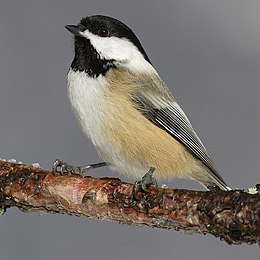
Chickadees can smell! That is the news from a study out of Lehigh University, the first to document naturally hybridizing songbirds' preference for the scent of their own species.

Amber Rice, an evolutionary biologist at Lehigh, studies natural hybridization-when separate species come into contact and mate-to better understand how species originate and how existing species are maintained. The two species that make up the hybridized population she studies are the black-capped chickadee and its relative the Carolina chickadee.

Rice and Ph.D. student, Alex Van Huynh, set out to test the potential for scent to act as a mate choice cue, contributing to reproductive isolation between the black-capped and Carolina chickadees who live in the "hybrid zone" in the eastern Pennsylvania region where Lehigh is located.

Huynh and Rice found that both black-capped and Carolina chickadees produce chemically distinct natural oils. Testing both males and females of both chickadee species, they found that males and females prefer the smell of their own species over the smell of the opposite species. These preferences could be impacting hybridization. Their results have been published in an article entitled: "Conspecific olfactory preferences and interspecific divergence in odor cues in a chickadee hybrid zone" in Ecology and Evolution.

Thursday, 18 July 2019

Sounds of intense emotion may be universal language across species, study shows


JULY 11, 2019

by Katie Willis, University of Alberta
People can tell how other people are feeling by the sounds they make and now, new research from the University of Alberta shows that may also apply to different animals.

"The idea is that some species (those that are vocal learners) can understand other species' vocalizations," explained psychology Ph.D. student Jenna Congdon, who led a new study that showed both humans and black-capped chickadees can detect intense emotions such as fear or excitement in other species.

"For instance, a songbird is able to understand the call of distress of a different type of songbird when they are in the presence of a predator, like an owl or a hawk. Or, for example, if your friend scared you and you screamed. Both of these are high-arousal vocalizations, and being able to understand what that sounds like in a different species can be very useful."


Monday, 12 May 2014

Black-Capped Chickadee voted Vancouver’s official bird

By Christine Tam Global News


The Black-Capped Chickadee has been named Vancouver’s official bird for 2015, beating out the flock of competitors by a landslide.
The winning bird rose to feathered fame during the city’s weeks-long competition that invited Vancouverites to vote online.

More than 700,000 votes poured in for the bird competition, which ended with a grand announcement at the Vancouver Public Library Saturday night to cap off Bird Week.

The Black-Capped Chickadee captured 39 per cent of the votes, beating out the Varied Thrush, who had 29 per cent.