As regular CFZ-watchers will know, for some time Corinna has been doing a column for Animals & Men and a regular segment on On The Track... particularly about out-of-place birds and rare vagrants. There seem to be more and more bird stories from all over the world hitting the news these days so, to make room for them all - and to give them all equal and worthy coverage - she has set up this new blog to cover all things feathery and Fortean.
Showing posts with label Maine. Show all posts

Thursday, 28 March 2019

Rare hawk that succumbed to Maine winter will go on display at state museum

State raptor biologists said it will help tell the story of ‘migrant’ birds.
BY DEIRDRE FLEMINGSTAFF WRITER

The great black hawk that was euthanized after it took up residence in Deering Oaks park and sustained frostbite during a storm in January will be mounted and displayed at the Maine State Museum.
Maine state raptor biologist Erynn Call said the Maine Department of Inland Fisheries and Wildlife made the decision to display the large hawk, which is native to Central and South America. She said the hawk’s plight tells the story of how birds – called vagrants by ornithologists – can fly off course and end up far from their usual habitats.
“IFW did make the decision on the great black hawk, and it will be at the Maine State Museum,” Call said. “I wouldn’t call it a non-native, I’d call it a migrant. To our knowledge, it did come here by the natural process of migration. This happens to other species of birds as well.”
It was only the second time a great black hawk was seen in the United States, Maine Audubon said.

Continued

Wednesday, 30 January 2019

Rare great black hawk rescued after suffering frostbite in Maine


By John Hilliard GLOBE CORRESPONDENT  JANUARY 21, 2019
A rare great black hawk that has become a celebrity for bird enthusiasts in Maine was rescued by visitors at a Portland park after they found the animal on the ground and suffering from frostbite Sunday morning, according to a local bird rehabilitation center.
The hawk, which is native to Central and South America, was expected to be examined by a veterinarian on Monday, according to a Facebook post by Avian Haven, a Freedom, Maine-based organization that cares for injured and orphaned birds.
“The bird’s obvious difficulty was frostbitten feet. After some emergency care for that condition as well as general debilitation, the hawk was settled into an ICU for the night. This morning, he was alert and standing,” Avian Haven said in the post.
UPDATE:  Rare raptor’s health improving after being rescued during snowstorm
January 22, 2019
By DEIRDRE FLEMING
Portland Press Herald
PORTLAND — A great black hawk that was found on the ground in Portland during Sunday’s snowstorm and brought to a midcoast wildlife rehabilitation center was standing and looking alert Monday morning, Avian Haven reported.
The rare raptor was residing in Deering Oaks Park the past few weeks and was found by passersby who said it was unable to stand and who contacted Avian Haven in Freedom, which specializes in the rehabilitation of wild birds.
Before this year, a great black hawk – a raptor native to Central and South American – had never been seen in Maine and was extremely rare in the United States.
A great black hawk believed to be the same bird found Sunday first appeared in Maine on Aug. 9, only the second time the bird had ever been seen in the U.S., according to Maine Audubon Naturalist Doug Hitchcox.
Avian Haven co-owner Diane Winn said the injured hawk that was found in the snow in Deering Oaks Park appeared to have frostbite on its feet, although frostbite can “take a while to declare itself.”

Wednesday, 22 August 2018

Hundreds see great black hawk in Maine; only second time bird spotted in US


By Andres Picon GLOBE CORRESPONDENT  AUGUST 10, 2018

Hundreds of bird enthusiasts flocked to Biddeford, Maine, this week to get a glimpse of a hawk that has only been seen in the United States once before.

“There’s really no precedent for one to show up all the way up here,” said Doug Hitchcox, the staff naturalist at the Maine Audubon.

The great black hawk was first spotted on Monday by a woman who was vacationing in the area. She took a photo of the bird, not knowing much about it, and posted it on Instagram. By the middle of the week, photos of the bird had made it to the “What’s This Bird” and “ABA Rare Bird Alert” Facebook pages, much to the delight of birders across the country, who confirmed that it was indeed a rare great black hawk, said Hitchcox.

The great black hawk is native to Central and South America, with the heart of its geographic range in Brazil, so the fact that one was seen in Maine is astonishing, Hitchcox said.

Over the course of the week, birders from across the country migrated to Fortune Rocks Beach in Biddeford and the surrounding area to try to see the bird, causing traffic jams and parking spot shortages. There were birders from all over New England, as well as some from New York who got a speeding ticket as they rushed to see the hawk, and at least two from Arizona, Hitchcox said.

The only other time one of these birds was seen in the United States was in April, on South Padre Island off the coast of Texas, and “birders went nuts,” Hitchcox said.

The relatively recent sighting in Texas, combined with photos of the two birds’ underwings, are enough to make many birders, including Hitchcox, believe that the two birds are actually one and the same. The unique patterns that have manifested themselves on the bird’s feathers are identical in the photos, Hitchcox said.

The patterns “are like a fingerprint for the bird,” Hitchcox said. “That makes it even more exciting.”

Great black hawks have black body feathers, a white tail with one or two black bands, yellow legs, and a yellow cere above the beak.

The area the bird roamed before it was seen flying out to sea Thursday afternoon is near several ponds — perfect for the coastal bird.

“It’s kind of the perfect spot for it to be, besides being in the wrong hemisphere,” Hitchcox said.
The bird was probably born last summer. It has not been given a name, partly because the sex is unknown, and partly because “when there’s only one of them, it doesn’t need a name,” Hitchcox said.

The great black hawk, a raptor, hunts for its food. It feeds on reptiles, other small vertebrates, and large insects. Several people saw it flying around, raiding the nests of American robins and American goldfinches throughout the week, snatching chicks to be devoured, Hitchcox said.

The only other bird that compares to the great black hawk, in terms of the rarity of its sightings in Maine, is a variegated flycatcher, a South American bird, that was seen in 1977 a couple of miles north of where the great black hawk was seen. It was the first time such a bird was seen in the United States. Only a couple of birders have been able to see both birds, Hitchcox said.

Because the great black hawk sighting is so isolated, its presence in Maine does not appear to be part of a new trend or a change in the bird’s normal geographic range. If anything, it simply reinforces a pattern of vagrancy among birds, Hitchcox said.


Thursday, 28 June 2018

Maine farm under fire after nesting fields for declining bird species gets mowed over


Abigail Curtis
This time of year, two familiar sounds seem to signal the arrival of summer.
One is the reassuring thrum of a tractor’s engine as farmers mow their sweet-smelling hayfields. The other is the bubbling, lyrical song of the bobolink, a small grassland bird with a shrinking population that is known for its cheerful plumage and captivating voice.
But put them too close together, and the bobolink and the tractor sound more like disaster. Just ask scores of ardent bird lovers who have registered their dismay that a farmer last weekend mowed large open fields at the Hart Farm in Holden, a historical dairy farm that was purchased last year by the Holden Land Trust.
Bobolinks are known to nest there, and a few of the birders had asked land trust officials if the mowing could be delayed so that the chicks would have a better chance of survival. But the farmer leasing the land needed to make sure that the hay he cut had sufficient nutrients to feed his herd of dairy cows and couldn’t wait, according to Betty Jamison, a board member of the land trust.
“We did not go out to kill off the bobolinks — it’s just a hard balance,” she said this week. “The farmer knew the bobolinks were an issue, but there’s not much you can do about it. These have been hayed fields for years. There are other wildlife that can be damaged in mowing a field. It’s a balancing act between trying to keep habitats and to preserve farming in this area.”


Monday, 25 December 2017

Beaked baby boomers: Record year for puffin chicks in Maine


By: PATRICK WHITTLE, Associated Press
Updated: Nov 27, 2017 - 4:02 PM

PORTLAND, Maine (AP) - Puffins face existential challenges, but the little birds found a new role in Maine this summer: baby boomers.

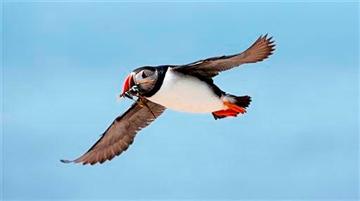
The 2017 nesting season was the most productive on record for a group of vulnerable Maine puffins, scientists with the Audubon Society said. The Atlantic puffins are small seabirds with an awkward walk and colorful beaks that are popular with eco-tourists.

The birds are at the southern edge of their breeding range in Maine, and the Eastern Egg Rock colony in Muscongus Bay is the subject of much study. Audubon reported that the colony increased from 150 to 172 pairs during this year's nesting season.

That is the highest single-year increase since puffins recolonized the little island in 1981, said Steve Kress, a biologist and vice president for bird conservation with Audubon.

"It was an excellent year," Kress said. "There's a reason to be happy, and a reason to be concerned because there still is a long-term trend toward warming waters."

Friday, 4 August 2017

Maine lobstermen rescue swimming bald eagle that is on the verge of drowning


USA TODAY NETWORKCydney Henderson, The Arizona RepublicPublished 6:29 p.m. ET Aug. 1, 2017 | Updated 6:29 p.m. ET Aug. 1, 2017

PHOENIX — Lobstermen have many strange encounters during their time at sea.

This memorable account in Maine, however, is one for the books.

Lobsterman John Chipman and his sternman Kevin Meaney lent a helping hand to one of the country’s most cherished animals — a bald eagle.

The national bird of the United States symbolizes unlimited freedom, but a wildlife biologist who serves as Maine’s bird group leader says this particular eagle was on the brink of drowning.

“I knew it wasn’t going to make it,” said Chipman. “The way he was acting, I knew he wanted help.”


Monday, 15 September 2014

Puffins: A small bird defies big odds

Human intervention, not nature, will ensure the puffin’s survival


By Derrick Z. Jackson | AUGUST 24, 2014

AFTER DECADES of successful efforts to restore its numbers, the Atlantic puffin remains a canary requiring more human care than ever. The last three years on the signature island of the National Audubon Society’s Project Puffin, Maine’s Eastern Egg Rock, have provided both a sobering and exhilarating illustration of that reality.

The project, which began in 1973 to rebuild a population all but wiped out by humans in the 1880s, reached a record number of 123 nesting pairs in both 2010 and 2011.

But the bird was brutally battered during the past two winters across the entire North Atlantic, with thousands of bodies washing upon European and American shores. Many of the dead birds showed signs of starvation. Scientists speculated puffins could not find traditional foods such as herring, either because of human overfishing or the fish moving away from waters being warmed by climate change. Puffins on Eastern Egg and other islands in Maine have, in recent years, caught more southerly fish that are unsuitable for chicks to eat, such as butterfish. The 2012 death of a chick nicknamed Petey, which could not eat butterfish, was captured on a web cam on another Project Puffin breeding ground, Seal Island.

Thursday, 21 August 2014

Groundbreaking bird study under way in southern Maine

By Jim Kanak
news@seacoastonline.com
August 20, 2014 12:29 PM

WELLS, Maine — The U.S. Fish and Wildlife Service is participating in a groundbreaking study of shorebird migration patterns, using cutting-edge technology to track the birds and record their data.

The technology includes lightweight radio transmitters, known as nano tags attached to shorebirds. The tags transmit signals picked up by a network of radio towers that span the Northeast coast of the United States and into Canada. Two of the towers are in the Rachel Carson Wildlife Refuge in Wells.

Kate O’Brien, a USFWS wildlife biologist, is leading the project in Wells. She said the technology is what makes this project different.

“Less than 5 percent of (traditionally) banded birds are ever (re)caught,” O’Brien said. “That’s why nano tagging is good. In terms of cost, they’re not that expensive. The science is moving so quickly. It’s fascinating what people can learn about birds.”

Tuesday, 12 August 2014

Scientists ask bird oglers to help study puffins


SPosted: Aug 06, 2014 6:24 AM GDTUpdated: Aug 07, 2014 7:26 PM GDT

By PATRICK WHITTLE and ROBERT BUKATY
Associated Press

EASTERN EGG ROCK, Maine (AP) - Wanted: puffinologists. No experience necessary.

The Audubon Society wants bird lovers to contribute research to a project scientists hope will help save Atlantic puffins from starvation in Maine.

There are about 1,000 pairs of the seabirds, known for their multi-colored beaks and clownish appearance, in Maine. Audubon says the number of puffin fledging chicks has declined in the last two years, possibly because their key food source, herring and hake, are leaving for cooler waters. Puffins are on the state's threatened species list.

Audubon maintains three web cameras on Seal Island, a National Wildlife Refuge in outer Penobscot Bay, 22 miles off Rockland and one of the key puffin habitats in Maine. Volunteers are being asked to watch the puffins feed and answer questions about their feeding behavior, said Steve Kress, director of the National Audubon Society's seabird restoration program.

From 2007-2011, Kress said that 77 percent of puffin pairs on Seal Island produced fledglings, or birds that are able to fly. The number declined to 31 percent in 2012 and 10 percent in 2013 and while 2014 "appears to be better," he said, it's too early to tell.

"This is a citizen science project, hoping to advance the science as well as entertain the viewers," Kress said. "There are some questions that can be better answered through lots of people viewing."

Saturday, 2 August 2014

Maine might add 2 birds to its endangered list

By PATRICK WHITTLE, Associated Press
Updated 6:28 pm, Friday, August 1, 2014

PORTLAND, Maine (AP) — Maine environmental officials are proposing to add two bird species to the state's list of endangered animals.

The species, the black-crowned night heron and great cormorant, could be upgraded from threatened to endangered, State Department of Inland Fisheries & Wildlife spokesman Mark Latti said. The change is subject to public hearings and approval by the state Legislature.

The cormorants' population has declined to about 50 pairs in the state, down from about 250 pairs in the late 1990s, said Brad Allen, a state wildlife biologist. The herons have dwindled to about 200 pairs in the state, down from about 400 pairs in the state 1980s, he said.


Friday, 30 May 2014

Nevermore: Police want to track down car-attacking raven in Maine town

Wed, 28 May 2014 11:40:00 CST

RICHMOND, Maine - Wanted: A raven that's attacking cars in Maine.

Richmond Police Chief Scott MacMaster tells the Kennebec Journal (http://bit.ly/1reiVHm) that the bird has attacked three vehicles, causing $500 in damage in one case.

One owner said he watched the bird land and see its reflection in a window before attacking. The bird damaged gaskets around windshield and windows and the windshield wipers on at least three cars.

One of the victims wants to make to make sure raven attacks are "nevermore." He wants to shoot the bird.

MacMaster advised them to contact the Maine Warden Service.

The raven is not the only animal to attack a car in town in recent weeks. Last month, police had to deal with two goats that climbed atop a car.

___

Information from: Kennebec Journal, http://www.kjonline.com/

Saturday, 24 August 2013

On A Rocky Maine Island, Puffins Are Making A Tenuous Comeback

Rocky, windswept Eastern Egg Rock, about 6 miles off the coast of Maine, was once a haven for a hugely diverse bird population. But in the 1800s, fishermen decimated the birds' ranks — for food and for feathers.

When ornithologist Stephen Kress first visited 40 years ago, the 7-acre island was nearly barren, with only grass and gulls left. Not a puffin in sight. Not even an old puffin bone.

"But it had great habitat because there were great boulders on the island, and I could imagine the puffins standing on top of them," Kress says.

No imagination is needed now. Thanks to a relocation experiment pioneered by Kress and his co-workers in the Audubon Society's Project Puffin, this treeless little island is now kind of a bird tornado.

In peak years, more than 200 of the orange-and black-beaked puffins nest here. Ten other bird species — including the endangered roseate tern — have been tempted into the island habitat, with an assist from handmade burrows, decoys and recorded bird calls. In nesting season, humans are posted to wave off predators such as black-backed gulls and eagles.

Kress heads to a bird blind out on the perimeter of the island. He's surrounded by a whirl of laughing gulls and terns — they're mostly what's heard here since puffins are silent above ground.

Tuesday, 11 June 2013

The street that banned feeding birds: Neighbors at war over radical step to control plague of pigeons


  • Drew Lane in Bangor has had an ever-growing population of pigeons for the past eight years
  • Pigeons arrived in droves after one resident began feeding them
  • The pigeon feeder was asked by neighbors to stop but refused
  • The ban will incur a $50 fine for the first offense, $100 for the second and $200 thereafter

PUBLISHED: 15:07, 3 June 2013 | UPDATED: 16:33, 3 June 2013

After 'angry exchanges' and years of neighborhood clashes over the issue authorities have now stepped in - warning the feeders that they face fines of up to $200. 


Resident Steve Coleman, who is legally blind, is in the anti-bird camp. 

'My deck gets nailed all the time,' Coleman told Bangor Daily News. 

Others claim they have to clean their vehicles every day as piles of corrosive pigeon poop build up, damaging the paintwork.

John Bruneel says verbal exchanges over the issue have taken place over the years leading to authorities need to weigh in. 

They say one particular unnamed man is responsible. 

Neighbors say he dumps piles of birdseed on his driveway every morning, leaving the atmosphere filled with floating feathers and houses, cars and driveways caked in pigeon droppings

Hunger games: The ban in Bangor won't prevent people having bird feeders in their backyards or from throwing bread to ducks in the park, but it will stop feeding practices that cause wildlife to become a nuisance

Drew Lane residents had ended up with a situation reminiscent to Hitchcock's 'The Birds', and felt there was little choice but to take the matter to the City Council.


Monday, 25 March 2013

Group Signals Intent to Sue Over Beleaguered Bird


03/19/2013 1:08 PM ET 


The Center for Biological Diversity says federal officials failed to make a timely decision on its 2010 petition to protect the Bicknell's thrush, whose range extends to Maine. 

A conservation group says it intends to sue the U.S. Fish and Wildlife Service for failing to act on endangered species protections for a bird whose breeding grounds extend to Maine.

The Center for Biological Diversity, based in Vermont, filed notice of intent to sue the federal agency, saying it failed to make a timely decision on the center's 2010 petition to protect the Bicknell's thrush.

The bird breeds in only one place: the high mountains of eastern Canada and the Northeast U.S., including Maine, New Hampshire, Vermont and New York. 

Scientists at the center say 98 percent, or more, of the bird's U.S. habitat is in danger of disappearing because of climate change. The group says in some areas, Bicknell's thrush populations have already declined by as much as 19 percent.

The conservation group says the U.S. Fish and Wildlife Service is required to produce a final decision on such petitions within a year, and it's now more than a year overdue. 

Today's notice gives the center 60 days to file a lawsuit, though an agreement could be reached in the meantime. 

Friday, 9 November 2012

The Puffin Charmer


By thinking like a social bird, Stephen Kress brought puffins back to the United States.

First things first: Puffins are adorable. You don’t have to be an animal lover to be charmed by their clownish faces, their waddling walk, and their chubby-dumpling bodies. Their fluffy chicks make even hardened cynics coo. (Really. They’re irresistible.)  

Every summer on the Maine coast, tourists pile into ferry boats to tour the small, rocky islands where Atlantic puffins nest. As they ogle the birds through binoculars, they hear that puffins are not only cute but also tough: Though wobbly on land, puffins can dive down 200 feet underwater, and they swim so expertly that people once believed them to be a cross between a bird and a fish. Adult puffins return to their home islands every summer to breed and carefully tend a single chick, often pairing with the same mate year after year. Never underestimate a puffin.

But Atlantic puffins were once driven to near-extinction in the United States by hunting and egg collecting. The busy colonies off the Maine coast today are the result of a long-running restoration project. It took a tremendous amount of time and effort to turn a heretical idea into the noisy, messy, thriving reality of the Maine puffin colonies—and it takes even more work to keep that reality in place.

In 1969, a young biologist and birding enthusiast named Stephen Kress moved to Maine to teach at the Hog Island Audubon Camp on the coast. He learned that puffins had once been common on the coastal islands but had been hunted relentlessly. By 1901, a single pair was left in the state, and only a few pairs had been seen since. Unlike many people in Maine at the time, Kress had a visceral sense of what had been lost: He had recently worked in eastern Canada, which has some of the largest puffin colonies in the world. He started to wonder if Atlantic puffin chicks could be transplanted from Canada to Maine and used to re-establish the population south of the border.

Monday, 15 October 2012

Osprey carrying a dead bird a rare sight, indeed


A long-time Chester reader had an unusual experience observing osprey while vacationing this summer on Bustin's Island, a small island in Casco Bay, Maine, reached by boat from South Freeport. 

His letter read in part: “The cottage we rent is very close to the water with a wonderful view which includes a large tidal pool. The osprey were very numerous this year and had nests on Bustin's Island and another small island nearby. One day, I looked up and saw an osprey carrying a dead bird. Knowing they feed on fish I was mystified. It landed by the tidal pool, flew across to the other side and sort of picked at the bird. It took off once again and this time dropped the bird that was black and could have been a crow. I walked out to see if I could find it, but it had evidently landed in the water and sank. I talked with others on the island including our 'resident naturalist,' who was as mystified as I was. One thing that might have happened is that it was a crow that might have been near the osprey's nest and, if there were young, was protecting them. Of course we will never really know as it got rid of the evidence.

“Another thing that happened was two poor sparrows were stuck with a baby Cowbird in their nest — an all too common occurrence.”

I believe our Chester reader came to a logical conclusion with respect to the mysterious osprey's catch. In any case, this is the first time I ever heard of an osprey carrying or “pecking” at a dead bird.