As regular CFZ-watchers will know, for some time Corinna has been doing a column for Animals & Men and a regular segment on On The Track... particularly about out-of-place birds and rare vagrants. There seem to be more and more bird stories from all over the world hitting the news these days so, to make room for them all - and to give them all equal and worthy coverage - she has set up this new blog to cover all things feathery and Fortean.
Showing posts with label critically endangered bird species. Show all posts

Friday, 3 April 2020

Whooping cranes form larger flocks as wetlands are lost -- and it may put them at risk


Date: April 2, 2020
Source: Cell Press

Over the past few decades, the critically endangered whooping crane (Grus Americana) has experienced considerable recovery. However, in a report appearing April 2 in the journal Heliyon, researchers found that habitat loss and within-species attraction have led whooping cranes to gather in unusually large groups during migration. While larger groups are a positive sign of species recovery, the authors say that these large groups mean that a disease outbreak or extreme weather event could inadvertently impact a substantial portion of this still fragile population.

"Whooping crane conservation is one of North America's great success stories," says Andrew Caven, Director of Conservation Research at Crane Trust, a non-profit organization dedicated to the protection of critical habitat for whooping cranes and other migratory birds. During the 1940s the whooping crane population fell to 16 birds, largely due to overhunting. However, after concerted conservation efforts, their numbers have increased 30-fold. "We had this species at the brink of extinction, and now there are over 500 birds. As conservation biologists, we've been extremely inspired by that."

Even with this boom in whooping crane numbers, researchers are observing larger migratory flocks than they would expect from population growth alone. Historically, groups of migrating whooping cranes seldom exceeded a family unit. "Twenty years ago, a group of nine was notable; something you'd write in your natural history notes about. But now it's becoming something quite regular. In the recent years we've seen bird groups over seventy multiple times."

Sunday, 29 March 2020

Action plan to save Bolivia’s red-fronted macaw awaits its reboot

by Yvette Sierra Praeli on 24 March 2020 | Translated by Alexandra Skinner

Nature reserves involving the participation of indigenous communities have developed tourism projects for bird-watching and succeeded in curbing the capture of the red-fronted macaw, a critically endangered species that is often caught up in the illegal wildlife trade.

The Bolivian government has been promoting an action plan to conserve the species, which was expected to be approved last year.


Following President Evo Morales’s removal from office and the subsequent change in government late last year, the plan is still awaiting approval.

For 13 years, Marlene Rivas has been part of a team working to protect the red-fronted macaw (Ara rubrogenysa), a bird endemic to Bolivia that is classified as critically endangered on the IUCN Red List.

“Before, we didn’t take care of the birds. We didn’t know they were in danger of extinction. Red-fronted macaws were captured as pets and killed because they damaged crops,” Rivas says about some of the factors pushing the species to the verge of extinction.

Now, she says, residents of the towns of San Carlos, Amaya and Perereta, in Omereque municipality, Cochabamba department, are proud to have the bird in their area. The towns are part of the Red-Fronted Macaw Nature Reserve, one of the areas dedicated to the conservation of this species.

Read on

Friday, 28 February 2020

Growing flowers to save a Critically Endangered hummingbird


Flitting through the mist in Ecuador’s high Andean forests, the Black-breasted Puffleg is running out of habitat. A forest restoration programme offers hope, working with local people to plant the species’ favourite flowers.

When it comes to birdwatching, Ecuador is a lucky country. Although it occupies only 0.2% of the earth's surface, it houses around 130 species of hummingbird – that is, more than 35% of all the world's hummingbirds. Some are found nowhere else on the planet, including the Black-breasted Puffleg Eriocnemis nigrivestis. This Critically Endangered endemic lives 3,200 – 3,400 metres above sea level, amid the cold mist and drizzle of the high Andean forests. Its unique name comes from the white feathers that adorn its legs, similar to the rustic trousers worn by local people. This glossy, iridescent bird is truly miniscule, measuring 9cm at most.

The species is so iconic that in June 2005, it was declared the Emblematic Bird of the Metropolitan District of Quito (the capital city of Ecuador). The founding member of Aves y Conservación (BirdLife in Ecuador), Juan Manuel Carrión, strongly advocated for this recognition during his time as City Councillor. His intention was: “To make the species visible, to attract attention in a symbolic way and for the city to have a natural emblem embodied in a bird; as well as encouraging municipal participation in efforts to preserve it”.

This bird needs all the recognition it can get. Its population is estimated not to exceed 1000 individuals, spread across just two sites. One spans the northwestern slope of the Pichincha Volcano. The other was rediscovered in 2006 by the ornithologist Olaf Jahn in the Toisán Range, Imbabura province.

Friday, 21 February 2020

South Coast shorebird hatching boom despite bushfires

FEBRUARY 19, 2020 8:18 AM AEDT


Critically endangered Little Terns, Hooded Plovers and Pied Oystercatchers have fledged chicks at nesting sites along the NSW South Coast despite bushfires and beach visitors.

Environment Minister Matt Kean was pleased the little nesting shorebirds are doing well despite many challenges this summer including the Currowan fire.

“It’s really encouraging to see great conservation outcomes for these rare birds,” Mr Kean said.

“It’s great to have positive news about these birds which are migratory and listed as endangered or vulnerable species at risk of predation, storms and other threats.”

“These precious birds made it through last week’s king tide which nearly washed the eggs away before they hatched. Thankfully, NSW Government’s Saving our Species (SoS) program experts and local volunteers snatched them to safety from the advancing tide, moving the nests to the top of a sand mound.”

Volunteers kept watch to ensure the chicks were safe as the youngsters are still feeding with their parents at the site. Other breeding successes include:
35 little terns at Mogareeka, near Tathra
10 little terns and three pied oyster catchers at Tuross estuary, despite fox attacks and high tides
5 pied oyster catcher fledglings near Durras Lake entrance.

Shorebird Recovery Coordinator Sophie Hall-Aspland said these results show the shorebirds’ resilience, with the help of the determined efforts of the SoS’s South Coast Shorebird Recovery Program, which is a collaboration between SoS, NPWS, local community groups and over 100 volunteers.

The shorebird nesting season occurs from August to January/February, with peak laying from late November to mid-December. While pied oystercatchers are residents on many Aussie beaches, little terns undertake an arduous migration from as far away as Korea and Vietnam.

Sunday, 16 February 2020

'Nestbox revolution' for Critically Endangered parakeet


07/02/2020

In 2007, Brazilian non-governmental organisation (NGO) Aquasis conducted museum research and exhaustive field expeditions on the historically reported distribution of Grey-breasted Parakeet in north-east Brazil. The search was instigated due to the alarming decline in the area of occurrences of the parakeet, caused mainly by habitat loss and the illegal traffic of wild-caught birds. At least 16 locations were considered to be possible refuges for the species, but only one population was found, in the humid upland forests of the Serra de Baturité in Ceará State.

As a consequence, Grey-breasted Parakeet was included in the IUCN Red List of Threatened Species as Critically Endangered and, from that year, Loro Parque Fundación has supported Aquasis's programme to save this species from extinction. The Zoological Society for the Conservation of Species and Populations (ZGAP) has also been an early supporter.

Friday, 14 February 2020

Kākāpō to head home from Auckland Zoo after lengthy battle with deadly disease


Danielle Clent15:38, Feb 04 2020
CHRIS MCKEEN/STUFF

Margaret Maree, a kākāpō from Codfish Island, has survived her battle with a potentially fatal fungal lung infection.

After eight months of battling a rare and deadly disease, 34-year-old kākāpō Margaret Maree is finally heading home.

She was one of 12 kākāpō treated by Auckland Zoo after an outbreak of aspergillosis - a mould or fungus that infects the lungs - on Whenua Hou/Codfish Island.

Nearly 50 of the critically endangered birds were brought to the mainland from Whenua Hou, near Stewart Island, to be assessed after the outbreak last year.

A total of 21 birds were diagnosed with the disease. Nine died, including three at Auckland Zoo.

On January 30, Margaret Maree had her seventh CT scan at Veterinary Specialists Auckland in Mt Wellington after being brought to the zoo in May for treatment.

Test results have given Margaret Maree the all clear and she will return to her home with another kākāpō on Wednesday.

Senior veterinarian for Auckland Zoo, Dr An Pas, said staff were very pleased that she could go home after a "long and challenging" period.

"Being able to send the last two kākāpō home, one of these being Margaret Maree, one of the founder birds, after so many months of intensive treatment for her, feels great.


Thursday, 13 February 2020

Critically endangered shore plovers released on offshore refuge


Matthew Tso15:54, Feb 07 2020

As the shoreline comes into focus from the cabin of the Charmaine Karol I can see green bush cascading downwards from a straw-coloured tabletop to meet the beach. 

It is entirely appropriate that a tiny symphony has been playing John Williams' magnificent theme from Jurassic Park inside my head on our approach to Mana Island.

Like the movie's fictional Isla Nubar, Mana is a man-made glimpse into the past. This becomes apparent as soon as I disembark.

A few steps from the boat I stop to adjust my grip on a camera bag I've carried ashore when I  look down to see an inky black skink wriggle out from between the rocks beneath my boot. "Must be more careful," I think.

We are here to witness the arrival of 18 critically endangered shore plovers, and are met by Department of Conservation staff and a party from Ngati Toa who perform a waiata to welcome the birds ashore.


Monday, 10 February 2020

Sandpipers on an arduous migration now have a rest stop all their own

by Nanditha Chandraprakash on 6 February 2020


  • The Rainforest Trust and the Bird Conservation Society of Thailand recently purchased 8 hectares (20 acres) of shoreland in the Gulf of Thailand to protect a vital stopover site for spoon-billed sandpipers (Calidris pygmaea).
  • Spoon-billed sandpipers fly annually from Russia to parts of Southeast Asia and depend on sites like the salty coastal wetland of Pak Thale for survival 
  • The species is critically endangered, with only about 240 to 456 adults globally.
  • This stretch of shoreland along the Inner Gulf of Thailand is also an important migrating and wintering site for other waterbirds passing through Thailand.
For the critically endangered spoon-billed sandpiper, a tiny shorebird that makes an 8,000-kilometer (5,000-mile) migration each year, wetlands are vital stopover points. To boost the small bird’s population, the Rainforest Trust and the Bird Conservation Society of Thailand (BCST) have purchased a stopover haven in the Gulf of Thailand from two banks for the species’ winter migration.

“The purchased land is currently an active salt pan which has supported a wintering population of spoon-billed sandpipers regularly every winter,” said Angela Yang, chief conservation officer of the Rainforest Trust.

Thursday, 12 December 2019

Critically endangered bird spotted in SW China


Source: Xinhua| 2019-11-24 23:28:26|Editor: Mu Xuequan

KUNMING, Nov. 24 (Xinhua) -- A white-bellied heron, also called Ardea insignis, a critically endangered bird species, was spotted and rescued in southwest China's Yunnan Province, local authorities said Saturday.

The physically exhausted bird was found in Changning County by a local villager on Nov. 10, and transferred to the Wildlife Shelter and Rescue Center of Baoshan City for feeding and nursing after identification.

"The bird has been identified as a white-bellied heron," said Han Lianxian, an ornithologist and professor at Southwest Forestry University, adding that the bird is a large heron unique to the southern slopes of the Himalayas, and listed as critically endangered by the International Union for Conservation of Nature.

"The bird may be a newborn and suffered from physical exhaustion as it strayed from its natural habitat," Han said.

The researchers conducted a two-day assessment of the bird's physical condition and whether it was fit for release. The bird was released from a vast river valley in Changning on Friday, after experts determined that it had regained its physical fitness and was able to survive in the wild.

"The scarcity of white-bellied herons is closely related to their stringent habitat requirements, making them an indicator species of river ecology," Han said.

Researchers have installed a satellite tracking recorder on the white-bellied heron's back and put on an ankle ring to monitor it and develop rescue measures.


Critically Endangered Shorebird Travels Thousands of Miles to New Protected Area


December 3, 2019/in Blog /by Ethan Freedman

This year, Rainforest Trust and the Bird Conservation Society of Thailand (BCST) purchased almost 20 acres of shoreline along Thailand’s Inner Gulf. This property, Pak Thale, is an important habitat for many migratory shorebird species, including the Critically Endangered Spoon-billed Sandpiper.

The Spoon-billed Sandpiper is an incredible — and incredibly threatened — bird. The International Union for Conservation of Nature (IUCN) estimates that only 240-456 mature sandpipers are still alive, anywhere in the world. Yes, you read that right. The entire species population is no more than 500 individual birds. For reference, that’s fewer than the number of Mountain Gorillas, one of the world’s most iconic threatened species, left in the wild.

But the species, like many other shorebirds, is also a prolific migrator. They breed up in the high Arctic, from the Russian Far East down through the Kamchatka Peninsula. From there, each fall, they migrate to their wintering grounds in southeast Asia. Along the way, they stop at shoreline habitat to rest and feed before continuing on their thousands-of-miles-long journey. Each of the sandpipers are essentially on their own for the whole journey. These little birds, just about six inches long, fly out over the ocean, migrating in an all-or-nothing battle for life against the elements.

And in the spring, they do it all in reverse.


Wednesday, 4 December 2019

It takes a school, and a community, to save this rare Philippine hornbill


by Leilani Chavez on 28 November 2019
The rufous-headed hornbill, known locally as dulungan, is a critically endangered bird found only on the Philippine islands of Panay and Negros.
The species is threatened by poaching and habitat loss, but a grassroots conservation campaign over the past decade has sought to put the community in Panay front and center of efforts to save the bird.
The campaign has focused on schools; by raising awareness and understanding of the species among children, conservationists hope the message ripples out through the community.
Researchers have also emphasized the need to further studies into the dulungan, given how little is known about it, including its flight range and the fruit species it prefers to eat.
The school bell rings for recess and as the students prepare to leave their rooms, a screeching bird call blares through the rooms and hallways of Sebaste National High School, a public school in the province of Antique in the Visayas region of the Philippines.
It initially caught them off guard, says Joenas Tunguia, one of the teachers behind the unusual announcement. The sound, followed by a series of short spiels, forms part of a series of a school-based information campaign to raise awareness about the rufous-headed hornbill or Walden’s hornbill (Rhabdotorrhinus waldeni), known locally as dulungan.

Thursday, 28 November 2019

The eagles have landed: Singapore shows off rare Philippine raptors

NOVEMBER 27, 2019


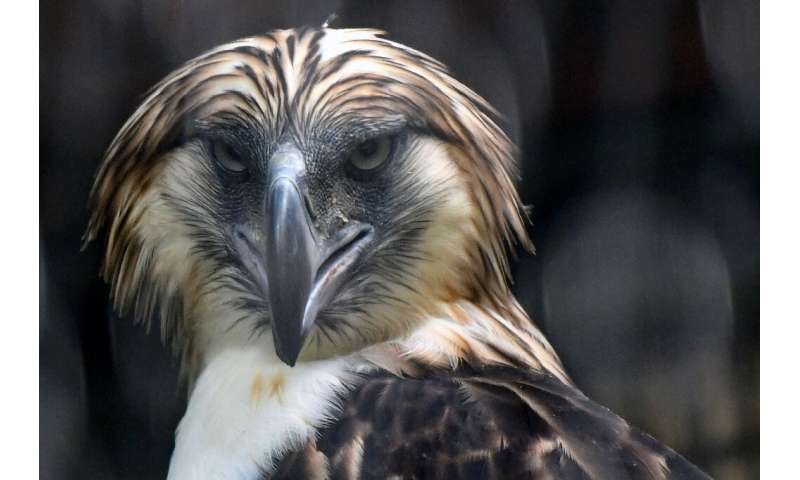
A male Philippine eagle named Geothermica is one of a pair being cared for in Singapore, part of a breeding programme to reverse the dwindling numbers of the feathered giants

Singapore showed off two critically-endangered eagles Wednesday that were loaned from the Philippines as part of a breeding programme to reverse the dwindling numbers of the feathered giants.

Destruction of tropical rainforest and relentless hunting have decimated the population of the Philippine Eagle—one of the world's biggest and most powerful birds whose wingspan can reach 2 metres (7 feet)—with only around 800 believed left in the wild, conservationists say.

The birds, Geothermica and Sambisig, are the first breeding pair ever to be sent outside the Philippines and arrived in Singapore in June on a 10-year loan from Manila.

The creatures are being cared for at the city-state's main aviary and were shown to the media Wednesday, as part of events marking 50 years of diplomatic relations between the countries.

"Any future offspring of the eagles will be returned to the Philippines to contribute to the sustainability of the species' population," said Wildlife Reserves Singapore, which runs the aviary.

The scheme has echoes of China's "panda diplomacy", which sees the Asian giant send the black and white bears to countries as gifts.

Monday, 30 September 2019

San Diego Zoo Releases 7 Hawaiian Crows to Help Rebuild Species in Wild


POSTED BY CHRIS JENNEWEIN ON SEPTEMBER 24, 2019 IN TECH | 29 VIEWS
The San Diego Zoo announced Tuesday that its researchers in Hawaii released seven ‘alala, a critically endangered species also known as the Hawaiian crow, into the wild earlier this month.
Researchers at the zoo’s Hawaii Endangered Bird Conservation Program and their partners with the Hawaii Department of Land and Natural Resources’ Division of Forestry and Wildlife and the U.S. Fish and Wildlife Service released the birds into the Pu’u Maka’ala Natural Area Reserve on Mauna Loa.
The three entities launched a partnership two years ago known as the ‘Alala Project to reintroduce the species back into the wild. The team released five males and two females into the reserve to join other groups of ‘alala already living in the area. Roughly 20 birds now live in the reserve’s forests despite the species once being extinct in the wild.
“Recovering threatened and endangered species is bigger than any one community or agency: it takes everyone working together,” said Michelle Bogardus, a geographic team leader in Hawaii with the Fish and Wildlife Service.
The research and conservation group documented multiple pairs of `alala showing breeding and courtship behaviors, including birds that were first released in 2017. The ‘Alala Project members expect the species’ recovery to take many more years, but say they are already seeing positive signs.
“‘Alala form complex bonds as breeding pairs and must work together to build their nests,” said Alison Greggor, a research associate with the Hawaii Endangered Bird Conservation Program. “Having released ‘alala engage in the full suite of breeding and nest- building behaviors in their first season as adults represents a huge step forward for the program, and their recovery as a species.”
— City News Service


Sunday, 4 August 2019

Repairing harmful effects of inbreeding could save the iconic Helmeted Honeyeater

AUGUST 1, 2019

Habitat destruction results in wildlife populations that are small, made up of relatives, and have low genetic variation.

Breeding between relatives (inbreeding) has harmful effects called 'inbreeding depression', often experienced as a shortened life, a poor breeder, or even death.

Not surprisingly then, most animals avoid breeding with their relatives. But when populations become too small, it becomes impossible to find a mate who is not some kind of relation.

Research published today in Current Biology by a collaborative research team led by Monash University reveals just how much damage is done by inbreeding in the critically endangered Helmeted Honeyeater.

Professor Paul Sunnucks from Monash University's School of Biological Sciences, who led the study said the findings have wide-ranging implications for wildlife management.

"Our study combines over 30 years of demanding fieldwork and advanced genetics to quantify how much harm is done by inbreeding in the last wild population of the Helmeted Honeyeater, and identifies ways forward," Professor Sunnucks said.

The Monash-led study involved collaboration with Zoos Victoria, the Victorian Department of Environment, Land, Water and Planning (DELWP), and other conservation partners, with funding from the Australian Research Council. The Helmeted Honeyeater, named for its 'helmet' of head feathers, is a much-loved State emblem found only in a small region of the State of Victoria.

Friday, 5 July 2019

Great Indian Bustard Eggs Being Collected to Kick-Start Captive Breeding


The critically endangered bird is down to just 160-odd individuals, most of them surviving in the Thar Desert in Rajasthan.
26/JUN/2019
The great Indian bustard has been in deep trouble for a while. Once found across India’s grasslands and dry landscapes, the critically endangered bird is now down to just 160-odd individuals, most of them surviving in the Thar Desert in Rajasthan state.
Even in this last stronghold, survival is hard. Agricultural fields and a growing network of power lines and wind turbines have taken over their habitats, while predators like dogs destroy the eggs that the ostrich-like birds painstakingly lay down. In a last ditch effort, wildlife researchers along with the forest department have started a hunt for the birds’ eggs in Rajasthan to begin the process of captive breeding. On June 20, they managed to collect two bustard eggs from the wild.
“A beginning has been made and I hope we are able to save the bird,” Arindam Tomar, the state’s chief wildlife warden, told Mongabay.
The Wildlife Institute of India, Rajasthan forest department and India’s environment ministry have entered into an agreement to build two captive breeding facilities for the great Indian bustards (Ardeotis nigriceps). The main, bigger facility is being constructed in the village of Sorsan in southeast Rajasthan, while a second, smaller facility is being built in Jaisalmer, in the west, close to where many of the wild birds breed.
The buildings will take a year or two to come up, Tomar said, but the hunt for eggs is on because the teams “did not want to miss this year’s breeding season.”
“That was the urgency of doing it,” he said. “There are only 150 great Indian bustards surviving in the wild, so every day is precious. We don’t have any captive population of great Indian bustards at all, we don’t have them in any zoos or anywhere else.”
Mongabay contacted two experts from the Wildlife Institute of India involved in the project; one declined to comment and the other did not respond.

Friday, 14 June 2019

Fungal infection setback for Kakapo


03/06/2019
After a strong start to 2019 for the Critically Endangered Kakapo, a debilitating fungus has dealt a major blow to its small population.
A healthy crop of berries was available this year on the species' favoured Rimu trees, with the breeding season producing a record 86 chicks, boosting the total population by some 50 per cent.
However, 30 Kakapos are now in hospital on the New Zealand mainland, with some fighting for their lives. Ten of the parrots have been confirmed as having the severe infection aspergillosis, caused by the fungus Aspergillus. This has already killed six individuals, while others are considered to be at high risk and are being tested for the fungus.
Deidre Vercoe, manager of the New Zealand Department of Conservation's Kakapo Recovery Team, explained: "It's a significant chunk of the population really, and it's the first time in living memory that number of birds has been on mainland New Zealand, away from their offshore islands.
"It's been quite hard with the birds that you know. Like when [a Kakapo named] Hoki died it was really difficult. She was 27 years old and she was known by so many people who worked with the programme. She was a staunch bird, she demanded your respect and everyone loved her. She was a real character."


Thursday, 6 June 2019

First Blue-eyed Ground-dove chick recorded


In great news for the Critically Endangered species, a chick has been seen close to fledging.
Marcelo Lisita was conducting his daily monitoring rounds when he spotted it.
The bird was perched on a branch – a smaller, slightly scruffier looking version of the mature Blue-eyed Ground-doves Columbina cyanopis Marcelo had been monitoring for the past year. A wave of emotion overcame him as he realized what he was seeing: the first Blue-eyed Ground-dove chick spotted in more than 75 years.
“It’s so exciting to record a dove at this stage!” Lisita said of the discovery. “This is such an important record as these doves do not breed easily, and require a few peculiarities in their habitat.”
The finding is especially poignant because for a long time, it seemed as though a Blue-eyed Ground-dove chick might never be seen in the wild again. From 1941 to 2014, not a single Blue-eyed Ground-dove was spotted in the wild, despite numerous surveys of their habitat. The world was ready to declare the species extinct when, in 2015, ornithologist Rafael Bessa was walking through the cerrado (a savannah-like ecosystem) and heard the bird’s call.
Since then, SAVE Brasil (BirdLife Partner) has been working diligently to help the Blue-eyed Ground-dove stage a comeback. In January 2018, with the help of the Rainforest Trust, SAVE Brasil bought the plot of land where the original dove was found, as well as the surrounding area, and formed the Blue-eyed Ground-dove Nature Reserve. In July of that same year, the government of Minas Gerais also officially extended protection to an additional 89,000 acres as protected, forming the Botumirim State Park (which overlaps with SAVE’s reserve). At this point, there were an estimated 15 doves known to be living in the wild.
In March of 2019, an additional population of four Blue-eyed Ground-doves were discovered, about five kilometers away from where the original population was found. With the new birds, the total known population of Blue-eyed Ground-doves rose to 19 individuals. Though the population increase was small, it was still significant. The new population meant increased genetic diversity, and pointed to the potential presence of more undiscovered doves in the wild.
For there to be real hope that the population would rebound though, the organization needed confirmation of one more thing: that the doves were successfully breeding. In the time the organization has been monitoring the birds, they had spotted eight nests, but had never recorded a chick. Worse still, there had been evidence of nest predation, leading to fears about the suitability of the doves’ habitat.
The chick that Lisita spotted, however, shows that the birds are successfully breeding. In order to further help the doves, SAVE has installed camera traps in different places around the reserve to understand what the doves’ potential predators are, and how to best protect the birds. Hopefully with the doves successful breeding and a better understanding of what their threats are, the birds can make a comeback once and for all.

10 May 2019

Wednesday, 5 June 2019

Singapore’s Jurong Bird Park to house Philippine Eagle pair


by Marje Pelayo   |   Posted on Monday, May 20th, 2019
MANILA, Philippines – The Department of Environment and Natural Resources (DENR) signed on Monday (May 20) a memorandum of agreement with the Wildlife Reserves Singapore (WRS) for the loan of a pair of Philippine eagles.
The eagle pair, named “Geothermica” and “Sambisig”, will stay in Singapore’s Jurong Bird Park in the next 10 years for conservation and breeding of this critically-endangered bird species whose population at present counts to only less than 400 pairs.
According to Environment Secretary Roy Cimatu, the eagle pair will serve as ambassadors for Philippine biodiversity.
“Sending Geothermica and Sambisig to Singapore acts as a biosecurity measure to ensure the survival of the species and as a fallback population in the event of catastrophic events like disease outbreaks or extreme natural calamities taking place in their Philippine habitats,” Cimatu said.
Jurong Bird Park is the largest bird park in Asia.
It houses close to 3,500 birds across 400 species, of which 20 percent is threatened.
The signing of the loan agreement was witnessed by Singapore Ambassador to the Philippines Gerard Ho Wei Hong and Philippine Ambassador to Singapore Joseph del Mar Yap. – Marje Pelayo


Monday, 3 June 2019

Critically Endangered Hawaiian Crows Build First Nest in Decades


May 19, 2019
Birds are building nests everywhere this spring, but for a pair of critically endangered crows in Hawaii it’s an especially big deal – it’s the first time they’ve made one in the wild in 20 years.
The ‘Alalā was once widespread throughout Hawaii, but a combination of threats ranging from habitat loss, disease and non-native predators to conflict with farmers drove their population down at an alarming rate. By the late 1970s, there were only estimated to be 50 to 150 left. The last two known individuals vanished from the wild in 2002.
Although they were declared extinct in the wild, a captive breeding program had begun years earlier and many have been hatched and raised at the Keauhou and Maui Bird Conservation Centers as part of a partnership between the State of Hawaii Department of Land and Natural Resources Division of Forestry and Wildlife, San Diego Zoo Global, and the U.S. Fish and Wildlife Service.


Sunday, 26 May 2019

Near-Extinct Native Crow Builds First Nest In Decades


One of the critically rare native Hawaiian crows appears to be incubating an egg, but first-time parents are not usually successful.
By Brittany Lyte    / May 8, 2019
The Alala, or native Hawaiian crow, is extinct in the wild. In the 1990s, there were less than 20 of the birds left on earth.
In a concerted effort to save the species, Alala have been hatched and reared at the Keauhou and Maui Bird Conservation Centers as part of a partnership between the state and federal land and wildlife regulators and the San Diego Zoo. All told, 21 birds have been released into a protected forest on Hawaii Island during the last two years.
Now researchers have discovered a nest built by two birds named Manaolana and Manaiakalani. Recently, the female bird Manaiakalani has started sitting on the nest and researchers believe there could be eggs under her jet-black rump.
Two Alala, the native Hawaiian crow, have reached a new milestone, one not seen in the forests of Hawaiʻi for almost 20 years: They have built a nest. The species is extinct in the wild.
The very existence of an Alala nest is a milestone — something not seen in Hawaii forests in nearly 20 years. Since there are no adult Alala in the wild for the reintroduced birds to learn from, Manaolana and Manaiakalani were guided by instincts in assembling the nest.