As regular CFZ-watchers will know, for some time Corinna has been doing a column for Animals & Men and a regular segment on On The Track... particularly about out-of-place birds and rare vagrants. There seem to be more and more bird stories from all over the world hitting the news these days so, to make room for them all - and to give them all equal and worthy coverage - she has set up this new blog to cover all things feathery and Fortean.
Showing posts with label released back into wild. Show all posts

Sunday, 8 March 2020

Rare seabird rescued from Sydney pub balcony


22/02/2020

An unusual seabird was recently rescued from a pub balcony in Cronulla, a suburb in the Australian city of Sydney.

The dark chocolate-brown bird transpired to be a Bulwer's Petrel, a very rare species in Australia that had never previously been officially recorded on land anywhere in the country.

The petrel, nicknamed 'Buggerlugs', was taken in to care and duly fattened up with a diet that included Southern Bluefin Tuna (at AUS $130 per kg), wombaroo (kangaroo milk), insectivore mix and sea water.

After a week or so, Buggerlugs' condition had improved considerably and he was deemed fit for release. Ornithologists decided that releasing Buggerlugs in the tropical waters off Darwin would give him the best chances.

Friday, 19 July 2019

Antarctic fulmars return home after rescue effort


JULY 12 2019 - 3:52PM

Two southern fulmars have been given a second chance at life after being found more than 5,000 kilometres from their home in Antarctica and nursed back to health by volunteers from the state's Seabird Rescue group.
The pair were released in Albany earlier this week after one was discovered in a retirement village in Australind and another was found on the canals in Halls Head in June.
Though the seabirds were among five to be found, they were the only ones to survive.
Western Australian Seabird Rescue spokesperson Fiona O'Sullivan said the birds' recovery had been a month-long process, having been exhausted, weak and underweight when they came into care.
"These fulmars, their minimum weight is typically around 700 grams," Ms O'Sullivan said.
"A couple of the fulmars that have come in have only weighed about 430 grams, which is a lot less than what they need to be.
"They came into care, thanks to a very experienced carer in Baldivis. 
"Initially, we only feed them fluids to rehydrate them and then we gradually reintroduce foods to help building up their strength.
"I transported the birds to our experienced carer in Albany and she continued their care until they were both released."
Southern fulmars typically breed in colonies on the Antarctic Peninsula, moving north during the winter months away from the pack ice.
Ms O'Sullivan said it was very unusual to see the birds in WA, and even more unusual for the rescue group to have two in its care at the same time.
"They're birds that live out on the ocean and they're from Antarctica, so we very rarely see them," she said. 


Monday, 4 May 2015

Rescuer saves falcon a second time after failed Westboro release

By Jim Haddadin MetroWest Daily News


Posted May. 2, 2015 at 9:40 AM
Updated May 2, 2015 at 9:57 AM 


WESTBORO — Matt Collins knew almost immediately on Friday that something was wrong as he stood on a hillside to watch a peregrine falcon being released back into the wild. 

When the bird began to flap its wings, an expletive rang out from the men huddled in a clearing behind the Division of Fisheries and Wildlife headquarters, where about 50 people had gathered to watch the bird begin its journey back home. 

Master falconer Bill Johnston and Tom French, MassWildlife’s assistant director of natural heritage and endangered species programs, were tasked with setting the bird free. They planned to simultaneously cut the leather straps around the bird’s talons and remove the leather hood wrapped around its head – a tool used to keep the bird calm during the release ceremony. 

But as soon as French snipped apart the leather straps, the bird took flight, leaving them helpless to yank away the hood covering its eyes. 

Some in the crowd gasped as the bird swooped down toward them, flying blindly in the direction of an office building a few dozen feet away. 

Friday, 3 April 2015

Two rare albatrosses rehabbed at bird center and released off San Pedro coast

By Carley Dryden, Daily Breeze


POSTED: 04/02/15, 3:54 PM PDT | UPDATED: 16 MINS AGO


They were rescued separately, one trapped between cargo containers on a ship into Long Beach, the other in the middle of the desert, but two rare albatrosses were released together Thursday afternoon in the ocean off San Pedro.

 (Scott Varley / Daily Breeze) 
With their striking gray and black eyes against a snow-white head and enormous wingspan, Laysan albatrosses are a sight to behold, if one is lucky enough to see one. The rare seabirds typically settle on remote islands in the North Pacific. But over the past couple of weeks, the adult birds have been gliding across a small pool at the International Bird Rescue Center in San Pedro, awaiting the OK for their release.

The bird rescued March 21 from the Port of Long Beach was drenched in grease and cleaned by center staff, but otherwise healthy. The man who found the bird estimated that it had been stuck between the cargo containers for up to 10 days.

The other bird was found March 20 near a construction site in the desert city of Rancho Mirage, 100 miles from the Pacific Ocean.

“He got marooned in the desert, literally,” said Julie Skoglund, the center’s operations manager. “Albatrosses need wind and a runway to take off.”

Wednesday, 1 April 2015

Rare bird found in Porth nursed back to health

1 April 2015 at 8:30am

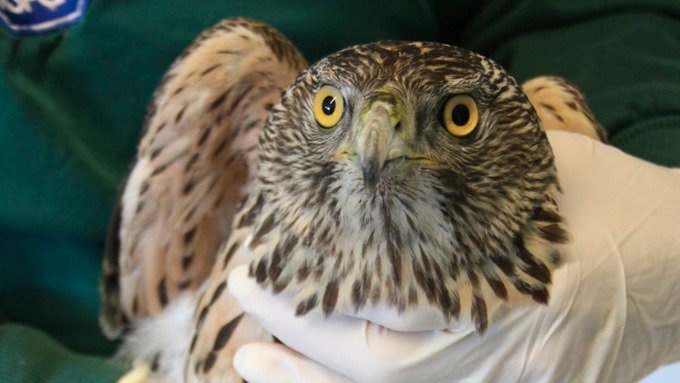
A rare goshawk that fractured her wing has been nursed back to health by the RSPCA.

The female goshawk, who is thought to be around one-year-old, was found with a broken wing by a member of the public in Porth Park, Porth, Rhondda Cynon Taf, in mid-January.

The Goshawk was found in January. Credit: RSPCA
After two months in the care of RSPCA West Hatch and time in the centre’s flight aviary building up her strength she has now been released back into the wild.

She is a beautiful bird and we rarely see them admitted to the centre and we are all very pleased we have been able to nurse her back to health and release her back into the wild where she belongs.

The goshawk was brought in to us with a damaged wing - but we had no idea how she had fractured it.

Her wing carriage took several weeks to return to normal - but we have a very long flight aviary at West Hatch in which she was able to get back to full fitness.

Our vet team strapped her wing up and prescribed rest for this beautiful and powerful bird of prey until the bone had healed and she was ready to build her strength back up in our aviaries.
– ARMINEL SCOTT, RSPCA WILDLIFE SUPERVISOR


Tuesday, 27 January 2015

Rescuers hope to release first batch of cleaned birds; mystery goo in SF Bay still unidentified


Rescuers hope to release first batch of cleaned birds; mystery goo in SF Bay still unidentified By Laura Dudnick @LauraDudnick

Wildlife rescue officials hope to release the first batch of seabirds contaminated by an unknown goo in San Francisco Bay.This week, wildlife rescue officials hope to release the first batch of seabirds contaminated by an unknown goo in San Francisco Bay earlier this month, though the identity and source of the sticky substance remains a mystery.

As of Monday, 247 birds – primarily surf scoters, horned grebes, scaups and common goldeneyes – were recovering at the International Bird Rescue center in Fairfield. Another 75 died either on the way to or at the center, bringing the total number of dead birds to more than 200 regionwide.

The birds were found primarily along the coastal East Bay region, though at least two were discovered in Foster City and another in Point Richmond.

Monday, 25 November 2013

Rescued Greater Adjutant Stork released in the wild

A Greater Adjutant Stork, rescued and rehabilitated by locals and conservationists, was today released in the wild here. 

The stork, named 'Arshiya' by her rescuers, was released at Boragaon by the Assam State Zoo Divisional Forest Officer Chandan Bora at an initiative of 'Aaranyak', a conservation organisation, in cooperation with the Bombay Natural History Society (BNHS) and College of Veterinary Science, Khanapara. 

"We are very proud to be a part of the bird's rehabilitation and Assam State Zoo team is committed for such endeavour in future," Bora said after releasing the bird. 

Boragaon is a popular feeding habitat of this stork. 


Saturday, 24 August 2013

Andean Condors released into wild after poisoning scare

Endangered Condors have been released back into the wild high up in Chile's Andes.


It comes after a poisoning scare in the area which saw more than a dozen of the large birds mysteriously crash to the ground earlier this month.

Denise Hammick reports.

Monday, 4 March 2013

Birds to be released in Dorset four weeks after oil rescue


Rescued birds are to fly at sea for the first time since being found on the coast covered in an oil additive.

More than 300 guillemots and razorbills found covered in glue-like polyisobutene (PIB) four weeks ago have been cared for by the RSPCA.

Most of them were discovered on Dorset beaches where they were found covered in the waxy substance.

The RSPCA said it hoped up to 29 birds could be released from a cliff top in the Portland area on Thursday.

Washing-up liquid
They are to be the first birds released from the West Hatch Animal Rescue Centre in Taunton, Somerset.

Peter Venn, centre manager, said: "Just over 300 birds were brought in. Just over 100 had to be put to sleep. The substance wasn't a crude oil but it was still an oil."

Other affected birds were found in Cornwall, Folkestone and on the Isle of Wight.

The RSPCA said there have been reports of birds found covered in the same sticky substance in Ostend, Belgium.