As regular CFZ-watchers will know, for some time Corinna has been doing a column for Animals & Men and a regular segment on On The Track... particularly about out-of-place birds and rare vagrants. There seem to be more and more bird stories from all over the world hitting the news these days so, to make room for them all - and to give them all equal and worthy coverage - she has set up this new blog to cover all things feathery and Fortean.
Showing posts with label albino. Show all posts

Friday, 7 June 2019

Albino magpie in Tasmanian wildlife sanctuary 'one in a million', keepers say


Updated 24 May 2019, 5:09am
A "one-in-a-million" albino magpie has been found living in Tasmania's north.
Key points:
Keepers say the magpie would not survive in the wild because its white coat would make it a target for predators
The bird is "an absolute character" and "prefers to be handfed despite being able to feed himself"
Experts say there are no accurate statistics that show how common albinism is in birds, but that social media has helped draw our attention to uncommon plumages
Instead of making its home in a suburban backyard, the unnamed bird lives alongside a yellow-tailed black cockatoo in the Trowunna Wildlife Park.
The young male was handed in as a fledgling bird late last year, and has been unable to be released into the wild.
"It was found at the base of a tree with no possibility of getting back to the nest," operations manager Darren Rumble said.
"As soon as we had the bird brought in, we knew we'd be taking care of him for his whole life — if we let him go, he won't last more than a day."
Due to the albino magpie's white pigmentation, Mr Rumble said it was susceptible to a high rate of predation.
"He'd be a prime target for crows or any other bird of prey," he said.
"He is a genuine albino and the statistics around a genuine albino magpie are around one in a million.
"You do see other forms of colour dysmorphia called leucism but that's a dilution of the dark pigment which can go into a creamy colour of the feathers, but the bird will still have normal coloured legs, beak and eyes.
"He's got the total absence of the pigment."


Thursday, 16 May 2019

Rare albino sparrow spotted in Herefordshire


1st May
By Charlotte MoreauReporter
A RARE albino sparrow has been spotted in a Herefordshire garden.
The unusual visitor was captured on camera by Bircher resident, Lindsay Muir.
After first making an appearance yesterday, the bold little sparrow again joined her regular garden visitors at the bird feeder this morning.
Photographer Lindsay said that although it appeared to be alone rather than with a colony of sparrows, it was not worried by the other birds in her garden.
Albinism occurs in many species, including humans, and is caused where there is a total lack of melanin produced.
The dark pigment is responsible for normal colouration in skin, scales, eyes and hair.
The genetic condition is characterised in birds by white feathers and pink or red eyes.
Sadly, the RSPB says, the rare and beautiful creatures tend to be weaker and have poorer eyesight than their pigmented relatives and do not often survive to adulthood.
Their lack of colour also makes them more prone to predation, as they are much more easily spotted.

Friday, 26 April 2019

Tennessee hunter kills bizarre albino turkey in Rutherford County - (Just had to kill it though eh?)


Mike Organ  Nashville Tennessean
Published 12:28 PM EDT Apr 13, 2019
It's being called the "turkey of a lifetime," by the Tennessee Wildlife Resources Agency.
That's how TWRA officials described a rare leucistic gobbler killed by a hunter in Rutherford County last week.
Cameron Bond of Warren County shot the unusual bird on April 6.
A rare leucistic turkey was shot by a hunter in Rutherford County.
Tennessee Wildlife Resources Agency
Leucism in birds, according to the TWRA, is a loss of pigmentation. It is a genetic abnormality.
The beard on the turkey Bond killed was dark and the back feathers still held some color. 
Bond said the turkey weighed 20 pounds. It's beard measured nine and one-half inches and its spurs were .75.
Spring turkey hunting season in Tennessee opened on March 31 and continues through May 1.

Friday, 5 April 2019

Forgotten your penguin suit? Rare Albino bird makes debut at zoo in Poland but faces being left out in the cold as other animals could reject it for being the odd one out

Penguin also prone to diseases because it lacks a black pigmentation 
Hatched in mid-December at Gdansk Zoo but sex has not yet been identified 
Director Michal Targowski said bird would have been first to be attacked in wild


PUBLISHED: 19:30, 22 March 2019 | UPDATED: 02:20, 23 March 2019


An extremely rare albino penguin has made its debut at a Polish zoo but faces being rejected by other birds because it is the odd one out. 

The albino penguin hatched in mid-December at Gdansk zoo, and has been under veterinary care since then. 

In footage of its release, the timid little bird is shown being prodded into its new enclosure with its companions. 

In the wild, such an unusual-looking penguin would be rejected by other penguins and would have little chance of survival. 

At its new home, it has its parents and two other birds for company. 

The bird's sex has not yet been determined. It weighs 1.1 pounds and stands 11 inches tall.

Thursday, 12 July 2018

Albino kingfisher chick draws birding community to East Coast Park


PUBLISHED
JUL 3, 2018, 10:07 PM SGT

SINGAPORE - A rare albino kingfisher chick is shooting to mini-stardom among the birding community here, after it was spotted last Wednesday (June 27) by wildlife observers at East Coast Park.

While white-collared kingfishers are common in Singapore, the sighting of an albino one was the first for many watchers, said observers.

The bird first flew into the public eye on Facebook pages such as the Nature Society (Singapore) group, and has made regular appearances online since.


Thursday, 14 June 2018

Super rare albino bird spotted in Somerset

4 June 2018 at 10:33am

An extremely rare albino house sparrow has been spotted in Somerset.

This one was captured on camera amongst a small colony in Westonzoyland.

They're one of the rarest birds in the world and are distinctive because of their pink eyes and pure white feathers.

Most white wild birds seen are leucistic, lacking pigment, and they are rare in themselves, but a true albino bird, with pink eyes is incredibly rare!

RSPB monitoring suggests a severe decline in the UK house sparrow population, recently estimated as dropping by 71 per cent between 1977 and 2008 with substantial declines in both rural and urban populations.

Last updated Mon 4 Jun 2018

Source 

Thursday, 24 May 2018

Rare albino turkey vulture found in Stuart


May 13, 2018

STUART-Brenda Bowman figures her granddaughter’s got a leg up on her: 11-year-old Kylee Tyson is seeing something her grandmother is only seeing at the age of 63.

It was an albino turkey vulture, something even an expert has only heard about three times.

They saw it on April 29, when “my granddaughter and I went out to take an evening stroll. Kylee is the one who spotted it,” Bowman said. They live in Patrick County between Stuart and the state line.

“There were other vultures after it — 10 to 14. I think they were trying to kill it,” she said.

The large white bird “circled around and landed on the tractor shed. It was pretty smart,” she said. “It walked along the tractor roof and hid itself under a tree from the other vultures.”

She got her binoculars to get a closer look at what she had thought was a hawk. She saw it looked like a vulture.

She and Kylee “waited a while, then we walked on toward the tractor shed, trying to scare the black vultures off.”

The white vulture flew away after the black ones had left, she said. It flew to the back of her property toward a creek.


Friday, 6 April 2018

Rare albino bird seen for 1st time in southern Turkey


Albino Eurasian coot (Fulica atra) spotted for first time among thousands of other fowls, say Turkish officials

12:02 March 28, 2018Anadolu Agency

A rare albino bird has been spotted for the first time in southern Turkey, the nation’s Forestry and Water Affairs Ministry said on Wednesday.

The Albino Eurasian coot (Fulica atra) was spotted among thousands of other birds at Lake Akyatan, in the Adana province, a protected nature area, the ministry said in a statement.

The bird is normally recognized by its white bill and forehead shield.

Lake Akyatan is important and rich in terms of the number of birds it attracts, its position along migration routes, the diversity of its living environment, and favorable climatic conditions, the statement added.

The area attracts around 250 species of birds over the course of the year, according to the statement.


Thursday, 30 November 2017

Has a rare albino pheasant been spotted in Lancashire?


COLIN AINSCOUGH
Published: 15:12 Wednesday 22 November 2017

While walking her dog on Tuesday morning (November 21, 2017), Tania Harasimiuk captured footage of what she believed to be a rare albino pheasant. Tania was walking her pooch just off Hoghton Lane in Hoghton when she spotted the white shape in the grass nearby.

Tania said: "I felt so lucky to see it, we’ve lived in Hoghton for the past 5 years and recently sold our house and move from the area. "One of our neighbours said he used to see a white crow here too for a while so maybe Hoghton is a special place." Albinism results in white feathers and pink eyes but true albinos are thought to be rare in the wild. True albinism in birds is caused by a genetic mutation resulting in an absence of an enzyme which controls the production of melanin.

Sadly, many albino birds die soon after fledgling due to their poor eyesight. After seeing the footage Alan Wright, Communications Manager for the Wildlife Trust for Lancashire, said: "While there are a number of kinds of pheasant there are no white ones. It is likely to be albino or leucistic, the latter is when the colour has been washed out with dark rather than pink eyes, which are found in albinos."


"Obviously we haven't got a close enough look at this specimen to tell the difference. You will have seen albino - or part albino - blackbirds in your garden. "Some experts say white pheasants are not common but could occur as a result of intensive breeding for shoots and food. The ones that we are seeing round about are obviously escapees, like most pheasants which are not historically native to this country. "Seeing a white pheasant is obviously something different and exciting and again shows the diversity of wildlife that we have in the county."

Video footage and Read more at: 

Friday, 1 September 2017

Rare albino pigeons are sighted in Minnetonka


By JIM WILLIAMS , CONTRIBUTING WRITER 

August 22, 2017 - 3:04 PM

Wedding doves were my first thought. Never thought of albino pigeons.

You know wedding doves — those white birds sold for symbolic release as part of a nuptial celebration. (Except, that’s not how it works.)

Anyway, I spotted three white birds in a tree in Minnetonka while I was driving west on I-394. Exact ID at 65 mph is above my pay grade. Turns out two of them were albino pigeons, the third possibly leucistic.

Albino birds are very uncommon. More often seen are leucistic birds, which have random white markings, sometimes a spot or two, and are sometimes almost white.#

Albino birds have white plumage, period. Feet, legs, bills and eyes are pink. Albinos completely lack melanin, the color ingredient.

I stopped at the Wild Birds Unlimited store in the shopping center at I-394 and County Road 73 (Hopkins Crossroad), the pigeon corner. Pigeons come to its front-door feeder.

Monday, 7 August 2017

VIDEO: Rare albino sparrow spotted in Perthshire garden


July 12 2017, 6.58amUpdated: July 12 2017, 9.06am

A rare albino sparrow has been captured on camera in a Perthshire garden.

John Anderson spotted the tiny white creature at his Dunning property after it fell out of its nest.

Pure white birds like the sparrow are rare.

He was able to capture it on film as the parents attempted to feed it but it was unable to fly back to its nest.

“I first noticed it last week, he said. “I’m not an expert on birds but I see a lot of them in my garden and I’ve never seen anything like it before.

“We do get a few house sparrows in the eaves of the building and I think one of its siblings must have pushed it out of the nest for fear it would attract predators.

“It was under a bush under one of the nests. We kept an eye on it but we were worried foxes would get it in the night, but it was still there the next morning. The mother would come along and feed it every so often.”

Sadly, the fledgling only survived for a few days.


Friday, 10 February 2017

What part of blackbird don't you understand? Couple are amazed to find an extremely rare WHITE version of the bird in their garden


Michael and Joan Parkinson spotted the albino blackbird in their garden

Couple, from Nottinghamshire, originally thought the bird was a seagull

Rare blackbird has been flying by garden on a daily basis to eat and wash

By Alex Matthews For Mailonline

Published: 15:17, 6 February 2017 | Updated: 15:45, 6 February 2017

A couple were stunned when they spotted a rare albino blackbird in their back garden.

Michael, 77, and Joan Parkinson, 69, couldn't believe their eyes when they saw the bird perched in their garden in Keyworth, Nottinghamshire.

But now the unusual visitor regularly flies by to eat and wash.

In an effort to tempt the bird back, the couple have left sultanas in different spots in their garden.

Video footage captured by Mr Parkinson shows the bird, which is almost completely white with a black tail, flying around and bathing itself in a mini pond.

Mr Parkinson said: 'I first saw it last August. We have a summer house in the garden and we were having lunch.

'My wife went into fetch something and I thought it was a baby seagull.

'She said 'it can't be' and then two to three weeks later she saw it. It has started to become a regular visitor to our garden.

Mr Parkinson thought the bird was a baby seagull at first but later discovered it was a rare breed of blackbird

'We left food at various spots and set the iPhone up and made a video.'

Mrs Parkinson added: 'My husband thought it was a seagull at first.

'But then one day it came onto the water feature and I thought it had to be a blackbird.

'It has a jet black tail and has an orange beak which gave it away.

'And it has a really loud squark on it too, it is so loud that we can hear it from inside the house.

'We see him every day if we are in, he is always flying into the garden for some food and to have a bath.'

Read more and watch video:


Thursday, 23 June 2016

Has bird watcher finally captured rare albino blackbirds on camera?

17:40, 13 JUN 2016
UPDATED 17:40, 13 JUN 2016
BY PETE BAINBRIDGE , JOSH PEACHEY

Paul Gartley has spent a month trying to get footage of the birds

A bird watcher who spent a month trying to film an elusive species believes he has finally captured them on camera.

Paul Gartley says he repeatedly saw a group of albino blackbirds in the early morning as he walked his dog in Irlams o’ th’ Height, Salford , but wanted to gather some hard evidence.
Paul, 42, thinks he finally caught the birds on his mobile phone as he walked on Bolton Road playing fields.

He told M.E.N: “I only saw them very early, between 4am and 7am in the morning. They hang around with others and I read online that they only last about a month in the wild because they stick out to predators.

"They bounce off as soon as you get within 50 yards of them but two weeks ago I managed to get close in my car and watch them for a couple hours.”

Albinism is often genetically inherited, and is a recessive characteristic, leading to rare numbers and very few of them surviving in the wild.


Sunday, 1 May 2016

Rare white blackbird spotted in North Devon

20:09 20 April 2016

A rare albino blackbird has been spotted at Hatherleigh.

The ‘white blackbird’ was discovered by Devon Wildlife Trust’s Jo Pullin in her back garden. Jo, who has worked for the conservation charity for 14 years, said: “My children and I spotted something unusual in the undergrowth at the edge of our garden. We went to investigate and soon discovered it was a white blackbird. It looked like it had only just recently left the nest.

“I’ve seen birds with odd colouring before, but never a completely white blackbird. It really stood out and looked very vulnerable.”

The albino blackbirdThe trust said albinism in birds is not unusual. It is caused when the normal pigmentation of feathers is missing. However, in most cases birds show patches of white feathers or dull colouring.

But what was rare about the case of the Hatherleigh blackbird was that it lacked all colour, even in its eyes. It belonged to a condition which is much more unusual and is known as being a true albino.

The story of the white blackbird may not have ended well. Its unusual looks may have meant it lived a short life. Steve Hussey from Devon Wildlife Trust said: “Being pure white isn’t a great survival strategy for a blackbird, particularly as a fledgling.

“When you’ve just left the nest you want to be as inconspicuous as possible to avoid the predatory eyes of cats and sparrowhawks. Added to this, part of the condition of albinos often means they have poor or little eyesight.


Monday, 25 May 2015

Rare albino sparrow spotted in Australia

The albino was photographed at Sanctuary Lakes near Melbourne, but it is not expected to survive long with its snowy white plumage making it stand out to birds of prey.
POSTED: 25 May 2015 15:16

SYDNEY: A rare pure white sparrow has been spotted in Australia, leaving ornithologists all aflutter Monday (May 25).

The albino was photographed at Sanctuary Lakes near Melbourne, but it is not expected to survive long with its snowy white plumage making it stand out to birds of prey.

Bob Winters, a birdwatching expert and environmental educator, photographed the animal after being alerted to its presence by a friend. But it wasn't an easy task.

"It's a very nervous animal, understandably, so I had to try for quite a few days to get some photos," he told AFP, adding that pure white sparrows had been seen globally only "once in a blue moon".

Australian media said there had been a handful of confirmed sightings of the bird across the world, including one reported in Britain in 2010.

Sunday, 5 October 2014

Vacationing couple spots rare albino hummingbird in Ogunquit

OGUNQUIT—Like many people this summer, Heather and Gary Ross decided to vacation in Ogunquit. Unlike others, however, the California couple had quite an unusual wildlife experience while visiting the seaside town.

While sitting on the lawn of the Beachmere Inn on the afternoon of Sept. 24, they observed what appears to be an albino hummingbird.

Photo courtesy of Heather and Gary Ross
“We had gone to breakfast and came back,” Heather Ross said. “We were sitting in the grassy area in the afternoon. I’ve always been a fan of hummingbirds. Gary said ‘look at that’ and pointed out a white hummingbird.”

Heather Ross quickly snapped some pictures with the camera she had on her.

“We were watching it,” she said. “It was stunningly beautiful.”

The Ross’ uploaded the photos, Heather said, and when they looked at the pictures saw that the bird had red eyes.

“Gary said it was an albino,” Heather Ross said.

Monday, 21 July 2014

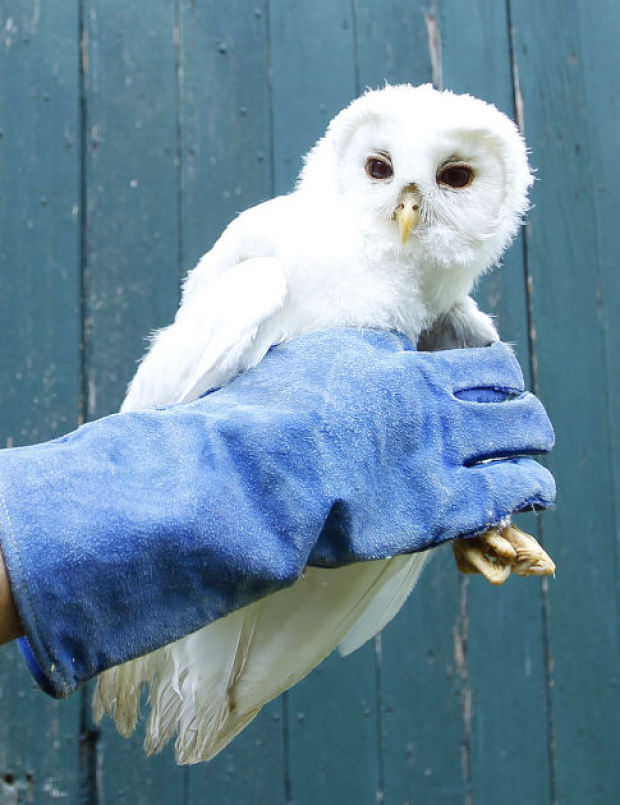
Rare albino barred owl found in Cedar Falls, taken to rehab center

July 18, 2014 5:30 am • ALISA HRUSTIC alisa.hrustic@wcfcourier.com
071714cc-owl-01CEDAR FALLS | A rare albino barred owl, picked up by animal control officers Saturday, is being nursed back to health by volunteers of the Black Hawk Wildlife Rehabilitation Project.
The bird was found along Main Street, a few blocks from his home nest, and left experts in awe at the sight of his completely white plumage.

When animal control called Linda Nebbe, a rehabilitation volunteer of about 40 years, she couldn't believe they had an all-white owl to bring her.

"I wanted to say 'yeah right,'" she said. "I've never seen anything like this."

Nebbe believes the owl became sick after eating something that clearly impacted his system.

"He started acting with a lack of control," she said. "He was very droopy and seemed not aware and didn't react to anything. I gave him some fluid and he was very dry."

The owl also was severely underweight, but is only a baby yet, and is improving already.

"Now he's eating well," Nebbe said. "We took him to the vet on Tuesday and she found him to be, from everything we could see, in good health."

read on

Monday, 12 November 2012

Leucistic birds lack colors of their species


I occasionally hear from readers who report a partially white bird — a bluebird, a house sparrow or some other type - in their yards.

While my wife and I were conducting a recent birding workshop at Block Creek Natural Area, between Fredericksburg and Comfort, we saw a chipping sparrow with a white head and neck, as though it had a cowl over its otherwise brown head. The other day, I was visiting a friend in Houston who had a blotchy white house sparrow coming to his bird feeder.
White patches in bird plumage is called leucism, a condition in which some feathers have scant deposits of pigment. It's caused by defective genes that restrict the body's melanin from entering certain feathers or feather groups. Unlike albino birds, leucistic birds have normally colored eyes, beaks, legs and feet.

The white patches on leucistic birds have resulted in such monikers such as "pied" or "piebald" birds, terms that seem to have originated among poultry farmers. Some people refer to leucistic birds as having partial albinism, which is misleading because leucistic birds are not albinos.

Albino birds have a genetic mutation that causes an absence of an enzyme called tyrosinase, which synthesizes melanin. As a result, albino birds generally lack melanin in their bodies and plumage. Their eyes, skin, beak, legs and feet typically have no color. However, carotenoids, organic pigments that come from plants in the birds' diets, may enter some feathers, giving albino birds slight coloration.