As regular CFZ-watchers will know, for some time Corinna has been doing a column for Animals & Men and a regular segment on On The Track... particularly about out-of-place birds and rare vagrants. There seem to be more and more bird stories from all over the world hitting the news these days so, to make room for them all - and to give them all equal and worthy coverage - she has set up this new blog to cover all things feathery and Fortean.
Showing posts with label Herefordshire. Show all posts

Thursday, 18 July 2019

Rare birds spotted nesting at Tarmac’s Herefordshire Quarry


 Save to read listPublished by Lucy Stewardson, Editorial Assistant
World Cement, Monday, 15 July 2019 10:22


A pair of oystercatchers have spent more than a month nesting at a Herefordshire sand and gravel quarry. The wading birds – which are a protected species in the UK – were first seen at Wellington Quarry, near Hereford, in early June and have remained at the Tarmac-owned quarry ever since.

Since the birds were first spotted by quarry workers, a 30 m exclusion zone was put in place to prevent the birds from being disturbed from the field they are nesting on. The soils excavated from the site (to gain access to the sand and gravel) are being used to create the margins of a lake, as well as a gravel island that will provide additional bird nesting opportunities.


Thursday, 16 May 2019

Rare albino sparrow spotted in Herefordshire


1st May
By Charlotte MoreauReporter
A RARE albino sparrow has been spotted in a Herefordshire garden.
The unusual visitor was captured on camera by Bircher resident, Lindsay Muir.
After first making an appearance yesterday, the bold little sparrow again joined her regular garden visitors at the bird feeder this morning.
Photographer Lindsay said that although it appeared to be alone rather than with a colony of sparrows, it was not worried by the other birds in her garden.
Albinism occurs in many species, including humans, and is caused where there is a total lack of melanin produced.
The dark pigment is responsible for normal colouration in skin, scales, eyes and hair.
The genetic condition is characterised in birds by white feathers and pink or red eyes.
Sadly, the RSPB says, the rare and beautiful creatures tend to be weaker and have poorer eyesight than their pigmented relatives and do not often survive to adulthood.
Their lack of colour also makes them more prone to predation, as they are much more easily spotted.

Thursday, 8 December 2016

Rare bird spotted in Herefordshire for the first time

ORNITHOLOGISTS reached for the history books when a flying visitor was spotted in Herefordshire for the first time.

The bearded tit, a striking bird with markings which look like it has a drooping black moustache, was seen at a wetland site at the Wellington gravel pits.

Frances Weeks, from the Herefordshire Wildlife Trust, said it was the first time the species has ever been recorded in the county.

While the bearded tit is sometimes seen on the east and south east coast of the UK, there are only around 630 breeding pairs in the country.

The bearded tits prefer reed beds, found around the edges of lowland lakes, where they can feed on the seeds of the reeds during the winter.

The Lugg Living Landscape Officer, Sophie Cowling, said this type of habitat is becoming increasingly scarce across the country but that the lakes found to the north of Hereford have the potential to provide large areas of reed bed.

And at Bodenham Lake nature reserve, Herefordshire Wildlife Trust is planning to re-profile areas of the lake to create shallower sides and areas of reed bed.

Ms Cowling added: “This is such an exciting sighting. The bearded tit is exactly the sort of reed bed specialist we are hoping to attract to the reserve." 
 

Tuesday, 23 August 2016

Rare bird spotted in Herefordshire


2 days ago / Sally Boyce

A RARE bird sighted in Herefordshire could well cause some twitter among spotters.

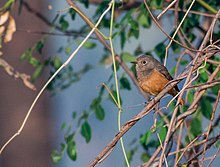
The robin-sized black redstart, photographed by a reader in the Golden Valley, is a “very rare” sight in the county, according to Herefordshire Wildlife Trust.

With fewer than 100 breeding pairs in the UK, the black redstart is on the the Royal Society for the Protection of Birds’ endangered red list.

A continental bird, in this country the black redstart has adapted to living in industrial and urban areas. Its name comes from the plumage of the male, a grey-black colour with a red tail. Their decline has put them on the official red list of birds of conservation concern.

“Seeing a black redstart here in Herefordshire is exciting,” said HWT expert, John Clark. “They are very rare, the only places they tend to breed are on building sites in London.

“They tend to prefer upland areas and dry, rocky habitats.”

The location of the county sighting was an area of uncultivated pastureland.

John advised the reader to record spotting the black redstart as an official sighting for the county with the British Trust for Ornithology.

“It is important to record such sightings of birds not commonly found in Herefordshire,” he said.


Thursday, 19 December 2013

Illegal bird trap user caught on camera

A part-time game keeper from Herefordshire has been caught and fined for setting an illegal trap designed to harm birds of prey.

Wayne Edward Priday was ordered to pay more than £500 for using a pole trap - a device with a powerful spring placed on top of a post or pole where birds of prey are likely to perch.


Sunday, 20 January 2013

2 leucistic blackbirds in Herefordshire


Leucistic blackbirds in Hereford
January 2013. Wildlife Extra has reported on many leucistic and albino animals and birds in the last few years, but I have never seen one myself, until yesterday. As ever, I wasn't looking for them, or for anything else. I had just dropped by daughter at college and I stopped somewhere I have never been before to walk the dog for 10 minutes.

I caught a flash of something unusual as I walked passed some scrub. A very bright black and white bird, all the wrong size and shape for a blackbird. Naturally, as I was in an urban park I didn't have binoculars or a camera, so I retrieved the 'emergency' camera from the cars glove box, and went back in search.

To cut a long story............ There were two leucistic blackbirds within 30 yards of each other, presumably from the same brood. They were in the scrub, and I didn't have the greatest camera with me (the photos are decidedly average, and that is being harsh on average), but at least I can now join the leucistic club.

Perfect camouflage?
I will go back and try again, but it is now snowing, so for just a few days, they now have perfect camouflage.