As regular CFZ-watchers will know, for some time Corinna has been doing a column for Animals & Men and a regular segment on On The Track... particularly about out-of-place birds and rare vagrants. There seem to be more and more bird stories from all over the world hitting the news these days so, to make room for them all - and to give them all equal and worthy coverage - she has set up this new blog to cover all things feathery and Fortean.
Showing posts with label Dartmoor. Show all posts

Friday, 22 January 2016

Exeter University crowdfunding initiative to help bird conservation research on Dartmoor

By WMNOVergnault | Posted: January 22, 2016
Charles R Tyler

The project, run by the Dartmoor Upland Bird Nest Group and led by a University of Exeter PhD student, has been studying the breeding of ground-nesting birds for eight years

A new crowdfunding initiative has been launched to help expand bird conservation research on Dartmoor.

The project, run by the Dartmoor Upland Bird Nest Group and led by a University of Exeter PhD student, has been studying the breeding of ground-nesting birds for eight years.

The group have been studying the nests of several declining bird species including robin-sized stonechats, small perching birds whinchats, meadow pipits and cuckoos, in order to better understand their breeding, which is essential to inform conservation.

Each year the group, which consists of local bird enthusiasts, ornithologists and scientists from the University of Exeter, monitor up to 350 bird nests on the upland moors of Dartmoor National Park.


Monday, 6 July 2015

PICTURES: Devon photographer captures rare nightjar chicks hatching on Dartmoor

A Devon wildlife photographer and policeman has captured extremely rare pictures of Britain's most reclusive bird hatching.

The stunning images show not only an adult nightjar incubating two eggs - but also captures the whole hatching process.

The new-born chicks are barely recognisable, with nothing more than a beak and fur on show - and are a far cry from the adult's frog-like features.

Nightjars are a rare sight in the UK and are widely considered to be the most reclusive bird in the Britain.


Friday, 19 September 2014

Rare British bird on the rise

A new study on birds in Dartmoor has revealed that the number of dunlin have increased in response to efforts to restore the moor’s mires.

Dunlins are small wading birds that breed across northern Europe, Russia, and North America, choosing Dartmoor as their most southerly breeding location. Their population in the UK is currently recorded at 9,600 pairs.

As they rely exclusively on good quality blanket bog to breed, Dartmoor provides an important location for them in the UK. The Dartmoor Mires Project is a pilot scheme that has been set up to assess the feasibility and impact of restoring the degraded blanket bog. 

The RSPB was contracted by the Dartmoor Mires Project to conduct a bird survey of blanket bogs on the north moor in 2014, following a similar survey undertaken in 2010, and two smaller ones in 2007 and 2013.

The results of the survey were positive, and revealed a 37 per cent increase in dunlin between 2010 and 2014, with 22 territorial pairs compared with 16 in 2010. 

Commenting on the finding, Helen Booker, Conservation Officer for the RSPB in the South West said: “It would genuinely seem that the restoration works have had an important positive effect on the dunlin breeding population. This is great news, and it’s to be hoped that continuing efforts to restore the mires will continue to pay off and secure the future of this wonderful bird here at its most southerly site in the world.

Tuesday, 18 March 2014

'Rare' habitat on Dartmoor set alight for scarce birds

Sections of a "globally rare habitat" will be deliberately set alight on Dartmoor in an attempt to help endangered bird species.

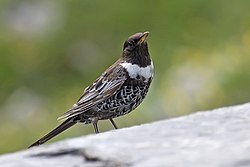
The legal burning of prime heather moorland in Devon will help create a suitable habitat for species including ring ouzels and skylarks, the national park authority has said.

It will allow fresh heather to grow and provide new nesting sites, it added.

Plots of about 300 sq m (about 3,200 sq ft) will be burnt from Monday.

The moor is home to about 30 breeding pairs of ring ouzels and is the only upland in the south of England where they breed.

Head ranger Rob Steemson said: "The burning will also help skylarks, which are nationally in decline.

"Fire will remove all the old vegetation and allow the nutrients to go back into the soil to encourage fresh growth.

"Within four years, ring ouzels should be nesting in the heather," he added.

Sunday, 6 October 2013

Red-backed Shrike breeds again in Dartmoor National Park

Posted on: 01 Oct 2013Expires on: 31 Dec 2013
The RSPB has announced that two Red-backed Shrike chicks have fledged on Dartmoor this year, after the species failed to breed in 2012.

The only breeding pair of the species in England nested this summer at a secret location in the National Park, and have been under close watch to guarantee their safety in a project managed by the charity, with support from the police, the Forestry Commission, Natural England and local conservation groups.

Kevin Rylands of the RSPB said: “This is now the fourth year they have returned to Dartmoor, but they failed to breed successfully last year, probably due to the awful weather. A lone male visited the previous breeding site in May this year but failed to find a mate. Fortunately though a pair was found at a new site in June and this bodes well for the future of the species on Dartmoor.” Red-backed Shrike was driven to extinction as a breeding bird in Britain by the end of the last century and egg collecting remains a major threat.

“As in previous years we used a combination of volunteers, staff and sophisticated wildlife surveillance equipment as part of site protection and monitoring. Although it’s been hard work, the efforts have been rewarded, with two youngsters fledged. We are particularly grateful to the volunteers involved and to Devon Birds for funding some of the cameras used on site as part of Devon and Cornwall Police’s Operation Wilderness.”


Wednesday, 11 September 2013

Cuckoo's dramatic decline tackled on Dartmoor

The call of the cuckoo is a sound that is fading from the British countryside as the bird's numbers plummet dramatically.

In the last 25 years England has lost over half its breeding cuckoos whilst in the south Devon lowlands, one of the bird's key breeding areas, numbers have dropped by as much as 80%.

On Dartmoor the British Trust for Ornithology is working with the National Park to satellite tag cuckoos to shed new light on what is going wrong.

Already they have found that cuckoos leave the UK much earlier than previously thought and birds from different regions of the UK take different routes to Africa, some more perilous than others.

Friday, 26 April 2013

Prince Charles's activity centre nest egg ruined by rare peregrine falcon


PRINCE Charles’s plans to create an activity centre in a world ­famous ­wilderness have been defeated...by a rare bird. 


Published: Sun, April 21, 2013 

It is an offence to intentionally or recklessly disturb protected birds close to their nesting sites 

The Prince’s Duchy of Cornwall ­estate failed in its efforts to develop an unused quarry on Dartmoor, Devon, ­because of a peregrine falcon. 

The protected bird of prey saw off the developers after planners said they feared the project at ­Merrivale, near Yelverton, would ­force it to abandon its home and breeding site. 

Members of the Dartmoor National Park development management committee kicked out the Duchy’s project earlier this month on the grounds that the falcon cannot be threatened by a commercial enterprise. 

Under the law, it is an offence to ­intentionally or recklessly disturb protected birds close to their nesting sites during the breeding season. 

A pair of peregrines were reported to have been seen mating at the site in March. They also attempted to breed in 2012 but were unsuccessful. 

The RSPB opposed the Duchy’s scheme, which would have included a zip wire, climbing walls and kayaking facilities. 

We should allow the ­peregrine falcons to enjoy their ­freedom. They have been there a considerable number of years 

Natural England, the Government’s advisor on safeguarding the nation’s natural heritage, was also against the development and warned that it had the legal power to refer the application to the Secretary of State if necessary. 

Currently, there are just 87 peregrine falcons in Devon, with a similar number in neighbouring Cornwall. 

Committee chairman Helen Jenny said that when members attended the quarry and approached a pool area a pair of peregrines were disturbed and took flight. 

John Nutley, also a member of the committee, said: “We should allow the ­peregrine falcons to enjoy their ­freedom. They have been there a considerable number of years.” 

His colleague Bill Hitchins, originally in favour of the plans, said the ­local ­authority was in danger of laying itself open to some sort of legal challenge if it accepted the Duchy scheme. 

He said: “I support the recommendation to refuse this. I’ve changed my mind.” 

The committee decided to reject the scheme by 12 votes to three.