As regular CFZ-watchers will know, for some time Corinna has been doing a column for Animals & Men and a regular segment on On The Track... particularly about out-of-place birds and rare vagrants. There seem to be more and more bird stories from all over the world hitting the news these days so, to make room for them all - and to give them all equal and worthy coverage - she has set up this new blog to cover all things feathery and Fortean.
Showing posts with label Weymouth. Show all posts

Sunday, 1 September 2019

Gulls across Weymouth and Portland found dead from disease


31st August


By Alex Cutler Reporter

AT LEAST 60 herring gulls have been reported dead across Weymouth and Portland following a disease outbreak.

It is understood that the birds have most likely been dying due to a suspected outbreak of avian botulism.

According to the government's Animal and Plant Health Agency, avian botulism is a paralytic and often fatal disease caused by ingestion of toxin produced by bacteria found in rotting plant and animal material.

These outbreaks are frequent in this country but are more common during hot weather and can last for weeks, resulting in several hundreds of bird deaths.

Many of the dead gulls have been found in the swannery at Radipole Lake, near to the The Gurkha restaurant in Weymouth, where there is a build up of green algae – a possible source of the outbreak.

Algae blooms are said to occur naturally in hot weather and the swannery has been affected in previous years.

Bimlashar Gurung, manager of The Gurkha restaurant, said it is starting to affect her business: "Everyone is saying it is our fault but there is nothing we can do.

"I clean up the litter and all the rubbish that everyone leaves, sometimes when our bin is full I take it home myself, but we have been told that we are not allowed to touch the dead birds.

Monday, 26 November 2018

Rare North American gull makes itself at home in Weymouth

15th November
A rare bird has been making itself at home in Weymouth - thousands of miles away from its usual habitat.
A Franklin's Gull, which breeds in northern USA and Canada, has joined flocks of other gulls at Swannery car park next to Radipole Lake to the delight of many birdwatchers in the area.
It arrived in Weymouth on Monday and has been spotted around different areas of the borough.
Daniel Bartlett, of RSPB Radipole Lake, said: "The bird was probably caught up in last weeks stormy weather, and may well have been blown here across the Atlantic. It seems to spend its days out in Weymouth Bay looking for food, and has been seen as far out as Portland Bill.
"Birdwatchers have responded to its arrival, and have been gathering around the RSPB Discovery Centre every afternoon hoping to see the bird. Gulls are often seen in large numbers at the lake during winter afternoons. They come to wash the salt water out of their feathers, before heading off to sea again at dusk, and so the cycle continues."

Wednesday, 26 September 2018

More swans are 'stolen' from Radipole Lake bird reserve in Weymouth


14th September

More swans have gone missing from a Weymouth bird reserve.
A week after the Dorset Echo reported the sad news that a family of mute swans were feared dead after being taken from the RSPB Radipole Lake reserve, it has been revealed that more of the protected birds have been targeted.
Swan warden at Radipole Lake Derek Davey claims a further nine birds, including some cygnets, have been stolen by thieves. This is on top of the seven which were taken previously and reported to police.
Police have said there is nothing to suggest the original family of swans were stolen.
The RSPB has also suggested an animal could be responsible, but that it was a 'mystery'.
Mr Davey is adamant that human thieves are at work.
He would not speculate on why the swans are being removed and by whom but said it was possible the birds were being targeted for food.
He has again asked people to be vigilant and to report any suspicious behaviour.
Swans are protected under the 1981 Wildlife Countryside Act which makes it illegal to keep or kill them.

Thursday, 13 September 2018

Swans stolen from RSPB Radipole Lake bird reserve in Weymouth


7th September

By Martin Lea  @DorsetEchoMart

A family of swans are feared dead after being stolen from a Weymouth bird reserve in a shocking theft which has left wardens saddened.
Thieves ‘forcibly removed’ the protected birds – two adults and five cygnets – from their home in Radipole Lake.
Shockingly, some entrails were found along with feathers in a ‘neat pile’ close to where the swans rest up at night in the inner part of the lake. It is accessed by the Buddleia Loop trail towards the northern end of the popular wetlands reserve.
It is thought the thieves parked their vehicle used to transport the birds on the nearby Weymouth Way as a feather trail was discovered leading out of the reserve to a lay-by on the road.
Wardens say the theft of so many swans in one raid is ‘unheard of.’
Swans are protected under the 1981 Wildlife Countryside Act which makes it illegal to keep or kill them.
The theft has been reported to the police and visitors to the reserve are being asked to be vigilant for any suspicious activity in case the thieves strike again.
Swan warden Derek Davey said it was a ‘sad case’.
He said: “Five cygnets and two adult swans have gone missing from the inner part of Radipole Lake. The swans were found to be missing earlier in the week.
“Evidence points to the swans being removed, by whom it is not yet known.”
He added: “I have no idea why anyone would take them but I suspect harm has come to them. They have been removed by force.”
Mr Davey said the swans could not have flown away as one of the adults is in molt and the cygnets were also unable to fly. Also, swans are very territorial so other birds would not have let the family move onto their patch.
He added: “The missing swans have been reported to the police, and I ask people to be vigilant and report any suspicious activity around the Radipole Lake nature reserve, to take note of any vehicles and call the police on 101.”

Friday, 13 June 2014

WEYMOUTH: Songbird numbers decline at Weymouth’s nature reserves

by Harry Walton

FOREIGN hunters have decimated songbird numbers at Weymouth’s Radipole and Lodmoor nature reserves.

RSPB staff say that tens of thousands of birds are being illegally trapped or shot on migration route points such as Cyprus and Malta where famous wildlife presenter Chris Packham was recently arrested while highlighting the problem.

The huge impact hunting has on cuckoos, turtle doves, warblers and other migratory birds is having a devastating impact on numbers reaching Weymouth.

Radipole RSPB spokesman Luke Phillips said: “Cuckoos have been wiped out here whereas before we always had several on the reserves while turtle doves, which used to be regular migrants here, are now extremely rare birds.

“Hunting is a major factor in this but not the only cause. Others include loss of habitat which is another key factor.”

He added that the dramatic fall in migrant birds was a serious concern for Weymouth and also for Portland Bird Observatory which keeps detailed records of migratory birds.

PBO figures show that the number of turtle doves they record has crashed from nearly 900 in 1976 to barely a dozen in 2011.

Friday, 1 November 2013

'Mystery' illness kills 'half' of Radipole Lake swans

Fourteen mute swans have died of a "mystery" illness at a wetland reserve in Dorset, the RSPB has said.

The charity said "half the herd" at Radipole Lake in Weymouth had been affected since September.

Two sick swans are being treated at West Hatch Animal Centre in Somerset. No other bird species have been affected.

The Animal Health and Veterinary Laboratories Agency is investigating the illness.

Tony Whitehead, from the RSPB, said: "The birds were showing signs of lethargy, so they were being unusually slow, and clearly seemed to be struggling in the water."

He described the deaths as "significant" and of "real concern".

Peter Venn, the manager at RSPCA West Hatch in Taunton, said inflammation of the intestine can "cause problems" for swans, but said this had not yet been proven to be the case at Radipole Lake.

The RSPB said the Environment Agency (EA) had tested the water for pollutants but the results are not yet known.

Thursday, 13 September 2012

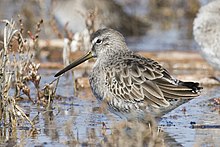
Twitchers clamber for glimpse of rare wader in Weymouth

Photo: Wikipedia

HUNDREDS of twitchers have been turning up to a Weymouth nature reserve hoping to catch a glimpse of a rare American bird.
The short billed dowitcher has got bird enthusiasts in a flap as it is only the second UK sighting of the bird.
Since it was officially identified the RSPB’s Lodmoor site has been inundated with twitchers. The bird was mistaken for the more common long billed dowitcher at first.
The small brown wading bird uses its long beak to forage for food in the mud and waters.
RSPB spokesman Luke Phillips said the team at Lodmoor believed the little bird might have been disorientated and blown off course from its winter migration by the recent Hurricane Isaac in the United States.
He said: “It’s a North American species. The recent hurricane they had in the United States could have sent it off in a slightly wrong direction, instead of sending it on its way to South America for the winter.”
The small billed dowitcher breeds in the far north of arctic Canada and migrates for the winter to warmer climes in South America.
Mr Phillips said: “It’s possible it could have been disorientated and started migration.”
He added: “It’s a long way from North America to here. It’s amazing they can fly that far.”