As regular CFZ-watchers will know, for some time Corinna has been doing a column for Animals & Men and a regular segment on On The Track... particularly about out-of-place birds and rare vagrants. There seem to be more and more bird stories from all over the world hitting the news these days so, to make room for them all - and to give them all equal and worthy coverage - she has set up this new blog to cover all things feathery and Fortean.
Showing posts with label Arctic tern. Show all posts

Wednesday, 27 November 2019

First evidence of the impact of climate change on Arctic Terns

NOVEMBER 19, 2019

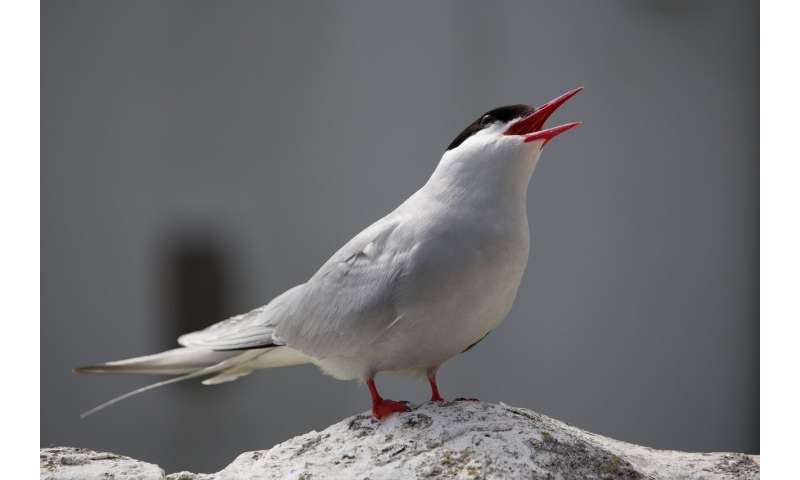
Credit: CC0 Public Domain

Data collected from electronic tags retrieved from 47 journeys made by the Farne Island Arctic Terns, has revealed for the first time how climate change might affect their behaviour.

Arctic Terns spend their breeding and non-breeding seasons in polar environments at opposite ends of the world and are our longest-migrating seabird.

Spending their non-breeding season in the Antarctic, the remoteness of this part of the world means that until now we have had a very limited understanding of their behaviour and distribution while they are there.

Analysing the data from 47 migrations over two study years, 2015 and 2017, the team found:
Arctic Terns live on the Antarctic ice for one third of their annual lifecycle.

Analysis of their feathers shows their main food source is krill or similar crustaceans.

There were marked differences in the bird's behaviour and distribution between those tagged in 2015 compared with those tagged in 2017. This coincided with a substantial change in ice conditions, with high ice cover in 2015 followed by unusually warm conditions which led to the break-up of the ice in late 2016 and lower ice cover than normal throughout the following year.

Dr. Chris Redfern, of Newcastle University, UK, who has led the study explained:

"Sea ice is an important habitat for juvenile krill as it provides protection from predators and from the intense light of the Antarctic summer.

"We now know that krill are the main food source for the Terns so it seems likely the warmer weather during 2016/2017 led to reduced krill abundance and so the birds were forced to forage in different areas.

"And in fact, in that second year, the birds converged on the Shackleton Ice Shelf rather than being spread out along the East Antarctica coastline.

Sunday, 14 July 2019

Bird found dead in Scotland was UK’s oldest Arctic tern


Published: 06:00Monday 08 July 2019
A seabird found dead on a nature reserve has been named the UK’s oldest ever recorded Arctic tern – beating the previous record by nearly two years.
First ringed as a chick at Buddon Ness in Angus, the tern was discovered at the Scottish Natural Heritage (SNH) Forvie National Nature Reserve in Aberdeenshire.
The bird was found to be 32 years old, almost to the day, when it died, which is more than double the averagetern lifespan of around 13 years.
The previous record holder was a tern recaptured on the Farne Islands, off the coast of Northumberland, in 2010, just over 30 years after being ringed as a chick.
Arctic terns are among the most remarkable birds that visit Scottish shores. Their pole-to-pole migration is the longest known annual journey by any animal.
By moving continually between Arctic summer and the Antarctic summer, terns see more daylight than any other creature on earth.
Clocking up up to 44,000 miles each year, the record-breaking bird may have flown up to 1.408 million miles during its lifetime.
Daryl Short, Reserve Officer at Forvie, who found the deceased bird, said: “It’s incredible to think that the bird I found flew the equivalent of to the moon and back, and then back to the moon and some way home again.
“Arctic terns are amazing animals. The birds are currently protecting their chicks at Forvie and other nature reserves around the country and they’re not afraid to give you a bump on the back of the head if you get too close to their nests.

Thursday, 4 April 2019

Overland migration of Arctic Terns revealed


Date:  March 25, 2019
Source:  Newcastle University
Data from a landmark study of the world's longest migrating seabird reveals how overland migration is an integral part of their amazing journey.
Analysing the data from electronic tags retrieved from 47 Arctic Terns, the Newcastle University-led team has been able to characterise in unprecedented detail the route and stop-off points during this record-breaking bird's 90,000 km annual migration.
This includes:
An 8,000km, 24-day, non-stop flight over the Indian Ocean, feeding on the move
An overland detour from the Farne Irelands to the Irish Sea and over Ireland to the Atlantic
A short stay on the New Zealand coast before completing the final leg of their journey
A stop-off at Llangorse Lake, in the Brecon Beacons National Park, during their return journey in the Spring
Led by scientists at Newcastle University, UK, in collaboration with BBC's Springwatch and The National Trust, 53 adult birds nesting on the Farne Islands off the Northumberland coast were fitted with geolocators over a three year period.


Friday, 10 June 2016

Tiny sea bird makes longest-ever known annual migration from Antarctica to Northumberland


00:00, 7 JUN 2016
BY TOM WHITE

The Arctic tern weighs less than an iPhone yet covered a massive 96,000km on its journey to its winter home before returning to the UK

A tiny sea bird has made the longest ever known annual migration, which saw it fly from Northumberland to Antarctica and back.

The record breaking Arctic tern, which weighs less than an iPhone, covered a mammoth 96,000km in its journey down to its winter home in the Weddell Sea before returning to the Farne Islands.

It was part of a study carried out by scientists at Newcastle University for BBC’s Springwatch, which mapped for the first time the annual migration of the terns.

Last year, 29 birds were fitted with geolocators by the researchers and have now returned to the islands to breed.

The previous record had been held by an Arctic tern that covered 91,000km on its flight from the Netherlands.

Dr Richard Bevan, from Newcastle University’s School of Biology, said: “It’s really quite humbling to see these tiny birds return when you consider the huge distances they’ve had to travel and how they’ve battled to survive.

“So far we’ve managed to catch 16 of our tagged birds from last year and we’ve seen at least another four birds with our geolocators attached.