Record 35 chicks expected to leave nests this year in successful wildlife comeback
Simon Birch
Fri 2 Aug 2019 09.00 BSTLast modified on Fri 2 Aug 2019 14.35 BST
This summer, as the snows finally melt across the Alps, a record 35 bearded vulture chicks are expected to leave their nests and take to the skies to patrol their mountain home, in one of the most successful wildlife comebacks of recent times.
“Bearded vultures were hunted to extinction in the Alps in the early 20th century. People referred to them as the devil bird believing that they would carry off small children and sheep,” said Théo Mazet, who works for Asters, a French wildlife organisation helping to bring the birds back to the Alps.
But attitudes have changed and the vultures have made a dramatic return, albeit with a helping hand.
“A captive breeding and reintroduction project began in the late 1980s and there are now a total of 250 birds, including 50 breeding pairs of bearded vultures in the Alps,” said Mazet.
Mazet works at a specialist captive breeding centre in a secluded forest high above the alpine town of Sallanches, one of five centres in the mountain range.
Here Mazet prepares food for the seven vultures housed in the centre’s massive aviary. He carefully weighs chunks of freshly butchered sheeps’ and goats’ legs for the birds – the only avian species to live on a diet of animal bones.
“Bearded vultures are scavengers and act as the rubbish collectors of the natural world which helps to eliminate potentially harmful bacteria and the spread of diseases, so keeping the mountain environment healthy,” he said.
Key to the project’s success has been the 100 captive vultures held in the breeding centres throughout Europe, which in turn are providing birds to be returned to the wild.
continued
Showing posts with label bearded vulture. Show all posts
Showing posts with label bearded vulture. Show all posts
Sunday, 4 August 2019

Friday, 8 June 2018
Europe’s biggest bird, the bearded vulture, is spotted over Zeeland
May 28, 2018
Europe’s biggest bird, the
bearded vulture, has been spotted over the province of Zeeland, broadcaster
Omroep Zeeland reports.
The bird, which has a wingspan of
almost three metres, was seen near Oostkapelle and the dunes at Dishoek at the
weekend.
The bearded vulture (Gypaetus barbatus), or lammergeier, is
rarely seen in the Netherlands. Its European habitat is in the Alps and the
Pyrenees where it was successfully reintroduced some forty years ago. The
quebrantahuesos (bone breaker), as they are called in Spain for the way they
drop bones from a great height to break them up in bite-size pieces, very
nearly became extinct, falling victim to poachers who robbed their nests,
hunters and sheep herders putting down poison.
Read more :
Read more :
Friday, 19 August 2016
Bearded Vulture Larzac found dead in northern Germany
The young male bearded vulture -
named Larzac – that left the Grands Causses several weeks ago to make a
complete tour of the Netherlands, and that had disappeared in northern Germany, has now
been found dead.
After spending some time in the
Netherlands and Belgium, Larzac flew to northern Germany on the 2nd of July. He
reached the island of Fehman before he turned around and flew back to the
mainland. The last data from his GPS tag was received on the 4th of July, in
the Schleswig-Holstein region.
Local birders checked the place
of the last GPS position, but they could not find Larzac, nor the
transmitter. Soon
after, we have mobilized German colleagues to spread the news about Larzac´s
disappearance. Conservation organizations such as NABU, BUND,
OAG (Arbeitsgemeinschaft Ornithologische Schleswig-Holstein), and all
rehabilitation centers in the region were contacted. And the news spread
quickly. Several articles about Larzac were published in specialized and
generalist press - so much so that we have received two possible observations
of Larzac, on the 13th and 20th of July 2016. These observations were very
approximate and hardly credible but gave us hope.
Unfortunately, the corpse of
Larzac was found on Monday 25th of July 2016 by a NABU volunteer. The body was
underneath a non-electrified line (pending removal after being buried!).
Considering the state of decomposition of the corpse of Larzac, we can assume
that his death goes back to the beginning of July.
The rests are now being sent to
France for comprehensive post-mortem analysis, so that we try to determine the
exact cause of death.
Thursday, 26 May 2016
'Sea hating' rare pelican and vulture could stay in UK
Two extremely rare birds which
were blown across to the UK due to prolonged wind currents could remain in the
country due to their dislike of sea crossings, experts have said.
A Dalmatian pelican which has
been spotted in Cornwall had not been seen in the country for hundreds of
years.
Meanwhile, a bearded vulture has
been seen in Wales, Devon and Cornwall.
Experts said the birds, which are
both "major rarities" had arrived in the UK on prolonged south
easterly airflows.
The species are more commonly
found across south eastern Europe, India and China.
Paul Freestone, from the Cornwall
Birding website, said thousands of birdwatchers had travelled from across the
country to try to see the birds.
"It's completely
unprecedented to have two major rarities in the South West," Mr Freestone
said.
'Reached end of the land'
Paul Stancliffe, from the British
Trust for Ornithology, said both birds were first seen in other parts of
Europe, with the pelican seen in Poland and vulture reported in Belgium before
they arrived in the UK.
Mr Stancliffe said both birds,
which are currently in Cornwall, "don't like sea crossings" so it was
"possible" for them to remain in the UK for the foreseeable future.
The pelican was first
seen on 9 May in West Cornwall and the vulture was first
photographed close to the second Seven Crossing on 12 May.
The Met Office said that since
the beginning of May south easterly winds had been regular across central and
southern Europe.
Tuesday, 24 May 2016
Fears for rare vulture spotted over Dartmoor
By WMNKRossiter | Posted:
May 23, 2016
By Keith Rossiter
Farmers should be allowed to
leave animal carcasses out in the fields to ensure that a rare vulture spotted
in the Westcountry does not starve to death, a conservationist says.
As reported in the WMN last week,
a lammergeier was
filmed over the Severn eastuary near Bristol, and later spotted near the
Venford reservoir on Dartmoor in Devon.
There were numerous reports of
sightings over Dartmoor today.
"This is an amazing thing to
have happened," conservationist Derek
Gow said.
Watch the vulture in flight
"There are very few records
of vultures coming to Britain in the past."
He said lammergeiers were found
in mountainous regions such as the Pyrenees and the Alps.
In Spain, farmers have a
dispensation to dispose of animal carcasses in an area frequented by
lammergeiers.
"Britain is too
sterile," Mr Gow said. "Farmers aren't allowed to leave dead
livestock out in the fields.
"Birds like vultures and red
kites are really going to struggle for food here.
"In this landscape you will
find the occasional dead sheep, but you are just not going to find the numbers
needed.
"Leaving carcasses out isn't
something that can't be done under EU law.
"Defra needs to make it
possible for farmers."
Mr Gow said that although the
lammergeier could have escaped from a collection somewhere in Britain, it was
more likely to be a juvenile from a wild population in the Alps or Pyrenees
which was looking for new territory.
Tuesday, 17 May 2016
Spectacular bearded vulture spotted for first time in UK
Ornithologists hope for glimpse of species reported to have been seen in Wales and west country
Monday 16 May 201618.09 BST Last modified on Tuesday 17 May 201600.50 BST
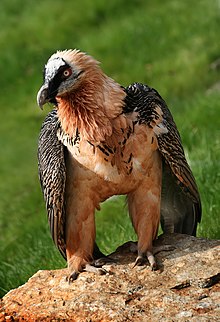 A spectacular bearded vulture, believed to be the first recorded in the UK, has been spotted soaring over the Severn estuary and moorland in Devon.
If it is confirmed that the vulture, also known as the lammergeier or ossifrage, is a wild bird, it will be the first of its species to be found in Britain and the sightings have already caused ornithologists to rush to the west country hoping for a glimpse.
The lammergeier was filmed on the Welsh side of the Second Severn Crossing at the end of last week, perched on rocks then flying off toward the bridge.
It is believed the same bird was seen last weekend over Dartmoor in Devon about 100 miles away. Though already a sizeable bird, the specimen is thought to be a juvenile. Adults can boast a wingspan of almost three metres (9.8ft).
Josh Jones, news manager at BirdGuides, said the sighting was very exciting. “I think we’re going to have a lot of people wanting to take a look,” he said. “This is special bird and we could get monster crowds.”
The same bird is believed to have been spotted in Belgium earlier this month. Some lammergeier have been released in the Alps as part of reintroduction programmes but those birds have dyed feathers so can be easily recognised.
There were no obviously dyed feathers – or rings – on the Severn vulture which suggests it could be a genuinely wild bird. Young lammergeier do travel large distances.
The bearded vulture eats mainly carrion and lives and breeds on crags in high mountains in southern Europe, the Caucasus, Africa, the Indian subcontinent and Tibet.
A posting on the Gwent Birding website relating to the sighting near the Severn estuary reads: “Lammergeier at Sudbrook, Gwent on Thursday 12th May. Seen to fly east, then circle and head west. Possibly/probably the bird seen in Belgium on 9th May. No obvious signs of bleached flight feathers (as per at least some reintroduced birds), colour marks, etc.”
Tuesday, 10 February 2015
Technology solves disappearance mystery of one of Africa’s famous birds
The mystery of the gradual disappearance of the Bearded Vulture, one of Africa's most famous birds, has been solved using the technology of satellite tracking.
Once widespread throughout much of Southern Africa, the Bearded Vulture is now critically endangered, with a decline in nesting sites of nearly 50 per cent since the 1960s.
The remaining population is now restricted to the Drakensberg mountains in Lesotho and South Africa. But even in these isolated mountains they continue to decline.
Satellite trackers attached to 18 Bearded Vultures have confirmed conservationists' worst fears: humans are largely to blame with collisions with power lines and poisoning being the two major vulture hazards that killed half of the birds in the satellite tracking survey.
These are key findings contained in two new research projects published this month. The studies paint the most detailed picture to date of the challenges facing the Bearded Vulture, also known as the 'bone breaker' due to its habit of dropping bones from a height to feed from the marrow inside.
Wednesday, 12 February 2014
Endangered vultures face added threat
January 30 2014 at 09:17am
By Tony Carnie
Durban - Two endangered African vulture species face danger from dozens of new wind turbines in Lesotho, the world bird conservation network Birdlife International warned on Wednesday.
Reacting to the approval of a wind farm near the Ukhahlamba-Drakensberg world heritage site in KwaZulu-Natal, Birdlife said the 42 turbines were likely to have “severe impacts” on vulture conservation.
The Letseng wind farm is in one of the main breeding and roosting grounds of the Bearded Vulture and Cape Vulture.
There are only 100 breeding pairs of Bearded Vulture in southern Africa, with nearly 60 percent of the population in Lesotho. This species is listed as endangered, but is expected to be relisted as critically endangered in the next edition of the Red Data book of birds.
Subscribe to:
Posts (Atom)