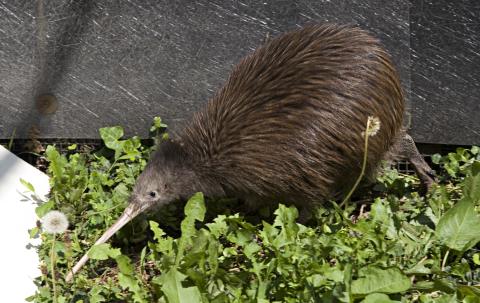
As regular CFZ-watchers will know, for some time Corinna has been doing a column for Animals & Men and a regular segment on On The Track... particularly about out-of-place birds and rare vagrants. There seem to be more and more bird stories from all over the world hitting the news these days so, to make room for them all - and to give them all equal and worthy coverage - she has set up this new blog to cover all things feathery and Fortean.
Showing posts with label brown kiwi. Show all posts

Wednesday, 25 March 2020

Two Brown Kiwi Die at Smithsonian Conservation Biology Institute

Mar. 20, 2020


Animal care staff at the Smithsonian Conservation Biology Institute (SCBI) are mourning the loss of two kiwi who were found deceased in their habitat March 7 and 8. The male, Ngati Hine Tahi, and female, Ngati Hine Rua, were 15 years old. Before their deaths, both birds appeared to be healthy and did not have any history of illness. Preliminary findings suggest that an intestinal infection and bacterial-toxin production were the causes of death. A final pathology report will provide more information in the coming weeks. Their habitat, Kiwi Flats, has been quarantined, and SCBI’s remaining kiwi have been moved to other animal holding areas to avoid spread of any infectious agent. These kiwi were examined by veterinary staff and remain healthy. 

Ngati Hine Tahi and Ngati Hine Rua arrived at SCBI in July 2010 as a gift from New Zealand. At the time, they were the first export of kiwi in more than 20 years, and adding them to the genetic pool in North America was a rare and valuable opportunity to breed and study this vulnerable species. Upon their arrival, SCBI held a ceremony with a traditional Maori blessing with former New Zealand Ambassador Roy Ferguson and Consul General John Mataira. Both birds came from the Ngati Hine people in New Zealand, and their bodies will be repatriated to the tribe for burial.

When Ngati Hine Tahi arrived at SCBI, he tipped the scales at 7.4 pounds, more than 40% above the ideal weight for brown kiwi. He had a propensity for stealing Ngati Hine Rua’s food and snacking on worms in his yard after rain. The extra weight made it difficult for Ngati Hine Tahi to get into position for successful breeding. Keepers devised a clever enrichment feeder that prevented him from overeating. Since females have longer beaks, keepers put their diets of meat, fruit and vegetables into the bottom of long tubes so that Ngati Hine Tahi could not reach Ngati Hine Rua’s food. Over time, he slimmed down to a svelte 4.8 pounds, and the pair successfully bred. 

Sunday, 2 June 2019

Toledo Zoo announces recent hatching of brown kiwi chick


THE BLADE
 MAY 16, 2019
 The Toledo Zoo announced Thursday that a female North Island brown kiwi chick recently hatched at the zoo’s Avian Breeding Center.
The egg was laid Jan. 9 at the Smithsonian Conservation Biology Institute, which is affiliated with the National Zoo in Washington, D.C. Staff there determined the developing embryo inside was a female through sophisticated blood-draw techniques.
They drove the egg to the Toledo Zoo several weeks before its expected hatch date to finish incubating here. The yet-to-be-named chick hatched March 21, appears healthy, and is currently being raised off-exhibit.
North Island brown kiwi are one of five existing kiwi species endemic to New Zealand. Only about half of all kiwi eggs hatch successfully and nearly 90 percent of chicks die within six months.


Sunday, 5 June 2016

A kiwi is born! Rare flightless New Zealand bird hatched at National Zoo’s Virginia research facility

It’s taken nearly six years, but two endangered flightless birds have a chick that hatched in May at the National Zoo’s research facility, a spokeswoman said.

The brown kiwi, which is native to New Zealand, made its debut May 10 at the Smithsonian Conservation Biology Institute in Front Royal, Va.

Devin Murphy, a zoo spokeswoman, said this is the first time a chick has hatched at the biology institute. And the little one is special: It’s the first offspring of two kiwis — Ngati Hine Rua and Ngati Hine Tahi — that were given as a gift from the government of New Zealand in 2010.

The birds — which are similar in size to chickens — mate for life, Murphy said. And when the chick’s parents arrived in Virginia six years ago, they were the first kiwis to leave New Zealand in 20 years.

After the chick’s mother, Ngati Hine Rua, laid the egg, she did not incubate it. Female kiwis do not incubate eggs, which typically weigh about 20 percent of the mama’s body weight, Murphy said. Instead, male kiwis do most of the work, and in this particular case, officials said, a kiwi named Iwi incubated the egg for 30 days before keepers placed it in an incubator.