As regular CFZ-watchers will know, for some time Corinna has been doing a column for Animals & Men and a regular segment on On The Track... particularly about out-of-place birds and rare vagrants. There seem to be more and more bird stories from all over the world hitting the news these days so, to make room for them all - and to give them all equal and worthy coverage - she has set up this new blog to cover all things feathery and Fortean.
Showing posts with label poisoning. Show all posts

Friday, 28 February 2020

Mass poisoning causes a heavy blow to the largest colony of Griffon Vultures in mainland Greece

We are devastated to report that eleven Griffon Vultures fell victim to poisoning in the area of Klisoura Gorge in Greece. Unfortunately, nine vultures died from the incident, and two are alive but currently in recovery.
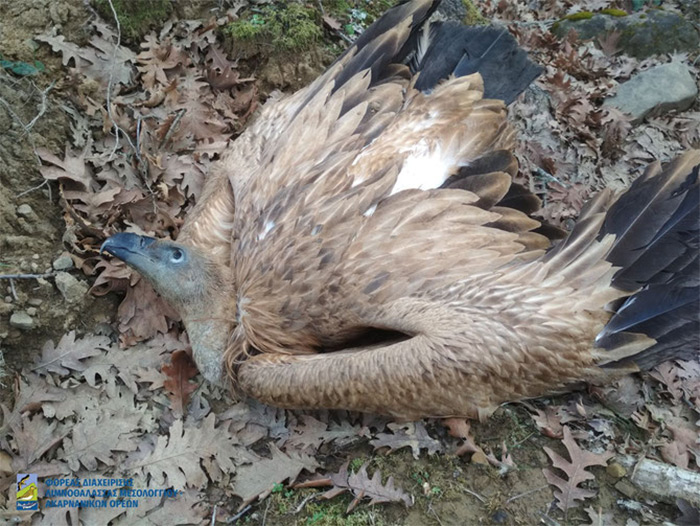
A total of eleven Griffon Vultures, a protected and critically endangered species in Greece, have been found poisoned in Klisoura Canyon in the Messolonghi-Etoliko Lagoon National Park a few days ago. This is the most severe poisoning case recorded in the country, after the one in the Strait of Nestos in 2012, and the largest confirmed case for Griffon Vultures.

The Messolonghi Management Body and HOS/BirdLife Greece discovered the carcasses of the nine Griffon Vultures. Executives from the Management Body of the Hunting Association of Messolonghi recovered the other two Griffon Vultures, which are currently alive and are being treated at ANIMA, gradually showing signs of recovery from poisoning. The dead vultures will be sent to the Athens Veterinary Foundations Centre for toxicological analysis, and to help avoid further poisoning.

Concerns about the fate of the rest of the vultures in the area are high and the danger of the local vulture population collapsing remains. The Griffon Vulture colony of Klisoura and Akarnania, are the only ones left in Western Greece and the largest remaining in the mainland.

Monday, 22 April 2019

Predators fall prey to poison attacks by pigeon fanciers


Shingi Mararike
March 31 2019, 12:01am, The Sunday Times
Birds of prey are being illegally trapped and poisoned by pigeon fanciers to protect their prized racing birds, according to Scotland’s leading animal welfare charity. The Scottish Society for Prevention of Cruelty to Animals (SSPCA) has raised concerns about the activities of some pigeon breeders, who allegedly go to extreme lengths to keep their birds safe from predators such as sparrowhawks and peregrine falcons.

Thursday, 7 March 2019

RSPB believes as many as 10 ravens were deliberately killed with poison, near Knighton


19th February
West Mercia Police has carried out an investigation after 10 dead ravens, a dead crow and parts of a dead lamb were found close together on farmland near Vron Woods, Beguildy, near Knighton, on the Powys/Shropshire border.
The birds were reported to the RSPB and collected by Natural England in April 2018, which sent the birds to be tested.
Government toxicology tests on five of the ravens, the crow and the lamb confirmed the presence of Diazinon. This is a veterinary product, used legally for sheep dip, but which is known to have been used illegally to poison wildlife. It is believed the lamb carcass was deliberately laced with Diazinon for this purpose.
Birds of prey and ravens are protected by the Wildlife and Countryside Act 1981. To kill or injure one is a criminal offence and could result in an unlimited fine or up to six months in jail. Police interviewed a local person under caution but, due to lack of evidence, the case could go no further.
Ravens are a recovering species which breed mainly in Wales, Scotland, and western and northern England.
Jenny Shelton from RSPB Investigations said: “Shropshire has a history of Diazinon abuse for the purpose of illegally targeting birds of prey and other protected species. We are grateful to Natural England and the police for investigating this matter, which poses a serious threat to wildlife and people.
"Ravens are incredibly intelligent creatures, able solve problems and form memories similar to our own. These once-scarce birds are gradually starting to recover after persistent persecution at the hands of humans, so it’s disturbing to hear of incidents like this still taking place.
“This area is also a stronghold for red kites – another bird making a comeback after disappearing entirely from England due to persecution. Poison baits pose a danger to these birds too.”
If you have any information relating to this incident, call West Mercia Police on 101.
The RSPB is urging people to be vigilant and report dead birds of prey or ravens this spring – a key time of year for illegal poisoning to take place. If you find a dead bird of prey or raven beside a carcass that could be a poison bait, contact the government hotline on 0800 321600. Alternatively contact the police on 101 or RSPB investigations on 01767 680551.

Sunday, 17 February 2019

Up to 100 vulture deaths prevented by rapid response to poisoning


On Sunday morning, a wildlife ranger in Nairobi, Kenya discovered 20 dead and 5 critically ill vultures slumped around a poisoned hyena carcass. Despite these tragic casualties, a rapid response protocol set up with the help of BirdLife almost certainly saved the lives of many more.
On the morning of the 27th of January, Eric Ole Reson was on his routine patrol on the Northern border of the Masai Mara when he spotted a group of vultures struggling to fly. Concerned, he hurried towards them, and stumbled across a tragic scene: 20 vultures lay dead around a hyena carcass, all of them Globally Threatened species including the Lappet-faced Vulture (Endangered) and Rüppell's Vulture (Critically Endangered). Beside them, six more vultures thrashed about in a critically ill state.
But despite this horrifying diorama, Reson didn’t panic or despair – he took action immediately. He knew exactly what he needed to do thanks to Kenya’s Rapid Response Poisoning Protocol, set up last year by a collaboration between BirdLife partners and other Kenyan conservation organisations* to tackle the growing threat of vulture poisoning.
Reson works for the The Peregrine Fund and the Masai Mara Wildlife Conservancies Association, organisations who regularly patrol the area for signs of incidents just like these. Following protocol, Reson mobilized support from Kenya Wildlife Service and Kenya Bird of Prey Trust, members of the collaboration, who arrived on the scene in time to collect forensic samples and rescue the surviving birds. They were joined by nearby community members who had also been trained in the Rapid Response Poisoning Protocol.
5th February 2019

Sunday, 23 December 2018

Buzzard found poisoned in Ayrshire

03/12/2018
Police Scotland has issued a warning after an illegally poisoned Common Buzzard was found on the outskirts of Mauchline, Ayrshire, on 2 November by a member of the public.. It was still alive upon discovery, although in a severely distressed state, but thankfully survived the ordeal. A toxicology report confirmed the buzzard had ingested poison.
As a result of the report verdict, Police Scotland are concerned that this illegal activity is happening in the area and have appealed to the public for any information that may lead to detecting the person responsible for this deliberate act.
PC Sam Briggs, Wildlife Crime Officer, said: "It is a serious concern that someone has targeted wildlife in this illegal and indiscriminate manner. If anything unusual is discovered I would advise not to touch it, but instead cover it if you can and contact the police, giving them the exact location."
Police are working alongside partner agencies Scottish SPCA, Science and Advice for Scottish Agriculture and Agricultural Officers to fully investigate the matter. Anyone with information on the illegal use of pesticides or who may has seen something suspicious – particularly in the last month or so – is advised to call 101 and quote No: SP-20181120-2194 or Crimestoppers anonymously on 0800 555 111.
This latest episode involving Common Buzzards is one of several to have occurred during the last 12 months, with other incidents having taken place in Co Cork, Powys and North Yorkshire.

Source  

Thursday, 27 September 2018

Man used poison to kill more than 130 wedge-tailed eagles in Australia, prosecutors say


Incident is largest case of protected species' poisoning in state history, Victoria officials say
Thursday 13 September 2018 09:36
A man has been charged over the deaths of more than 130 wedge-tailed eagles – Australia’s largest bird of prey.
The bodies of 136 birds were found hidden in scrubland on properties in Tubbut, Victoria, in south east Australia’s Snowy Mountains region, in April.
It is alleged the man used poisoned baits to kill the protected species between October 2016 and April 2018.
Victoria’s Department of Environment Land Water and Planning (DELWP) said it was the largest case of wedge-tailed eagle deaths in the state’s history.
“We would like to inform the community that investigations are ongoing, including forensic examination of evidence recently seized during searches of relevant properties,” a spokeswoman said.
In June, locals told the authorities they feared the true figure could be far higher.
The remains of the birds found were spread across four properties which covered about 2,000 hectares.
The Australian Broadcasting Corporation understands the man charged is not the owner of the Tubbut properties involved.
He is facing two charges under the Wildlife Act 1975 and has been released on bail. The deliberate killing of this number of wedge-tailed eagles carries a maximum penalty of up to six months’ imprisonment and fines totalling about AUS$115,000 (£63,000) the ABC said.
The man was charged following a state-wide investigation involving more than 30 people.


Sunday, 8 July 2018

POISONED - Rare birds of prey killed in south Kilkenny


INTENTIONALLY TARGETED - LARGE AMOUNTS OF THE POISON CARBOFURAN INGESTED BY DEAD RAPTORS

Sean Keane
2 Jul 2018

A pair or rare and legally protected birds have been intentionally poisoned at their nesting place in South Kilkenny.

Large amounts of the poison carbofuran was ingested by them near their nests at the Slate Quarries, close to the Tipperary border.

Ranger with the National Parks and Wildlife Service, Jimi Conroy believes that a live pigeon was probably used as bait and was first covered in the poison and then tied to a stake close to the nest to lure the nesting couple.

He said that the fact two had been killed had made it certain they were knowingly poisoned and because carbofuran is a controlled substance, he believes it was intentionally used to kill them.
He said it was a shocking crime and that because peregrines are so rare they are protected under The wildlife Acts.

He is looking for information which will lead to the conviction of those responsible. He is asking anyone that saw anything suspicious in the Slate Quarries area over the last number of weeks, including the tying up of a pigeon to come forward. The number to ring is 076-1002655


Friday, 29 June 2018

Protected red kites poisoned in Northern Ireland


June 20 2018
The PSNI have launched an investigation after a pair of protected birds died after being poisoned in Co Down.
The Royal Society for the Protection of Birds (RSPB) NI and the PSNI have appealed for information after the pair of protected red kites died.
A male bird was found in distress close to a known nest site in the Katesbridge area on April 24. A member of the public alerted RSPB NI but the bird died shortly afterwards.
When the RSPB NI red kite project officer attended the scene, she found the female parent bird immobile on the nest – she too was dead. A rescue mission was launched in an attempt to save three orphaned eggs found in the nest beneath the deceased mother.
The bodies of the parent birds were collected and taken for toxicology testing by the PSNI. This has now revealed that both birds – known as Blue 21 and Red 63 because of their identifying tags - died from Carbofuran poisoning.

Monday, 4 June 2018

Rare birds ‘at risk of poisoning from eating lead shot’


Warning by expert panel says up to 400,000 wildfowl a year may suffer lead poisoning

Sun 27 May 2018 08.00 BST

Several rare bird species, including a breed of red-headed duck listed as “vulnerable”, are under threat from lead poisoning linked to shooting, a new report says.

Numbers of common pochard, a duck species at risk of global extinction, have fallen substantially over the past 30 years, a decline partly attributed to the fact that they eat some of the 5,000 tonnes of lead pellets discarded in the countryside by people shooting game, according to the Lead Ammunition Group (LAG).

Other species affected by lead poisoning include the grey partridge, which is also on the RSPB’s “red list” of threatened species, as well as the golden eagle, common buzzard and red kite, the LAG says.

The warning comes in a major new report by the LAG, an expert panel set up by the government in 2010, which says up to 400,000 wildfowl a year may suffer from lead poisoning, causing up to 100,000 deaths. Recent research cited in the report shows that lead can be toxic at lower levels than previously thought.

More than 600,000 people go shooting in the UK each year, part of an industry worth about £2bn. They typically use lead shot to hunt birds, a practice known as wildfowling. The shot scatters when it leaves the gun barrel, and a large proportion falls to the ground. Birds eat the lead shot, mistaking it for the gravel their gizzards need to digest food.


Monday, 7 May 2018

Rare vultures poisoned


Avik Chakraborty Apr 23, 2018 00:00 IST

Dibrugarh: As many as 18 rare slender-billed vultures were found dead at Jamuguri Gaon in the Demow area of Sivasagar district on Sunday. According to a forest official, they died after eating a poison-laced carcass of a calf.

Three other vultures are in critical condition and provided veterinary care by a vulture-conservation team.

Talking to this correspondent on Sunday, Sivasagar divisional forest officer Bidya Bordoloi said the incident took place at Nitaipukhuri Jamuguri village near Pani Dihing wildlife sanctuary.

Bordoloi said the flock of vultures had died after consuming the poisoned carcass of a calf that was dumped in a paddy field on Saturday evening by goons. The official added that post mortemof the vultures confirmed that they had died of poisoning.

Continued  

Friday, 6 April 2018

Birds of prey found poisoned in southwestern Slovakia


The perpetrators might spend one to six years in prison if found guilty.

State conservationists have launched special inspections in areas inhabited by rare birds of prey, following the increased number of cases where poisoned animals were found close to municipalities in southwestern Slovakia.

Just during the past week, a female eastern imperial eagle from Hungary was found poisoned close to the village of Malý Cetín, and four white-tailed eagles were discovered in the district of Šaľa (both in the Nitra Region). Most recently, the police informed the public about two new cases from the Nitra Region on March 29, involving common buzzards and the western marsh harrier.

“All crucial measures are aimed at reducing the risk of this serious deed,” said Martin Lakanda, head of the State Nature Protection of Slovakia (ŠOP SR), as quoted by the SITA newswire. “The employees of ŠOP SR, in cooperation with the relevant subjects, are carrying out a special inspection of affected areas and will intensify the guarding of selected localities.”

Read on 

Sunday, 25 February 2018

Andean Condors poisoned in Colombia

12/02/2018

After last week’s large-scale poisoning of Andean Condors in Argentina was found to have been caused by Carbofuran, the Vulture Conservation Foundation (VCF) has reported another case of poisoning, this time from Colombia. Two condors were found dead in the country, where only around 100 individuals remain in the wild.

Poison is the biggest threat to vultures worldwide. This was the main conclusion of the Vulture Multi-species Action Plan, which was co-developed by VCF and has been recently endorsed by the Convention for Migratory Species (CMS). A significant part of this global action plan for vultures focuses on the fighting this threat.

In Europe, VCF is actively pursuing different lines to these ends, including a brand new project in the Balkans, where the organisation will be working and funding local partners in Croatia, Albania, Bosnia-Herzegovina, Macedonia and Greece to try to eradicate this illegal and highly damaging practice.

In South America, Fundación Bioandina Argentina (FBA), which is leading the Andean Condor Conservation Program of Argentina, is implementing similar actions, as cases of poisoning have grown exponentially. In the last 13 months, at least 66 condors were killed by poison in several provinces of the country.


Wednesday, 31 January 2018

Marijuana farms poisoning Spotted Owls


Wildlife species are being exposed to high levels of rat poison in northwest California, with illegal marijuana farms the most likely source point, according to a study led by the University of California, Davis, with the California Academy of Sciences.

The study, released in the journal Avian Conservation and Ecology, showed that seven of the 10 Northern Spotted Owls collected tested positive for rat poison, while 40 percent of 84 barred owls collected also tested positive for the poison.

The study is the first published account of anticoagulant rodenticide in Northern Spotted Owls, which are listed as a threatened species under federal and state Endangered Species acts.

The study area encompasses Humboldt, Mendocino and Del Norte counties. It supports previous accounts that rat poison is contaminating the food web in this region, as the primary food source for owls—rodents—is being contaminated.

Timberland converting to marijuana farms
Driving the issue is the increasing conversion of private timberland into private, illegal and unpermitted marijuana cultivation sites. These sites often overlap with designated critical habitat for Northern Spotted Owls, and the owls feed at their edges.


Friday, 2 June 2017

Collateral damage - ivory poachers poison over 90 Critically Endangered vultures


Hundreds of vulture researchers and conservation managers have been engaging with the VCF and other organisations to prepare the Vulture Multi-Species Action Plan - a seminal piece of work commissioned by the Raptors MoU of the Convention for Migratory Species (CMS), and that aims to plan and guide conservation policy and actions for the next decade on the conservation of the 15 old world vultures. The main message that has resonated across the many meetings and workshops held is one – poison is the biggest threat to vultures worldwide. 

This once again came to light yesterday [22 May] – ironically, when we are celebrating the International biodiversity day – when news that at least 94 African White-backed Vultures were found dead around a poisoned elephant carcass on the Zimbabwe-Mozambican border, one more victim of the rampant poaching for ivory in that part of the world. 

The vultures were victims of what experts call “sentinel poisoning” – they were killed with a potent poison so as not to alert wildlife enforcement brigades about the presence of the carcass, so that poachers could hack the ivory out without being detected. 

The scene has been properly investigated and is being decontaminated to prevent any additional poisoning from taking place. 

This is yet another devastating blow to African vultures – and a sign that the African vulture crisis continues unabated. Most of African vulture species are now either critically endangered or endangered. This poisoning incident will have even bigger consequences as the breeding season for African white-backs is now starting in that part of the world – many of the dead birds would be adult birds attending a nest. 

At least two of the killed birds were wing-tagged, originating in South Africa and Swaziland – another reminder that conservation knowns no borders and needs concerted international action – such as the vulture MSAP and events like´ International Biodiversity Day.


Sunday, 18 September 2016

Dead birds of prey found on estate in 'most significant wildlife poisoning case ever recorded in Wales'


13:19, 7 SEP 2016
UPDATED 13:19, 7 SEP 2016

Investigators said an inquiry revealed 'the extensive use of poisoning'

Slain birds of prey were discovered on land belonging to a Queen’s representative in Wales in what has been dubbed “the most significant wildlife poisoning case ever recorded” in Wales.

Eight buzzards, five red kites, two ravens and five pheasants – used as bait for the other birds – were discovered on the Glanusk estate.

The land belongs to the Legge-Bourke family. Shân Legge-Bourke is Lord Lieutenant of Powys and the mother of the nanny of Princes Harry and William, Tiggy.

There is no suggestion the family have done anything wrong.

In a statement posted on Twitter, the Glanusk estate said the incident was “nothing to do with the management team or the owners of the estate” and that they “followed and complied with and aided the investigation at all stages.”

The estate said the incident happened “on a forested area of the outer estate grounds and not within the Glanusk Park walls” and that “the owners and management of the Glanusk estate continue to observe the highest standards of animal welfare and general habitat wellbeing.”

A spokesman added: “This was an abhorrent incident at the time and deeply upsetting for the owners and trustees of the estate who were disappointed there was not enough evidence for the CPS to prosecute.”

The edge of the Glanusk Estate, near Crickhowell

The dead birds were found in 2013 but the incident has not been reported until now.
In October the year before four pheasants were discovered near the remains of a red kite. The kite could not be tested but the pheasants were poisoned.

TV wildlife expert Iolo Williams was appalled by the incident. He said: “It is the second worst incident of bird of prey poisoning in the UK 

in the last 40 years. It’s horrific, disgusting, absolutely disgusting. This is something that belongs in Victorian times.”