As regular CFZ-watchers will know, for some time Corinna has been doing a column for Animals & Men and a regular segment on On The Track... particularly about out-of-place birds and rare vagrants. There seem to be more and more bird stories from all over the world hitting the news these days so, to make room for them all - and to give them all equal and worthy coverage - she has set up this new blog to cover all things feathery and Fortean.
Showing posts with label Israel. Show all posts

Wednesday, 11 December 2019

Israeli fish farmers give peckish pelicans free lunch

DECEMBER 8, 2019

by Jonah Mandel
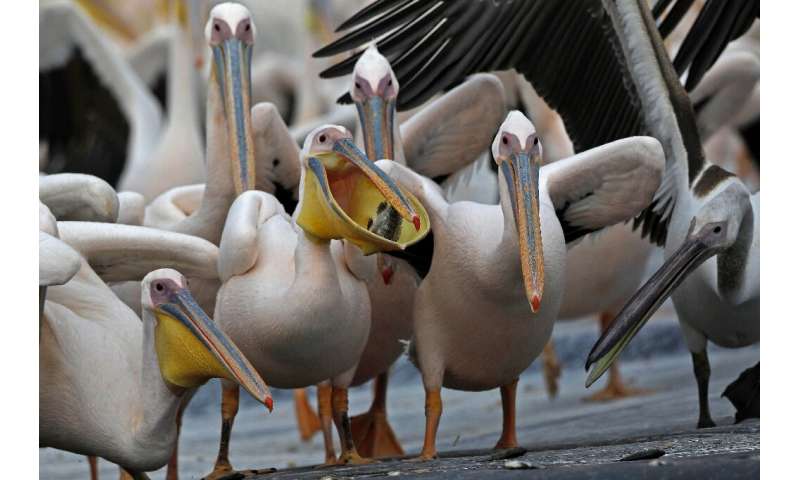
Great white pelicans eat fish provided by Israeli farmers at a water reservoir in the Emek Hefer valley north of Tel Aviv

Migratory pelicans have long raided Israeli fish farms, which try to deter them with loudspeakers, laser beams and by firing blank rounds from rifles.

In their desperation, they have come up with another way: offering the birds a free lunch.

An estimated 50,000 pelicans stop off in Israel during their annual migration from the Balkans to Africa, where they enjoy a mild winter before returning to Europe.

They rest and feed in the Middle Eastern country for weeks, causing chaos for fish farmers, whose outdoor commercial pools and reservoirs provide rich pickings.

Before the pelicans reach Israel, "they have nowhere to stop and eat", said Eli Sharir, general manager of the Israel Fish Breeders Association.

The impact on the fish farms is enormous.

"We're talking millions of shekels a year," he said.

So six years ago Israeli fisherman came up with a solution—providing alternative feed with unmarketable fish to try to keep pelicans away from the commercial pools.

One recent day on a reservoir in northern Israel, hundreds of great white pelicans swooped down to position themselves in the shallow waters, eyeing a truck backing up to the water's edge.

Then the truck dropped its cargo of thousands of small, live, flapping fish into the water, where they were almost instantly scooped up by the pelicans' nimble beaks.

Friday, 24 August 2018

Israel seeing early flocks of migrating storks amid hot European summer


After heading south from Poland, stork seen nesting in Beit She'an Valley, the only known nesting site below sea level

By AP and MICHAEL BACHNERToday, 12:25 am 1

White storks that have nested in Poland are heading south for the winter earlier than usual after an especially hot, dry summer — a development experts are linking to climate change — and some have already been observed in Israel, which is a major migration route on the birds’ route to Africa.

In a rare case that has stoked Israeli ornithologists’ excitement, a stork has been observed over the last month nesting at the Beit She’an Valley, the only known nesting site in the world for storks located below sea level.

The valley is the one of the hottest areas in Israel, with temperatures regularly reaching 40 degrees Celsius (104 degrees Fahrenheit) in the summer — another unusual feature for a stork nesting site.

“White storks normally just fly through Israel,” ornithologist Nadav Israeli of the Society for the Protection of Nature in Israel told the Walla news site. “About 500,000 storks pass Israel in every migration season. However, a small nesting population has in recent decades established itself in the Golan Heights, where some 15 couples nest annually.”

Thursday, 9 August 2018

Bird Sent To Israel From Gaza Wearing A Harness Holding Flammable Material


July 17, 2018 By JTA

JERUSALEM (JTA) — First kites and balloons, and now birds are being used to by Palestinians in Gaza to set fires in southern Israel.

Israel Nature and Parks Authority personnel on Monday afternoon found a common kestrel, a member of the falcon family, hanging from a burned tree wearing a harness to which was attached a wire wrapped around flammable material.

The bird was discovered after workers put out a fire that had broken out in Habesor National Park.

It is the first time that an animal has been used to ignite fires, according to a statement from the Israel Nature and Parks Authority.


Thursday, 15 February 2018

Rare Sighting: Egyptian Nightjar Bird Finds a Home on Israeli Kibbutz


The disappearing Dead Sea has provided this rare bird species not seen in the region since 1947 with new nesting grounds

 Feb 09, 2018 11:30 PM

In 2014, rangers from the Israel Nature and Parks Authority arrested a number of foreign workers at Kibbutz Beit Ha’arava, just north of the Dead Sea in the West Bank, on suspicions of illegal hunting. When the rangers reenacted the alleged crimes with the suspects, the kibbutz’s security coordinator told Erez Bruchi, one of the rangers, that the night before he had hit a bird with his car.

The dead animal was still stuck in the car’s grill and the security coordinator sent Bruchi a picture, which he sent out to birdwatchers for help. The identification turned out to be a big surprise. A number of birdwatchers raised the possibility that the bird was an Egyptian nightjar (Caprimulgus aegyptius), which is crepuscular – most active around nightfall and dawn. It feeds on insects and nests on the ground.

The last time an Egyptian nightjar was seen nesting in what is now Israel or the West Bank was 1947; since then it has occasionally been spotted in the far south in the Arava region and the resort city of Eilat.


Monday, 16 January 2017

Israel’s 500 million birds: The world’s eighth wonder

German journalist and photographer Thomas Krumenacker was amazed by the bird migrations he witnessed in Israel. He couldn’t help but write the book on the subject.
 
By Zafrir Rinat Jan 13, 2017
read more: http://www.haaretz.com/israel-news/.premium-1.764710

Migratory birds love Israel, now Israel is out to lure bird-watchers
Israel has best bird conservation record in the region
In Pictures Flights of fancy: Bird migration in Israel's Hula Valley

A working visit to Israel by German journalist and photographer Thomas Krumenacker 11 years ago changed his life. After witnessing the seasonal migration of birds here, he made his hobby something much more serious. The result: his book “Birds in the Holy Land,” which has just come out in German and English.

The work was published with the help of the Hoopoe Bird Foundation, founded by Rachel and Moshe Yanai and administered by the Society for the Protection of Nature in Israel. Krumenacker lives in Berlin but visits Israel often. He follows the birds from the heights of Mount Hermon to the Gulf of Eilat.

The book’s photos and accompanying text show why birds’ migration along the length of the country has been termed “the eighth wonder of the world.” In a short period, more than 500 bird species pass overhead, and almost every year a new species not seen before in Israel is observed.

read more:

Friday, 8 July 2016

Israeli wildlife hospital builds world’s first blood bank for birds

Posted on July 6, 2016 by JNS.org.


(JNS.org) The Israeli Wildlife Hospital (IWH) is opening the first bird blood bank in the world to be used for migrating birds, especially birds of prey, who are found injured or exhausted in Israeli territory.

Like humans, birds have different blood types. The project to create a blood bank for birds is the brainchild of Dr. Elad Smit, who said the Israeli blood bank already has 16 samples.

“Now we're considering taking a blood sample from every bird we treat, to aid in the saving of the next bird that would come,” he said, Yedioth Ahronoth reported.

So far, the blood bank has helped a common buzzard, which was given a blood transfusion and was later released back into the wild after it recovered.

"We know we still have a long road ahead, but this is a significant breakthrough in the treatment of wild birds," said Dr. Yigal Horowitz, IWH's director. "We're proud to be the first hospital in the world with such a blood bank."

Friday, 4 December 2015

Wind Turbines in Southern Israel Would Hurt Bird Migration, Environmentalists Say

The bird migration route through Israel is the second most-important in the world.

Zafrir Rinat Nov 19, 2015 2:50 AM

A company producing electricity from wind-power seeks to install giant turbines in the Eilat area, which environmentalists fear endanger the important international bird migration route in the area.

Last week Israel joined an international agreement protecting birds of prey in Europe, Asia and Africa. The agreement, signed in Bonn, Germany, recommends not erecting wind turbines on migration routes because the birds fly into the turbines and are injured or killed by the blades.

The bird migration route through Israel is the second most-important in the world.

Last week Eilot Wind company submitted to the Southern District Planning and Building Committee a proposal to install 13 wind turbines built by Siemens in an area north of Eilat. The 180-meter-high turbines, with 13-meter-long blades, would be placed one kilometer apart and produce 42 megawatts of electricity.

The Environmental Protection Ministry’s representative on the zoning committee said the region’s ecology and landscape were sensitive and expressed concern that birds flying in the area would be harmed. Representatives from the Society for the Protection of Nature in Israel said the project threatened an important avian migration route.


Sunday, 23 August 2015

Israel Has Best Bird Conservation Record in the Region

Slaughter greatest in Egypt, Italy; Israel gets high marks for enforcing no-hunting laws.

Zafrir Rinat Aug 23, 2015 5:18 AM

About 25 million birds are illegally hunted and killed or captured every year in countries bordering the Mediterranean, and many of these countries have adopted a policy of looking the other way when it comes to the mass killing of the winged creatures, a report released over the weekend by the group BirdLife International claims. On the other hand, Israel, the report says, has the best record among Mediterranean countries when it comes to bird conservation.

The most wide-scale slaughter is being committed in Egypt and Italy, says the report from BirdLIfe International, the world’s largest organization dedicated to the protection of birds, while the island nation of Malta has the worst record in relation to its size. Many of the avian creatures are killed or captured in the course of their seasonal migration between Europe and Africa.

After Egypt and Italy, the worst offenders on the list are Syria and Lebanon, which together account for the deaths of six and a half million birds every year. The annual toll in Malta is 110,000, but that puts it in first place based on relative area due to the country’s small size.

Tuesday, 21 April 2015

Parks Authority calls for swift action to curb bird poisonings


During the past six weeks, three poisoning cases have occurred, the most recent of which was discovered just last weekend.

In light of several troublesome cases of bird poisonings in the past few weeks, Israel Nature and Parks Authority director-general Shaul Goldstein is calling upon all relevant parties to help eradicate the phenomenon.

Goldstein drafted a letter on Monday to the directors-general and officials of government bodies and environmental organizations, requesting that they urgently prioritize the matter “in order to efficiently and rapidly reduce the amount of illegal poisonings in Israel which harm nature and may also impact humans,” the INPA said.

During the past six weeks, three poisoning cases have occurred, the most recent of which was discovered just last weekend. While two griffon vultures stricken by the poison over the weekend received treatment and were returned to nature on Sunday, two kites and one Egyptian vulture died, according to the INPA.

On March 13, meanwhile, five griffon vultures and two black vultures died of severe poisoning on the Golan Heights. Just two weeks later, on March 28, five griffon vultures died of poisoning in the country’s South, the INPA added.


Sunday, 19 April 2015

Rare vultures nesting in Israel poisoned by farmers aiming to kill wolves

The poison in the bodies of dead livestock is racking an Israeli vulture population that has already shrunk in recent years.
By Zafrir Rinat | Apr. 19, 2015 | 1:29 PM

Two vultures are in critical condition Sunday, suspected of being sickened by farmers who spread illegal poison in the carcasses of cows and sheep as a way to kill wild dogs, wolves and jackals.

The number of vultures and eagles nesting in Israel has fallen sharply in recent years, so these and other recent poisonings represent a serious blow to the country’s wildlife.

The two vultures were found in the Shunra Sands region in the south, which is used by farmers and also by the army for training. The birds were found over the weekend and sent to the animal hospital at the Zoological Center Tel Aviv-Ramat Gan, commonly known as Safari Park.

Alongside the vultures lay the bodies of two other birds of prey — one kite and one Egyptian vulture — and three wild dogs. All the animals had died from the poison, whose source was probably the decaying body of a dead sheep, which was found nearby.

This was the third incident in six weeks in which wild animals have been poisoned in either the Negev in the south or the Golan Heights in the north.

This weekend’s poisonings were discovered after an exhausted vulture was spotted at the Shunra Sands. It was suffering heart problems and was treated with atrophine, which can neutralize harm to the nervous system. Its condition improved.

Tuesday, 6 January 2015

Escaped emu turns motorists' heads running on Israel roadway

HERZLIYA, Israel (AP) — Israeli traffic this weekend was really for the birds.
In the central Israeli town of Herzliya near Tel Aviv, an escaped emu ran through traffic Sunday on a main road between cars in the rain. Local authorities say the bird escaped from a private farm.
Passer-by Iliya Zelser filmed the bird's run. He says the experience made him feel like he was in a cartoon.
Zelser says he expected to hear the "beep beep" of the cartoon Road Runner.

Tuesday, 18 March 2014

Carmel man snaps photo of rare black flamingo

By MATT DAVENPORT 
Herald Correspondent
POSTED: 03/12/2014 05:20:29 PM 

When he couldn't find any snakes on a desert plain, a Carmel man turned his camera lens to a salt pond and captured an even rarer sight — a black-feathered flamingo.
Don Presser, 70, photographed what he said could be the "one and only black flamingo in the world" on a trip to Eilat, Israel, in February. Presser sent the image to Monterey County bird experts who identified it as a rare melanistic Greater Flamingo.

Other photographs of a darkly-hued flamingo in Eilat first appeared on birding websites last spring, and some sites also claimed the bird is one of a kind. It's unclear if what Presser saw is the same bird.

Tuesday, 22 October 2013

Endangered Israeli eagle falls prey to Hezbollah

TEL AVIV, Israel (AP) — Israeli eagles dangerously endangered by pesticides, electrical wires and poachers now apparently face a new threat: Lebanese Hezbollah guerrillas.

Hezbollah's Al-Manar website recently boasted of capturing an eagle that carried an Israel-labeled transmission device on its back and claimed the bird was an Israeli spy. It said hunters in central Lebanon shot down the bird and found devices on it as well as a copper ring on its leg that reads "Israel" in English followed by letters that refer to Tel Aviv University. The fate of the eagle remains unclear.

Israeli ornithologist Yossi Leshem said Thursday he was tracking the bird for research and was "incredibly frustrated" it was harmed. Leshem, a Tel Aviv university professor, has specialized in the Bonelli's Eagle for decades and said they are in great peril with just nine pairs of mating age remaining in Israel.

"The whole field of conservation is based on regional cooperation and not this nonsense," said Leshem, who collaborates on several projects with Palestinian and Jordanian scientists.

Leshem said Egypt, Saudi Arabia, Sudan and Turkey all have targeted migrating birds from Israel in the past and made similar unfounded espionage accusations.

Egyptian authorities, for instance, recently detained a stork that was tagged with a tracking device and claimed it was spying for Israel. Previously, Egypt has accused Israel's Mossad spy agency of training sharks to reach the Sinai Peninsula to harm tourism there.

"Every time a migrating bird from Israel, carrying a satellite transmitter or a ring, is captured by one of the neighboring countries, it is immediately thought to be the instrument of a sophisticated spy work by the Israeli Mossad," Leshem wrote in a recent essay after an Israeli common kestrel was captured and investigated by Turkey. "All the countries mentioned employ the same methods of research and use the same electronic devices in tracking birds and mammals in their studies, and yet the paranoia persists in the Middle East."

Monday, 12 August 2013

Endangered Houbara bustard bird making return

The presence of an extremely rare bird – the Houbara bustard – in Israel has increased by 10 percent in comparison to last year.

The Israel Nature and Parks Authority counted 192 individuals on Friday in the Hatzerim area, west of Beersheba.
Photo: Assaf Moroz

One of the largest, rarest and most impressive birds in Israel, the Houbara bustard tends to prefer a desert environment and many of its behaviors are still not completely known, the INPA said.

In 2001, there were only about 500 Houbaras in the country, nesting predominantly in the Negev and the Arava. Over the past decade their population decreased by 20 percent and therefore became critically endangered, the authority said.

“The Houbara serves us as a kind of indicator for loss of soil and desert shrubbery and is of course a flag-bearer for preserving these habitats,” the INPA said.

Wednesday, 31 July 2013

Turkey clears bird of spying for Israel

The kestrel was discovered by residents of Altinavya, a village in Elazig province, wearing a metallic ring stamped with the words “24311 Tel Avivunia Israel”. Suspicious that the bird may have been on a spying mission for the Jewish state, villagers turned the bird over to local authorities, according to Turkish media.

So great was the level of concern medical personnel at Elazig’s Firat University initially identified the kestrel as “Israeli Spy” in their registration documents. Intensive medical examinations - including X-rays - determined that the bird was, indeed, just a bird. There were no sign of microchips that might transmit information back to Israel, local media reported. The kestrel was allowed to fly off after authorities determined there was no need to press charges.

Yet the incident shows the degree of paranoia and xenophobia regarding Israel that exists among large segments of Turkish society. It comes as talks between Turkey and Israel over compensation for families of those killed in the 2010 Mavi Marmara incident have stalled.

Eight Turks and one Turkish-American were killed on May 31, 2010 when Israeli commandos stormed the Turkish vessel carrying aid to the embargoed Gaza Strip.

Ties between the countries suffered until United States President Barack Obama brokered a reconciliation between the two sides during a visit to Israel earlier this year.

Sunday, 28 April 2013

Israel & Jordan Collaborate to Save Endangered Bird

A badly injured Egyptian Vulture, an endangered species, was discovered within the Hashemite Kingdom of Jordan after it hit a power line in the Jordan Valley. This Egyptian Vulture had a dislocated wing and slightly broken beak, in addition to having an extremely low body temperature and was suffering from dehydration. The injured bird, however, was born in Israel in 2012 as part of a program run by the Nature and Parks Authority in the Carmel region to increase the number of endangered birds in the region. This bird was raised in the nature and was released into the wild. So far, a total of 19 Egyptian vultures have been released into the nature as part of this program. 

Thus, when this endangered Egyptian Vulture was found in Jordan, the Jordanian authorities contacted the Society for the Protection of Nature in Israel and told them that they could take the bird in order to treat it, provided that they came to Jordan to pick up the bird. Noam Weiss agreed to make the trip. “Because the vulture is a rare bird, we needed special permission from the Jordanian monarchy,” Weiss said. “In the past it wasn’t possible to get authorizations, but this time, fortunately, it happened immediately.” In fact, the only Jordanian requirement was that a Jordanian citizen partook in the transfer of the bird to Israel and the Israeli Veterinary Service issue authorizations, which occurred within a record amount of time so that the bird could be healed quicker. 

“When we got to the border, we were again asked to show the paperwork and the bird, and on the Israeli side, they did not give up on any security check, but they conducted them as quickly as possible,” Weiss said. The injured Egyptian Vulture is presently receiving medical treatment at the Safari Wildlife Hospital in Ramat Gan. As the injured Egyptian Vulture is undergoing various tests, it is still unknown whether or not the bird will succeed in being able to return to the wild or the bird will be forced to live in the Hai Bar Nature Reserve. However, this case exemplifies that when there is joint cooperation between Israel and her Arab neighborhoods, wonderful things can be accomplished. In this case, it was saving the life of an endangered bird, yet joint cooperation between Israel and the Arab world can succeed to accomplish many other wonderful things as well. 


Sunday, 3 February 2013

500 Million Migrating Birds Can’t Be Wrong

Bird watchers in Israel can never cry fowl 

By Adam Chandler|January 28, 2013 11:17 AM
In case you didn’t know (or perhaps you have such acute ornithophobia that you’ve blocked it out), Israel–at the crossroads of three continents–boasts one of the largest bird migrations IN THE WORLD. 

Each year, one billion birds soar above this tiny stretch of ancient land, where Africa, Europe and Asia meet. Second only to Panama, this geographical intersection is one of the world’s largest bird migration paths, with more than 540 species traversing the airspace each autumn and spring.

Dr Yossi Lesham, director of Israel’s International Centre for the Study of Bird Migration, explained that per square mile, the country has one of the highest concentrations of bird traffic in the world. “In one morning, we can see maybe 10,000 eagles. Just in one morning,” he said.

In other words, bird migration in the Levant would make Alfred Hitchcock blush.

For a spectacular read on birding, I’d highly recommend our own Jonathan Rosen’s book The Life of Skies, which looks at the meaning of observing migrations, which are, in essence, one of the most poignant markers of time.

Where birds know no borders [BBC]

http://www.tabletmag.com/scroll/122759/500-million-migrating-birds-cant-be-wrong

Friday, 1 February 2013

Wednesday, 12 December 2012

Another Israeli 'Spy Bird' Nabbed, This Time By Sudan


For the second time in two years, one of Israel's neighbors claims to have intercepted a spy bird deployed by Israel.

Not a satellite or drone. An actual bird.

Sudanese officials have bagged a vulture tagged with an Israeli GPS chip, labeled with “Israel Nature Service” and “Hebrew University, Jerusalem,” Yedioth Ahronoth reported. 

Sudan is located south of Israel on the Red Sea, bording Egypt and Ethiopia.

In January, 2011, it was Saudi Arabia that caught an Israeli "spy" vulture, though that one was afiliated with Tel Aviv University. A month earlier, Egyptian officials had claimed Israeli agents had somehow provoked sharks to attack swimmers off the Egyptian coast.

Relations between Israel and Sudan have been tense since an airstrike destroyed a weapons manufacturing compound in Khartoum in October. Though Sudan blamed Israel, the Jewish state neither confirmed nor denied responsibility for the bombing. 

In fact, Israeli conservation officials often tag wild birds that visit Israel as part of their migration paths with GPS chips for ornithological study. The vulture caught in Sudan is capable of flying 600km a day. “This is a young vulture that was tagged, along with 100 others, in October. He has two wing bands and a German-made GPS chip,” said Ohad Hazofe, an ecologist with the Israel Nature and Parks Authority. 

Tuesday, 13 November 2012

From carrier pigeons to text-messaging pelicans


Many Israelis rarely leave home without a cellphone. Starting this month several pelicans headed abroad will also be equipped with SIM cards in an unusual attempt to track the movements of the migrating birds.

The pelicans, which are making their way to Africa, will start transmitting SMS messages from devices attached to their bodies, in a joint project of the Israel Nature and Parks Authority, Small World telecommunications company, the Hebrew University of Jerusalem and the Society for the Protection of Nature in Israel.

One of the goals of the project is to monitor the birds, some of which arrive in Israel malnourished, and determine how to meet their nutritional needs without harming the livelihood of commercial fish breeders.