As regular CFZ-watchers will know, for some time Corinna has been doing a column for Animals & Men and a regular segment on On The Track... particularly about out-of-place birds and rare vagrants. There seem to be more and more bird stories from all over the world hitting the news these days so, to make room for them all - and to give them all equal and worthy coverage - she has set up this new blog to cover all things feathery and Fortean.
Showing posts with label Oxfordshire. Show all posts

Monday, 3 February 2020

Reintroduced eagle settles in Oxfordshire


22/01/2020

Forestry England has revealed that one of the six White-tailed Eagles released on the Isle of Wight last summer has taken up residence in Oxfordshire.

The eagle, known as G3-93, has been favouring an area close to the M40 in the county for some four months, having flown there last autumn from the release site on the south-coast isle.

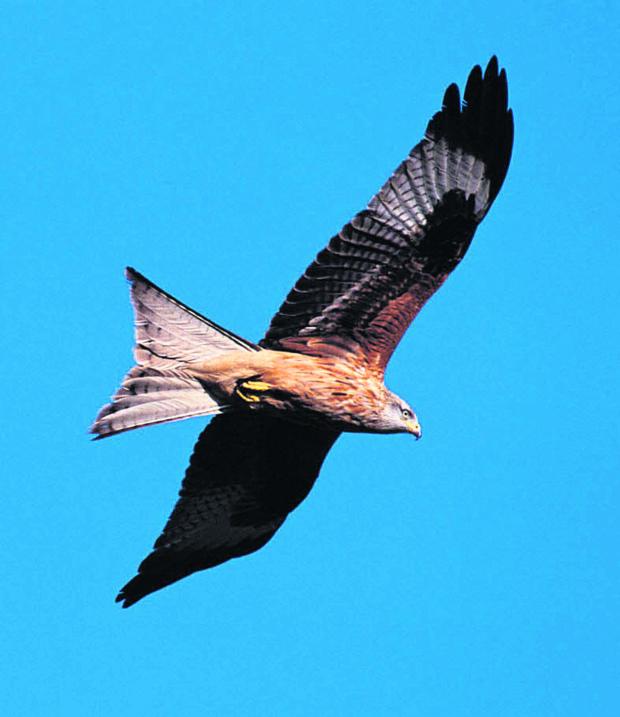
Here, G3-93 has been happily co-existing with the local Red Kites, following them around and feeding on carrion, including a Roe Deer carcass. It may seem surprising that a bird with a 2.4-metre wingspan hasn't been seen more regularly but, like with most other eagles, it spends most of its time perched out of sight in trees.

Steve Egerton-Read, a project officer for the reintroduction programme led by Forestry England and the Roy Dennis Wildlife Foundation, said the bird is safe from human persecution: "Oxfordshire is full of game shoots but there's no ill-will towards it and the landowners are very pleased to have another exciting bird to add to their list.

Monday, 20 January 2020

Young sea eagle takes up residence among Oxfordshire's red kites

Bird is one of six released on Isle of Wight as first residents in England for 250 years


Fri 17 Jan 2020 12.39 GMTLast modified on Fri 17 Jan 2020 19.40 GMT

It is one of the country’s top predators, with a 2.4-metre (8ft) wingspan and a preference for plucking fish from the ocean.

So a young sea eagle’s choice of landlocked Oxfordshire as its home is unexpected. More surprising still is that the bird has lived for four months almost completely unnoticed by the public close to the M40 and the commuter belt.

The eagle, known as G3-93, is one of six satellite-tracked specimens released on to the Isle of Wight last summer, when they became England’s first resident sea eagles, or white-tailed eagles, for 250 years.

“He thinks he’s a red kite,” said Steve Egerton-Read, a project officer for the reintroduction programme led by Forestry England and the Roy Dennis Wildlife Foundation. “Like all young birds, he tries to learn from other birds. In the absence of other eagles, he’s learning from red kites. He flies around picking up bits of dead stuff – dead rabbits, dead game birds.”

Scavenging carrion is normal for young sea eagles, which rarely learn to hunt live animals in their first year. According to Egerton-Read, G3-93 is living on private land where the bird is safe from persecution by humans.

“Oxfordshire is full of game shoots but there’s no ill-will towards it and the landowners are very pleased to have another exciting bird to add to their list,” he said. “I don’t have many concerns for their safety over southern England and there is much more food for them here than in Scotland.”

Wednesday, 23 January 2019

Rhea, there and everywhere! Five-foot bird is STILL on the loose six weeks after escaping from owner's home


Chris the rhea escaped from a sanctuary near Henley-on-Thames, Oxfordshire
The flightless bird has been sighted several times and caused traffic chaos  
Attempts to recapture him have been likened to scenes in comedy film Hot Fuzz
PUBLISHED: 22:01, 13 January 2019 | UPDATED: 01:03, 14 January 2019
Police have a good description of their suspect – around 5ft, a good sprinter and packing a hefty kung-fu kick.
But hapless officers are being given the runaround. Their quarry, Chris the escaped rhea, has managed to stay out of custody for six weeks.
The flightless bird, distantly related to ostriches and emus, escaped from a private sanctuary in Sonning Common, near Henley-on-Thames, Oxfordshire. He has been sighted several times, including on one surprised resident’s driveway, while a video shows him causing traffic chaos.
Attempts to recapture Chris, who can run at 40mph, have been likened to scenes in the comedy film Hot Fuzz, where police try to catch a renegade swan. 

Sunday, 28 January 2018

Police investigation launched after red kites found dead

17th January

A POLICE investigation has been launched after five red kites, a raven and a buzzard were discovered dead in a village in Oxfordshire.

The birds were discovered by a family on Sunday, September 17, near the village of Pyrton, on the edge of the Chilterns, who reported them to the RSPB.

All the birds were recovered and X-rayed by a local vet. The X-rays revealed no signs of shot.

However, the birds have now been sent off for toxicology testing by Natural England as part of the Wildlife Incident Investigation Scheme (WIIS), to see if the birds have been poisoned.

All birds of prey and ravens are protected by UK law, making it illegal to kill or harm them. Those found to have done so could face six months in jail or an unlimited fine.

Thames Valley Police, Natural England and RSPB are now working together on a joint investigation and are appealing to the public for information.

If you have any information relating to this incident, call Thames Valley Police on 101.

With their six-foot wingspan, red kites are Britain’s third-largest bird of prey and feed mainly on carrion.

If you find a wild bird which you suspect has been illegally killed, contact RSPB Investigations on 01767 680551, email crime@rspb.org.uk or fill in the online form: https://www.rspb.org.uk/our-work/our-positions-and-campaigns/positions/wildbirdslaw/reportform.aspx


Sunday, 9 October 2016

Farmers and conservation groups work together in Oxfordshire to help threatened bird species


The Royal Society for the Protection of Birds (RSPB) and local farmers in Oxfordshire are celebrating the completion of a pilot project to protect an iconic, yet threatened wading bird.

The curlew, a threatened and secretive wading bird which makes its home in farmland across the Upper Thames River Valleys, is largest European wading bird.

It is often found on winter estuaries or in summer meadows, and recognisable by its long, down-curved bill, brown upperparts, long legs and evocative call.

Considered a rare bird – they are highly secretive, hiding their nests in long grass.

And according to surveys of wading birds across the Upper Thames River Valleys, spotting a curlew could get even harder, as breeding curlew have declined by 51% between 2005 and 2015, in line with the national trend.

The area still managed to attract more than 40 pairs over the last 10 years, making the river valleys of Oxfordshire one of the most important areas for this species in southern England.

Support of local farmers 'vital' to success
In April 2016, the RSPB was delighted to receive funding from through the Landfill Communities fund for a new pilot project to discover more about the breeding habits of this enigmatic bird, and the possible reasons behind its decline.
 
The support from local farmers was vital to the success of the project, as most curlew nesting sites are found on farmland.

Every week over the spring and early summer, volunteers visited farms and nature reserves where curlew were thought to live, gradually identifying the birds’ territories and recording their behaviour.

Sunday, 5 April 2015

Ring-necked ducks spotted at nature reserve

1 hour ago 

Birdwatchers have flocked to a former gravel pit in Oxfordshire to see the "unprecedented" sight of four rare birds.

The ring-necked ducks are native to North America and are thought to have come over to the UK during a storm.

Mark Thomas, at the RSPB, called the sighting "really unusual" and possibly the largest group seen in England.

Official bird recorder Ian Lewington said the ducks in Standlake were attracting a stream of admirers.

The three drakes and one female were first spotted on Saturday in "Pit 60" by Witney birdwatcher Dave Doherty.

"We've got four American visitors here in Oxfordshire," Mr Lewington explained.

"We get two or three records in the country a year... but they've always been single birds.

"A single ring-necked duck on its own would attract a trickle of admirers but four is unprecedented."

Tuesday, 16 September 2014

Red Kites are becoming a pest - don't feed them, say conservation groups

First published Wednesday 3 September 2014 in News
Last updated 18:25 Wednesday 3 September 2014
by Pete Hughes, Reporter covering Abingdon and Wantage, South Oxford and Kennington. 

BIRD watchers have been asked to stop feeding Red Kites because the creatures have become too successful in Oxfordshire.

Snatching fledglings out of nests, chasing smaller birds for food and hovering in an “intimidating” way over homes and gardens, conservation groups have said the once-rare species may have become reliant on food left out by its admirers.

Hunted almost to extinction by farmers and poisoned by pesticides, the Red Kite was brought back from the brink of extinction when 93 were introduced into the Chilterns in 1989.
The Chilterns Conservation Board now estimates there are 1,000 breeding pairs in the Area of Outstanding Natural Beauty.

But the board and the Royal Society for the Protection of Birds (RSPB) say they are receiving a growing number of calls from worried residents about the large raptors swooping down on garden bird tables and school playgrounds.

Wednesday, 11 June 2014

Air base is told killing birds will not solve danger threat

5:00am Tuesday 10th June 2014 in News By Ben Wilkinson, 
Crime Reporter, also covering Barton and Wood Farm.


BIRD watchers have warned RAF Benson will get no benefit from shooting red kites out of the sky.

The military helicopter air base has said it may need to kill some of the birds of prey for safety reasons after two flew into aircraft in the past two months.

The base got permission to kill the birds from Natural England in June last year. But experts have said more of the birds will come and replace any killed.

Ian Lewington, Oxford Ornithological Society’s bird recorder for the county, said: “If it is that much of a problem they have to get rid of all of them. You cannot just get rid of two of them.

“It is a void – it will be filled. They are opportunist, that is why they are so successful.”

Between 1989 and 1994, 93 fledgling kites were released in the Chilterns where the birds had been hunted to extinction.

It is thought there are now more than 1,000 pairs in the area.

Monday, 5 May 2014

Grasslands are crucial for cuckoos

12:29pm Thursday 1st May 2014 in OutdoorsBy Colin Williams

If we want to hear this iconic bird's special song, we must take care of our meadows, stresses the BBOWT's Colin Williams

The cuckoo, a much-vaunted herald of summer, is calling loudly across Oxfordshire’s meadows this year. But how many of these rare birds are here, and for how many more years will we hear their distinctive song?

In the last 25 years the UK has lost more than half of breeding cuckoos, and they are now on the Red List of Birds of Conservation Concern.

This is due to many factors including the long journey from Central Africa where they spend the winter in the Congo Basin and West Africa. Their flight path crosses not only the inhospitable Sahara Desert, but many countries where shooting birds is common. High numbers will be killed before they reach Europe.

Saturday, 12 October 2013

Otmoor snipe population to benefit from soil work

Work to help reverse the decline of a bird species is to be carried out on an Oxfordshire nature reserve.

Soil structure on the RSPB Otmoor reserve is set to improved to make it suitable for worms, a major food source of snipe.

The RSPB said the site near Headington was "an ideal home for these captivating and enigmatic birds".

The charity's figures show long-billed snipe have suffered a 60% fall in breeding numbers since the 1980s.

As part of a five-year conservation plan for the 400 acre site, gypsum and an aerator will be used to loosen the soil, allowing air to penetrate, benefiting soil bacteria and the decomposition process which will encourage worms.

Manure sourced from a local farm will be spread to provide extra nutrients and organic matter.

Joe Harris, nature reserve warden, said: "We are justifiably proud to have snipe breeding on Otmoor, but there is still a lot of work we can do to make it even better for them.

The £109,000 funding for the scheme has come a grant by not-for-profit conservation business, WREN.