As regular CFZ-watchers will know, for some time Corinna has been doing a column for Animals & Men and a regular segment on On The Track... particularly about out-of-place birds and rare vagrants. There seem to be more and more bird stories from all over the world hitting the news these days so, to make room for them all - and to give them all equal and worthy coverage - she has set up this new blog to cover all things feathery and Fortean.
Showing posts with label nest. Show all posts

Thursday, 4 May 2017

City's drug problem sees birds 'making nests out of needles'

Adam Boult

4 May 2017 • 11:04am

A viral photo tweeted by a high ranking police officer in Vancouver purports to show a pigeon's nest made entirely from used hypodermic needles.

The image was shared on Twitter by Superintendent Michelle Davey of Vancouver Police, who said that pigeons had been spotted making a nest out of needles in a single room occupancy (a form of low-cost housing) in the Downtown Eastside area of the city.

She described the image as reflecting the "sad reality of the opioid crisis", and added the hashtag #notstaged, indicating she believed the image had not been faked in any way.

Staff Sergeant Randy Fincham said the image “was captured by our Homeless Outreach Coordinator during an inspection of a vacant room."

Vancouver is experiencing an epidemic in the use of fentanyl, an analgesic estimated to be up to 100 times stronger than morphine.

In December nine people died from fentanyl opioid overdoses across the city in one 24 hour period. Two milligrams of pure fentanyl - the size of about four grains of salt - is enough to kill an average-size adult.

Mayor Gregor Robertson, addressing the overdose crisis, said: "It's desperate times in Vancouver and it's hard to see any silver lining right now when we haven't hit rock bottom."

As the "bird's nest" image started to go viral the fact-checking site Snopes commented: "The authenticity of the 'pigeon’s nest' photograph is still uncertain, and we are one of many news outlets who have sent requests to Superintendent Davey seeking more information about it.

"We don’t yet know if or how it was determined that a pigeon had in fact constructed and used the pile of needles as a nest."


Continued

Wednesday, 15 July 2015

Philippine Eagle nest found in Apayao, thanks to IP habitat conservation scheme

ByContributoron July 14 2015 11:48 pm


Jayson C. Ibañez
Director-Research and Conservation
Philippine Eagle Foundation

In July of 1896, a local Samareño acting as guide to British Ornithologist John Whitehead brought back to camp one of the largest forest birds that Whitehead has ever seen. Then a new species to the western world, this first Philippine eagle specimen from Samar was a jewel among Whitehead’s wildlife collections. It was then one of the world’s greatest discoveries for a biological expedition.

One hundred nineteen years later today, we celebrate the same spirit of scientific discovery to announce another first in the history of Philippine Eagle research and conservation – the discovery of the world’s first active Philippine Eagle nest on Luzon Island.

On April 24, 2015, the first Philippine Eagle nest on Luzon with a downy chick was finally located by Philippine Eagle Foundation (PEF) biologists andIsnagresearch assistants in the lush lowland forests of Apayao Province in the Cordillera Administrative Region of Luzon.

The nest search was everything except easy. Finding the elusive nest involved a total of 3,456 hours of observations, which is equivalent to watching television 24/7 for over three months straight. Field work spanned five years in rugged and remote jungles. In the field, observers spent time mostly on platforms atop trees, scanning ridges and valleys for the highly secretive national bird.

The tedious nest search tested the team’s skills, patience and determination said PEF Biologist and expedition team leader Tatiana Abaño. “In the thick lowland jungles of Apayao, finding an eagle nest is like searching for a needle in a pile of hay”, Abaño added.

Saturday, 7 June 2014

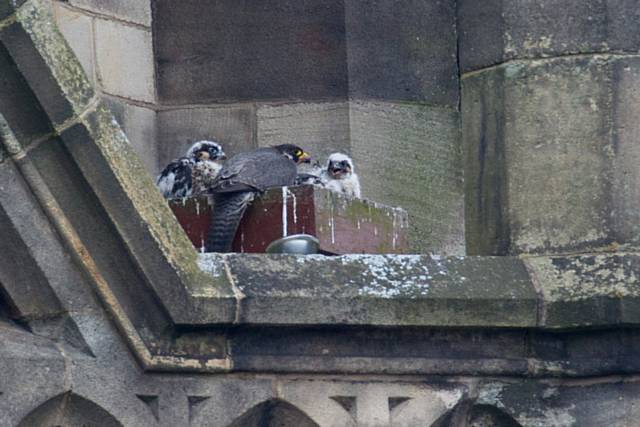
Four Peregrine Falcon chicks in a nest in Town Hall clock tower

Date published: 06 June 2014
Four Peregrine Falcon chicks can be seen in a nest in the Town Hall clock tower.

The birds of prey first began nesting in the clock tower of the Grade-I Listed building six years ago, after a nesting tray was installed by the Manchester Bird Recorder. Four chicks and two adult falcons mean the box is getting a little crowded so plans are being put in place to enlarge the box for next year.

Staff at the town hall have been keeping a close eye on the progress of the four young chicks, who all seem to be progressing well and will soon be ready for flight.

Assistant Cabinet Member for Community, Culture and Tourism, Councillor Janet Emsley said: “Our town hall is a fantastic building which attracts visitors from all over the world. We’re really pleased to see such beautiful wildlife as these Peregrine Falcons nesting here again and it adds another string to the town hall’s bow.”

Richard James from The Royal Society for the Protection of Birds (RSPB) said “It’s great to see the falcons nesting on the building. They have become a popular attraction in many towns and cities and we hope they continue to be successful.”

Reaching speeds of up to 200mph during dives to catch prey, Peregrine Falcons are the fastest animals in the world. Although they are commonly found living and hunting in open countryside, they are increasingly being spotted in towns and cities where tall buildings provide plenty of nesting opportunities and pigeons to feed on.

As one of around 1,500 breeding pairs across the UK, these falcons delayed works as part of the town hall restoration when two chicks nested in the clock tower in 2012.

Saturday, 24 May 2014

Sutton police to patrol Carshalton nature reserve after dad lets son smash rare bird's nest

9:00am Wednesday 21st May 2014 in Sutton
By Mike Murphy-Pyle, Chief Reporter

Police have stepped up patrols around a nature reserve after a man allowed his son to kick the nest of a rare bird.

The incident was spotted by nature wardens at Wilderness Island in Carshalton at the end of April.

The man was leaning on the bank while his eight-year-old son kicked a kingfisher's nest - despite signs indicating it is a nature reserve and that wildlife should not be disturbed.

A pair of the birds had been nesting at the site but have not been seen since the incident.

Kingfishers are a rare and easily disturbed bird and are afforded the highest level of legal protection meaning it is an offence to take, injure or kill a Kingfisher or to take, damage or destroy its eggs, nest or young.

Thursday, 24 April 2014

Maryland v. Osprey: The battle of the nest

By Susan L. Ruth, Communities Digital News


Osprey nest at MD Transportation traffic camera


WASHINGTON, April 23, 2014 — There has been a battle raging in Maryland over the past week between two federally protected Ospreys and the Terrapin State.

The conflict started a week ago when the Maryland Transportation Authority noticed an Osprey nest being build around a traffic camera along the Chesapeak Bay Bridge.

The large nest was being built at the top of a camera pole located at the toll plaza for the busy bridge.

The first problem was that as the nest grew, the camera’s view was being blocked and second was that the birds did not seem to like sharing their newly chosen nesting area with the camera and started attacking it.

According to the local news source, WTOP, the Transportation Authority reached out to the U.S. Fish and Wildlife Service for assistance in relocating the nest before more damage was done to the $6,000 camera and before any eggs were laid.

Once eggs or young birds are in the nest it becomes more difficult to move and would require a permit.

The nest was removed, and the birds rebuilt another one in the same location on the traffic camera pole.

Saturday, 10 August 2013

Splat – bird of spray lets fly to evict sparrow

A few seconds before the picture was taken, this unfortunate sparrow had been living in the bottom of the giant nest.

His landlords’ notice of eviction came out of the blue. The dead-eyed stork was clearly not interested in spreading the love.

The moment was captured in the northern German town of Lübbecke which has several nature reserves.

The sparrow was sent spiralling off course but soon recovered and escaped, according to photographer Martin Nobbe.

e noticed a family of tree sparrows had been sharing the nest as ‘sub-tenants’ until things turned ugly.

‘The little sparrow who was hit could fly unharmed afterwards, but he must certainly have learned a lesson,’ he said.

The stork’s dirty bomb is all the more impressive because it was looking the other way at the time.

Sparrows often share nests made by white storks. This one had been built over several years on a man-made platform. They are used to stop the birds nesting on electricity pylons.

Monday, 6 May 2013

Birds, nests, eggs stripped from rookery island in bay

Posted: Friday, May 3, 2013 12:03 pm | Updated: 12:11 pm, Fri May 3, 2013. 

By Charles Steward 

During the past week one of the rookery islands in San Antonio Bay has been ravaged. Most of the nests, chicks, and birds are gone. 

“I’ve been watching this island since 1969,” said Captain Kevin Sims of Aransas Bay Birding Charters. “I’ve never seen the island where the birds have left like they have.” 

For Sims this island was also special because a rare white Great Blue Heron was at a nest with a chick, also white. Both of these rare birds are lost too. 

He recalled, “I went by the island, Monday April 22, in the morning and everything was okay. There were lots of chicks, nests, and eggs. There were a lot of reddish egrets setting on eggs.” 

Sims said, “I went by Thursday (April 25) and the island was stripped of nests, eggs and chicks. It is disappointing about the white chick. I wanted to see this bird grow up and see how it behaved.” 

Sims returned to the island Friday and it appeared someone had returned and stripped it even more. He added, “I went by there on Sunday and there were just a handful of spoonbills left.” 

Monday, 22 October 2012

Fossil Flamingo Eggs Found in Their Nest


A fossil bird's nest has been discovered in Spain, cradling at least five eggs that scientists believe belonged to an ancient flamingo some 18 million years ago.
The nest was found in a limestone block in the Ebro Basin in northeastern Spain. The researchers think it was abandoned and sunk to the bottom of a shallow, salty lake (which once also housed snakes, turtles and crocodiles) before being covered in mud and fossilizing during the early Miocene.
Scans of the eggshell fragments revealed microscopic features that closely match that of the modern flamingo's eggs. However, the type of nest the eggs sit in is much different from the type the birds build today.