As regular CFZ-watchers will know, for some time Corinna has been doing a column for Animals & Men and a regular segment on On The Track... particularly about out-of-place birds and rare vagrants. There seem to be more and more bird stories from all over the world hitting the news these days so, to make room for them all - and to give them all equal and worthy coverage - she has set up this new blog to cover all things feathery and Fortean.
Showing posts with label bird populations. Show all posts

Wednesday, 11 March 2020

The impact of energy development on bird populations

MARCH 6, 2020

by Wiley
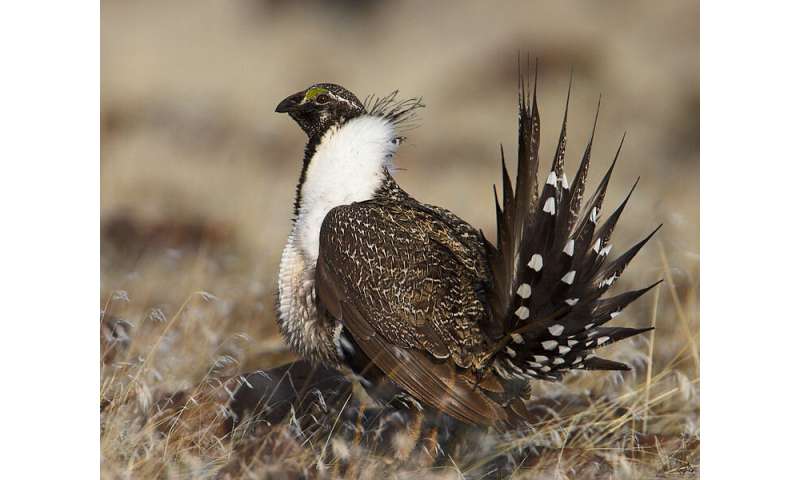
A  male Sage Grouse (also known as the Greater Sage Grouse) in USA. Pacific Southwest Region U.S. Fish and Wildlife Service from Sacramento, US

The greater sage-grouse is an iconic bird that lives in the western United States, and its populations are in decline. A new study published in the Journal of Wildlife Management reveals that energy development has negative impacts on sage-grouse reproduction.

The study's authors note that the full extent of such impacts on reproduction are not always realized because most female sage-grouse choose to nest and raise chicks in less disturbed areas, but only when these areas are still available to them.

The findings indicate that efforts are needed to avoid disturbing sage-grouse habitat when positioning renewable and non-renewable energy projects, and they highlight the complexities of balancing species conservation with energy development demands.

"Our study is unique in that instead of a commonly used metric for development intensity such as density of wells in an area, we delineated the actual footprint of energy development to measure the direct removal of sagebrush habitats for energy infrastructure, across several study areas," said lead author Christopher P. Kirol. "Our findings suggest that reproductive costs incurred by sage-grouse have a direct relationship to the footprint of energy development and this relationship holds irrespective of the type of energy infrastructure, whether natural gas or conventional oil, for example."

Wednesday, 5 February 2020

Wren retains top spot as the UK’s commonest bird

The latest report on bird populations by the British Trust of Ornithology has revealed the UK’s most common birds, and the wren has beaten other species to the top of the list.

February 4, 2020 at 3:22 pm

Following the RSPB‘s Big Garden Birdwatch which concluded the first month of the new decade, the latest report from the British Trust of Ornithology (BTO) suggests the wren has become the UK’s ‘commonest bird’, with over 11 million pairs.

They led the way in the last report from 2013, with a population of 8.5 million pairs. It’s thought that milder winters are probably benefitting the species.

Out of a total of 249 breeding species assessed in the report, 21 species have estimates of more than one million pairs.

Wednesday, 10 July 2019

Irish bird populations ‘decimated’ over space of few decades


July 2nd, 2019
The populations of a host of birds, including iconic species such as the Barn Owl and Curlew, have been “decimated” over the past few decades, BirdWatch Ireland has said.
Speaking before the Joint Oireachtas Committee on Heritage today, BWI’s assistant head of policy and advocacy Oonagh Duggan said that climate change, the intensification of the agricultural industry, habitat loss, and plastic pollution are all contributing to the decline in numerous terrestrial and sea birds.
Celebrating its 50th anniversary this year, Ms Duggan said that the conservation charity has seen “dramatic changes” to both Ireland’s landscape and biodiversity over the past half century.
Ms Duggan said that one in five of species that have been assessed on our island are now threatened with extinction, with “dramatic changes” particularly evident in bird populations.
While some bird species are quite adaptable to habitat change, she warned that many are seeing such a rapid loss of their habitats that they “cannot cope with the change, and their populations have been decimated”.
Waterbirds
For example, Ms Duggan said, Ireland has lost around 40 per cent of waterbirds – close to half a million birds – that migrate to Ireland in less than 20 years. This includes a decline in over half of the 15 wader species that winter here, such as Lapwing that is down 67 per cent.


Thursday, 7 February 2019

NW Forest Plan 25 years later: Wildfire losses up, bird populations down


Date:  February 4, 2019
Source:  Oregon State University
Twenty-five years into a 100-year federal strategy to protect older forests in the Pacific Northwest, forest losses to wildfire are up and declines in bird populations have not been reversed, new research shows.
The findings, published today in the Proceedings of the National Academy of Sciences, underscore the importance of continuing to prioritize the safeguarding of older forests, the scientists say -- forests characterized by a complex structure that includes multiple canopy layers, large trees, downed wood and snags.
The researchers stress it's vital to remember that upon its adoption in 1994, the Northwest Forest Plan was conceived as a century-long plan, and was not expected to show significant positive impacts on biodiversity for 50 years.
"Trees in the northwestern United States are some of the longest-lived and largest in the world," said Matt Betts of Oregon State University. "Douglas-fir can live to be more than 800 years old and grow to be more than 100 meters tall, so it shouldn't be surprising that it is hard to 'restore' this forest type, and that any plan to do so will take a long time.
"The plan has been one of the most impressive forest conservation strategies in the world, and there is no doubt that it has had a strong positive impact on the conservation of old-growth forests, but our results show that even with these strong conservation measures, bird species living in this system still aren't doing too well."
The NWFP, a series of federal policies put in place at the behest of then President Bill Clinton, encompasses 10 million hectares of land, including national forests, national parks, wilderness areas and Bureau of Land Management parcels, in Oregon, Washington and California.
Betts and OSU research associate Ben Phalan led a collaboration that used region-wide bird surveys, forest data and land ownership maps to gauge the plan's effect on biodiversity so far. Birds are a key indicator of biodiversity.
The researchers examined population trends for 24 widespread bird species for which the Pacific Northwest holds important populations -- some associated with older forests, some with diverse early-seral ecosystems, and some with both.
While there have been other detailed studies of threatened species such as spotted owls and marbled murrelets, this study focused on what populations of more-common birds can tell us about wider forest biodiversity.

Wednesday, 21 March 2018

Bird populations in French countryside 'collapsing'


March 20, 2018

Bird populations across an eerily quiet French countryside have collapsed, on average, by a third over the last decade-and-a-half, alarmed researchers reported on Tuesday.

Dozens of species have seen their numbers decline, in some cases by two-thirds, the scientists detailed in a pair of studies, one national in scope and the other covering a large agricultural region in central France.

"The situation is catastrophic," said Benoit Fontaine, a conservation biologist at France's National Museum of Natural History and co-author of one of the studies.

"Our countryside is in the process of become a veritable desert," he said in a communique released by the National Centre for Scientific Research (CNRS), which also contributed to the findings.

The common white throat, the ortolan bunting, the Eurasian skylark and other once-ubiquitous species have all fallen off by at least a third, according a detailed, annual census initiated at the start of the century.

A migratory song bird, the meadow pipit, has declined by nearly 70 percent.

The culprit, researchers speculate, is the intensive use of pesticides on vast tracts of monoculture crops, especially wheat and corn.

The problem is not that birds are being poisoned, but that the insects on which they depend for food have disappeared.

"There are hardly any insects left, that's the number one problem," said Vincent Bretagnolle, a CNRS ecologist at the Centre for Biological Studies in Chize.

Monday, 19 March 2018

South African bird populations have never been in a worse shape


NEWS / 10 MARCH 2018, 6:35PM / SHEREE BEGA

Waning waterbirds, declining raptors, seabirds under pressure and large terrestrial birds running out of space.

This is the alarming new assessment of South Africa's birds, which warns how the country's bird populations have never been in a worse shape.

"South Africa’s bird populations are in trouble," says Martin Taylor, the special projects programme manager at BirdLife South Africa. "The increase in extinction risk faced by our region’s bird species needs to be of concern to all South Africans."

Taylor compiled the State of South Africa's Birds 2018, a landmark report, scheduled to be released next week. 

He explains that the report, the first of its kind, draws on national survey and monitoring data to provide a highly visual snapshot of the conservation status of birds as well as the biomes they reside in. 

The report shows how the conservation status of birds has declined drastically over the past 30 years with 132 species now classified as regionally threatened with the number of critically endangered and endangered bird species increasing significantly since the 2000 assessment.


Thursday, 11 January 2018

Wildflower planting on farms boosts birds, from skylarks to starlings


New research shows wildlife-friendly farming can quickly help bird populations bounce back, but large-scale rollout will be needed to reverse long-term declines

Wed 3 Jan ‘18 06.01 GMT

Planting wildflowers and protecting nests on farms enables birds, from skylarks to starlings, to bounce back rapidly from long-term declines, new research shows.

Intensive agriculture has led to overall farmland bird numbers in the UK plunging by more than 50% since 1970 and the fall has not stopped yet, with the latest figures showing a 9% drop from 2010 to 2015.

The new analysis shows that subsidy schemes that pay farmers to use about 10% of their land to support birds and other wildlife can work. But the RSPB experts behind the new study say such schemes will have to increase hugely in size just to prevent further falls in numbers.

Environment secretary Michael Gove said: “These results show that with the right management, and more targeted support for farmers, we can reverse the decline in numbers of our birds.”


Read on  

Friday, 16 December 2016

Researcher studies increased predation of sagebrush songbirds in natural gas fields

Date: December 15, 2016
Source: University of Wyoming

Arid land bird populations are in decline around the vicinity of oil and gas wells in Wyoming -- but, not for the reasons you might initially think.

While such development has encroached on and hindered nesting habitat for three types of sagebrush-obligate birds, predation of these birds has increased because rodent populations in the vicinity of oil and gas wells have increased, which has, in turn, increased nest predation.

Anna Chalfoun, a University of Wyoming associate professor in the Department of Zoology and Physiology, and assistant unit leader of the Wyoming Cooperative Fish and Wildlife Unit, and her graduate students have been studying and collecting data about three species -- the Brewer's sparrow, sagebrush sparrow and sage thrasher -- in Wyoming for seven years. These birds use sagebrush for cover to build their nests on the ground or low to the ground within the sagebrush.

The study, which began seven years ago, has taken place at six sites in Jonah Field and six more at the Pinedale Anticline in western Wyoming.

"We found the majority of nest predators at the nests are rodents. Rodents are more abundant where there is natural gas development," Chalfoun says. "We tested the hypothesis that rodents were more abundant surrounding gas fields because their main predators (raptors, coyotes and badgers) avoided gas fields, but our data did not support this idea."

Wednesday, 21 September 2016

Bird populations in steep decline in North America, study finds


The Globe and Mail
Published Wednesday, Sep. 14, 2016 11:51AM EDT
Last updated Wednesday, Sep. 14, 2016 9:50PM EDT 

North America has more than a billion fewer birds than it did 40 years ago, with the snowy owl and the chimney swift just two of the better-known species in dramatic decline across the continent, a recent survey has found.

The Partners In Flight report concludes that urbanization, growth in agriculture and possibly even climate change have driven the decline in North American landbird populations, a category that excludes ducks and other waterfowl.

The total number of continental landbirds stands at about 10 billion, down from about 11.5 billion in 1970. The study’s authors – a range of academic, activist and government bodies in Canada and the United States – list 86 of North America’s roughly 450 breeding species as vulnerable, with some populations expected to be halved in a matter of decades.

“I don’t want my grandchild to go out in the forest and not hear the songbirds in the spring, and that seems to be where we’re headed right now,” said Andrew Couturier, senior analyst at Bird Studies Canada and a co-author of the report, which was released in August.

As “North America’s bird nursery,” Canada has an added responsibility to conserve habitat, Mr. Couturier said. A majority of the continent’s birds are hatched here, before migrating south.

Keeping forests musical is not the only reason healthy bird populations are important, he notes. The creatures also provide “ecosystem services” such as pollination and insect control.

Wednesday, 27 July 2016

New data on bird population trends and the climate conditions they occupy


Work contributes to more accurate future species distribution models

Date: July 20, 2016
Source: University of Massachusetts at Amherst

A new study of population trends among 46 ecologically diverse bird species in North America conducted by avian ecologist Joel Ralston and colleagues at the University of Massachusetts Amherst overturns a long-held assumption that the climate conditions occupied by a species do not change over time.

Instead, as the researchers report in the current early online issue of Global Ecology and Biogeography, birds that have increased in abundance over the last 30 years now occupy a wider range of climate conditions than they did 30 years ago, and declining species are occupying a smaller range of climate conditions than 30 years ago, Ralston says.

Species with relatively stable population trends maintained them. The authors believe this is the first study to investigate the relationship between population trend and the range of climatic conditions occupied, or "climate niche breadth" (CNB).

Ralston, now at Saint Mary's College, Notre Dame, Indiana, says, "It was previously thought that as species expand their ranges, they would do so while maintaining their climate niche. We show that as species become more abundant, they are actually moving into new climate conditions, and declining species are disappearing from some of the climate conditions they used to be found in. This makes theoretical sense but it counters the long-held assumption that climate niche breadth doesn't change in species."


Friday, 1 April 2016

Strong effects of climate change on common bird populations in both Europe and US

March 31, 2016

Scientists have shown for the first time that common bird populations are responding to climate change in a similar pronounced way in both Europe and the USA.

An international team of researchers led by Durham University, UK, found that populations of bird species expected to do well due to climate change had substantially outperformed those expected to do badly over a 30 year period from 1980 to 2010.

The research, conducted in collaboration with the RSPB and the United States Geological Survey (USGS), is published in the journal Science.

It is the first real demonstration that climate is having a similar, large-scale influence on the abundance of common birds in widely separated parts of the world, the researchers said.

Among the species showing pronounced effects of climate change are common woodland and garden birds such as the wren, in Europe, and the American robin in the USA.

The scientists characterised the climates favoured by different bird species to find out if recent changes in climate should have positively or negatively affected common breeding birds.

Using climate records for the period 1980 to 2010 they split species into two groups based on whether climate had been getting progressively better or worse for each species.

Friday, 3 July 2015

Scientists warn of species loss due to human-made landscapes

Study found 35 percent fewer bird species in agricultural habitats

Date:July 2, 2015

Source:University of Exeter

Research led by the University of Exeter has found a substantial reduction in bird species living in cultivated mango orchards compared to natural habitats in Southern Africa. The results, which are published today in the journal Landscape Ecology, highlight the value of assessing habitats prior to land use change to predict the impact of agriculture on biodiversity.

The researchers monitored bird populations across cultivated mango orchards and natural habitats in the Kruger to Canyons Biosphere region in South Africa. They found that replacing a natural habitat with an agricultural landscape can result in a substantial decline in the richness of species living within the region.

The scientists were aiming to ascertain whether agriculture could add novel habitat elements and thereby support additional bird species complementary to those already present in the natural areas -- but found that in contrast, there was a loss of 35% of the bird species within the farmed land.


Friday, 17 April 2015

Bird Populations in Fukushima Plummet After Nuclear Disaster

First Posted: Apr 16, 2015 11:46 AM EDT

Bird populations may have declined to a large extent in Japan's Fukushima province due to the disaster that occurred there in 2011. Scientists have taken a closer look at bird populations and have found that since the March 11 earthquake, which caused the nuclear catastrophe, bird populations have plummeted.

"We were working with a relatively small range of background exposures in this study because we weren't able to get into the 'hottest' areas that first summer after the disaster, and we were only able to get to some 'meium-hot' areas the following summer," said Tim Mousseau, one of the researchers, in a news release. "So we had relatively little statistical power to detect those kinds of relationships, especially when you combine that with the fact that there are so few barn swallows left. We know that there were hundreds in a given area before the disaster, and just a couple of years later we're only able to find a few dozen left. The declines have been really dramatic."

Tuesday, 17 March 2015

Habitat degradation, climate shifts impact survival of the white-collared manakin

Date:
March 6, 2015

Source:
USDA Forest Service - Pacific Southwest Research Station

Summary:
To better understand the interacting effects of habitat degradation and climate on bird populations, researchers spent 12 years studying the white-collared manakin, a fruit-eating tropical bird, in mature and young forests along the Caribbean coast of Costa Rica.


Saturday, 21 June 2014

Feather forensics: scientist uses genes to track macaws, aid bird conservation

June 17, 2014

Highway development may isolate bird populations in Brazil, Peru 

When a massive road project connected the ports of Brazil to the shipping docks of Peru in 2011, spanning the South American continent, conservationists predicted widespread impacts on wildlife living along the route that stretches almost 5,500 kilometers (about 3,400 miles). Roads are a well-documented source of habitat fragmentation, interfering with access to available habitat for many terrestrial and tree-dwelling species. However, it wasn’t clear whether or not birds are able to fly over these barriers. George Olah, a biologist from the Australian National University, set out to see if they can. 

Olah was already studying the genetics of scarlet macaws (Ara macao) in a remote area of southeastern Peru when the Transoceanic Highway was built through the middle of his research area. He realized that the forensic genetics techniques he was using to learn more about the local macaw population might also uncover evidence of the road’s impact on the birds. 


Tuesday, 11 February 2014

Nepal losing its bird populations: Experts


KAPILVASTU, FEB 02 - The increasing loss of habitat due to deforestation, use of chemical fertilizers and human encroachment has caused the decline in the number of country’s bird population over the years.

According to the 2011 report of the Department of National Parks and Wildlife Conservation (NPWC) and Bird Conservation Nepal (BCN), 149 species of birds have been listed in the threatened list.

“There has been no let up in human activities and the bird habitat is dwindling. Not much effort is being put for conservation. It is only inevitable if the list of threatened bird species have become longer by now,” said Hemraj Baral, an ornithologist. 

The Zoological Society of London, National Trust for Nature Conservation and Himalayan Nature are jointly conducting a survey to find out the number of bird species in the country. The preliminary study suggests as many as 170 species could fall in the threatened list. 

Sushila Neupane, chief executive director of BCN, said nearly 84 percent of the threatened bird species had reached the endangered state solely due to habitat loss. 


Sunday, 8 September 2013

Parasite hitting bird populations in Sussex

A deadly disease is having a devastating impact on bird populations, an ornithological enthusiast was warned.

Greenfinch populations in Sussex are thought to have dropped by up to a third and chaffinch populations by a fifth, according to a study by the Garden Bird Health Initiative.

The garden birds are suffering from trichomonosis, a parasite which infects the digestive system of mostly finches, doves and pigeons.

It causes lesions in the throat which makes it hard for the bird to swallow food leading it to die of starvation.

Affected birds appear “puffed-up” with fluffed-up plumage and are generally lethargic.

Peter Calladine, member of the Royal Society for the Protection of Birds (RSPB) and Royal Ornithological Society, said: “It’s very bad news. It is very widespread and causing huge losses to the bird population in Sussex. The numbers have fallen terribly. We are talking thousands.

“Greenfinches seem to be the most affected. The disease is very distinctive. They get all puffed up and it’s quite obvious they’re dying.”


Thursday, 21 March 2013

Deus ex Cicada: Are Predatory Bird Populations Influenced by Cicadas’ Odd Life Cycles?


Bird population crashes seem to correlate with the strange 13-year and 17-year cycles of periodical cicadas. Some researchers suggest that the dissonant insects actually orchestrate the behavior of their predators

As the first day of spring approaches a scientific mystery will soon return with a roar— the 2013 return of the east coast brood of cicadas, or Brood II. Now a team of scientists hint they may have a solution as to why this brood and its fellows bizarrely emerge only after lulls more than a decade long—to control their surroundings in ways that may lead to crashes in numbers of predatory birds.

Magicicada septendecim
Periodical cicadas are the longest-lived insects known. After childhoods spent underground living off the juices of tree roots, broods of red-eyed adults surface in precise cycles— 13 years long in the southeastern U.S. and 17 years long in the northeastern part of the country. Fifteen broods are known to exist today on Earth, all native to North America. Brood II is set to emerge this spring in New York State, Connecticut, Maryland, North Carolina, New Jersey, Pennsylvania and Virginia with choruses of males bent on wooing mates with their din. It remains an enigma why these cicadas only emerge together in the adult stage every 13 or 17 years, as opposed to some other duration — other cicada species are not so synchronized.


Continued:  http://www.scientificamerican.com/article.cfm?id=are-predatory-bird-populations-influenced-by-cicadas-odd-life-cycles

Tuesday, 20 November 2012

44 Million birds lost since 1966


Since 1966, we’ve lost breeding birds from our countryside at an average rate of a nesting pair every minute, say a group of conservation organisations in a report published today (Monday 19 November, 2012).
These shocking statistics are contained in the State of the UK’s Birds 2012 report published today, charting the ups and downs of our bird populations over the last few decades.
The scientists producing the report estimate there are 166 million nesting birds in the UK, compared with 210 million nesting birds in 1966.  The house sparrow has seen one of the greatest losses of any bird in the UK. Although since 2000 house sparrow numbers have started to increase, the UK still has 20 million fewer sparrows than it did in 1966. The current population is estimated at around 10 million.
Dr Mark Eaton is an RSPB scientist who worked on the report. Commenting on the figures, he said: “It is shocking to think that we’ve lost one in five of the individual birds that we had in the 1960s, especially when you think that the 44 million birds we have lost since 1966 is equivalent to the current adult human population of England and Wales.”
There have been many changes in the UK which have affected birds, most notably changes in the land use and the management of our countryside and seas – these can change the amount or quality of key resources needed by birds, such as suitable places to nest or a shortage of food in summer or winter. However, for some species, including the house sparrow, the precise reasons behind these declines aren’t fully understood.

Continued:  http://www.smallholder.co.uk/news/10055717.44_Million_birds_lost_since_1966/