As regular CFZ-watchers will know, for some time Corinna has been doing a column for Animals & Men and a regular segment on On The Track... particularly about out-of-place birds and rare vagrants. There seem to be more and more bird stories from all over the world hitting the news these days so, to make room for them all - and to give them all equal and worthy coverage - she has set up this new blog to cover all things feathery and Fortean.
Showing posts with label US Fish and Wildlife Service. Show all posts

Thursday, 26 March 2020

Federal plan might let states kill unwanted cormorants


By KATRIANNA RAY | March 13, 2020

By KATRIANNA RAY
Capital News Service

LANSING — More than 1,000 people have submitted public comments about a proposed U.S. Fish & Wildlife Service rule that would permit state wildlife agencies to authorize previously prohibited techniques to manage cormorant populations. 

They would include killing some birds.

Under the proposed rule, each state would have the power to determine how to control cormorants, a migratory aquatic bird sometimes blamed for damaging fish populations in parts of the Great Lakes. The state agencies would need to work within limits set by the Fish & Wildlife Service.

Michigan is home to around 55% of North America’s double-crested cormorant’s breeding pairs, according to the Michigan United Conservation Clubs (MUCC).

The double-crested cormorant is the most numerous and most widely distributed cormorant in North America, according to the National Audubon Society. They are the only cormorants to occur in large numbers outside of the Atlantic and Pacific coasts.

The birds are federally protected, making it illegal to take, possess, sell, transport or purchase any part of them.

Sunday, 3 April 2016

Judge: Sanctioned slaughter of fish-eating birds broke law

Posted: Mar 30, 2016 7:20 PM GDTUpdated: Mar 30, 2016 10:11 PM GDT
By JANET McCONNAUGHEY
Associated Press

The U.S. Fish and Wildlife Service acted improperly when it allowed tens of thousands of migratory aquatic birds to be shot each year to protect farmed and sport fish populations, a federal judge has ruled.

The agency said it lacked resources for a "hard look" at either the long-range environmental effects of or possible alternatives to its decisions about double-crested cormorants, and that just isn't a good reason, U.S. District Judge John D. Bates wrote.

Letting that stand could gut the National Environmental Protection Act, "since many an agency would frequently so argue," wrote Bates, a federal judge in Washington.

He ruled Tuesday on a pair of orders that opponents say let people kill up to 160,000 double-crested cormorants each year to protect sport fish in 24 states east of the Mississippi River and farmed fish in 13 of those states.

"The Service is reviewing and studying the decision," Fish and Wildlife spokeswoman Laury Parramore said in an email Wednesday.

The advocacy group Public Employees for Environmental Responsibility sued the government to stop the practice, which is known as "lethal removal."

Fish and Wildlife has allowed fish farmers to kill cormorants that were eating or about to eat fish in their ponds since 1998. Five years later, it said Indian tribes and state and federal wildlife agents could kill those eating or about to eat "public resources of fish." Those orders have been renewed every five years.

Read on ...

Wednesday, 27 May 2015

Federal Program Allows Killing of Half a Million Protected Migratory Birds a Year

Wednesday, May 27, 2015

Being a bird of “conservation concern” or even the oldest bird species on the continent is not enough to avoid being slaughtered under a little-known federal program that authorizes the killing of half a million birds a year.

The Center for Investigative Reporting’s Reveal looked into the U.S. Fish and Wildlife Service’s “depredation permit” program, which allows businesses, farmers and others to kill members of more than 300 species of migratory birds each year. The body count during a recent three-year period totaled 1.6 million birds, or just over 500,000 a year.

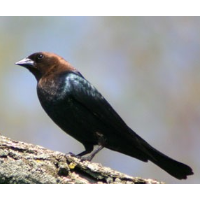
Brown-headed cowbird (photo: Wikipedia)
Two-thirds of all the birds killed were brown-headed cowbirds, red-winged blackbirds, common grackles and Canada geese. The rest of those killed included upland sandpipers, barn owls, wood ducks, lesser yellowlegs, snowy owls, roseate spoonbills, curlew sandpipers, red-throated loons, great blue herons, white and brown pelicans, cedar waxwings, robins, belted kingfishers, mourning doves, red-tailed hawks, American kestrels, turkey vultures, mallard ducks and sandhill cranes, North America’s oldest bird species.

Some of the birds “are struggling to cope with habitat loss, climate change and other threats and are classified by the government as ‘birds of conservation concern,’” according to Reveal’s Rachael Bale and Tom Knudson. “These include upland sandpipers, lesser yellowlegs, roseate spoonbills and red-throated loons, who, because of declining populations, could be on their way to the endangered species list.”

Friday, 17 October 2014

SOLAR POWER: Bird deaths in plant's ponds investigated

BY DAVID DANELSKI / STAFF WRITER
Published: Oct. 16, 2014 Updated: 10:28 p.m.

Federal wildlife officials are investigating the deaths this week of as many as 60 birds in water evaporation ponds at the Genesis solar plant in eastern Riverside County.

A spokeswoman for the U.S. Fish and Wildlife Service said the birds apparently got caught up in an oily substance in the ponds at the Genesis solar plant west of Blythe operated by the Florida-based NextEra Energy Resources Co.

The company uses water to clean thousands of curved mirrors and to make steam, though the source of the water in the ponds was not immediately available on Thursday.

It is not known yet what species of birds died, said Jane Hendron, a Carlsbad-based spokeswoman for the wildlife service. “We are still gathering facts,” she said.

NextEra spokesman Steven Stengel said by telephone that 50-60 birds were found dead in two water evaporation ponds on Monday. He said officials with the agency came to the solar plant Wednesday and took possession of the carcasses.


Thursday, 21 August 2014

Feds move to protect bird habitat in Utah, West

Posted: Wednesday, August 20, 2014 4:04 pm

Troy Wilde / Utah News Connection


Yellow Billed Cuckoo
Photo credit: Lower Colorado River Multi-Species
Conservation Program.
SALT LAKE CITY - The federal government is moving to protect hundreds of thousands of acres of land in Utah and several other Western states where the yellow-billed cuckoos spend time.
The U.S. Fish and Wildlife Service is proposing to designate more than 500,000 acres as critical habitat for the cuckoo, which is being considered for endangered-species designation.

Michael Robinson, conservation advocate at the Center for Biological Diversity, said the protections would give the birds a better chance of survival.

"The critical habitat under the Endangered Species Act provides protections from federal actions that might degrade the critical habitat or destroy it so that it's not usable by whatever endangered or threatened animal it's been designated for," he said.

Groundbreaking bird study under way in southern Maine

By Jim Kanak
news@seacoastonline.com
August 20, 2014 12:29 PM

WELLS, Maine — The U.S. Fish and Wildlife Service is participating in a groundbreaking study of shorebird migration patterns, using cutting-edge technology to track the birds and record their data.

The technology includes lightweight radio transmitters, known as nano tags attached to shorebirds. The tags transmit signals picked up by a network of radio towers that span the Northeast coast of the United States and into Canada. Two of the towers are in the Rachel Carson Wildlife Refuge in Wells.

Kate O’Brien, a USFWS wildlife biologist, is leading the project in Wells. She said the technology is what makes this project different.

“Less than 5 percent of (traditionally) banded birds are ever (re)caught,” O’Brien said. “That’s why nano tagging is good. In terms of cost, they’re not that expensive. The science is moving so quickly. It’s fascinating what people can learn about birds.”

Wednesday, 2 July 2014

Cockatoos Get Protection to Curb Illegal Pet Trade

By RAMONA YOUNG-GRINDLE 

WASHINGTON (CN) - Three species of cockatoos have received final listing status under the Endangered Species Act, according to the U.S. Fish and Wildlife Service. The Philippine cockatoo and the yellow-crested cockatoo are listed as endangered, while the white cockatoo is listed as threatened.

Because the white cockatoo is listed as threatened, the USFWS has also issued a special rule for that species under the ESA to allow import, export and interstate commerce of the birds without a permit if they are captive-bred or already in captivity at the time of listing, as long as those activities were in compliance with the Convention on International Trade in Endangered Species of Wild Fauna and Flora (CITES) and the Wild Bird Conservation Act, according to the agency's press release. The ESA's special rule clause is not applicable to species listed as endangered.

The Friends of Animals (FOA) petitioned the USFWS to list the cockatoos and 11 other parrot species in 2008. In 2010, the FOA and the WildEarth Guardians sued the agency for failure to issue a 12-month finding on the petition. A 2010 settlement agreement outlined a timetable for determining listing status for the species and the three cockatoos were proposed for listing in August 2011, according to the action.


Wednesday, 30 April 2014

U.S. Fish and Wildlife Service Approves $3.6 Million to Conserve Migratory Birds and Their Habitats in Western Hemisphere


Last Updated on Tuesday, 29 April 2014 03:56April 28, 2014 - 

Migratory birds throughout the Western Hemisphere will benefit from $3.6 million in grants for 29 collaborative conservation projects across the Americas, the U.S. Fish and Wildlife Service announced today.

The Neotropical Migratory Bird Conservation Act grants will leverage the Service’s investment with nearly $12.1 million in additional private funds—a more than 3-to-1 match. The projects will conserve migratory bird habitat, stimulate critical research into declining bird populations, and strengthen international relations, raising awareness of the importance of bird conservation.

“Migratory birds are an integral part of the landscape the Service seeks to conserve for the benefit of the American people,” said Service Director Dan Ashe. “Collaboration with our partners on conservation projects throughout these birds’ breeding and winter ranges is essential to protect their habitats and to reduce threats.”

Wednesday, 23 October 2013

‘Endangered’ Label Restricts Sales of Blue-throated Macaw

Selling blue-throated macaws across state lines will be outlawed as of Nov. 4, three weeks after the bird was listed as endangered under the Endangered Species Act.

The rule is part of an effort by the U.S. Fish & Wildlife Service to save a parrot species whose numbers in its native Bolivia are estimated at less than 500. Opponents, however, argue that the sales restrictions will have no impact in Bolivia given that the South American country already bans the bird’s capture and export.

Not all movements of the blue-throated macaw will be illegal in the United States. Private and commercial breeding efforts and the bird’s sale to a resident of the same state may continue unabated, the Pet Industry Joint Advisory Council reported.

Blue-throated macaws, like other parrot species, are monogamous and tend to mate for life, the U.S. Fish & Wildlife Service pointed out it its report.

In addition, a permit may be issued for a bird’s sale or commercial use if the activity is for scientific research or to enhance "the propagation or survival of the species,” the Fish & Wildlife Service stated.

The blue-throated macaw is both rare and expensive. Breeders and pet stores typically price individuals at $2,000 or more.


Saturday, 27 July 2013

Feds advance plan to kill barred owls in Northwest

GRANTS PASS, Ore. Federal wildlife officials plan to dispatch armed bird specialists into forests of the Pacific Northwest starting this fall to shoot one species of owl to protect another that is threatened with extinction.

The U.S. Fish and Wildlife Service on Tuesday released a final environmental review of an experiment to see if killing barred owls, which are bigger, more aggressive and less picky about food, will allow northern spotted owls to reclaim territory they’ve been driven out of over the past half-century.

The agency has been evaluating the idea since 2009, gathering public comment and consulting ethicists, focus groups and scientific studies. It will issue a final decision on the plan in a month.

“If we don’t manage barred owls, the probability of recovering the spotted owl goes down significantly,” said Paul Henson, Oregon state supervisor for Fish and Wildlife.

The agency’s preferred course of action calls for killing 3,603 barred owls in four study areas in Oregon, Washington and Northern California over the next four years.

The plan is expected to cost about $3 million and requires a special permit under the Migratory Bird Treaty Act, which prohibits killing nongame birds.

Monday, 20 May 2013

Companies won't face charges in condor deaths

The U.S. Fish and Wildlife Service grants exceptions to a wind farm and a building project in harassing or killing the endangered birds. 

By Louis Sahagun, Los Angeles Times 

May 10, 2013, 8:10 p.m. 

Federal wildlife officials took the unprecedented step Friday of telling private companies that they will not be prosecuted for inadvertently harassing or even killing endangered California condors. 

In a decision swiftly condemned by conservationists and wildlife advocates, the U.S. Fish and Wildlife Service said operators of Terra-Gen Power's wind farm in the Tehachapi Mountains will not be prosecuted if their turbines accidentally kill a condor during the expected 30-year life span of the project. 

California condors were brought back from the brink of extinction a quarter-century ago and still cling precariously to survival. Federal law prohibits the harassment or killing of endangered species for any reason. 

Fish and Wildlife also made an exception for the 270,000-acre Tejon Ranch Co., saying that the government will not prosecute if construction of the company's controversial 5,553-acre development of luxury homes, hotels and golf courses violates the harassment ban in the endangered species law. The exception will last for 50 years. The project is expected to consume 8% of the critical condor habitat in the Tehachapis, about 60 miles north of Los Angeles. 

Fish and Wildlife Director Daniel Ashe said the decision reflects a difficult reality. The threat of prosecution jeopardized the construction of large-scale alternative energy facilities and real estate developments in the wild and windy places preferred by condors.

Monday, 25 March 2013

Group Signals Intent to Sue Over Beleaguered Bird


03/19/2013 1:08 PM ET 


The Center for Biological Diversity says federal officials failed to make a timely decision on its 2010 petition to protect the Bicknell's thrush, whose range extends to Maine. 

A conservation group says it intends to sue the U.S. Fish and Wildlife Service for failing to act on endangered species protections for a bird whose breeding grounds extend to Maine.

The Center for Biological Diversity, based in Vermont, filed notice of intent to sue the federal agency, saying it failed to make a timely decision on the center's 2010 petition to protect the Bicknell's thrush.

The bird breeds in only one place: the high mountains of eastern Canada and the Northeast U.S., including Maine, New Hampshire, Vermont and New York. 

Scientists at the center say 98 percent, or more, of the bird's U.S. habitat is in danger of disappearing because of climate change. The group says in some areas, Bicknell's thrush populations have already declined by as much as 19 percent.

The conservation group says the U.S. Fish and Wildlife Service is required to produce a final decision on such petitions within a year, and it's now more than a year overdue. 

Today's notice gives the center 60 days to file a lawsuit, though an agreement could be reached in the meantime. 

Thursday, 7 March 2013

Endangered Species: Lesser Prairie Chicken Decision Delayed


The U.S. Fish and Wildlife Service has delayed a decision on the endangered species status of the lesser prairie chicken, and reopened the public comment period on the proposed listing for the threatened prairie grouse, which at one time was one of the most populous gamebirds on the southern plains, but now hangs on in just a few areas.

The U.S. Fish and Wildlife Service reopened to public comment the potential listing of the lesser prairie chicken on the federal protected list. U.S. Rep. Michael Conaway of Midland announced the move after he and seven other House Republicans requested a delay of at least 90 days in the decision on designating the grouse as a threatened species under the Endangered Species Act. They say protecting the fowl would impair oil and gas development, agriculture and other sectors that drive local economies. Experts say the lesser prairie chicken population has declined in part due to expanded farms, ranches and oil and gas operations across the Southwest and other states.

Kansas is the lone remaining state that offers a general hunting season on lessers, which is remarkable considering just how many prairie chickens there used to be in the birds' historic range of Texas, Oklahoma, Kansas, New Mexico and Colorado. Anyone ever get the chance to hunt lessers in your state before the season was closed?

Sunday, 27 January 2013

Protection Plans: Bird conservation & project management


By Caitlin Bell
Ecology and wildlife conservation is an issue with almost any construction project, and renewable energy projects are no exception. This is particularly true of wind energy farms, which are often located in remote, ecology rich areas. Bird management and conservation is a necessary consideration for any wind energy developer. Nesting birds on turbine grounds or to-be turbine grounds are of particular concern, often creating project delays before construction even begins.

Fortunately, new approaches are helping renewable energy project proponents to streamline agency consultation, and reduce the risk of project delays resulting from nesting birds at construction sites. Since 2005, the US Fish and Wildlife Service (USFWS) has recommended that site planners voluntarily develop Avian Protection Plans to reduce an electrical transmission project’s impact on birds—particularly bald and golden eagles—during building and operation.

Although originally specific to transmission projects, USFWS now recommends Avian Protection Plans be developed for any large-scale energy project, including for wind and solar power farms. These plans serve to outline design standards, training programs, permit compliance, as well as reporting and monitoring programs that collectively reduce the risk of avian mortality during site construction and operation.

Avian Protection Plans also act as a tangible way to document compliance with federal and state wildlife regulations, including the Bald and Golden Eagle Protection Act, and the Migratory Bird Treaty Act (MBTA).

Avian safety
Recently, the USFWS and other wildlife agencies have recommended the addition of Nesting Bird Management Plans (NBMP) to augment Avian Protection Plans. Or, implemented as stand-alone documents, to describe measures that will be taken to reduce the impacts to birds protected under the MBTA during the construction and operation of a project.

Nesting birds have been highlighted as a resource of increased concern on many large transmission, wind, and solar projects. The supplementation of a NBMP is intended to detail protective measures for special status and non-special status bird species. Increasingly, project proponents and compliance agencies are spending a large amount of effort and resources on nesting bird protections during project implementation.

To help simplify the process, the California Public Utilities Commission (CPUC), federal and state resource agencies—such as the California Department of Fish and Game (CDFG), USFWS, Bureau of Land Management (BLM), US Forest Service (USFS)—and several California utilities have initiated discussions concerning the development of NBMPs in a standardized, consistent fashion.

NBMPs allow project owners and operators to “operationalize” the requirements of a bird-specific applicant proposed, and mitigate the measures listed in a project’s environmental document. No regulatory mechanism exists to authorize incidental take of a common bird species the way an Incidental Take Permit allows for a listed species under the federal and California Endangered Species Acts.

Saturday, 8 December 2012

Endangered Birds Thriving Thanks to Keauhou Bird Conservation Center


Quietly working on 150 acres in Volcano, the staff and volunteers at the Keauhou Bird Conservation Center (KBCC) are successfully helping some endangered Hawaiian birds stay off the extinction list. They are not normally open to the public, but will be opening the doors of their educational areas for an annual open house on December 8, from 8 a.m. until 2 p.m.
Operated by The Zoological Society of San Diego, KBCC’s facility includes 64 ‘alala (Hawaiian crow, which is extinct in the wild); the Maui Parrotbill (an insect-eating honeycreeper); the palila (found only on the slopes of Mauna Kea); and the puaiohi (small Kaua‘i thrush)

Partnerships Help the Birds’ Survival
The ‘alala has been hard to breed in captivity, but a partnership with the U.S. Fish and Wildlife Service and the Hawai‘i Division of Forestry and Wildlife succeeded in producing 19 healthy chicks in 2011, which proved to be a record breaking year for their conservation efforts. As of November 2012, 109 individual ‘alalas now exist.

Between 1996 and 2011, the Center successfully hatched 395 nene chicks and also has released 442 of this endangered goose back into the wild on Maui, Kaua‘i and the Big Island. On Molokai, they started a brand-new nene population. Largely due to their efforts, the current nene population on all of the Hawaiian Islands now totals almost 2,000 birds. 

Although this bird remains on the endangered species list, the Center is no longer breeding them. Christina Simmons of the San Diego Zoo explained, “We aren’t breeding nene because they are doing well out in the wild, our program was successful, and our partners are protecting and managing the wild flocks, which is a progression that occurs in successful programs.”


Sunday, 2 December 2012

Debate begins over rare bird's affect on New Mexico jobs

SANTA FE — The U.S. Fish and Wildlife Service on Friday proposed to list the lesser prairie chicken as a threatened species, igniting a debate about whether protecting a rare bird could cost New Mexico jobs.

This Western grouse, found in five states, has been a candidate for listing since 1998. The recommendation begins a yearlong process of whether the lesser prairie chicken should receive federal protection.

Fish and Wildlife said it made the recommendation based on evidence that the lesser prairie chicken's population and habitat are in decline.

"Listing cannot come soon enough for the lesser prairie chicken," said Taylor Jones of WildEarth Guardians. "Threats are increasing, the species' range is contracting and current conservation efforts are too little, too late."

U.S. Rep. Steve Pearce took the opposite position, sending out a statement headlined, "Here we go again." Pearce, R-Hobbs, successfully led opposition to listing the dunes sagebrush lizard as an endangered species.

"Unfortunately, our jobs and our way of life in southern New Mexico continue to come under assault," Pearce said. "The prairie chicken is yet another example that federal species regulation is not based on science, but rather driven by lawyers for extreme interest groups, like Santa Fe-based WildEarth Guardians, who filed the lawsuit in this case."

The Environmental Defense Fund, based in New York City, entered the debate suggesting the type of compromise that ended the dunes.

Continued:  http://www.daily-times.com/ci_22103356/debate-begins-over-rare-birds-affect-new-mexico


Tuesday, 27 November 2012

Feds ditch bird poisoning plan; public input sought on plover protection


After public outcry, a proposal to protect threatened snowy plovers on Clam Beach by poisoning egg-gobbling predators was withdrawn Tuesday by the U.S. Fish and Wildlife Service.

”That didn't seem to fly -- no pun intended -- with the public,” Fish and Wildlife Field Supervisor Nancy Finley said of the plan to use an avicide called DRC-1339 to kill corvids -- crows and ravens -- that preyed on plover eggs.

Humboldt County's Clam Beach has one of the most aggressive predation rates by corvids, according to a Fish and Wildlife press release. In the last 11 years, more than 70 percent of snowy plover eggs on the north coast have been lost due to corvid predation.

A series of methods put forward at the last meeting included discouraging preying behavior, trapping corvids, and more comprehensive approaches like reducing trash that attracts corvids to the beach: “things to reduce the corvid population on a more holistic scale,” Finley said.

She said the goal of Fish and Wildlife is managing snowy plover protection with realistic methods. Labor intensive options could be made possible with community volunteers.

”That's something I'd like to gauge as well,” Finley said.

Third District Supervisor Mark Lovelace expressed appreciation at the community meetings that led Fish and Wildlife to drop its proposal.

”I'm really glad the Fish and Wildlife Service has gone out to get some outreach in the community,” he said. “There's widespread agreement that something needs to be done... but perhaps they need to be involving the community in exploring a wider range of options.”

Read on:

Thursday, 11 October 2012

Birding might hold key to preserving wild places


Worried that the future of the nation's wild places may rest with an increasingly diverse population that has little experience in the outdoors, the U.S. Fish and Wildlife Service is looking to an unusual savior: birding.

On Saturday, black, Hispanic and female birders, nature photographers, teachers and professors will gather at the Minnesota Valley National Wildlife Refuge in Bloomington to share ideas and brainstorm about how to bring more minorities into birding.

Counter to its little-old-lady-with-binoculars image, birding is an ideal way to lure young people into the natural world, said U.S. Fish and Wildlife's Paula Ogden-Muse.

"This is about saving the kids, but also about how to save the planet," said Ogden-Muse, visitor services manager for the Upper Mississippi River National Wildlife and Fish Refuge near La Crosse, Wis. "We need to get the people we don't see into the refuge, and stop talking to the choir."

Ogden-Muse said her own interest in birds was sparked by a mentor who kept bringing up his bird sightings in conversation.

"He would say, 'Did you see the hawks migrating?' I would say, 'No,' and then think, why am I not paying attention to what's going on around me?" she said.

Continued:  http://www.startribune.com/lifestyle/homegarden/173178281.html