As regular CFZ-watchers will know, for some time Corinna has been doing a column for Animals & Men and a regular segment on On The Track... particularly about out-of-place birds and rare vagrants. There seem to be more and more bird stories from all over the world hitting the news these days so, to make room for them all - and to give them all equal and worthy coverage - she has set up this new blog to cover all things feathery and Fortean.
Showing posts with label leucistic. Show all posts

Monday, 7 January 2019

Rare white magpie a regular visitor to Whittington home


TAMARA McDONALD, Geelong Advertiser
January 3, 2019 1:00pm

A rare and eye-catching bird has come to call Whittington home.

The white magpie has been at Julie Mitchell’s home daily since she moved in three years ago.

Experienced bird observer and Geelong Advertiser columnist Trevor Pescott said leucistic – meaning animals with light colouring due to a lack of pigment – magpies were “very uncommon”.

Whittington's Julie Mitchell has white magpie hanging out at her house. Picture: Mike
The birds have the unusual appearance is due to a genetic issue, Mr Pescott said.

“They’re so terribly conspicuous that if one does appear, if people do see it, they notice it,” Mr Pescott said.

Ms Mitchell said she had been told the bird had been in the area “for a long time”, and Mr Pescott said a white magpie had been known to frequent Whittington for an extended period.

But the rare bird has not been isolated from its black and white counterparts.

Ms Mitchell said it currently had a partner – a conventionally-coloured magpie – as a companion.

And luckily, the leucistic magpie does not swoop, Ms Mitchell said.

“It’s about the only one that doesn’t,” she said.


Thursday, 9 August 2018

Rare white magpie sighting in Aussie state capital points to new behavioral insights


Source: Xinhua| 2018-07-22 13:49:31|Editor: Chengcheng

SYDNEY, July 22 (Xinhua) -- A rare white magpie has been spotted in South Australia's state capital Adelaide, fueling interest among animal biologists and the community about new insights into the popular birds' characteristics.

The male magpie, found in the city's northern parklands, is not an albino but is instead leucistic, or having a genetic variation in its cells responsible for making black pigment, local media quoted University of South Australia biology professor Chris Daniels as saying on Sunday.

The bird's beak can still be black and its eyes the normal brown color, but the body "can be completely white, or can be a mixture of grey and white or can have odd white patches across it," Daniels told the ABC news channel. An animal with albinism usually sports distinctive pink eyes.

Daniels said the rare magpie will offer unique opportunities to study color and color variation in animal behavior.


Wednesday, 4 June 2014

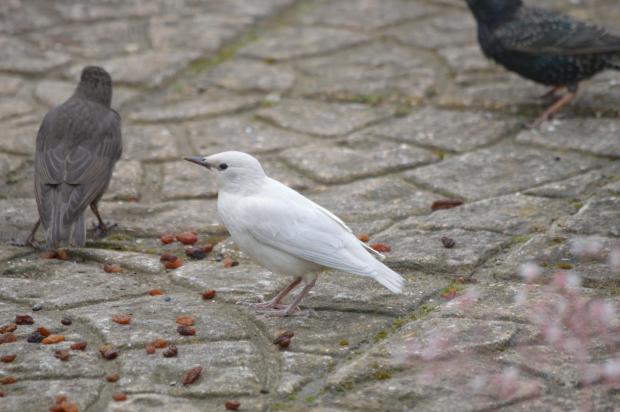
Snowy the starling is rare sight for York couple

8:01am Monday 2nd June 2014 in News

You could have knocked Derek and Sandra Shewan down with a feather when a rare white bird swooped onto their patio.

At first they though the starling they christened Snowy was an albino but they then spotted it did not have pink eyes.

The couple, from Hemlock Avenue, Huntington, discovered the bird was a Leucistic starling, sightings of which are occasionally reported in national wildlife magazines.

Experts say Leucism is a very unusual condition whereby the pigmentation cells in an animal or bird fail to develop properly.


This can result in unusual white patches appearing on the animal, or, more rarely, completely white creatures.

Retired Royal Mail sorting office worker Derek, 66, said: “From what I have read it is more rare than an albino.