As regular CFZ-watchers will know, for some time Corinna has been doing a column for Animals & Men and a regular segment on On The Track... particularly about out-of-place birds and rare vagrants. There seem to be more and more bird stories from all over the world hitting the news these days so, to make room for them all - and to give them all equal and worthy coverage - she has set up this new blog to cover all things feathery and Fortean.
Showing posts with label dogs. Show all posts

Wednesday, 3 April 2019

Dog owners join birders in pushing for leash enforcement to protect burrowing owls at Berkeley park


The burrowing owls that make Cesar Chavez Park their winter home are bringing together dog owners and bird fans who are both urging the city to do more to enforce leash laws to prevent the rare birds from being harassed and chased from the park.
The small brown and cream mottled owls, with their piercing yellow eyes and long skinny legs, face continued threats at the park, including dogs disturbing their protected nesting areas when owners let them wander outside the park’s off-leash zone with minimal supervision.
Two owls returned to the park this winter season, after none were spotted last season, according to tallies from the Golden Gate Audubon Society.
Bird watchers are concerned that the uncontrolled dogs and other predators — such as other raptors and feral cats — could chase the tiny owls away from the park for good. Dog owners who frequent the park say they are also concerned and want the city to step in and do something about it.

Sunday, 31 March 2019

After antelopes, the Great Indian Bustard's survival is threatened by dogs


Press Trust of India  |  Jodhpur Last Updated at March 19, 2019 10:35 IST
After antelopes, dogs have emerged as a major threat to the endangered Great Indian Bustard, inspite of conservation and breeding projects underway in the state to stop the bird, one of the heaviest flying birds, from being extinct.
According to wildlife enthusiasts, the bird is falling prey to stray dogs in desert areas of Jaisalmer, where the number of the canines has seen a spurt.
"These dogs have emerged as a major threat to conservation efforts. They kill the birds and even destroy their eggs," said Radheshyam Pemani, a wildlife enthusiast from Pokhran.
He said dogs routinely attack the birds in evening, when they come out to feed.
The weight of the bird which can be up to 15kg proves fatal for it when dogs attack. If the bird is alert, it takes a flight away from dogs but a delay weakens its chances of survival.
Until 1980s, up to 2000 Great Indian Bustards could be found in western India, reports say. But due to rampant poaching and dwindling grasslands, their population declined rapidly.
In 2011, the International Union for Conservation of Nature categorised the bird as "critically endangered".
A petition is being heard in the Rajasthan High Court for the safety and conservation of the endangered bustard, with a focus on identification and elimination of the threats to its life.

Sunday, 10 June 2018

Rare yellow-eyed penguins killed by dogs at Catlins wildlife reserve


24 May, 2018 2:33pm
By: Hamish MacLean

Two yellow-eyed penguins have been killed by dogs at a wildlife reserve in the Catlins over the past four weeks.

Yellow-eyed Penguin Trust general manager Sue Murray called the deaths at the trust's Long Point Irahuka Reserve south of Owaka ''devastating'' in so far as they were ''totally preventable''.

Signs at the reserve clearly indicated dogs were not allowed.

The South Island's estimated 250 breeding pairs of the bird remain the lowest for one of the world's rarest penguin species for more than a quarter of a century, and experts have predicted the penguins' extinction from mainland New Zealand because of threats such as climate change, starvation and disease, including avian diphtheria and avian malaria.


Thursday, 3 November 2016

Dogs, drones and microlights – it’s a bird’s life trying not to be disturbed


Media release FOR IMMEDIATE PUBLICATION

The RSPB is appealing for visitors to the Westcountry’s estuaries to put wildlife first, in the hope it stops incidents of wintering birds being disturbed. The problem is particularly acute on the Exe estuary, where thousands of geese, ducks and waders congregate, including winter-residents and migratory birds passing through. But many other of the Westcountry’s estuaries also hold internationally important numbers of wintering birds, and the last thing they need is to be disturbed by people, their dogs, or by machinery of one kind or another.

Dogs not being kept on leads where birds are gathered are a perennial problem, which has now been joined by contemporary menaces, such as intrusive drones and, occasionally, microlight aircraft being flown above flocks at very low altitude. The Exe estuary’s large flock of Brent geese offer an example: every year thousands arrive after their 3,000-mile journey from Siberia, and the last thing they need is to waste energy flying around after being disturbed by people, dogs, drones, or microlights. 

Peter Otley, site manager for the RSPB’s Exe estuary reserves, said: “The Exe is one of the best places in the UK to see geese, ducks and waders in winter, it’s a wonderful but fragile place and the birds are sensitive to disturbance. “So we urge everybody to put wildlife first if they visit the estuary and are near estuary’s birds. “You can’t miss the flocks, they’re obvious, from the air as well as on land, so please keep your distance and let the birds go about their business in peace.” Autumn and winter is a great time to watch waterfowl and waders and the RSPB has some advice for making the most of birding trips to the region’s estuaries: A spokesman said: “Waders and other estuary species, such as avocet, black-tailed godwit and widgeon, feed on exposed mud at low tide and roost above the tide line when the water covers their feeding grounds. 

“Favoured areas of shingle and mud sometimes draw thousands of birds together as they wait for the tide to fall again. It’s best to get in a good viewing position an hour or two beforehand, so that you can see the birds fly in, and, of course, avoid disturbing them as you come and go.” 

Ends For further information, images, or to arrange an interview, please contact: Chris Baker, RSPB Communications Officer, 01392 453299 / 07701 050010
Notes: The RSPB’s recently refurbished hide at Bowling Green Marsh, Topsham, is a superb place to see many of the waterfowl that congregate on the Exe estuary, and the high tide roost makes it one of the best places to see birds in South West England. Thinking of taking up bird watching? The RSPB is running a taster session at Dart’s Farm on November 3, in advance of its popular Birdwatching for Beginners course, beginning in March next year. The evening will include talks on migration of birds to the area in autumn and winter, the importance of the Exe for wildlife, and on some of the skills involved in becoming a birdwatcher, together with information about the full course.
Booking is essential and the taster session costs £10 (free to RSPB members).
Booking and further information on 01392 432691 or by email: swbooking@rspb.org.uk Chris Baker Communications Officer Tel: 01392 453299 Mobile: 07701 050010

Sunday, 8 May 2016

Crows swoop on puppy, carrying it away from back garden

Owner heard four-month-old chihuahua ‘screaming’ before she disappeared from outside her Melbourne home

Wednesday 4 May 201610.12 BSTLast modified on Wednesday 4 May 201613.13 BST

The owner of a chihuahua puppy remains hopeful the dog is still alive after it was snatched from her backyard and carried away by crows.

Four-month-old Fudge, who was small enough to fit in the palm of a hand, was swooped upon by crows while outside her owner Heather Sinden’s home in Melbourne’s outer east on Wednesday afternoon.

Sinden’s daughter Melinda Pride told the Lilydale & Yarra Valley Leader that the dog spent most of its time indoors but had been let outside to urinate.

Her mother had seen the crows at the Astor Court address and “was quite concerned”, said Pride.

“Then she heard [Fudge] screaming and she was gone.”

Sinden – who has lung cancer, and was given the puppy for companionship two months ago – “collapsed from shock”, said Pride.

“Mum was only saying a week or so ago ‘if anything happens to this little dog I don’t know what I’ll do’ ... she was very attached to the little dog.”

Pride was hopeful that Fudge landed safely.

In an interview on local radio, she said members of the community were scouring the area for Fudge.

“We’ve had people walking around everywhere; it’s just amazing the feedback we’re getting ... people are going to parks and everything, trying to find her, but there’s no sign of her at all.


Thursday, 30 July 2015

Grim kiwi winter continues

By Peter de Graaf
9:30 AM Thursday Jul 30, 2015

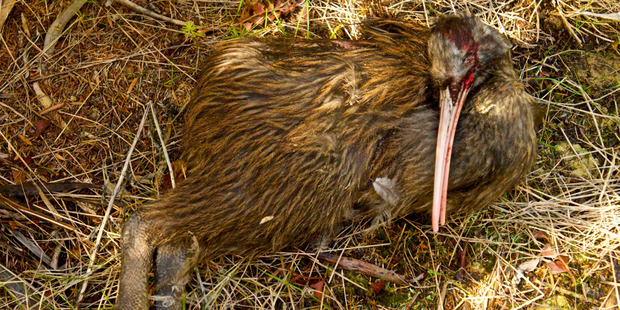
Another kiwi has been killed by a dog as the national bird's grim winter in the Bay of Islands continues, with at least 12 victims of canines in the last month alone.

The latest death, of an adult male, occurred at Oromahoe, off State Highway 10 south of Kerikeri. The dog's owner was reluctant to hand the dead bird to the Department of Conservation (DoC) so delivered it to conservation group Bay Bush Action instead.

The Bay of Islands is a stronghold for kiwi but many have been killed by dogs this month. Seven mauled kiwi have been found in the Wharau Rd area, near Kerikeri - the total number killed is thought to be at least 10 - and at least five more in places such as Te Puna Inlet, Okaihau and Puketi Forest. One was killed on Golf View Rd in urban Kerikeri and one in Russell cemetery.The kiwi had been stripped of feathers and it had bite wounds to its head and neck.

Bay Bush Action trustee Brad Windust said the dog's owner handed over the kiwi killed at Oromahoe last week.

Sunday, 22 June 2014

Dogs running free may have wiped out colony of threatened birds on Disappearing Island


Published: Thursday, June 19, 2014 at 4:20 p.m.
Last Modified: Thursday, June 19, 2014 at 10:38 p.m.

Nearly 90 percent of the 63 rare least tern nests on a Volusia County beach disappeared at some point over the past week, in a demonstration of the fragile nature of nesting seabird colonies.

A week after celebrating the 63 nests, county officials returned to the colony on Disappearing Island on Wednesday and found only six nests, two of them new from the week before. They believe dogs running free in protected areas could be partly to blame.

County officials found some flightless chicks, said Jennifer Winters, the county’s coastal habitat program manager, “but the colony was pretty devastated.”

“It’s a major disappointment,” she said. “People were really interested and excited.”

It was the first time a sizable colony of least terns had been found on a Volusia beach in the last 10 years, said Alex Kropp, the Florida Fish and Wildlife Conservation Commission biologist responsible for helping ensure the protected birds continue nesting along Florida beaches.

Tuesday, 8 April 2014

Dogs 'running wild' on nature reserve spark Twitter complaints

Posted on: 02 Apr 2014


The problem of dogs off the leash on some RSPB reserves has been highlighted after numerous local Surrey birders began complaining on Twitter.

A dogs-on-leads policy, or even a seasonal ban from some areas to protect wildlife, could be the way forwards at the RSPB’s Farnham Heath nature reserve after yet more complaints from visitors about dogs 'running wild'. A number of people complained on Twitter about out-of-control dogs, flushing a rare bird from a drinking pond and leaving dog mess behind, after visiting reserve in Surrey last weekend.

“I am not anti-dog, I just think there should be places for wildlife and places for dogs,” tweeted one visitor, while another added: “Maybe dogs should have to be on a lead, as they are disturbing the birds.”