As regular CFZ-watchers will know, for some time Corinna has been doing a column for Animals & Men and a regular segment on On The Track... particularly about out-of-place birds and rare vagrants. There seem to be more and more bird stories from all over the world hitting the news these days so, to make room for them all - and to give them all equal and worthy coverage - she has set up this new blog to cover all things feathery and Fortean.

Saturday, 5 July 2014

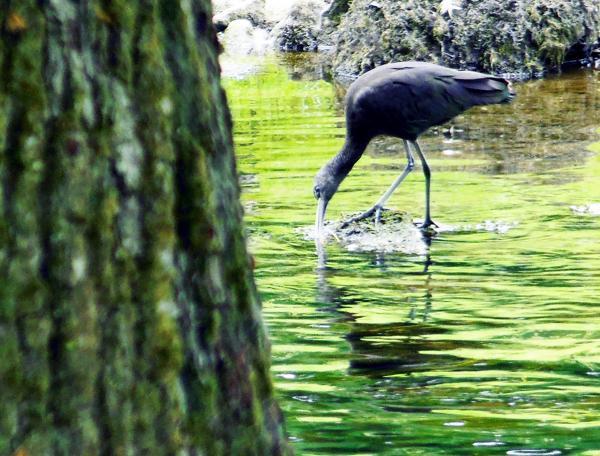
PICTURE: Rare bird turns up for a wade in South Lakeland water after Greece and Turkey turns too hot

Updated 9:09am Thursday 3rd July 2014 in NewsBy Katie Dickinson, Reporter
AN exotic visitor to the River Bela has been attracting birdwatchers from Cumbria, Lancashire and beyond.

The rare glossy ibis was first spotted just south of Milnthorpe on June 17 and has been sighted most days since.

An RSPB spokesperson said the wading bird was ‘a fairly rare sighting but not unheard of’ in the UK.

The glossy ibis would normally be in Greece or Turkey at this time of year after spending the winter in north Africa.

There have been around ten sightings across the UK so far this year.

SATELLITE BID TO AID RARE CHICKS


PUBLISHED: 15:53, 3 July 2014 | UPDATED: 15:53, 3 July 2014

Rare hen harrier chicks have been fitted with satellite tags to track them as part of efforts to protect England's most threatened bird of prey.

The four-week-old chicks are being raised on the United Utilities Bowland Estate in Lancashire, in the first successful hen harrier nest in England since 2012, the RSPB said.

Last year, hen harriers failed to nest successfully in England for the first time since the 1960s, leaving the bird on the brink of extinction in the country, the conservation charity said.

But this year the protected bird of prey, which has been subject to long term persecution, appears to be faring slightly better with three active nests in England.

Chicks produced in the other English nests, one of which is also on the United Utilities Bowland Estate, will also be tagged when they are big enough.

Government conservation agency Natural England's lead adviser for hen harriers, Stephen Murphy, who fitted the tags, said: "The lightweight tags weigh just 9.5 grams and are solar recharging, giving an operational life of at least three years.

"This is where technology can really aid conservation as there is no better way of gaining an insight into the complex dispersal of these iconic birds."
Rare breed of hawk spotted in North Platte

Posted: Friday, July 4, 2014 3:00 am


North Platte is dealing with a real-life version of Angry Birds.
Julie Waters broad winged hawk.JPG
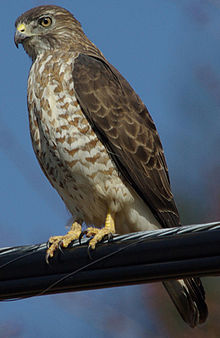
A pair of broad-winged hawks has set up residence at 2615 Birchwood Road, causing quite the stir.
“Basically, they have been dive-bombing the landowner and anyone else who gets too close to their tree,” said T.J. Walker, Nebraska Game and Parks Commission wildlife biologist. “The property owner called to ask what should be done, and the unfortunate answer is nothing, except wait for them to get done raising their young.”

The hawks have built a nest in a tree in the front yard and have at least two babies inside it. When Game and Parks officials went to investigate, they got buzzed by the birds too.

“It’s kind of an oddball occurrence,” Walker said. “Aside from North Platte, the only places we have documented broad-winged hawks nesting in Nebraska is in the southeast portion of the state. They like areas along the Missouri River and south of the Platte.”

Live webcam provides rare glimpse of Arctic snowy owls

Arctic snowy owls are the featured performers for a new webcam near Barrow, Alaska.


Science Recorder | Delila James | Friday, July 04, 2014

A high-definition camera trained on the nesting site of two Arctic snowy owls and their six chicks went live this week, giving scientists and bird enthusiasts an unprecedented look into the daily lives of these magnificent birds. The burrow is located on the coast of the Arctic Ocean near Barrow, Alaska.

“You’re not able to watch the birds 24/7, even with 24 hours of daylight,” researcher Denver Holt of the Owl Research Institute in Charlo, Montana, told The Associated Press (AP). “By having the camera, it just opens up another avenue and more periods of time we’re able to look and record.” Holt is in the 23rd year of a longterm study of the owls and their primary prey, brown lemmings.

The media division of the Annenberg Foundation provides the new webcam as the latest addition to explore.org’s Pearls of the Planet, which sponsors a variety of live wildlife cams


No two lark sparrows are alike (at least when it comes to migration habits)

Date:
July 3, 2014

Source:
LarkSparrow.jpgDe Gruyter Open
Summary:
A new study conducted by researchers who used geolocators to track birds migration journey, shows that migration flyways and winter destinations of sparrows are unique to each bird.


Friday, 4 July 2014

Poachers of rare birds arrested in Damghan

Marjan Golpira

TEHRAN – The local chief the Environment Protection Organization in Damghan said on Tuesday that two poachers of rare birds have been arrested and now they are in police custody. 

Moslem Araghi told IRNA the illegal hunters had 500 animals traps extended in a wide sweep of 6 kilometers in southern Damghan, a city 342 kilometers east of Tehran.

Apparently the violators had a long history of illegal hunting as it was their fourth time in the past couple of years to get arrested not to mention their second time in the past three weeks, Araghi recounted. 

The area, he added, is now cleared off the traps with tractors. 

Hobara, an endangered and threatened bird, is being smuggled by poachers from southern Iran to the neighboring countries. 


The British Avian Invasion: More weird British Bird News


You’re dealing with an expert in guerrilla warfare, a rhea who’s been trained to ignore pain, ignore weather, to live off the land, to eat things that would make a billy goat puke.
Image: Warren Allott of the Telegraph

Well, it looks like it time for another wildlife-related article. But let’s start with an update from a story I covered a few months ago.
Chris the rhea found and killed.

Some of the more astute readers may have noticed that for this article’s cover, I decided to paraphrase First Blood. That’s mainly because, with all the information I’ve managed to gather, the rhea can really be so dangerous that it can justifiably be compared to John Rambo. Granted, it can’t use an M60, but it’s far more dangerous than one would expect the ostrich’s shorter cousin to be. Case in point: while researching this article, I found out about how a young boy, as a birthday present, had a “zookeeper for a day” job at a bird zoo, and the powers that be allowed him to work with all the birds, except for the rhea. And, in April, one escaped from his owner and roamed Herefordshire.