As regular CFZ-watchers will know, for some time Corinna has been doing a column for Animals & Men and a regular segment on On The Track... particularly about out-of-place birds and rare vagrants. There seem to be more and more bird stories from all over the world hitting the news these days so, to make room for them all - and to give them all equal and worthy coverage - she has set up this new blog to cover all things feathery and Fortean.

Friday, 3 April 2015

Two rare albatrosses rehabbed at bird center and released off San Pedro coast

By Carley Dryden, Daily Breeze


POSTED: 04/02/15, 3:54 PM PDT | UPDATED: 16 MINS AGO


They were rescued separately, one trapped between cargo containers on a ship into Long Beach, the other in the middle of the desert, but two rare albatrosses were released together Thursday afternoon in the ocean off San Pedro.

 (Scott Varley / Daily Breeze) 
With their striking gray and black eyes against a snow-white head and enormous wingspan, Laysan albatrosses are a sight to behold, if one is lucky enough to see one. The rare seabirds typically settle on remote islands in the North Pacific. But over the past couple of weeks, the adult birds have been gliding across a small pool at the International Bird Rescue Center in San Pedro, awaiting the OK for their release.

The bird rescued March 21 from the Port of Long Beach was drenched in grease and cleaned by center staff, but otherwise healthy. The man who found the bird estimated that it had been stuck between the cargo containers for up to 10 days.

The other bird was found March 20 near a construction site in the desert city of Rancho Mirage, 100 miles from the Pacific Ocean.

“He got marooned in the desert, literally,” said Julie Skoglund, the center’s operations manager. “Albatrosses need wind and a runway to take off.”

Bird-spotters using technology to find Kokako


Friday 3 Apr 2015 6:33 p.m.

Bird-spotters hoping to prove the elusive South Island Kokako is not extinct believe modern technology could be the key to solving a 40-year mystery.

The species was thought to be extinct, but after reported sightings near Reefton it was reclassified as 'data deficient'.

The call of the South Island Kokako is something Rhys Buckingham hopes to one day hear for himself and despite hunting for 40 years, he's not ready to give up just yet.

"We've prepared a strategic plan and what we think now, to make any headway, we've got to use state-of-the-art hi-tech technology to try and get our bird," he says.

Mr Buckingham is wasting no time, setting up near Nelson where pest trapper Don Sullivan believes he spotted a South Island Kokako.

"I saw this bird and I said 'oh' and I looked at it and it was in a nest and it didn't do anything and it just stayed there and then I said 'oh, what a lovely little bird.'"

But identifying the bird isn't easy. In the past, feathers thought to be those of the Kokako have been DNA profiled but have either been lost or identified as coming from another species.


Thursday, 2 April 2015

Hundreds of rare birds of prey return to Reading

ITV REPORT
1 April 2015 at 12:34pm


More than 300 rare red kites are 'commuting' into Reading, Berkshire every day for food.

Research by the University of Reading shows that almost one in 20 households in the town – the equivalent of more than 4,300 homes – regularly feed red kites.

Many of those are putting out pieces of meat, particularly chicken, in order to attract red kites into their gardens.

The birds of prey almost went extinct in Britain until a recent successful reintroduction in 1989.

Almost half of households in the UK leave food out for birds - but usually peanuts or seed - rather than meat.

Feeding the red kites meat is controversial. Some conservation groups claim that leaving out food for the birds makes them dependent on human hand-outs and the birds may end up stealing food from picnics and barbecues.

Red kites were once a common sight over medieval towns, where they were welcomed as they helped keep the streets free of rotting carcasses of dead animals. But following centuries of persecution, only one or two pairs survived in Wales by the 1930s.

New South American Bird Species Discovered in Old Museum Drawer

A group of tropical passerines adds another member to its ranks (sort of).

Jesse GreenspanPublished Mar 31, 2015

For 70 years, the small brown-and-gray songbirds stashed in a drawer at the Smithsonian were a mystery that no one thought to question. Their labels read White-crowned Tapaculos, a species native to mountain forests across equatorial South America. But as scientists recently discovered, the birds are actually an entirely unique species.

Perija Tapaculo (Scytalopus perijanus) is a
newly identified species found in the humid
 mountains and elfin forests of northwestern
 Venezuela and northern Colombia.
Photo: Andres Cuervo/Flickr Creative Commons
This species, which is named the Perijá Tapaculo, after the mountain range in which it lives, is the newest member of a group of tropical, New World songbirds that forage for insects near the ground. It’s a perilous practice (“tapaculo” essentially means “cover your ass” in Spanish) that leaves them vulnerable to predation. A few species sport bright colors and patterns, but the majority are somber in shade—hence the ambiguity. Of the 50 known species of tapaculos, 10 have been discovered within the last 20 years, thanks to DNA analysis and vocalizations.

“The recognition of the new tapaculo in the Perijás is welcome and exciting news, but it's not totally unexpected,” says Kenn Kaufman, birding expert and Audubon field editor.

The tale of the Perijá Tapaculo’s discovery began in 1941, when ornithologist Melbourne Carriker Jr. collected 27 tapaculo specimens in the Andes on the Colombia-Venezuela border. Carriker sent his bounty to the Smithsonian, where they were recorded as White-crowned Tapaculos, and forgotten. Additional specimens from the area were added to the collection from 1951 to 1978, but they too gathered dust, Jose Avendaño and colleagues report in The Auk: Ornithological Advances.

Wednesday, 1 April 2015

Jonathan Franzen: climate campaigns killing the birds?

The author’s suggestion in a New Yorker essay this week that bird populations would thrive if we gave up the fight on climate change is ‘nonsense’ say conservationists


Wednesday 1 April 2015 15.29 BSTLast modified on Wednesday 1 April 201515.42 BST

In Jonathan Franzen’s 2010 novel Freedom, lauded for its biting critique of the US environmental movement, a conservationist enters a Faustian pact with a coal miner. He cuts a deal in which a community of 200 families are to be relocated and a mountain denuded in return for the creation of a sanctuary for warblers.

In this week’s New Yorker, Franzen flirts with his own protagonist’s folly by proposing to protect birds by giving up on the fight to slow down climate change. A suggestion that has angered and confused bird conservationists across the world.

Franzen begins his essay with an expression of deep and admirable love for birds, for which he has been a long-time advocate. He “cares more about birds than the next man”, he says. His typically brilliant opening double entendre works as an ode to birds, but also reveals an apathy for his fellow humans. They are beyond help from climate change and thus beyond caring about it. Birds on the other hand have a future. It’s a modern, nihilistic rendition of Byron’s declaration: “I love not man the less, but Nature more.”

Rare bird found in Porth nursed back to health

1 April 2015 at 8:30am

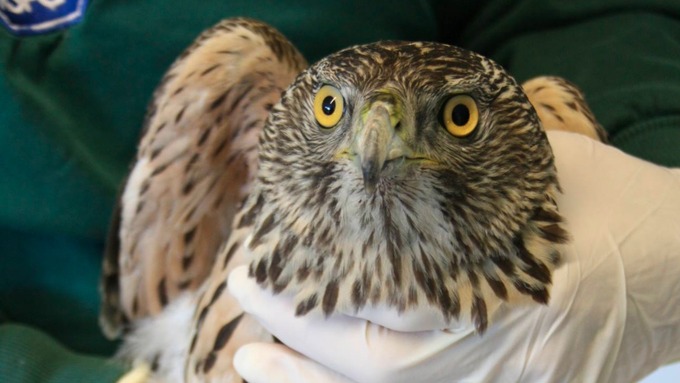
A rare goshawk that fractured her wing has been nursed back to health by the RSPCA.

The female goshawk, who is thought to be around one-year-old, was found with a broken wing by a member of the public in Porth Park, Porth, Rhondda Cynon Taf, in mid-January.

The Goshawk was found in January. Credit: RSPCA
After two months in the care of RSPCA West Hatch and time in the centre’s flight aviary building up her strength she has now been released back into the wild.

She is a beautiful bird and we rarely see them admitted to the centre and we are all very pleased we have been able to nurse her back to health and release her back into the wild where she belongs.

The goshawk was brought in to us with a damaged wing - but we had no idea how she had fractured it.

Her wing carriage took several weeks to return to normal - but we have a very long flight aviary at West Hatch in which she was able to get back to full fitness.

Our vet team strapped her wing up and prescribed rest for this beautiful and powerful bird of prey until the bone had healed and she was ready to build her strength back up in our aviaries.
– ARMINEL SCOTT, RSPCA WILDLIFE SUPERVISOR


Little bird's arduous migration reaches 'brink of impossibility'

By Will Dunham

WASHINGTON (Reuters) - The blackpoll warbler accomplishes a mighty big feat for a such a little bird.

Scientists on Tuesday documented how this songbird that weighs half an ounce (12 grams) completes an arduous nonstop flight over the Atlantic Ocean from forests in New England and eastern Canada to Caribbean islands as it migrates each fall toward its South American wintering grounds.

By placing miniature backpacks with geolocators on the birds, the researchers determined they flew an average of nearly 1,600 miles (2,540 km) over two to three days.

"No other bird this size migrates for this long in one go. It is truly one of the most amazing migratory feats ever recorded," said ecologist Ryan Norris of the University of Guelph in Ontario, describing "a fly-or-die journey."