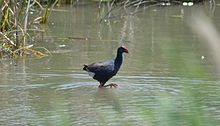
More than a thousand birdwatchers
have come from across the country to see the bird, which is about the size of a
chicken and looks like a fancy coloured moorhen.
Continued ..
As regular CFZ-watchers will know, for some time Corinna has been doing a column for Animals & Men and a regular segment on On The Track... particularly about out-of-place birds and rare vagrants. There seem to be more and more bird stories from all over the world hitting the news these days so, to make room for them all - and to give them all equal and worthy coverage - she has set up this new blog to cover all things feathery and Fortean.
Friday, 5 August 2016
Rare Purple Swamp Hen brings flocks to RSPB Minsmere in Suffolk
Scientists Discover New Virus That Cause Beak Deformities in Birds
Aug 01, 2016 07:06 AM EDT
Scientists have discovered a
new virus responsible for causing mysterious deformities in birds.
Researchers from the California
Academy of Sciences, University of California San Francisco (UCSF) and the U.S.
Geological Survey (USGS) have found the new virus that has been linked to Avian
Keratin Disorder (AKD), a disease that causes debilitating beak overgrowth.
The disease has affected
populations of wild birds around the world, and the cause has remained elusive
despite decades of research.
"Take one look at a bird
suffering from Avian Keratin Disorder, and you'll understand the importance of
stopping its spread," Jack Dumbacher, Academy curator of ornithology and
mammalogy and co-author of the study, said in a press
release.
"Birds must be able to feed
themselves and preen their plumage by carefully spreading waterproofing oils on
their feathers. When deformed beaks restrict them from these life-giving
activities, birds become cold, hungry, and often die. We're trying to
understand the causes, origins, and distribution of this disorder."
Avian Keratin Disorder is
characterized by severe beak deformities such as elongation, crossing or
curvature. The deformities affect birds' basic behaviors such as feeding and
preening, which are crucial to their survival.
The mysterious condition was
first documented among a population of black-capped chickadees in south-central
Alaska in the 90s and spread into Canada and the Pacific Northwest.
Thursday, 4 August 2016
Gamekeepers and RSPB clash over licence to cull buzzards on shooting estate
By WMNPBowern | Posted:
August 02, 2016
The RSPB stands accused of
hypocrisy over its opposition to the granting of a licence by Natural England
to control buzzards that threaten pheasant poults on a commercial shoot.
The accusation, in a blog written
by the gamekeepers’ political advisor, Charles Nodder, is that the RSPB is
itself happy to use lethal control in the name of conservation of certain
species and it is hypercritical of the organisation and its conservation director,
Martin Harper, to complain when someone uses the same rules to protect their
own interests.
In his blog on the RSPB website,
Mr Harper wrote: “The thorny issue of licenses for buzzard control reappeared
when Natural England issued a licence permitting the control of up to 10
buzzards to “prevent serious damage to young pheasants”.
He goes on: “The killing of a
recovering British bird of prey to protect an introduced gamebird for the
benefit of commercial interest is wrong. The decision sets a worrying
precedent. What will be next? Red kites, peregrines, hen harriers?”
But Mr Nodder, political adviser
for the National Gamekeepers’ Organisation, says buzzards are thriving and
asks, if it is okay for the RSPB to be granted licences to kill even rarer birds
in the name of conservation, why it is wrong for shooting estates to also apply
for licences to control buzzards?
He writes: “I was particularly
interested in Martin’s reaction, because there is no risk to buzzard
conservation arising from Natural England’s (NE) decision whatsoever.
In law, NE cannot issue a licence
if, as a result of its being carried out, the conservation status of the
licensed bird would be adversely effected.
Cuckoos count cost of shortcut home, say scientists
By Helen Briggs BBC News
19 July 2016
The sound of the first cuckoo in
spring is a familiar one in the British countryside.
But the summer visitor is in
decline and, according to a new study, its migratory habits may be to blame.
Scientists have tagged birds
leaving the UK and believe they take two different routes on their journey to
spend the winter in Africa.
Surprisingly, survival is lower
on the shorter route via Spain, they report in the journal, Nature
Communications.
And this suggests that migration
- as well as other factors such as loss of farmland and insect food - may be to
blame for the cuckoo's decline.
More than half of cuckoos in the
UK have been lost over the past 20 years, according to the British Trust for
Ornithology (BTO) in Norfolk, which led the research.
"That pattern of starting in
the same place but taking two very different routes to get there has not been
seen before in any birds, to the best of our knowledge," said lead
researcher Dr Chris Hewson.
"We need to understand the
full annual cycle of a migratory bird in order to understand its population
decline."
Why one of the world’s best fossil sites is full of severed bird feet
By Brian Switek July 20
Prehistoric
creatures aren’t exactly renowned for their table manners. Most dinosaurs, for
example, were incapable of chewing and had to swallow their food whole. But
some ancient eaters were messier than others. And in southwestern Germany,
something especially sloppy left severed bird feet strewn about a dense fossil
boneyard.
The Messel Pit is
one of the greatest fossil sites in the world. Within stacks of
47-million-year-old oil shale is an unmatched record of life in and around an
ancient lake. There are early mammals preserved down to their fur, pairs of
turtles that somehow died in the middle of mating, dozens of plant species and
more than 1,000 bird skeletons. It’s the closest paleontologists can get to
actually walking through a humid Eocene forest.
Not all the Messel fossils are so
dazzlingly complete, though. At least eight isolated bird feet have been pulled
from the same stone. They were a curiosity, but mostly overlooked as experts
focused on studying and describing birds that were more intact. But now Natural
History Museum paleontologist Gerald
Mayr has
taken another look at the feet and come up with an explanation for how they
became violently separated from the rest of the avians they once belonged to.
Wednesday, 3 August 2016
Six New Species of Birds Have Settled in Iceland
July 31, 2016 12:52 Updated:
August 02, 2016 08:30
Six new species of birds have
settled in Iceland since the turn of the century. Being a settler is not a
well-defined term, but when a bird returns for nesting for 10 years or so, it
seems fairly safe to say that it settled.
The six bird species are: The
barnacle goose (Branta leucopsis), the shelduck (Tadorna tadorna), the eurasian
woodcock (Scolopax rusticola), the blackbird (Turdus merula), the goldcrest (Regulus
regulus) and finally the red crossbil (Loxia curviriostra).
According to Yann Kolbeinsson,
biologist and bird enthusiast, it is a big change for a bird to decide coming
to Iceland, a far-away island. Winds can play a role, and birds on their way
somewhere else may stop in Iceland and decide to settle. A warmer climate might
also play a role.
Flesh-eating MICE threaten to wipe out rare birds on wildlife paradise island
DEADLY flesh-eating mice are
threatening to wipe out some of the world’s rarest birds on a precious wildlife
paradise run by Britain.
Plagues of hungry rodents are
killing up to 600,000 birds a year on one of the UK’s 30 UNESCO World Heritage
Sites.
Conservationists warned today
that Gough Island in the South Atlantic is in danger of losing its prestigious
status – a standing that puts it on par with the Great Barrier Reef,
Yellowstone National Park and the Galapagos archipelago – unless the
carnivorous mice are not wiped out.
Britain has 30 World Heritage
Sites, including Stonehenge, the Giant’s Causeway and Blenheim Palace as well
as four overseas, but there are mounting fears for the future of Gough Island’s
status because of the mice infestation.
A new report timed to coincide
with the 40th World Heritage Committee meeting is revealing how the mice are
causing massive breeding failure in most of the seabird colonies, including the
threatened Atlantic petrel and the critically endangered Tristan albatross, now
down to its last 2,000 pairs.
Subscribe to:
Posts (Atom)