As regular CFZ-watchers will know, for some time Corinna has been doing a column for Animals & Men and a regular segment on On The Track... particularly about out-of-place birds and rare vagrants. There seem to be more and more bird stories from all over the world hitting the news these days so, to make room for them all - and to give them all equal and worthy coverage - she has set up this new blog to cover all things feathery and Fortean.
Showing posts with label Alaska. Show all posts

Wednesday, 27 November 2019

From Alaska to Australia, anxious observers fear mass shearwater deaths

Migratory short-tailed shearwaters are Australia’s most numerous seabird, but washed-up carcasses, late arrivals and low numbers have conservationists worried


Sat 23 Nov 2019 19.00 GMTLast modified on Sat 23 Nov 2019 23.24 GMT

The carcasses began to arrive in July.

Residents around the Bristol Bay area of Alaska found thousands of dead short-tailed shearwaters washing up on remote beaches, and sent samples to Anchorage.

“We collected about 100 birds for testing and they didn’t test positive for any diseases or toxins,” says Dr Kathy Kuletz of the US Fish and Wildlife Service.

“They were severely emaciated. The birds had starved.”

Two months later, observers in Australia began to register similar concerns. Every year the shearwaters – also known as mutton birds – make a remarkable 15,000km migration from the northern hemisphere to breeding sites in the Bass Strait and the south-east of the continent.

But this year they have arrived late, and in lower numbers than usual, leading at least one watcher in Victoria to warn that Australia’s most common seabird could suddenly become one of its rarest if numbers plummet drastically this year.

“I’m very, very concerned,” says Peter Barrand, the president of Birdlife Warrnambool.
Patchy and late return

The arrival of shearwaters at places such as Griffiths Island and Phillip Island in Victoria is well known not only for its scale, but also its precision timing.

Monday, 13 August 2018

Seabird die-off has scientists on high-alert

Tuesday, August 7th 2018, 11:15 am AKDT
Updated: 
Tuesday, August 7th 2018, 4:46 pm AKDT
By Makayla Clark


The cause behind unusual bird behavior on Alaska's coastline has scientists on high alert.

Beginning in May, wildlife officials began receiving reports of dead and dying seabirds from the northern Bering and southern Chukchi seas, including in the vicinity of the Western Arctic National Parklands. 

National Park Service investigators found 100 carcasses in a 4-kilometer stretch of beach in late June, most of which were murres along the coast of the Bering Land Bridge National Preserve. Although, investigators say other species were found there and in Cape Krusenstern National Monument. 

Scientists say the culprit is starvation-- but they don't know why. There has been no evidence of disease, and tests are pending to determine if birds were exposed to harmful algal toxins. 

A Facebook post from Alaska National Parks outlines the birds in question.

Thursday, 24 May 2018

Eastern curlew, a visitor from Siberia and Alaska, draws calls for help to save it from extinction


Posted Thu at 3:17am

A wildlife group is calling on the Federal Government to tighten the country's environment laws to help save a bird that migrates from as far as Siberia or Alaska each year from the brink of extinction.

BirdLife Australia says eastern curlew numbers have dropped by 80 per cent over the past three decades due to the destruction of their habitat along Australia's east coast.

The bird, not to be confused with its noisy cousin the bush stone curlew, takes up residence on mud and sand flats from Cape York to Tasmania.

They are known for their long bill and legs and eerie call and use their time in the country to fatten up before making their return.

BirdLife Australia's acting head of conservation Dr Jenny Lau says the bird is already critically endangered and she fears they will become extinct in the years to come.

She said direct Government action is needed to protect Australia's coastal habitats.

Thursday, 17 May 2018

Russian cuckoo invasion spells trouble for Alaskan birds, study finds


May 7, 2018 by Diana Yates, University of Illinois at Urbana-Champaign

Common cuckoos and oriental cuckoos in eastern Russia appear to be expanding their breeding range into western Alaska, where songbirds are naive to the cuckoos' wily ways, researchers report. A new study suggests the North American birds could suffer significant losses if cuckoos become established in Alaska.

Like brown-headed cowbirds, cuckoos are "brood parasites," laying their eggs in the nests of other species, said University of Illinois animal biology professor Mark Hauber, who led the new research with Vladimir Dinets of the University of Tennessee, Knoxville. Cuckoos time their egg-laying so that their chicks will hatch first. The chicks then kick the other eggs out of the nest, "thereby eliminating the entire reproductive success of their hosts," Hauber said.

"Brood parasitism is a rare strategy among birds. Only about 1 percent of birds engage in it," he said. "Obligate brood parasites do it always. They never build a nest, they never incubate the eggs, they never feed their chicks. Instead, they sneak their eggs into somebody else's nest, forcing the foster parent to take care of the young."

Birdwatchers and ornithologists occasionally report seeing oriental cuckoos and common cuckoos in Alaska, and Alaskan natural history museums already contain a handful of cuckoo specimens collected locally, Hauber said. These birds are likely traveling from sites in Beringia, in eastern Russia.
"We don't have evidence of them breeding in Alaska, but it's likely already occurring," Hauber said. "We wanted to know whether the potential Alaskan hosts are ready for this cuckoo invasion."
In the new study, researchers tested whether more than a dozen Alaskan bird species had evolved defenses to counter the cuckoos' parasitic ways. Such defenses are common among bird species that frequently encounter brood parasites elsewhere.

Friday, 22 December 2017

Bird commonly found in Asia spotted by enthusiasts in Alaska


Published 9:41 am, Tuesday, December 5, 2017

SITKA, Alaska (AP) — Bird watchers have spotted a rare thrush in Alaska.

The dusky thrush, which is commonly found in Asia, has only been spotted a few times in Alaska, the Daily Sitka Sentinel reported . Bird enthusiast Matt Goff reported seeing one Friday in Sitka.

"I don't think it's an uncommon bird in Asia," Goff said. "But in North America — it's very unusual."

The dusky thrush's appearance differs slightly from that of its North American counterparts. It lacks the bright red or orange breast of a varied thrush, or robin, and has "pale," ''distinctive" lines around its eyes, Goff said.

Word of Goff's sighting spread quickly and enthusiasts from all over flocked to the Crescent Harbor in hopes of catching a glimpse.

One out-of-state enthusiast even flew in to see the bird, Goff said. That was Yve Morell, who is on a quest to achieve an American Birding Association Big Year, an informal competition in the birding community to identify the largest number of birds within a year.


Monday, 10 October 2016

Caspian terns discovered nesting 1,000 miles farther to the north than ever recorded in Alaska

Date: September 23, 2016

Source: Wildlife Conservation Society

WCS reported today that in the late summer of 2016, a WCS field team led by Dr. Trevor Haynes monitored Caspian tern chicks through to fledging in Cape Krusenstern National Monument in Alaska. This discovery of Caspian terns breeding above the Arctic Circle in the Chukchi Sea is nearly 1,000 miles farther north than previously recorded -- a strikingly large jump in the range of nesting for this (or any) species.

Rapid range expansions in the Arctic are largely being driven by climate change. The arrival of Caspian terns is just one of a suite of profound alterations to the rhythms of this environment being reported by scientists and local residents. There is now less summer sea ice, and a longer snow and ice-free season -- simply put, summer conditions now last longer. Therefore, more temperate species can, where possible, opportunistically move north.

Species such as fin and humpback whales are now spending more time in the Arctic, and boreal species such as the red fox and brown bear now interact more routinely with their arctic counterparts -- the arctic fox and polar bear.

"The challenge for scientists is to help understand the repercussions of these changes- for example, we've seen red foxes take over areas previously used by arctic foxes. We don't know what the repercussions of new colonies of Caspian terns will be on the current resident species, particularly if they gain more of a foot hold and expand their numbers," says Dr. Martin Robards. Elsewhere there have been critical concerns about predation by Caspian terns on local fish stocks, such as in the Columbia River.

Caspian terns are the largest and most majestic of all tern species and are avid full-body divers for fish. They occur on all continents except Antarctica. Unlike many other species of wildlife, Caspian tern populations appear to have increased in recent years. They were first noted in Alaska in 1981 and were thought to be breeding in Southeast Alaska by 1989. They have gone from being rare occurrences to breeding annually, but only at a handful of locations, and no farther north than Neragon Island in the southern Bering Sea, a thousand miles to the south.

Read on

Sunday, 24 July 2016

Alaska's shorebirds exposed to mercury


Date: July 13, 2016
Source: Central Ornithology Publication Office

Shorebirds breeding in Alaska are being exposed to mercury at levels that could put their populations at risk, according to new research from The Condor: Ornithological Applications.

Thanks to atmospheric circulation and other factors, the mercury that we deposit into the environment tends to accumulate in the Arctic. Mercury exposure can reduce birds' reproductive success and sometimes even be lethal. Shorebirds may be particularly vulnerable because they forage in aquatic environments where mercury is converted into methylmercury, its most dangerous form. Marie Perkins of the Biodiversity Research Institute (BRI) and her colleagues investigated the level of mercury in Alaska's shorebirds and found that some birds breeding near Barrow, at the state's northern end, have mercury concentrations upwards of two micrograms per gram of blood.

"These species already face a lot of tough new challenges, from climate change to disappearing stop-over habitat, so throwing a neurotoxin in the mix that can reduce reproductive success is likely to harm their populations," according to Dan Cristol of the College of William & Mary, an expert on mercury in birds who was not involved with the new study. "The mercury concentrations reported in this paper are likely to reduce reproduction, but not catastrophically, based on what we know from other species. What may be even worse, though, is that these mercury levels probably spike when they leave the breeding grounds and start burning their reserve fuel, making their already arduous continent-jumping trips even harder."

Continued … 

Monday, 6 June 2016

First Alaska ibis sighting has birders going ‘ballistic’

Posted On May 26 2016

An unusual bird was spotted in two separate Southeast towns on the same day last week. The ibises were a rare treat that has left bird experts scratching their heads, wondering why these southern birds have landed in Alaska.

Words like ‘flabbergasted’ and ‘astonishing’ came up when birders described hearing about the Ibis sightings last week. The large long-legged, wading bird is not native to Alaska. According to bird experts its northernmost boundary is the southern Canadian border. There has never been a recorded sighting in Alaska before now.

Andy Piston is a biologist with the Alaska Department of Fish and Game in Ketchikan. And while his professional focus is fish, he’s been studying birds in Southeast for two decades. He says if you saw an ibis you’d know it.

“You’d definitely notice,” he says. “It’s distinctive. It’s a heron-sized bird with a big, long, down-curved bill, and in the right light their plumage can look glossy and iridescent.”

The first glimpses happened last Thursday – one in Haines and one in Klawock, on Prince of Wales Island.

Bird enthusiast Jason Colon snapped a photo and posted a description of the encounter online. He wrote that he saw it in the early evening feeding in a grassy mudflat. He said its body shape and long, curved beak were dead giveaways that it was an ibis. After a little research, he deduced that it was a white-faced ibis.

Colon’s friend Amy Courtney runs Icy Straight Birding Tours out of Hoonah. She says when he sent her a photo of the bird, she knew what it was right away.

“It was definitely an ibis and I was really flipping out inside,” she says. “I didn’t realize that it would be the first Alaska record, but I knew it was going to be really rare.”

Biologist Piston says the overlapping sightings are indeed the first recorded in the state.

“I guess the bottom line is trying to say what caused it is pretty difficult. People want to say it’s related to the warm winter and spring, but it could be something unrelated down south that just caused more ibis to be in the Pacific Northwest, and a couple to stray up here.”

Haines bird expert Pam Randles says an ibis was also spotted on Friday and again on Sunday in Haines. She says she’s been fielding calls from interested parties across the state that want to come to Haines to see it. But, alas, it hasn’t been spotted since Sunday.

Monday, 21 March 2016

Common Murre die-off has died down after 40K carcasses found this winter

Beth Verge, Reporter and Multimedia Journalist
POSTED: 05:20 PM AKDT Mar 19, 2016    UPDATED: 05:39 PM AKDT Mar 19, 2016 

For now, a crisis has been averted for the massive seabird die-off that concerned scientists this winter, according to officials with Anchorage's Bird Training and Learning Center.

"We were afraid that this was going to carry on through the spring," said Bird TLC Director of Operations Guy Runco, referring to the thousands of Common Murres found exhausted and starved hundreds of miles north of their natural habitat near the sea. 

"We didn't know when it would end, so when February came around and we stopped getting calls, we were very happy with that," he said.

U.S. Geological Survey research wildlife biologists told the Associated Press that an estimated 6,000 to 8,000 carcasses of the penguin-like bird had been counted last month on the shores of a southwest Alaska lake, contributing to the total count of nearly 40,000, which could actually be a fraction of the true number.

But, for the last month, Bird TLC has not received any calls regarding Common Murre carcass discoveries.

"It's not just Anchorage," Runco said. "We got birds sent to us from as far north as Fairbanks. We were finding them inland throughout Alaska, and now that's just not the case."


Wednesday, 13 January 2016

8,000 common murres found dead on Whittier, Alaska, beach

Arctic seabirds washed ashore after apparently starving to death

By Dan Joling, The Associated Press Posted: Jan 12, 2016 1:41 PM CT Last Updated: Jan 12, 2016 1:41 PM CT

Seabird biologist David Irons drove recently to the Prince William Sound community of Whittier to check on a friend's boat and spotted white blobs along the tide line of the rocky Alaska beach. He thought they were patches of snow.

A closer look revealed that the white patches were emaciated common murres, one of North America's most abundant seabirds, washed ashore after apparently starving to death.

"It was pretty horrifying," Irons said. "The live ones standing along the dead ones were even worse."

Murre die-offs have occurred in previous winters but not in the numbers Alaska is seeing. Federal researchers won't estimate the number, and are trying to gauge the scope and cause of the die-off while acknowledging there's little they can do.

Scientists say the die-offs could be a sign of ecosystem changes that have reduced the numbers of the forage fish that murres depend upon. Warmer water surface temperatures, possibly due to global warming or the El Nino weather pattern, may have affected murre prey, including herring, capelin and juvenile pollock.

There are about 2.8 million breeding common murres in 230 Alaska colonies, part of a worldwide population of 13 to 20.7 million birds. Awkward on land, their short, powerful wings make them extraordinary swimmers, "flying" beneath the surface as deep as 600 feet to hunt for fish.

Wednesday, 6 January 2016

Dozens of starving seabirds grounded inland in Southcentral Alaska

December 30, 2015

Normally found skimming the North Pacific, seabirds known as common murres are appearing inland in the Matanuska-Susitna Borough and elsewhere in Southcentral Alaska, starving and unable to fly.

Reports of grounded murres have emerged from Moose Pass to north of Talkeetna, with many found this week in the Susitna Valley. The foot-tall black and white birds that resemble small penguins are showing up in odd places -- on the shoulder of busy Knik-Goose Bay Road outside Wasilla, just off a sled dog trail in Willow, tucked up next to a house in Houston.

The influx of murres is inundating local wildlife rehabilitation centers.

On Wednesday alone, 20 murres arrived at the Bird Treatment and Learning Center in Anchorage from Alaska WildBird Rehabilitation Center in Houston, where Susitna Valley residents are bringing grounded birds.

Hundreds of people shared social media posts about the bizarre murre sightings. One Valley resident posted a pathetic photo of a murre on its side in the snow on a Facebook group for Mat-Su lost and found pets with a comment: "This little fella is sitting in our driveway. I'm not sure what's wrong with him but he can't seem to fly away -- he can waddle and that's about it."

Thursday, 22 October 2015

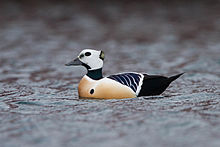
Threatened sea duck may be reintroduced in southwest Alaska

By DAN JOLING | Associated Press – Sat, Oct 17, 2015

ANCHORAGE, Alaska (AP) — A colorful, threatened sea duck whose numbers plummeted in Alaska may be reintroduced to the southwest corner of the state.

Steller's Eider (Polysticta stelleri) (13667966664).jpgFederal wildlife officials are taking public testimony on possible environmental effects of a plan to move breeding pairs of Steller's eiders to the Yukon-Kuskokwim Delta, where the birds once thrived.

Only 11 nests have been found there in the past 18 years. The birds' declining numbers on the delta figured heavily in a 1997 federal decision to declare the species threatened.

The U.S. Fish and Wildlife Service proposal calls for the release of Steller's eiders raised in captivity at the Alaska SeaLife Center in Seward. The agency says it's unlikely a subpopulation of Steller's eiders will re-establish itself without the introduction of captive birds.

Wild Steller's eiders continue to breed on tundra near coastlines in Arctic Russia and on Alaska's North Slope near Barrow, the northernmost community in the United States. The Alaska population is the only one listed under the Endangered Species Act.

Monday, 28 September 2015

Park employees spot yellow-throated warbler in Alaska

Posted: Saturday, September 26, 2015 1:39 pm

Associated Press

JUNEAU, Alaska - When two National Park Service interpreters stopped to watch a bird outside their offices in Glacier Bay, they didn't realize it was the first time the species had been spotted in Alaska.

Interpreters Steve Schaller and Emma Johnson were looking at a yellow-throated warbler, reported The Juneau Empire (http://bit.ly/1KC3IqG).

"When we first spotted it, it sort of looked like a yellow-rumped warbler, but then we started to notice its behavior was different, and it had a longer beak," Schaller said. "We started realizing that this was something new."

It's surprising to hear about the species in Alaska: The yellow-throated warbler usually spends summers in the Midwest and winters as far south as Cuba and the Dominican Republic.

Sunday, 5 April 2015

97% of Northwest Alaska bird, mammal species could experience habitat change from warming climate

Date:
April 3, 2015

Source:
USDA Forest Service - Pacific Northwest Research Station

Summary:
Of the 201 bird and mammal species that call northwest Alaska's arctic and subarctic region their home, 195 of them -- or, roughly, 97 percent -- could experience some form of habitat loss or gain stemming from climate change, a new study has found.


Saturday, 6 September 2014

Swallows Of The Western Skies

By Jessica Arriens, National Science Foundation | September 05, 2014 11:56pm ET

This Behind the Scenes article was provided to Live Science in partnership with the National Science Foundation.

Ushuaia and Fairbanks are cities near the tips of the world.

The capital of Argentina's Tierra del Fuego province and the Alaskan metropolis don't share much in common. Except for a cluster of simple wood boxes on poles and the scientists and swallows who flock to them.

Both animals are part of Golondrinas de las Américas — the Swallows of the Americas, an international research project studying the slight, swift swallow to answer larger questions about biological patterns.

"Looking at these birds across this huge hemispheric span of habitats provides a broader opportunity to explore relationships between the environment, temperatures and breeding," says David Winkler, a professor in Cornell University's Department of Ecology and Evolutionary Biology. He is the lead investigator for Golondrinas, funded through the National Science Foundation's Partnerships in International Research and Education (PIRE) program.

Read on ...

Wednesday, 9 July 2014

Arctic warming upsetting birds' breeding calendar, study warns

2,500 nests in Alaska show that nesting is taking place up to seven days earlier, reports 

Tim Radford for Climate News Network, part of the Guardian Environment Network

theguardian.com, Tuesday 8 July 2014 15.13 BST

Arctic migrants are nesting up to seven days earlier as the world warms. The sandpiper makes a beeline for the Alaskan shores, to join the phalarope on the beach and the songbirds in the woods − and all because the winter snows are melting earlier.

Conservation scientists Joe Liebezeit and Steve Zack – both then of the Wildlife Conservation Society (WCS) – and colleagues report in the journal Polar Biology that they looked into nearly 2,500 nests of four shorebird species in Alaska – two sandpipers, two phalaropes − and a songbird called the Lapland songspur over a nine-year period.

They recorded when the first eggs were laid. And they also assessed snow melt in nesting plots at different times in the early spring, and took note of predator abundance and the seasonal flush of vegetation − both of which can affect nest timing − to see what mattered most in terms of breeding.

“It seems clear that the timing of the snow melt in Arctic Alaska is the most important mechanism driving the earlier and earlier breeding dates we observed in the Arctic,” said Liebezeit, now of the Audubon Society of Portland, Oregon.

“The rates of advancement in earlier breeding are higher in Arctic birds than in other temperate bird species, and this accords with the fact that the Arctic climate is changing at twice the rate.”

During the nine years in which the scientists conducted their study, they found that nesting advanced by between four and seven days.

Saturday, 5 July 2014

Live webcam provides rare glimpse of Arctic snowy owls

Arctic snowy owls are the featured performers for a new webcam near Barrow, Alaska.


Science Recorder | Delila James | Friday, July 04, 2014

A high-definition camera trained on the nesting site of two Arctic snowy owls and their six chicks went live this week, giving scientists and bird enthusiasts an unprecedented look into the daily lives of these magnificent birds. The burrow is located on the coast of the Arctic Ocean near Barrow, Alaska.

“You’re not able to watch the birds 24/7, even with 24 hours of daylight,” researcher Denver Holt of the Owl Research Institute in Charlo, Montana, told The Associated Press (AP). “By having the camera, it just opens up another avenue and more periods of time we’re able to look and record.” Holt is in the 23rd year of a longterm study of the owls and their primary prey, brown lemmings.

The media division of the Annenberg Foundation provides the new webcam as the latest addition to explore.org’s Pearls of the Planet, which sponsors a variety of live wildlife cams


Wednesday, 14 May 2014

Juneau birders photograph rare Long-billed Curlew

Posted on May 11, 2014 at 6:00 am

A Juneau couple has likely made the first verified sighting of a Long-billed Curlew in Alaska. North America’s largest shorebird, rarely seen in this part of the country, may become No. 502 on the Checklist of Alaska Birds.
Martina Kallenberger and husband Doug Sanvik were bird watching at Boy Scout Camp on May 3. Kallenberger says they started around 11 a.m. walking the trail and beach and were going through the meadow around 1:30.

“We were actually watching a flock of Lapland Longspurs when we noticed these two shorebirds on a little rise by the stream and one of them was a Whimbrel, which we recognized, and the other one was just shockingly different,” Kallenberger says.

Kallenberger and Sanvik watched the bird for at least an hour, taking pictures and referring to guidebooks. They had an inkling it might be the Long-billed Curlew.

“During the course of the time we were sitting there I was going through the bird book thinking, ‘Well, gosh it can’t be this, it could be— No…’ And I kept coming back to the Curlew, and Doug and I were both like, ‘It sure looks like a match but, gosh, it just doesn’t seem right.’”

They had reason to be hesitant.

Wednesday, 18 December 2013

Savvy bar-tailed godwit equipped for climate challenge

The bird world's long-distance champion is probably savvy enough to cope with climate change, researchers believe.

The bar-tailed godwit makes the biggest no-stop migration, flying 11,000km from Alaska to New Zealand every autumn.

It relies on the right type of winds to make this epic journey - winds that computer models indicate could become less favourable in the future.

But scientists say the godwit's ability to judge weather conditions means it should rise to the challenge.

Tuesday, 10 December 2013

Disease kills hundreds of seabirds in Alaska

Saturday December 7, 2013 7:00 PM

ANCHORAGE, Alaska (AP) — A disease has killed hundreds of seabirds on an island in the Bering Sea — the first documented outbreak in the state.

The Alaska Department of Fish and Game says avian cholera is to blame for the birds found dead on the beaches of St. Lawrence Island, 200 miles from the mainland. The Anchorage Daily News reports (http://is.gd/yXJOYK ) that while the disease is common elsewhere, including in California, Nevada and Texas, this is the first confirmed outbreak in Alaska.