As regular CFZ-watchers will know, for some time Corinna has been doing a column for Animals & Men and a regular segment on On The Track... particularly about out-of-place birds and rare vagrants. There seem to be more and more bird stories from all over the world hitting the news these days so, to make room for them all - and to give them all equal and worthy coverage - she has set up this new blog to cover all things feathery and Fortean.
Showing posts with label Rotoroa Island. Show all posts

Sunday, 26 April 2015

Conservationists turn tiny New Zealand island into bold wildlife experiment

Big things are happening on Rotoroa, a new sanctuary for endangered species that aims to create a whole new ecosystem


Tuesday 21 April 2015 22.00 BSTLast modified on Wednesday 22 April 201517.25 BST
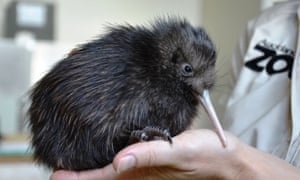
Auckland Zoo conservationist holds the first
North Island brown kiwi chick to be released
 on Rotoroa Island. Photograph: Auckland Zoo
Rotoroa Island, off the coast of New Zealand is tiny, at just 82 hectares (200 acres), but don’t let its diminutiveness fool you: big things are happening here. Over the past few years the island has become the site of a quiet, but grand, conservation experiment. What would happen if you populated an island with a whole suite of endangered species, some of which were never found there to begin with? And what would happen if you didn’t fence the island off and keep pesky humans out, but let people – school groups even – tramp through the grounds? 

Across most of our planet, truly wild, unmanaged places are a thing of the past.Onnie Byers

“We are deliberately aiming not to recreate an ecosystem, but to create an ecosystem anew,” says Jonathan Wilcken, the director of Auckland zoo. “We don’t frankly care very much whether those species existed on Rotoroa Island.”

Wilcken’s words – a shot across the bow of traditional conservation – marks just how radical and interesting the experiment on Rotoroa Island has become. The zoo has partnered with the island’s private mangers, the Rotoroa Island Trust, to conduct this wild endeavour: creating a new, managed ecosystem on a patch of land rising from the North Island’s Hauraki Gulf. 

Wilcken adds: “Nor do we care very much if the species could sustain themselves if we weren’t there to manage them.” 

Saturday, 31 May 2014

Fake birds and droppings lure gannets


Last updated 12:53 28/05/2014

Things are not quite what they seem on Rotoroa Island in Auckland where fake seabirds and droppings are being used to attract a whole new type of visitor.

Australasian gannets are what Auckland Zoo and the Rotoroa Island Trust are after - and lots of them.

They want to get the birds interested in forming a new nesting colony on the island as another conservation attraction and to benefit its ecosystem.

But the gannets won't want to know unless they can be convinced that others of their species are already living there.

That is why 16 plastic decoy gannets from the United States, man-made nest mounds splashed with white paint to resemble guano (droppings) and recordings of gannet cries are now in place.

The sound system was officially turned on two weeks ago and the daily bird calls are being monitored by trust and zoo staff.

Cameras, like the elephant cams and others used in David Attenborough's television wildlife series, are being installed in some of the fakes.


Wednesday, 14 May 2014

Native birds introduced to Rotoroa Island

12:17 PM Tuesday May 13, 2014

Forty tieke (saddleback) and 40 popokotea (whitehead) are being flown from Hauturu o Toi (Little Barrier) to Rotoroa Island today - the first wildlife species to be introduced to this unique new wildlife reserve in the making.

The relocations follow extensive planting, monitoring and pest eradication on Rotoroa, and mark the start of an ambitious 25-year plan by Auckland Zoo and the Rotoroa Island Trust (RIT) that includes introducing up to 20 new species by 2018.

Kiwi, Duvaucel's gecko and moko skink are among other wildlife planned for release later this year.

"Together with our RIT partners, we're taking a very new approach to creating a wildlife reserve. We're aiming to help secure New Zealand's unique biodiversity in a way that's a deliberate departure from what's been done before," says Auckland Zoo director, Jonathan Wilcken.


"We will be introducing species at a greatly accelerated rate and including wildlife that wouldn't necessarily have been found on Rotoroa Island before. In doing so, we aim to create a diverse and novel ecosystem, and one which will allow us to showcase the sort of interventionist approach to conserving wildlife that New Zealand is increasingly becoming known for around the world.