As regular CFZ-watchers will know, for some time Corinna has been doing a column for Animals & Men and a regular segment on On The Track... particularly about out-of-place birds and rare vagrants. There seem to be more and more bird stories from all over the world hitting the news these days so, to make room for them all - and to give them all equal and worthy coverage - she has set up this new blog to cover all things feathery and Fortean.
Showing posts with label migration. Show all posts

Sunday, 5 July 2020

Experiment shows it is possible for fish to migrate via ingestion by birds


JUNE 23, 2020 REPORT
by Bob Yirka , Phys.org
A team of researchers from the Danube Research Institute and the National Agricultural Research and Innovation Centre, both in Hungary, and Estación Biológica de Doñana, Consejo Superior de Investigaciones Científicas in Spain reports that is it possible for fish eggs to survive the trip through the bird digestive tract and subsequently to hatch. In their paper published in Proceedings of the National Academy of Sciences, the group describes their experiments with birds and fish eggs and what they found.
Fish have been found swimming in extremely isolated lakes over the years, raising the question of how they got there. Prior research has shown that most such fish are related to fish in other less isolated areas, which suggests that fish in isolated places must have somehow migrated there. Scientists have suggested that the most obvious explanation for such migration is fish eggs being consumed by birds who carry them in their digestive tracts and then deposit them in a new locale when they defecate. Surprisingly, no one has thought to test this theory until now.

Monday, 29 June 2020

Antioxidant-rich diet reduces stress response during bird migration


Date: June 18, 2020
Source: University of Rhode Island
A research team led by a University of Rhode Island ornithologist had birds fly in a wind tunnel to simulate migration and found that birds that consume dietary antioxidants before and during fall migration can reduce the endocrine stress response triggered by long-duration flights.
The results, published this week in the Proceedings of the Royal Society B, emphasize the importance of protecting habitat with an abundance of available berries containing antioxidants at migratory stopover sites.
"This reduction in the endocrine stress response may be a major benefit birds gain in fall by eating fruits at stopover sites during migration," said Scott McWilliams, URI professor of natural resources science, noting that many species of birds select berries containing anthocyanins, a type of dietary antioxidant present in purple-colored berries. "We know birds prefer certain berries that have lots of antioxidants."


Friday, 26 June 2020

Be still, my beating wings: hunters kill migrating birds on their 10,000km journey to Australia


MAY 25, 2020

by Eduardo Gallo-Cajiao, The Conversation

It is low tide at the end of the wet season in Broome, Western Australia. Shorebirds feeding voraciously on worms and clams suddenly get restless.

Chattering loudly they take flight, circling up over Roebuck Bay then heading off for their northern breeding grounds more than 10,000 km away. I marvel at the epic journey ahead, and wonder how these birds will fare.

In my former role as an assistant warden at the Broome Bird Observatory, I had the privilege of watching shorebirds, such as the bar-tailed godwit, set off on their annual migration.

I'm now a conservation researcher at the University of Queensland, focusing on birds. Populations of migratory shorebirds are in sharp decline, and some are threatened with extinction.

We know the destruction of coastal habitats for infrastructure development has taken a big toll on these amazing birds. But a study I conducted with a large international team, which has just been published, suggests hunting is also a likely key threat.

Continued

Thursday, 2 April 2020

American robins now migrate 12 days earlier than in 1994

APRIL 1, 2020


Every spring, American robins migrate north from all over the U.S. and Mexico, flying up to 250 miles a day to reach their breeding grounds in Canada and Alaska. There, they spend the short summer in a mad rush to find a mate, build a nest, raise a family, and fatten up before the long haul back south.

Now climate change is making seasonal rhythms less predictable, and springtime is arriving earlier in many parts of the Arctic. Are robins changing the timing of their migration to keep pace, and if so, how do they know when to migrate? Although many animals are adjusting the timing of their migration, the factors driving these changes in migratory behavior have remained poorly understood.

A new study, published in Environmental Research Letters, concludes that robin migration is kicking off earlier by about five days each decade. The study is also the first to reveal the environmental conditions along the migration route that help the birds keep up with the changing seasons. Lead author Ruth Oliver completed the work while earning her doctorate at Columbia University's Lamont-Doherty Earth Observatory.

At Canada's Slave Lake, a pit stop for migrating birds, researchers have been recording spring migration timing for a quarter century. Their visual surveys and netting censuses revealed that robins have been migrating about five days earlier per decade since 1994.

In order to understand what factors are driving the earlier migration, Oliver and Lamont associate research professor Natalie Boelman, a coauthor on the paper, knew they needed to take a look at the flight paths of individual robins.

Friday, 13 March 2020

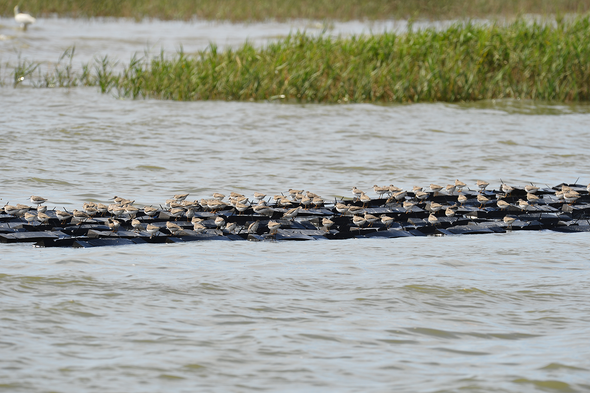
Repurposed Oyster Farm Bags Offer New Real Estate for Migratory Birds

As development and rising seas diminish roosting sites, shell-filled bags provide “islands” to rest and refuel

By Priyanka Runwal on March 4, 2020


Terek sandpipers on a floating roost in the Geum Estuary in South Korea. Credit: Hong-Tae Jeon and Young-Min Moon


Standing atop a 16-foot-high seawall on South Korea’s western coast, Chris Purnell and his colleagues slide mesh bags stuffed with empty oyster shells down onto the sandy mudflats of the Geum Estuary. They then clip the heavy bags to ropes and drag them into the gently lapping waters that run into the Yellow Sea.

Purnell’s aim is for these bags, attached to foam floats and lashed together in clusters up to 80 feet wide, to act as artificial roosting sites for the tens of thousands of migratory shorebirds that traverse the East Asian-Australasian Flyway. Coastal development has deprived these travelers of crucial resting spots, leading to drastic shorebird declines in key stopover areas like this one. “We’re hoping this could be a rapid-response intervention,” says Purnell, wetland birds program manager at Birdlife Australia, a nonprofit conservation organization.


Thursday, 12 March 2020

Fifty years of data show new changes in bird migration

FEBRUARY 20, 2020


A growing body of research shows that birds' spring migration has been getting earlier and earlier in recent decades. New research from The Auk: Ornithological Advances on Black-throated Blue Warblers, a common songbird that migrates from Canada and the eastern U.S. to Central America and back every year, uses fifty years of bird-banding data to add another piece to the puzzle, showing that little-studied fall migration patterns have been shifting over time as well.

Loyola Marymount University's Kristen Covino and her colleagues used data housed at the USGS Bird Banding Laboratory on migrating Black-throated Blue Warblers between 1965 and 2015. Across the United States, researchers working with this program safely capture migrating birds, collect data on them, and fit them with metal leg bands with unique codes that allow them to be identified if they're captured again. Analyzing almost 150,000 individual records, Covino and her colleagues found that the timing of the birds' spring migration has advanced over the last fifty years, with early migrants passing through banding sites approximately one day earlier each decade. Crucially, their data also covered fall migration, which has been less well-studied, and found that while the timing of the peak of fall migration hasn't changed, fall migration takes longer today than it did fifty years ago.

Monday, 2 March 2020

Protection for Antipodean albatross

FEBRUARY 24, 2020 9:29 AM AEDT

Australia has helped secure international agreement to protect the endangered Antipodean albatross on its 100,000km annual migration between New Zealand, Australia and Chile.

In India overnight, 130 countries agreed to further protections for the Antipodean albatross at the Conference of Parties on the Convention on the Conservation of Migratory Species of Wild Animals.

Each year, these majestic seabirds lay their eggs on breeding islands in the subantarctic waters south of New Zealand before heading off over winter to search for sparse feed supplies of cuttlefish in places like the NSW South Coast.

With as few as 9050 breeding pairs remaining, it was vital that the international community acted to protect the Antipodean albatross.

This is a tremendous outcome that will help reduce instances of the albatross being inadvertently caught by fishing vessels in coastal waters and the high sea, so that these birds can migrate safely.

Australia, New Zealand and Chile proposed the protections to prevent the further decline of the species, which without our help is in danger of being extinct within 20 years.

Sunday, 1 March 2020

Protecting the Canada Warbler at both ends of its epic journey


The Canada Warbler migrates more than 10,000 kilometres a year, from Canada and the United States to the forests of South America. Find out how our Colombian Partner is using a local grassroots approach to support an Americas-wide action plan to protect the species.

Each year, one of the biggest wonders of the natural world occurs: bird migration. You may be surprised to learn that of the 11,000+ species of birds that exist, one in five is considered migratory. Some of these species make really incredible trips. The Canada Warbler Cardellina canadensis flies more than 10,000 kilometres every year from Canada and the United States to the humid cloud forests of South America, coming to rest across Colombia, Ecuador, Venezuela and northern Peru.

Eliana Fierro, a biologist at Asociación Calidris (BirdLife in Colombia), explains that the threats facing this tiny voyager are different at each end of its journey: “[At their breeding sites], agrochemicals are harming the insects they feed on. While here in their wintering area, the main problem is deforestation. When these birds arrive in South America, they rely on forests 500 – 2000 meters above sea level. But often they arrive to find that there is no forest anymore.”

Because of its wide distribution, all efforts to protect the Canada Warbler must cross borders. From 2004 – 2017, around 30 organisations from all over the Americas joined forces to develop the Canada Warbler Full Life Cycle Action Plan, bringing together research on threats the species faces in each country. Fierro explains: “The plan first started at the breeding sites, coordinated by Nature Canada and Birdlife. Then we decided to include the wintering grounds, and the construction of the complete cycle action plan for the species began.” As part of this process, Asociación Calidris became the Species Guardian in Colombia.

Their first step focused on raising awareness of the species; not only among birdwatchers, but also among the owners of farms that host the species every year. "We are currently working in the Western Cordillera in two very specific locations: Dapa [in the village of Chicoral] and Villa Carmelo," explains Eliana Fierro. Chicoral village is located at the highest part of the Bitaco district in the municipality of La Cumbre. Whereas Valle del Cauca can be found on the Pacific slope of the Western mountain range.

Wednesday, 19 February 2020

Radar captures huge bird migration over Florida


A huge swarm of birds migrating is nothing unusual - flocks can fly thousands of miles undetected.

But in a rare event on Monday, US National Weather Service radar captured birds migrating from South America over Florida.

Atmospheric conditions caused the systems to detect the birds, which took hours to fly over the Key West station.

The group measured at least 90 miles (145km) in radius, according to meteorologists.

In 2017 a swarm of migrating Printed Lady butterflies was detected by radar over Colorado, but the phenomenon is rare.

A GIF produced by the Weather Service shows the migrating birds in green and yellow, and rain depicted in blue.

Monday, 10 February 2020

Sandpipers on an arduous migration now have a rest stop all their own

by Nanditha Chandraprakash on 6 February 2020


  • The Rainforest Trust and the Bird Conservation Society of Thailand recently purchased 8 hectares (20 acres) of shoreland in the Gulf of Thailand to protect a vital stopover site for spoon-billed sandpipers (Calidris pygmaea).
  • Spoon-billed sandpipers fly annually from Russia to parts of Southeast Asia and depend on sites like the salty coastal wetland of Pak Thale for survival 
  • The species is critically endangered, with only about 240 to 456 adults globally.
  • This stretch of shoreland along the Inner Gulf of Thailand is also an important migrating and wintering site for other waterbirds passing through Thailand.
For the critically endangered spoon-billed sandpiper, a tiny shorebird that makes an 8,000-kilometer (5,000-mile) migration each year, wetlands are vital stopover points. To boost the small bird’s population, the Rainforest Trust and the Bird Conservation Society of Thailand (BCST) have purchased a stopover haven in the Gulf of Thailand from two banks for the species’ winter migration.

“The purchased land is currently an active salt pan which has supported a wintering population of spoon-billed sandpipers regularly every winter,” said Angela Yang, chief conservation officer of the Rainforest Trust.

Thursday, 5 September 2019

Slowed metabolism helps migrating geese soar


Date:  September 3, 2019
Source: eLife

Researchers have shed new light on how some geese can fly high for long periods of time, according to a study published today in eLife.

The team collected the first ever cardiorespiratory measurements of bar-headed geese flying in a wind tunnel at a simulated altitude of 9,000m. They discovered that the animals are able to maintain flight in these low-oxygen conditions via a reduction in their metabolism.

Bar-headed geese are famed for migratory flight at extreme altitudes, having been directly tracked flying as high as 7,290m, and anecdotally reported reaching 9,000m. Previous research suggests these birds have several adaptations that allow them to maximise their oxygen usage at high altitudes, such as the ability to deliver oxygen efficiently to individual cells. But until now, no studies have comprehensively measured the physiology of bar-headed geese during flight in low-oxygen conditions, partly because there are few wind tunnels in the world suitable to carry out such experiments.

To address this gap in our knowledge, a research team from the University of British Columbia (UBC), Vancouver, Canada, imprinted a flock of bar-headed geese born and raised at sea-level, and trained them to fly in a wind tunnel. The group was led by Jessica Meir, a postdoctoral researcher in Bill Milsom's lab at UBC at the time the study was carried out, along with Julia York, an undergraduate researcher, currently a PhD candidate at the University of Texas at Austin, US.

Wednesday, 28 August 2019

Using artificial intelligence to track birds' dark-of-night migrations

In a first, UMass Amherst, Cornell use AI to mine big migration data on massive scale

Date: August 28, 2019
Source: University of Massachusetts at Amherst


On many evenings during spring and fall migration, tens of millions of birds take flight at sunset and pass over our heads, unseen in the night sky. Though these flights have been recorded for decades by the National Weather Services' network of constantly scanning weather radars, until recently these data have been mostly out of reach for bird researchers.

That's because the sheer magnitude of information and lack of tools to analyze it made only limited studies possible, says artificial intelligence (AI) researcher Dan Sheldon at the University of Massachusetts Amherst.

Ornithologists and ecologists with the time and expertise to analyze individual radar images could clearly see patterns that allowed them to discriminate precipitation from birds and study migration, he adds. But the massive amount of information ¬- over 200 million images and hundreds of terabytes of data -- significantly limited their ability to sample enough nights, over enough years and in enough locations to be useful in characterizing, let alone tracking, seasonal, continent-wide migrations, he explains.

Clearly, a machine learning system was needed, Sheldon notes, "to remove the rain and keep the birds."

Now, with colleagues from the Cornell Lab of Ornithology and others, senior authors Sheldon and Subhransu Maji and lead author Tsung-Yu Lin at UMass's College of Information and Computer Sciences unveil their new tool "MistNet." In Sheldon's words, it's the "latest and greatest in machine learning" to extract bird data from the radar record and to take advantage of the treasure trove of bird migration information in the decades-long radar data archives. The tool's name refers to the fine, almost invisible, "mist nets" that ornithologists use to capture migratory songbirds.


Thursday, 22 August 2019

These migratory birds will risk their lives for a good nap

AUGUST 19, 2019


When driving across country, people can only make it so far before stopping off to rest. Likewise, most migratory songbirds must make stops during their long-distance journeys to sleep along the way. Now, researchers have evidence that songbirds tuck themselves in differently depending on just how worn out they really are.

As reported in the journal Current Biology on August 19, birds that are low on fat reserves will tuck their heads under their feathers for a deep snooze. They do so despite the fact that this more restful sleeping position slows their reaction to the sound of potential trouble. By comparison, birds in better shape stop and sleep with their head facing forward, untucked, and more alert.

"We discovered that migratory birds trade off safety for lower energy expenditure," said Leonida Fusani of the University of Vienna and University of Veterinary Medicine, Austria. "If they sleep with their head tucked in the scapular feathers, they enter a sort of deeper sleep that is associated with lower energy consumption but exposes them to a higher predation risk. Consequently, birds in good condition sacrifice some energy to sleep more safely with the head untucked, whereas birds in poor condition sacrifice vigilance to save energy while sleeping unsafely tucked in."

Thursday, 1 August 2019

EU acts to protect future of bird facing extinction in UK

European commission moves to halt loss of habitat for migrating turtle doves


Jennifer Rankin in Brussels

Thu 25 Jul 2019 13.13 BST Last modified on Thu 25 Jul 2019 17.00 BST

The European commission has launched legal action that could protect one of the best-known birds of the English countryside from extinction.

The turtle dove – once a familiar sound of summer in south-east England – has been in steep decline since the 1970s because of intensive farming across Europe.

The birds are now listed as vulnerable by BirdLife International, a global partnership of conservation organisations, and are on the brink of extinction in the UK. With their mottled chestnut and black wings, the dainty birds feature in Shakespeare, the Bible and were the true love’s gift on the second day of Christmas.

Ariel Brunner, the senior head of policy at BirdLife International, said the turtle dove was “on life support” in England and could disappear from the English countryside by 2021 without urgent action across Europe. “The turtle dove is an iconic species that was providing the soundtrack of spring since the times of the Bible’s Song of Songs. But it is now racing to extinctionbecause of unsustainable agriculture and hunting.”

The commission announced on Thursday that France and Spain had not done enough to protect the birds from habitat loss and hunting during their migration from the Sahel to their breeding grounds in northern Europe. Spain hosts more than half the EU’s breeding population of turtle doves, while France has another 10%, meaning conservation efforts in those countries will be critical for the future of the birds.

Wednesday, 10 July 2019

SC swamp warbler migration leads to dramatic study discovery


Jul 4, 2019
HARLEYVILLE — Longshot the warbler is likely long gone. But the tiny yellow flash of a bird left a legacy that spans a globe.
The prothonotary warbler in the Audubon Sanctuary at Beidler Forest near Harleyville was outfitted with a geolocator chip in 2014 after staff noticed the migratory bird had returned to the sanctuary boardwalk within 15 feet of where it departed the summer before.
Longshot came back again the next year, with the trip-logging chip still attached and against stunning odds.
It had flown through Florida, Cuba, Central America, down the Pacific coast of Colombia and back to Four Holes Swamp — an odyssey of 4,000 miles.
Data from Longshot and 29 other warblers tagged in six states has been incorporated in a newly published multi-institution study. The study found nearly all of the wetlands birds wintered in a relatively small area of coastal mangrove and inland forests in northern Colombia — an area that is heavily logged.
The discovery was unexpected and alarming.
The prothonotary warbler, with its deep yellow head and chest, is the eye-catching songbird of the Southeast bottomlands. It’s a personable native bird — not as apt to fly off as other species and seeming to be almost curious as humans approach.
Like a lot of songbird species, it’s in a long-term decline, one of a number of species that conservationists have begun tracking by geolocators to get a fix on the environs where they migrate in order to work with groups in those countries to protect habitats along the entire range.


Friday, 5 July 2019

Key locations for declining songbird


Date:  June 19, 2019
Source:  American Ornithological Society Publications Office
Many of North America's migratory songbirds, which undertake awe-inspiring journeys twice a year, are declining at alarming rates. For conservation efforts to succeed, wildlife managers need to know where they go and what challenges they face during their annual migration to Latin America and back. For a new study published by The Condor: Ornithological Applications, researchers in six states assembled an unprecedented effort to track where Prothonotary Warblers that breed across the eastern U.S. go in winter -- their "migratory connectivity" -- and found that nearly the entire species depends on a relatively small area in Colombia threatened by deforestation and sociopolitical changes.
The Ohio State University's Christopher Tonra and his colleagues coordinated the deployment of 149 geolocators, tiny devices that use the timing of dawn and dusk to estimate birds' locations, on Prothonotary Warblers captured at sites across their breeding range. When the birds returned to their nesting sites the following year, the researchers were able to recover 34 devices that contained enough data for them to use. The geolocator data showed that regardless of where they bred, most of the warblers used the same two major Central American stopover sites during their migration and spent the winter in a relatively small area of northern Colombia. Additionally, many Prothonotary Warblers appeared to winter in inland areas, rather than in coastal mangrove habitat, which previous studies suggested they relied on most heavily.


Thursday, 30 May 2019

As the climate changes, migratory birds are losing their way


By ADAM WERNICK • MAY 16, 2019
Every spring and fall, a journey of thousands of miles begins, as migrating birds find their way between breeding and overwintering grounds.
It’s an amazing phenomenon that naturalist Kenn Kaufman brings to life in his new book, "A Season on the Wind: Inside the World of Spring Migration." Kaufman is also the author of the "Kaufman Field Guide" series and is a contributing field editor with the Audubon Society.
Bird migration is largely invisible to most people because it happens primarily at night, Kaufman says. But if you go outside at dawn near a spot where migrating birds congregate — like along the coast of Lake Erie in Northern Ohio, where he lives — you will see something extraordinary.


Sunday, 26 May 2019

Orange-bellied parrots spotted well off migratory course a concern for bird experts


Updated 30 Apr 2019, 4:37am
Wildlife experts in Tasmania will attempt to trap two critically endangered parrots that have been spotted in a backyard well off their migratory course in the state's far south.
It is the end of the breeding season for orange-bellied parrots, and by this point the birds should be somewhere between Melaleuca and mainland Australia.
But a captive-bred male and wild-born female — both are fitted with leg bands for identification — were sighted in Cockle Creek, happily grazing on a backyard lawn.
Ornithologist Mark Holdsworth told ABC Radio Hobart it was concerning because the birds were more than 60 kilometres off course.
"While this is an interesting sighting, their chances of survival are very low and it will be almost impossible to track them when they leave this site," he said.


Thursday, 2 May 2019

Songbird-body changes that allow migration may have human health implications


Date:  April 25, 2019
Source:  Penn State
Songbirds that pack on as much as 50 percent of their body weight before migrating and that sleep very little, exhibit altered immune system and tissue-repair function during the journey, which may hold implications for human health, according to Penn State researchers.
"Imagine if you became morbidly obese before running a marathon, you didn't sleep for a few days before competing -- and you performed so well that you win," said lead researcher Paul Bartell, associate professor of avian biology. "Then, consider that you were protected from the cardiovascular and metabolic disease that normally would result from either obesity or long-term sleep deprivation. That's the example I like to use to illustrate how amazing the changes are that occur in these birds to allow migration." Although similar changes occur in other songbirds that make their migration flights at night, the species that Bartell refers to is the white-throated sparrow. His research group, based in the College of Agricultural Sciences, studied the birds' physiological mechanisms that confer protection against the consequences of sleep deprivation while simultaneously allowing for the increased physical performance required for migration.


Wednesday, 1 May 2019

Red-neck phalarope: A migratory divide towards the Pacific Ocean and Arabian Sea


An exceptional strategy when winter comes
Date:  April 26, 2019
Source:  University of Barcelona
When winter comes, populations of red-neck phalarope from the Western Palearctic migrate to two different destinations -the Pacific Ocean or the Arabian Sea- following an exceptional migratory divide strategy which has never been described in this geographical area.
A part of these bird populations -which breed in Greenland, Island and the British Islands- cross more than 10,000 kilometres to reach the Pacific Ocean, while populations in Scandinavia and Russia go to the Arabian Sea in the Indian Ocean, more than 6,000 kilometres away from their breeding areas.
This migratory behaviour is now described for the first time in an article published in Frontiers in Ecology and Evolution -in which the researchers Raül Ramos and Jacob González-Solís, from the Faculty of Biology and the Biodiversity Research Institute of the University of Barcelona (IRBio) take part.
An uncommon wintering species in the peninsula
The red-neck phalarope (Phalaropus lobatus) is a migratory bird from the family of phalaropes that live in the tundra and high polar latitudes during their reproduction season. These small shore birds spend a part of their annual cycle -mainly the wintering period- at open sea, and therefore they are regarded as pelagic birds. During the migratory routes after breeding season -from August to September- this species can be occasionally seen in peninsular areas such as the Ebro Delta or the Atlantic and the Cantabrian coasts.