As regular CFZ-watchers will know, for some time Corinna has been doing a column for Animals & Men and a regular segment on On The Track... particularly about out-of-place birds and rare vagrants. There seem to be more and more bird stories from all over the world hitting the news these days so, to make room for them all - and to give them all equal and worthy coverage - she has set up this new blog to cover all things feathery and Fortean.
Showing posts with label Spix's macaw. Show all posts

Friday, 20 March 2020

Spix’s macaw returns to Brazil, but is overshadowed by controversy

by Suzana Camargo on 19 March 2020 | Translated by Matt Rinaldi

  • Twenty years after the species was officially declared extinct in nature, 52 Spix’s macaws (Cyanopsitta spixii) arrived in Brazil’s Bahia state for eventual reintroduction back into their native habitat.
  • But controversy surrounds the program, stemming from the organization providing the captive-bred birds: the Association for the Conservation of Threatened Parrots, whose founder, Martin Guth, has been accused of running a private collection linked to wildlife trafficking and organized crime.
  • The ACTP is footing the bill for the Spix’s macaw reintroduction program, including building a $1.4 million facility in Bahia, but it’s not clear where the money is coming from. The Brazilian government, as a partner in the program, has also not provided details about the terms of the agreement, and is reportedly pressuring local breeders to send their birds to the ACTP in Germany.
  • The birds are slated for released into the wild in 2021, after a process of adaptation, into two conservation areas established specifically for the Spix’s macaw in Bahia.

The town of Curaçá in Brazil’s of Bahia state lost its last wild Spix’s macaws (Cyanopsitta spixii) two decades ago. So there was a large celebration when, on March 3 this year, 52 of the parrots, bred in captivity, were brought back here to their native region. The macaw was declared extinct in the wild in 2000, a victim of wildlife trafficking and symbol of the ongoing struggle to conserve Brazil’s biodiversity.

But there’s a shadow hanging over their return, cast by the controversial organization that bred them and continues to wield outsize influence over their fate.

The birds brought to Bahia (26 males and 26 females) are the result of a successful captive-breeding program by the Germany-based Association for the Conservation of Threatened Parrots e. V. (ACTP), which has partnered with the Brazilian government. The event was considered so important that the minister of the environment, Ricardo Salles, was in Petrolina, Pernambuco state, to receive the macaws alongside ACTP head Martin Guth and other Brazilian authorities.

Sunday, 8 October 2017

More than a 38 percent of the Neotropical parrot population in the American continent is threatened by human activity


September 27, 2017

More than 38 percent of the neotropical parrot population of the American continent is endangered due the impact of human activity, according to a scientific study published in the journal Biological Conservation.

Hunting for local and international trade and the loss of natural habitat are the main threats for these tropical birds, according to the article led by the experts Igor Berkunsky (National University of Central Buenos Aires) and Juan Masello (Justus Liebig University, Germany). The study involved the collaboration of 101 experts from 76 institutions and non-governmental organizations to determine the main threats affecting 192 populations of 96 neotropical parrots in 21 countries.

From hunting pets to extinction
Capture for the pet trade is one of the main threats to the preservation of wild parrots. From 1980 to 1990, millions of individuals were captured in the neotropic and taken to the United States and Asia. This huge removal of parrots could be the cause of the decline and local extinction of many species, such as the Spix's macaw. In the African continent, the trade of the grey parrot played a main role in its removal in Ghana and other areas of Africa. Currently, some of the most threatened species in Brazil are the Spix's macaw (Cyanopsitta spixii) and the red-tailed amazon (Amazona brasiliensis). Species such as the sun parakeet (Aratinga solstitialis) and brown-backed parrotlet (Touit melanonotus) are quite vulnerable due the small size of their populations.

Friday, 1 July 2016

Spix’s Macaw reappears in Brazil

By Shaun Hurrell, 24 Jun 2016

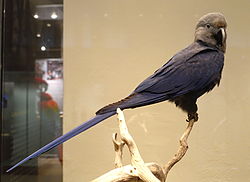
Cyanopsitta spixii - Museum fur Naturkunde, Berlin - DSC00194.JPGIt was Grandpa Pinpin’s dream: to see his favourite bird, Spix’s Macaw, fly again over the skies of Curaçá, a small town of about 30,000 in the dry Caatinga area of Bahia, Brazil, where goat herding is the main activity. Pinpin Oliveira passed away last year, aged 94, his wish unfulfilled. But the baton was passed to his 16 year old grand-daughter, Damilys, who not only saw the macaw, not seen in the wild since 2000, but also managed to film it with her mobile phone.

Spix’s Macaw Cyanopsitta spixii is Critically Endangered and possibly extinct in the wild, primarily as a result of trapping for trade plus habitat loss. Does this vibrant blue bird look familiar? The species also became the star of the animated film ‘Rio’, as main characters ‘Blu’ and ‘Jewel’. 130 Spix’s Macaws remain as part of a captive breeding programme.

The bird was first sighted on 18th June by local farmer Nauto Sergio de Oliveira. On the following day, his neighbour Lourdes Oliveira and daughter Damilys woke up before dawn to look for the macaw in Barra Grande creek’s riparian forest. At 6:20 AM they were able to not only see the bird, but record a video on Damilys’ mobile phone.

With the video Lourdes contacted the biologists from the Society for the Conservation of Birds in Brazil (SAVE Brasil, BirdLife Partner), one of the organisations that make up Projeto Ararinha na Natureza (Spix’s Macaw in the Wild Project) which aims to bring the bird back from extinction. The video and the distinctive vocal calls killed all doubts: it was indeed a Spix’s Macaw. Pedro Develey, SAVE Brasil’s Director, immediately told other project members and organised an emergency trip to Curaçá to locate the bird.

“The local people were euphoric,” said Develey.

“They set up a WhatsApp group to coordinate and maximise the search for the bird, and ensured no potential dealers could enter the area.”

Wednesday, 2 July 2014

Only One "Rio" Parrot Left

No Disney ending here: A rare blue parrot named Presley died last week, leaving only one known, wild-born Spix's macaw left. And, unlike in the movie "Rio," which Presley may have inspired, he didn't leave behind any offspring.

The native Brazilian birds are already believed to be extinct in the wild, after deforestation and non-native honeybees started competing with them for nest space. The last sighting of a Spix's macaw in the wild came in 2000.