As regular CFZ-watchers will know, for some time Corinna has been doing a column for Animals & Men and a regular segment on On The Track... particularly about out-of-place birds and rare vagrants. There seem to be more and more bird stories from all over the world hitting the news these days so, to make room for them all - and to give them all equal and worthy coverage - she has set up this new blog to cover all things feathery and Fortean.
Showing posts with label Indiana. Show all posts

Sunday, 9 August 2015

Elkhart Police help rescue osprey

Posted: Aug 07, 2015 4:30 PM GDTUpdated: Aug 07, 2015 4:30 PM GDT
By Melissa Hudson

ELKHART, Ind. -

Thursday morning Elkhart Police officers helped rescue an osprey that had flown into a power line.
Photo courtesy Elkhart Police Department

Elkhart Police Corporal Todd Thayer and a citizen wrapped a blanket around the bird until Elkhart Police Departments Animal Control Officer Corporal Dennis Russell could respond to the scene and place the bird in a cage.

Corporal Russell took the bird to the Elkhart County Humane Shelter where it was evaluated by a wild bird rehabilitation expert.

The bird was also taken to a veterinarian where it was discovered it had a muscle injury.

The bird will be treated by a bird rehabilitator and it could be released back into the wild within two to three weeks.

The rescued osprey is approximately 20 inches tall and has a wing span of approximately 50 inches.


Thursday, 21 May 2015

Rare Trumpter Swans Visit Taltree Arboretum & Gardens

LAST UPDATED ON 14 MAY 2015

Two trumpeter swans have flown in to Taltree Arboretum & Gardens’ wetlands, joining the resident mated pair that live at Taltree year-round. The visiting trumpeter swans flew in on Sunday, May 11 and have been spotted by visitors around the wetlands on Taltree’s Bluebird Trail.

The swans have been considered rare or completely extinct in most of the United States by the early 20th century. Their population has increased enough to remove them from the endangered species list. They have not been able to sufficiently grow their population in the Great Lakes region due to an increase in competition for habitat by the non-native mute swan.

“To have a pair of these rare birds join our residents is very exciting. The last time we had a visitor was three years ago when our birds were new to Taltree,” said Stephanie Blackstock, Interim Executive Director at Taltree Arboretum & Gardens.

Tuesday, 7 April 2015

Rare bird turns Indiana teacher into birding celebrity

Ryan Sabalow, ryan.sabalow@indystar.com6 a.m. EDT April 7, 2015

It was Friday morning, and Jeremy Ross needed to head to home to help with the kids.

But Ross, newly initiated into the world of bird watching, couldn't resist a few more minutes looking through his spotting scope.

He'd hoped to spot some of the long-beaked shorebirds that often stop in Indiana during their spring migration to feed in fields along Patoka River National Wildlife Refuge.
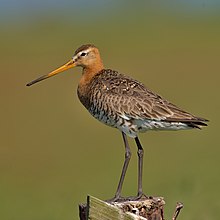
Black-tailed Godwit Uferschnepfe.jpg
He was driving down a bumpy, muddy dirt road near Francisco in Gibson County when he spotted a bird that just didn't look right.

"I got the binoculars out and watched it land," Ross said. "It was real pretty. But with the black and white and orange, I thought 'That's just not normal. I don't know what this is, but it isn't normal.' "

Ross had spotted a black-tailed godwit, a gull-sized shorebird native to Europe and Asia. Ross' find has made the middle- and high-school arts teacher a celebrity of sorts among birdwatchers. After all, they might spend a lifetime tallying birds and never find one so rare.

These types of godwits have been spotted along North American coasts, but this sighting is likely the first so far into the U.S. interior, says John Kendall, chairman of the Indiana Bird Records Committee who also edits the birdwatching publication "Indiana Audubon Quarterly."

The black-tailed godwit is certainly the first spotted in Indiana.

Friday, 20 March 2015

DNR burns grasslands to promote habitat for endangered bird

Posted: Thursday, March 19, 2015 9:14 am


OWENSVILLE, Ind. (AP) — State wildlife crews have burned hundreds of acres of grasslands in southwestern Indiana to keep a wildlife area in good shape for an endangered water-loving bird.

State Department of Natural Resources staffers conducted a prescribed burn Tuesday of 300 acres at the Tern Bar Slough Wildlife Diversity area about 20 miles northwest of Evansville.

DNR assistant non-game bird biologist Amy Kearns tells the Princeton Daily Clarion the burn cleared out young trees and will help promote "a nice mix of grasses" for the wildlife area's population of least terns.

Indiana's least tern populations have grown significantly since a single pair of the petite shorebirds was found in Gibson County in 1986.

DNR crews say they try to conduct prescribed burns before most reptiles and amphibians emerge from winter hibernation.

Friday, 18 April 2014

Conservation Funds Granted To Patoka River


On March 26, the Migratory Bird Conservation Commission approved $61.3 million in funding to protect, restore and enhance more than 205,000 acres of wetlands and associated uplands in the United States, Canada and Mexico. Of that, approximately $6.5 million will go toward projects in the U.S. Fish and Wildlife Service’s Midwest Region.

In Indiana, the Patoka River NWR Expansion has been granted $1 million with a $2.1 million matching fund amount. This project focuses on wetland and upland habitat protection, restoration and enhancement within Patoka River National Wildlife Refuge. Project activities will provide important migration, wintering and breeding areas for waterfowl, benefit rare and endangered species of wildlife and fish associated with large river ecosystems, improve water quality and help stimulate local economies through recreation on project lands.

“Conservation of our nation’s wetlands is critical to protecting our wildlife, watersheds, coastal communities and important economic activities,” said Secretary of the Interior Sally Jewell, Chair of the Commission. “Wetlands not only are home to hundreds of species of migratory birds, but they also provide us with clean water, act as buffers against storms, support our vibrant coastal fishing industries, and provide unique opportunities for outdoor recreation.”

Monday, 17 March 2014

Columbus Municipal Airport using “Bird Bangers”


By Staff Reports
Published: Thursday, March 13, 2014, 1:55 pm


COLUMBUS, Ind. (WISH) – Workers at the Columbus Municipal Airport say they have added “frightening wildlife” to their workload after large numbers of birds began to show up near runways during the spring and fall seasons.

Airport officials say it is unsafe to have birds in the area, as planes can crash if a bird is sucked into the engine or crashes into the plane’s windshield.

24-Hour News 8′s news gathering partner the Republic reports exploding Bird Bangers and propane cannons are used to startle and scare off birds and wildlife.

The devices make a loud noise, like a gunshot, that startles the birds. They do not harm the birds.

“Essentially (the) propane cannon will send off a blast every 15 to 20 minutes,” Airport Director Brian Payne said. “It just kind of keeps the birds stirred up, and hopefully that will engage them enough to want to move on somewhere else.”

Airport officials say so far, the technique is working well.

Wednesday, 4 September 2013

Use of cannons to deter birds spurs counterattack

SPENCER, Ind. (AP) — There seems to be a truce between neighbors on Timber Ridge Road, where dueling propane cannons have been silent since Monday.

Steve Dean and his wife live adjacent to Owen Valley Winery, where grapes hang heavy on the vine. About two weeks ago, owner Anthony Leaderbrand began firing a propane-fueled cannon to shoo away doves and other birds that were plucking his nearly ripe hybrid red Marechal Foch grapes.

He said the cannon fired every 10 or 15 minutes for a few hours in the morning and evening. Neighbors were upset by the loud shotgun blast sound. Dean took up a petition and got signatures from 43 neighbors who wanted the cannon blasts to stop.

He even went to a county commissioners meeting Aug. 19 to complain. County attorneyRichard Lorenz explained that a state law prohibits the commissioners from having jurisdiction over farming operations and suggested the matter would have to be settled through a civil lawsuit.

Saturday, 15 June 2013

Bald eagle seized from Greencastle man’s apartment

GREENCASTLE – A Putnam County man has been issued a court summons after Indiana Conservation officers found a bald eagle inside his apartment.

Officials from the Department of Natural Resources received an anonymous tip that Jeffrey Henry, 49, was keeping the eagle after capturing the juvenile a few days ago.

Conservation officers seized the bird and took it to a licensed wildlife rehabilitator.

Bald eagles are protected under the Bald and Golden Eagle Protection Act, which prohibits people from buying, selling, or making transactions with bald or golden eagle, alive or dead, including any part, nest or egg unless allowed by a permit.

The unlawful taking or possession of a non-game migratory bird is punishable by up to 60 days in jail and fines of up to $500.