As regular CFZ-watchers will know, for some time Corinna has been doing a column for Animals & Men and a regular segment on On The Track... particularly about out-of-place birds and rare vagrants. There seem to be more and more bird stories from all over the world hitting the news these days so, to make room for them all - and to give them all equal and worthy coverage - she has set up this new blog to cover all things feathery and Fortean.
Showing posts with label gyrfalcon. Show all posts

Friday, 30 November 2018

Air Force Academy's Falcon Mascot Will Be Back In Action Thursday


BY COLORADO PUBLIC RADIO STAFF NOV 21, 2018
Aurora, the 22-year-old gyrfalcon mascot of the Air Force Academy, will be back in action this Thursday after recovering from injuries sustained when a student prank went wrong earlier this month.
Air Force football will take on Colorado State University Thanksgiving Day at 1:30 p.m. in Colorado Springs, and Aurora will be there to greet fans.
“She likes getting her picture taken with a bunch of people,” said Joseph Kloc, an Air Force senior and member of the elite falconry club. “She's a little bit of a diva.”
Aurora also made an appearance at Air Force’s game against New Mexico on Nov. 10, Kloc said, but didn’t travel to the University of Wyoming in Laramie last week because of icy weather.
The falcon was injured when two West Point students stuffed her and another bird into dog crates before the rivalry football game Nov. 3. Aurora bloodied a wing, likely thrashing around in the crate, before the students turned the birds over.
While football-game pranks are a time-honored tradition between military schools, they’ve never before involved birds. That’s according to the recollection of Lt. Col Don Rhymer, who runs the falconry. He was “ecstatic” to see how Aurora was recovering.

Sunday, 4 November 2018

Air Force's falcon mascot reportedly kidnapped and injured in pre-game prank

Aurora reportedly stolen by West Point cadets before game
Air Force and Army played college football game this weekend


Sun 4 Nov 2018 13.27 GMTLast modified on Sun 4 Nov 2018 13.29 GMT


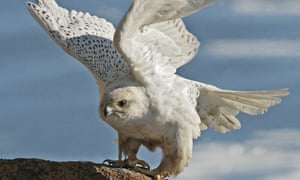
Air Force’s mascot is a white gyrfalcon, similar to this
one photographed in the Canadian Arctic. 
Photograph: BBC/Ian McCarthy/BBC


Air Force’s mascot, a 22-year-old white gyrfalcon name Aurora, may have to be euthanized after she was kidnapped in a prank by West Point cadets in the run-up to a college football game this weekend.

Troy Garnhart, the associate athletic director for communications at the Air Force academy, told the Colorado Springs Gazette that Aurora had been taken from a colonel’s house before the annual rivalry game between Air Force and Army on Saturday. Army were hosting the game between the two military academies at Michie Stadium and won 17-14.

“USAFA mascot Aurora was injured over the weekend and is being transported back to Colorado,” academy spokesman Lt Col Tracy Bunko told the Gazette. “We have specialists at the academy who have the best training and facilities for her care. She is part of our academy family and we are all hoping for her full and speedy recovery.”

An academy source told the Gazette that Aurora may have to be euthanized due to her advanced age – gyrfalcon typically live to around 25.

The US Navy and Army academies have a long history of stealing each other’s mascots – goats and mules respectively. However, no one had ever stolen Air Force’s falcon before.

Thursday, 1 March 2018

An extremely rare raptor visits from the tundra


Updated Feb 25; Posted Feb 25
For lehighvalleylive.com

It was raining and so warm the morning I wrote this column that I went out on the deck without a coat to refill a peanut feeder. We only put out peanuts in the mornings because they're costly, but at that time, blue jays put on a good show as they come in to grab them. I've seen a jay take three peanuts at the same time.

It was so unusually warm that mid-February day that snowdrops, small white flowers produced by bulbs, were blooming in the front yard. But, as often happens in the winter, the weather was going to turn on a dime. Dropping temperatures and snow were predicted for the next night.

As the day wore on I debated with myself about going for a second look at an extremely rare raptor that's been frequenting several places in the area. A dark-phase gyrfalcon, a tundra breeder and the largest and most powerful falcon in North America, has been drawing birders from miles around and surrounding states.


Sunday, 24 February 2013

What's troubling subarctic bird species like ptarmigan, gyrfalcon?


A Yukon biologist says ptarmigan and gyrfalcon populations could be in decline across Canada's northwestern Yukon territory. Dave Mossop says the fluctuations in these two "key" species could be a sign of greater trouble across the food chain.
Robert Massolini photo

Both populations usually peak in a 10-year cycle but recent bird surveys do not indicate a peak as expected. Mossop says the unexpected change in the cycle could be a result of climate change or other factors.

"For the last cycle yes, it declined, for reasons that we don't understand," says Mossop. "But the great hope is that things will re-establish themselves. The 10-year cycle in the boreal system is one of the most obvious things that's happening, and for some reason it faltered. That's kind of where we are now."

Mossop says gyrfalcons depend on ptarmigan as a source of food and that the predatory birds will stop breeding when there aren't enough ptarmigan to eat.

He says the Yukon Research Centre has access to a database on arctic birds which dates 50 years. Mossup says tracking willow ptarmigan and gyrfalcons is important because the birds are respectively at the bottom and top of the food chain.

"A lot of the research went into understanding the amazing intricacies between these two species," he says. "They evolved together and depend on each other. But recently as everybody knows the tundra systems are in harm's way and things are changing. In particular at the top of the food chain because the gyrfalcon is dependent on the whole thing working properly. What we're seeing is a change in the birds' ability to maintain their populations."

Scientists recently counted gyrfalcon eggs in the Ogilve Mountains in central Yukon as part of a falcon survey.

Mossup says the predators are relatively easy to monitor because they build nests in the same place year after year.