As regular CFZ-watchers will know, for some time Corinna has been doing a column for Animals & Men and a regular segment on On The Track... particularly about out-of-place birds and rare vagrants. There seem to be more and more bird stories from all over the world hitting the news these days so, to make room for them all - and to give them all equal and worthy coverage - she has set up this new blog to cover all things feathery and Fortean.
Showing posts with label Vietnam. Show all posts

Monday, 25 September 2017

Ornamental bird trade a threat to wild species in Vietnam: survey


By Minh Nga   September 21, 2017 | 11:35 am GMT+7
Only 10 percent of popular species in Vietnam are protected by trade regulations.
A recent survey has found massive holes in regulations governing the trade in ornamental birds in Vietnam.
Researchers at TRAFFIC, the global wildlife trade monitoring network, found more than 115 species of birds for sale in Hanoi and Ho Chi Minh City in April last year.
Of the thousands of birds observed, over 99 percent were species native to Vietnam, while regulations only cover 10 percent of the total, TRAFFIC said in a statement released on Thursday.
“The survey's findings are consistent with a thriving demand for native birds within Vietnam. However, as trade in most of the species seen is not regulated by law, it means large numbers of birds are being extracted with no oversight of sustainability or how severely it will impact wild populations,” said Kanitha Krishnasamy, acting regional director for TRAFFIC in Southeast Asia.
She said the survey showed a rise in the number of species and volume of birds for sale since previous studies in 1991, 1998, 2001 and 2008. The volumes, the array of species and the high number of immature individuals for sale were all signs of the need for improved monitoring of the trade, including regulations on offtake and oversight of any ranching or captive breeding operations.

Monday, 26 June 2017

Can we bring back the pheasant that was wiped out by the war in Vietnam?

16 Jun 2017

The Edwards’s Pheasant, a Vietnam endemic, has been all but wiped out in the wild in the aftermath of the war that once ravaged the land. But a prospering caged community brings hope that it could once again come home to roost

Framed by mounds of white tuft, the ruddy faces of the Red-shanked Douc monkeys peer out from the forest canopies. In the distance, calls of White-cheeked Gibbons echo through the early morning stillness. Underneath, browsing in the shadows of the forest floor are myriad species of deer; among them forages one of the world’s rarest large mammals – the Saola, a bovine that lives in forests so wild and remote, that they were unknown to humans until researchers happened upon the remains of one during an expedition in 1992.

That is a measure of how deep into the wilderness we’ve had to come to get here. We’re in Khe Nuoc Trong, an evergreen-broadleaf forest situated in the Annamese lowlands, Vietnam. It feels like you couldn’t stretch your arms out to yawn without knocking three or four endangered species off their perch. The area is a jewel of biodiversity, but something’s missing. A very important part of the forest’s heritage, in fact. You could spend all morning listening out into the stillness without ever once hearing a guttural “uk-uk-uk-uk-uk” call, which once rang loud and clear through the canopies. A call that belongs, or perhaps once belonged, to the Edwards’s Pheasant Lophura edwardsi (Critically Endangered) – an endemic species that has not been seen in the wild since 2000.

This beautiful bird, whose males are iridescent blue with a flash of red on the face and a white crest, was little known in the wild even prior to its disapperance; it was said to love the dark shadows of ever-wet lowland forests. It was discovered in 1896 and was recorded by French ornithologists during the early 20th Century, but then went unrecorded for almost 60 years. Suddenly, in 1996, it was rediscovered, but almost as soon as it was found, it vanished again. Extensive surveying of its favoured haunts has found no trace of it since.

Monday, 18 April 2016

Endangered crane returns after 18 years to bring hope to Vietnam sanctuary

TUOI TRE NEWS

UPDATED : 04/17/2016 12:02 GMT + 7

The rare return of a member of the endangered red-headed cranes on March 8 after nearly two decades away has rewarded conservationists’ dedication and is expected to draw more visitors to an internationally recognized bird sanctuary in Vietnam’s Mekong Delta.

Nguyen Van Hung, director of Tram Chim National Park, spanning several communes of Tam Nong District in Dong Thap Province, said that he had accidentally snapped shots of a male ‘seu dau do’ (red-headed crane) to which he and his colleagues had attached a positioning device 18 years ago.

The bird is now feeding and nesting along with its new family at the sanctuary, which became the world’s 2,000th and Vietnam’s 4thRamsar site in February 2012.

The red-headed crane, the largest of the crane family and the world’s tallest flying bird, has teetered on the brink of global extinction over the past several years.

Carrying the scientific name Grus antigone, the non-migratory crane, which typically stands up to 1.8 meters tall, can be distinguished from other cranes by their overall grey color and distinctive red head and upper neck.

The number of red-headed cranes has declined steeply over the past century.

The bird has been listed in Vietnam’s Red Book and the International Union for Conservation of Nature’s Red List of Threatened Species.

Hung said it was the first time in ten years any bird with a tracking ring had returned to the park.

Wednesday, 22 October 2014

Studying common birds could help save rare species in Vietnam

Studies in conservation biology often focus on rare, threatened species faced with impending extinction, but what about common animals of least concern? Could they too help conservationists fine-tune their approach? 

Doctoral researcher Laurel Yohe not only claims that they can, but demonstrates how in a new study recently in mongabay.com's open-access journal Tropical Conservation Science. She and five other researchers from universities in the U.S., U.K., and Vietnam compared ranges of five babblers (family Timaliidae) with development across Vietnam. They then used that comparison to predict which areas of the ever-urbanizing country warrant the most protection and which species were hit hardest by past urbanization. 


Monday, 27 January 2014

Rare bird at risk as farms encroach

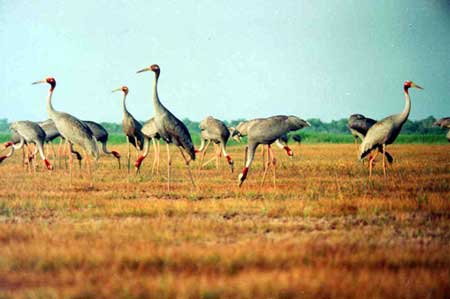
VietNamNet Bridge – The decline of the Sarus crane, the tallest flying bird in the world, is causing concern for conservationists.

Sarus cranes at Dong Thap Province's Tam Nong
Natural Conservation
 Centre. A decline in the bird's
 population has conservationists concerned about its survival.
Less than 2,000 members of the Indochinese subspecies are left in Cambodia, extreme southern Laos, Myanmar and southern Viet Nam.

Every November, the birds migrate to Tram Chim National Park in the Cuu Long (Mekong) Delta's Dong Thap Province. In 1998, about 1,100 Sarus cranes arrived in the national park.

But in recent years, that number has dwindled to approximately 200, said Nguyen Van Hung, director of the national park.