As regular CFZ-watchers will know, for some time Corinna has been doing a column for Animals & Men and a regular segment on On The Track... particularly about out-of-place birds and rare vagrants. There seem to be more and more bird stories from all over the world hitting the news these days so, to make room for them all - and to give them all equal and worthy coverage - she has set up this new blog to cover all things feathery and Fortean.
Showing posts with label reintroduction. Show all posts

Monday, 1 July 2019

Reintroduction of Great Green Macaws boosts wild population


Great Green Macaws have disappeared from the Ayampe region some 50 years ago, as a result of loss of its forest habitat to agriculture and ranching and also from the illegal collection for the pet trade. The total number of this species, the second largest macaw in the world (the Hyacinth Macaw is the largest), are thought to be less than 3,500. They feed on seeds, fruits, hard-shelled nuts, and flowers, and will move through the landscape in search of fruiting trees; they are particularly partial to the Pechiche tree, which provides food and nest sites across much of its range in Ecuador. These birds have a great importance on the ecosystem because they help to promote the natural regeneration through seed dispersal.
The release of the six additional individuals on 10 May 10 is the third Great Green Macaw release event and another milestone following three years of collaboration between Fundación Jocotoco, Fundación de rescate Jambelí and Loro Parque Fundación. The video below explains the lengthy process of from chick to release,

World Land Trust
17 June 2019

Sunday, 30 June 2019

Endangered bird returns to South Korea 40 years after extinction


Rare wader is designated a national monument that features in popular children’s song
Wednesday 22 May 2019 18:48 

The endangered crested ibis has reportedly been reintroduced to South Korea 40 years after it went extinct in the Asian country. 
Forty of the rare wading birds were bred in captivity before being released into the wild at Upo Wetland in South Gyeongsang province, southeast of Seoul, the Yonhap news agency reported.  
The last time a crested ibis was spotted on the Korean peninsula is believed to have been in 1979 when it was spotted in the demilitarised zone separating the south from North Korea.
The bird used to be a common sight until pesticide use reportedly damaged its food sources. 
A designated national monument in South Korea, it is also seen in China and Japan.
The captive population in South Korea has now reached 363, according to the Agence France-Presse news agency.
The breeding programme began with a birds donated by Beijing.
In South Korea the crested ibis is linked to an eponymous popular children’s song, composed when Japan ruled the country.


Monday, 8 April 2019

Isle of Wight sea eagle reintroduction gets green light


Natural England has issued a licence to allow the release of white-tailed eagles on the Isle of Wight.
The issued the following press release
The release is part of a project, led by the Roy Dennis Wildlife Foundation and Forestry England, to establish a breeding population of white-tailed eagles in southern England.
White-tailed eagles became extinct as a breeding species in England in the eighteenth century. Releases over the past 40 years have successfully re-established breeding populations in Scotland and Ireland.
Natural England has very carefully considered all aspects of the licence application. I would like to personally thank the expert working group of local staff and national specialists who have carefully tested the application against our licensing criteria and the IUCN: International Union for Conservation of Nature's Guidelines for Reintroductions and Other Conservation Translocations.
We have paid particular attention to:
the impacts on other wildlife and socio-economic interests, including livestock
the risk of disease transmission
the feasibility of the proposal and likely success
any risk to the donor population
the contribution to the conservation of white-tailed eagles
the adequacy of the applicant’s consultation, the evidence of support and how issues raised will be addressed
the applicant’s experience
the applicant’s monitoring plan
evidence of sufficient finances to support the project
the applicant’s communications plan and exit strategy
We have very thoroughly assessed the potential impacts on protected site features and existing wildlife. We have discounted any adverse impacts through direct predation and disturbance by the eagles or indirectly through increased visitor pressure from ‘eagle tourists’.
We have carefully examined the potential risk of lamb predation. There is no evidence of this becoming a problem where the eagles live alongside lowland sheep farming in Europe. However, we will ensure that the applicant puts in place clear routes to identify and manage any unexpected issues that might arise.
The licence permits the release of up to 60 eagles (12 per year) over the next five years. Young eagles will be sourced under licence from nests in Scotland and raised through to release on the Isle of Wight. The first release is planned for summer 2019.

Wednesday, 20 March 2019

Reintroduction Efforts Bring the Hihi Back to Mainland New Zealand


The Hihi, a bird species native to New Zealand, went extinct locally in the 1800s, but new reintroduction techniques are restoring their population.
The Hihi (Notiomystis cincta), a bird species once native to New Zealand, was driven locally extinct on mainland New Zealand in the 1880s. The leading threat this species faced came from the introduction of invasive rats, feral dogs, and cats. Now, after over 100 years, there is renewed hope for the native Hihi as a reintroduction project within Rotokare Scenic Reserve is restoring them to their rightful home once again.  
Researchers understand that when reintroducing a species in a given location, it will take them time to adjust. They will likely move around a fair amount before settling in a location that best suits them. In fact, wildlife managers tasked with monitoring the progress of the Hihi reintroduction suspected it would take females about four weeks to settle into a breeding territory. Oliver Metcalf, a doctoral student involved in the project commented:
We found the Hihi were initially pretty random in their movements around Rotokare, as you would expect from birds exploring a new home, but towards the end of the study they had settled down onto territories, and they preferred to have territories in areas close to water.”
Researchers are using novel methods in acoustic monitoring that allow them to track the ways the Hihi is moving across time and space without having to track each animal individually. Monitoring the reintroduction as it unfolds requires acoustic recording devices to monitor the species in the wild. These techniques are being used to get a sense of how the Hihi are settling in and what breeding locations they prefer. This new method of monitoring has the potential to be less intrusive to the species being monitored as well as more cost effective in the long term. Not only this, it makes monitoring much simpler. If an animal is particularly small or cryptic, tracking each animal individually can be an incredibly daunting task for researchers.


Thursday, 20 December 2018

Plans afoot to reintroduce White-tailed Eagle to the Isle of Wight

30/11/2018

Conservationists are exploring the feasibility of a White-tailed Eagle reintroduction project in the Solent. The Forestry Commission and Roy Dennis Wildlife Foundation, along with other partners, have identified the Isle of Wight as a potential release area due to its position amid rich foraging areas in the Solent, and with a strategic location on the south coast. White-tailed Eagle hasn't bred on the Isle of Wight – or anywhere in England – for almost 150 years, but the species has benefited from successful reintroduction schemes in Scotland and Ireland.
White-tailed Eagles were once widespread along the entirety of the south coast from Cornwall to Kent before being driven to extinction by relentless persecution. Members of the public have been invited to three open meetings in the island so they can find out more about the proposals and these have – according to the foundation – generated significant interest.
The charity is also conducting an online survey to gather opinions on the scheme and Dr Tim Mackrill, who is working on the project, said: "We feel that the Isle of Wight and surrounding area is a perfect place for them because there is high food availability and plenty of nesting sites. There are other far-reaching benefits such as tourism – they have generated £5m for the economy on the Isle of Mull and £2.4m for the Isle of Skye."

If the consultation and feasibility study are successful, the foundation would need to apply for a licence from Natural England. Should one be granted, it's possible the first birds could be released as soon as 2019. Preliminary releases would involve very small numbers, derived from the Scottish populations, at a confidential site over a five-year period. Any tentative population restoration on the island would be part of international efforts to help the eagles, linking populations north of the border and across the Irish Sea, as well as with those in The Netherlands and France

Roy Dennis said: "We believe that the Isle of Wight is highly suitable for White-tailed Eagles. It is the last known breeding site of the species in southern England, the Solent and surrounding estuaries will provide a rich food supply, there are numerous potential nesting sites in woods and cliffs and also good loafing areas for young birds.

"Evidence from The Netherlands, where there is a small but growing population of White-tailed Eagles, indicates that the birds will do very well in this landscape. We are keen to consult the local community, landowners and other stakeholders on the Island to encourage support and involvement in the project, and to identify and resolve any concerns."

Continued  

Wednesday, 14 November 2018

Kiwis to be reintroduced to New Zealand capital for first time in a century


Ancient, flightless, nocturnal birds have been absent from Wellington for more than a century
Eleanor Ainge Roy in Dunedin
Tue 13 Nov 2018 02.01 GMTLast modified on Tue 13 Nov 2018 02.55 GMT
Wellington could soon have kiwis nesting beside Parliament House thanks to an ambitious conservation project that aims to reintroduce the country’s iconic national bird to the capital city within the next decade.
There are 68,000 kiwi left in New Zealand but the number of birds are declining at a rate of 2% per year. A century ago, there were millions but attacks by dogs, cats, possums, stoats and rats have led to huge population decline.
The ancient, flightless, nocturnal birds have been absent from Wellington for more than a century, but after extensive predator-trapping by the council and as part of the country’s predator-free 2050 goal, conservationists believe Wellington is ripe for a reintroduction of the shy national bird, which few New Zealanders have ever seen in the wild.
“I would love to be woken by the sound of kiwi,” said Wellington mayor Justin Lester, who has been a strong proponent of predator control in the city, which sees school children set traps on school grounds, and mountain bikers check and set traps in rural areas.
Under the program, which is being coordinated by a consortium of conservation groups, 20,000 hectares of public and private land surrounding Wellington will be targeted with intensive trapping over the next three years to begin the reintroduction of kiwi.

Monday, 13 August 2018

After a 400-Year Absence, A Rare Ibis Returns to European Skies

The northern bald ibis is critically endangered, with fewer than 1,000 existing in the wild. But a German group is reintroducing these birds in Europe, where they once thrived, and is using ultralight aircraft to lead them on migrations south toward the Mediterranean.

BY CHRISTIAN SCHWÄGERL • JULY 16, 2018

With its black body and wide wings, the bird flying along Austria’s Salzach Valley on a mild summer day looks, at first glance, a lot like a crow. But when it lands in a nearby meadow, it quickly becomes clear that this is a very different animal.

The bird’s iridescent feathers give it an almost magical appearance. Its long, curved beak enables it to hunt for small animals, and its naked head, with feathers that point straight into the air, Mohawk-style, make it look like no other bird in Europe.

This particular bird even has a name: Liethe. It is a waldrapp, or northern bald ibis, a species that is critically endangered in the wild. In former centuries, the species occurred widely in northern and eastern Africa, Asia Minor, Arabia, and parts of Europe. The ancient Egyptians revered the northern bald ibis as an afterworld divinity, and its likeness can clearly be seen in hieroglyphs dating back thousands of years.

Today, however, all that’s left of the northern bald ibis is a small population of around 600 wild birds in Morocco, a semi-wild population — dependent on captive breeding — of about 200 individuals in southern Turkey, and perhaps a few individuals in East Africa. A tiny remnant population in Syria, numbering seven individuals, was discovered in 2002. But that population dwindled to a single bird in 2014, and an expert on the northern bald ibis in the Middle East says the bird is now extinct in Syria, with the civil war acting as “the classic straw that broke the camel’s back.”

Wednesday, 11 July 2018

Ground-breaking reintroduction for Cabo Verde's most threatened bird


6 Jul 2018

Great escape: After years of preparation, the Raso Lark (Critically Endangered) now spreads its wings on its new home of Santa Luzia – video below

By Shaun Hurrell

Approach Raso by boat and it can look like the foundations of a prison: a ten-metre-high perimeter wall of seemingly impenetrable reddish volcanic rock rises from a 'moat' of turbulent, shark-patrolled, Atlantic water. But rather than tall turrets and defensive battlements, the only human infrastructure on this mostly flat little island is an ex-military tent; rather than guards carrying guns, instead one might spot conservation biologists programming radio tags through the wind-torn gaps in the tent’s canvas.

Who, then, are the ‘prisoners’? Raso Larks Alauda razae (Critically Endangered), some of the rarest birds in the world. For many decades this little brown, crested bird has been confined to Ilhéu Raso (Raso Islet), a mere seven square kilometres of barren rock in Cabo Verde, off the west coast of Africa. The ‘crime’? It’s a complicated case of injustice: the Raso Lark is an innocent victim of the human introduction of invasive predators.


Monday, 20 November 2017

Restoration of iconic native bird causes problems in urban areas


After a century-long absence, kaka were successfully reintroduced in Wellington in 2002 - but the restoration of the iconic native bird has ruffled a few feathers.

Kaka are a delight, says Victoria ecologist Associate Professor Wayne Linklater. "They're wonderful birds to watch and listen to, and you watch kids' faces light up around them." But, just like their cousins the kea, kaka are boisterous, brainy and also potentially problematic in urban areas.

An emerging challenge in Wellington's suburbs is kaka damaging property - gouging into trees, roofs and buildings.

"Kaka are cavity nesters and, like most birds, attract in numbers where there is food," explains Wayne. "They're quite happy living in cities, where there are human-made cavities and food everywhere."

This has led to neighbours arguing about whether people should be feeding kaka, says Wayne. "Wellingtonians love feeding birds and connecting with wildlife - somewhere between 25 and 40 percent of residents at least occasionally feed birds in their backyard. It extends from throwing out some scrap food to placing large quantities in bird feeders.

"It could be that for many kaka their primary food source is people's backyards, and this is driving them to gather in particularly large numbers in some neighbourhoods."

Continued  

Friday, 27 October 2017

Reintroduced marsupials may pose new threat to ground–dwelling birds

23 October 2017

October 24, 2017

Native marsupials reintroduced in south-western Australia are a threat to ground-dwelling birds, a University of Queensland study has found.

Researcher Graham Fulton said ground-nesting and ground-dwelling birds had generally declined at a greater rate than other Australian bird groups, with the loss of eggs believed to be an important factor.

"We don't know a lot about the identity of ground-nest predators," he said.

Mr Fulton, a PhD student in the UQ School of Biological Sciences, said his research at Dryandra, south-east of Perth, highlighted the need for a greater understanding of the impacts of reintroducing native marsupials.

"Marsupials are not generally regarded as potential nest-predators of these birds, partly because the biology of rare Australian marsupials is not fully understood due to their rarity," he said.

The study found that three marsupials – boodie and woylie bettongs (Australian rat kangaroos) and brushtail possums (pictured right and left) – took eggs from artificial nests similar to those of the threatened painted button quail (pictured below right).

"Approximately one-third of the eggs were taken by the two bettongs and another third by brushtail possums," Mr Fulton said.

Sunday, 24 September 2017

Reintroducing the pink pigeon and echo parakeet in Mauritius

5 Sep 2017

By Jean Hugues Gardenne and Obaka Torto

Re-introducing birds to suitable habitats where species have gone extinct is often a very important and sometimes a last resort to sustain the survival of some threatened Mauritian bird species. The Mauritian Wildlife Foundation (MWF), the BirdLife International Partner in Mauritius, has a long and successful track record of exploiting bird translocation opportunities at any given time.

In recent years, MWF has worked with other partners in the country like the National Parks and Conservation Service of the Ministry of Agro Industry and Food Security, the CIEL Group, the UNDP/GEF Small Grants Programme (SGP), HSBC, Chester Zoo (UK),and the Critical Ecosystem Partnership Fund (CEPF), to translocate several Mauritian birds, including the Pink Pigeon, Echo Parakeet, Cuckoo Shrike and Paradise Flycatcher from the Black River Gorges National Park in the south west to the east of the island, in Ferney Valley (Bambous Mountains). This strategy has helped to create new subpopulations and increased the total population of some bird species, as it contributes to their distribution, saves them from extinction and loss of genetic diversity.


Wednesday, 10 May 2017

Parachuting birds into long-lost territory may save them from extinction


 May. 5, 2017 , 4:00 PM

Saving the Spanish imperial eagle was never going to be easy. This enormous bird, which once dominated the skies above Spain, Portugal, and northern Morocco, saw its numbers drop to just 380 breeding pairs in 2014, thanks to habitat loss, poaching, poisoning from farmers and hunters, and electrocution from power lines. Now, a new study highlights a potential way of restoring eagle populations to their former glory: dropping them into long-abandoned habitat.

One common approach for bringing threatened species back from the brink is to reintroduce them to the places they were last known to live. For example, the sea eagle in Scotland—which was hunted to extinction on the Isle of Skye in 1916—was successfully reintroduced in 1975 to Rùm Island near its last known breeding ground. But not all such efforts bear fruit: When scientists tried to release the same bird to its former range in western Ireland in 2007, the newcomers fell victim to the same poisoning that had done them in 107 years earlier.

“The tendency is to think that the last place that an animal was present is the best place for the species, but this isn't always the case,” says Virginia Morandini, a biologist with the Spanish National Research Council’s Doñana Biological Station near Seville.


continued

Sunday, 17 January 2016

Plans to reintroduce hen harriers to the south welcomed by both sides of the debate


Friday 15 January 2016

PLANS have been unveiled to protect one of England’s rarest birds of prey and reintroduce it in parts of the south of England. 

Although there are more than 600 pairs of hen harriers nesting in the UK, in England they are teetering on the brink of extinction, as a result conservationists say, of being targeted by gamekeepers because they prey on red grouse. 

In an increasingly bitter debate, the shooting industry says grouse estates spend millions of pounds a year on conservation and wants to see a well-dispersed hen harrier population which co-exists with local businesses. 

As well as monitoring hen harrier numbers with satellite tagging and protecting nests, the plan includes measures to provide other food for hen harriers and their young to stop them taking grouse chicks. 

It also includes controversial plans to take young birds in areas with larger numbers of harriers and rear them in captivity before releasing them elsewhere. 

The RSPB said the plan was not perfect and there were many hurdles. But it reflected “real potential for progress on one of the most deep-rooted conflicts in conservation.” 


Saturday, 9 August 2014

Last cranes released into British wild

Final set of birds in ambitious to reintroduction project has been released at a secret location in Somerset


theguardian.com, Thursday 7 August 2014 16.46 BST


The final set of cranes from an ambitious project to reintroduce the birds to Britain has been released at a secret location in Somerset.

Cranes used to be common throughout the country but were driven to extinction in the 16th century by over-hunting and the loss of wetlands.
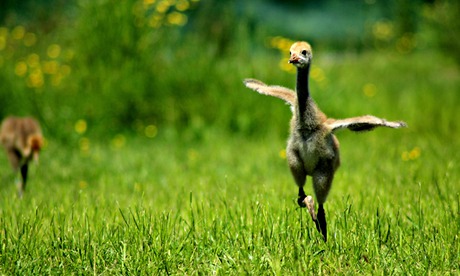
Over the past five years, the Great Crane Project has raised five classes of young crane chicks and released almost 100 on to the Somerset Levels and moors.

The classes, including foraging and exercise, were taught by humans dressed in grey hooded overalls to prevent the young birds becoming accustomed to people.

Yesterday, 16 young cranes completed the last 10-week course of Crane School at Wildfowl and Wetlands Trust (WWT) Slimbridge reserve in Gloucestershire.

They will join previous graduates and it is hoped the crane flock will start to grow naturally as the birds reach maturity and breed.

Thursday, 8 May 2014

Isle of Man study supports red grouse reintroduction

Experts said the size of a grouse population is an "indicator of the health of the Manx upland ecosystem"

A study of the Isle of Man has recommended reintroducing red grouse to boost the island's dwindling population of the bird.

The Manx Uplands report, compiled by Professor Jim McAdam, said in the past three years breeding had declined.

Research suggests the fall in grouse population was "almost entirely due to predation by harriers and peregrines".

The report said: "The size of the grouse population is an indicator of the health of the upland ecosystem."

It recommended "to at least maintain the current level of upland management and strive to increase it by a controlled and monitored reintroduction of red grouse".

Thursday, 17 April 2014

Yorkshire’s Red Kite reintroduction 15 years on

3:03PM, THU 10 APR 2014 
- last updated Tue 15 Apr 2014
RED KITES FLOURISHING IN YORKSHIRE

In the Victorian era, Red Kites were branded vermin and seen as a direct threat to the food supplies of a fast-growing human population.They were consistently persecuted until there weren’t any left in England at all.

But in 1989, dozens of birds were shipped over from Spain in the hope they would recolonize the country. They did so well down in the Chilterns that ten years later, 70 were brought up to Yorkshire and released at Harewood House.


It was a joint effort between conservationists, Yorkshire Water, the Harewood Estate and lots of other people who wanted to see the kites return. Doug Simpson led the project and was awarded an MBE for his achievements. About a thousand chicks have been born since 1999 and there’s now thought to be hundreds of breeding adults. People have reported seeing them across the region, from inner-city Leeds to East Yorkshire.

But both Mr Simpson and the RSPB are concerned about Red Kites being found shot or poisoned. 30 birds found dead since the reintroduction had been illegally killed and the RSPB reports that over the last 20 years, North Yorkshire has had the most reported incidents of bird of prey persecution. They say that in 2012 alone, there was twice as many reported incidents in North Yorkshire than in any other county.

Tuesday, 17 September 2013

Jersey's rogue chough pair rejoin the flock

A pair of rare birds that left an aviary during a phased reintroduction to the wild release have returned.

Red-billed choughs have not thrived in Jersey for a century and are being reintroduced by an environmental group.

The aim was to allow the birds out for short periods to allow them to gradually adjust to the wild.

On the first release two birds left the flock and spent about a week living in a quarry before returning to the aviary last week.

The Birds on the Edge programme aims to restore the natural diversity of the north coast of the island.

Dr Glyn Young, leading the project, said the birds were born in captivity but hoped they would thrive in the island.

Flock of crows

He said after the pair had returned they decided to go back to the original plan of a phased release but not everything went to plan.

Wednesday, 28 August 2013

Reintroduced white-tailed eagle pair raise chick

Scotland's largest bird of prey, the white-tailed eagle, has bred in the east of the country for the first time in almost 200 years.

BBC Scotland has learned a pair of the birds have raised a male chick, after nesting at a secret location in Fife.

The country's last native white-tailed eagle was shot in Shetland in 1918.

The species only returned to the UK following a reintroduction project in the west of Scotland, which began on the Isle of Rum in 1975.

Environment Minister Paul Wheelhouse welcomed the news.

"I hope this will be the first of many of this magnificent species, which will eventually spread their territories right across Scotland," he said.

"I'd like to thank all the partners who have played their part in making this exciting and special event happen."