As regular CFZ-watchers will know, for some time Corinna has been doing a column for Animals & Men and a regular segment on On The Track... particularly about out-of-place birds and rare vagrants. There seem to be more and more bird stories from all over the world hitting the news these days so, to make room for them all - and to give them all equal and worthy coverage - she has set up this new blog to cover all things feathery and Fortean.
Showing posts with label Suffolk. Show all posts

Friday, 7 February 2020

Suffolk Little Owl 'too fat to fly'


29/01/2020

A Little Owl, unceremoniously rescued from a Suffolk ditch as it was unable to fly, has been declared "extremely obese" by the Suffolk Owl Sanctuary.

The soggy owl was found in a ditch in the county in early January and, in these circumstances, wildlife rescue centres generally find that birds are carrying injuries, or occasionally have become waterlogged.

However, Suffolk Owl Sanctuary was surprised to find that it was in fact extremely overweight. Upon assessing the owl, a female, it weighed in at a rather chunky 245 g – roughly a third heavier than a healthy adult female Little Owl. It was unable to fly due to the large fatty deposits around its body.

It is extremely unusual for wild birds to get into this condition naturally, so the vets decided to investigate some obvious scenarios – the first being that it was possibly an escaped aviary bird. There was no indication of rings or chip identification, and asking around in the local area also didn't produce any leads.

They therefore decided to observe the rotund bird over a period of time for signs of a captive history – familiarity with 'artificial' foods used in aviaries, such as bright yellow chicks, can be a telltale sign. However, the owl didn't show any hints of previous confinement and has readily taken 'wild' food types, such as dark mice.

Sunday, 26 January 2020

Rare bird has found its own 'McDonalds' in Christchurch Park

PUBLISHED: 16:10 20 January 2020 | UPDATED: 16:20 20 January 2020


A certain visitor has been ruffling feathers in Christchurch Park with people trying to find out where the newcomer hails from.

The Hooded Merganser is native to North America but has been spotted in Ipswich of late, bathing in the wilderness pond.

The male duck has a distinctive crest along the top of it's head with a large white plume against a distinctive black outline - closely resembling a quiff.

A spokesperson for Ipswich Borough Council said: "It has created quite a stir, lots of people have been down to photograph it as it is a particularly handsome specimen.

"The rangers think it might stay as the pond is its equivalent to McDonalds - plenty of fish."

There has been speculation among bird watching communities as to where the mystery visitor had come from as the species is native to North America.

John Grant, president of the Suffolk Bird Group, said: "There's a 99.9% chance that it's not a wild bird.

"It's very likely to be an escapee from an ornamental collection as they are very attractive - though the owner will be unlikely to admit they let it escape."

Short of stowing away on a boat to Felixstowe it's doubtful whether the Hooded Merganser would have made it across from North America alone.

Mr Grant says that whilst there have been some accepted as a wild bird in rare cases in Britain, this is not likely to be one of them.

Wherever it's from, the sightings have prompted a wave of interest as the feathered celebrity has reportedly been hanging around for some weeks now.

Friday, 8 November 2019

Suffolk golf club sees 25% increase in bird species


Tania Longmire
October 29, 2019 20:14


Ufford Park Woodbridge Hotel, Golf and Spa in Suffolk has seen a nearly 25 per cent rise in bird species that live at the venue in just eight years, according to a Royal Society for the Protection of Birds (RSPB) survey.

The club is now home to 39 species and new residents include four mistle thrushes and a number of hawfinches.

Mistle thrushes have been scarcer in south east England because of drier summers in recent years, and sightings of hawfinches – the UK’s largest finch – are increasingly rare because their breeding areas are in decline.

Wednesday, 31 July 2019

Where have all the thrushes gone?


PUBLISHED: 19:00 20 July 2019


Alarmed residents in Suffolk have voiced their concerns at the worryingly low number of songbirds spotted in the county this summer.

Their concerns have been raised as songbird populations across the UK have continued to decline over the last 30 years.

Clare-based writer and birdwatcher Sylvia Loch claimed she and fellow villagers have only seen a single songbird in four months.

She said: "We need to wake up to the amount of birds we are losing like swallows and swifts.

"It has been getting worse for years - but I never expected to only see one song thrush in the last four months. It is terrible.

"People love feeding their birds, but there isn't a single bird to feed."

According to the RSPB, the declining population is significantly caused by farming - notably of which through increased efficiency, changing in cropping practices and the use of fertilisers and pesticides.

Sunday, 5 May 2019

Drones could disturb Suffolk's rare birds, pilots warned


PUBLISHED: 21:38 01 April 2019 | UPDATED: 08:39 05 April 2019
Rare birds could be disturbed or even distressed by errant drone pilots trying to get photographs, it has been warned.
Suffolk has some very sensitive sites where rare bird breeds, both native and migratory, are either already nesting or will shortly be arriving.
Areas like RSPB Minsmere and the Area of Outstanding Natural Beauty (AONB) of the Suffolk Coast and Heaths are both sites of nests that should not be disturbed, as birds there are protected under law.
Some of these sites are protected from entry, so some users of drones may want to use technology to try to get a view from above.

Thursday, 21 February 2019

Surprise arrival of rare ‘cartoon birds’ on random Suffolk street causes a stir


PUBLISHED: 20:01 29 January 2019 | UPDATED: 17:50 30 January 2019
But these rare waxwings are causing something of a stir after flying all the way from Scandinavia and randomly picking an Ipswich street to nest for winter.
The 20 or so of the brightly coloured birds are currently camped out on telegraph poles, television aerials and in trees in Defoe Road - picking Suffolk, perhaps surprisingly, for its warmer winter climate.
They have brought with them a flock of their own - in the form of nature lovers with binoculars and cameras, who have travelled from far and wide to capture a glimpse of the rare birds famous for their plump shape and prominent crest.
In scenes watchers have described as something out of a cartoon, the creatures fly down from their perches to eat berries from trees, comically tossing the fruit up in the air before taking a bite.

Sunday, 10 June 2018

Stone-curlew eggs stolen


17/05/2018

Suffolk police are appealing for information following the theft of four Eurasian Stone-curlew eggs from Cavenham Heath NNR in Suffolk. Offenders took the eggs from the nesting site at some point between 4 and 9 May.

The species was almost lost as a breeding bird in Britain, with numbers declining from around 2,000 pairs in the 1920s to just 168 pairs in 1991. A successful recovery programme in the east of England has increased this number to 400 pairs. However, Eurasian Stone-curlew remains Amber listed as a Bird of Conservation Concern in the UK.

Sergeant Brian Calver of Suffolk Constabulary commented: “These are a Schedule One bird, which receive a high level of protection, to include their nesting sites.


Sunday, 29 April 2018

Rarely seen American bittern spotted in UK for first time in eight years


Lucky birdwatchers spot wading bird flying alongside its European cousin in Suffolk

Wednesday 11 April 2018 16:01 BST

The Independent Online

The American bittern spotted at Suffolk Wildlife Trust’s Carlton Marshes, near Lowestoft SWNS
Hundreds of bird watchers flocked to Britain after an American bittern was spotted for the first time in almost a decade.

People came from across Europe to catch a glimpse of the bird, which is believed not to have been seen in the UK since 2010.

It was first sighted on Saturday evening flying above the reeds in Carlton Marshes, Suffolk; the first time it has been recorded in the county.

After reports of the sighting were posted on social media, admirers arrived in droves to see the bird for themselves.

Photographer Jeff Higgott captured an image of the wading bird in flight after waiting by the reeds for more than six hours.


Wednesday, 18 April 2018

Appeal for volunteers to help rare coastal seabird


The RSPB's appealing for volunteers in Norfolk, Suffolk and Essex to help one of the UK's rarest seabirds, the Little Tern.

Their numbers have seriously declined in recent years as they struggle to find safe beaches to nest and feed their young.

Over a third of the UK breeding population make a home in East Anglia.

“Norfolk beaches are fantastic places to see little terns. Over a third of the UK breeding population make a home in East Anglia, and some of the largest colonies in the UK can be found here in Norfolk. However, our beaches are busy places and the little terns rely on our help to ensure chicks thrive and are able to successfully follow their parents back to Africa in August."

– PHIL PEARSON, SENIOR CONSERVATION OFFICER

The RSPB says that the birds are often disturbed when nesting by people as well as being vulnerable to predators such as crows or foxes. Severe weather events have also affected numbers in recent years.


Friday, 2 March 2018

Investigation after at least one buzzard found dead in Suffolk woodland


PUBLISHED: 15:11 26 February 2018 | UPDATED: 16:49 26 February 2018

Police are investigating the shooting of at least one common buzzard - a legally protected bird of prey - that was found dead in a Suffolk wood.

Two buzzard corpses were reported to Suffolk Constabulary’s wildlife crime team in an incident described by naturalists as “appalling and abhorrent.” The bodies were found in woodland known as Little Carr, “on the edge of a shooting estate” on the banks of the River Dove, near Hoxne, the team’s Sgt Brian Calver said yesterday.

The discovery was reported by “a person with shooting rights”, but when a police officer visited the site only one corpse could be found. It was believed that the birds died in January, he said.


Wednesday, 28 February 2018

“How 40,000 starlings go to bed in less than a minute” – amazing moment huge flock drops from sky


By Paul McGowan -

February 20, 2018

A REMARKABLE video shows the moment a murmuration of 40,000 starlings evaporates as they drop out of the sky at the same moment.

Retired water worker Simon Waters, 61, captured the stunning scene at the RSPB Minsmere Nature Reserve, in Suffolk.

His footage shows the birds create incredibly dense shapes at one moment and seem to fill the sky the next.

But the clip is really notable for how the starlings suddenly and in unison land to roost for the night.

Wednesday, 31 January 2018

Five penguins set up home on Felixstowe beach


By The Editor | January 14, 2018

A group of penguins has set up home on Felixstowe beach, the first to ever settle naturally in the UK, it has emerged.

The five Magellanic penguins – all adults and apparently healthy – have been spotted over recent days on the pebbled beach close to the Spa Pavilion.

Experts say the flightless seabirds normally live in South America, and they are curious about how they came to be splashing around on the Suffolk coast.

It is likely they hitched a ride on a container ship from the Falkland Islands to Felixstowe Port, which arrived last week – and liked it so much they decided to stick around.

“From the photographs we have seen, the group seem healthy and happy enough,” said zoologist William Spence, from Cambridge University.

He added: “It’s certainly nice and cold at the moment, so they are quite at home in the conditions, and are likely to be finding plenty to eat in the North Sea.

“However, although we understand the public will want to go and see them, we urge them to keep back and give them some space.

“They should also keep their dogs on a lead.”

Daytripper Lorraine Fisher, 34, who was visiting the coast from Ipswich, said: “We saw them waddling around this morning.

“They’re really cute – much nicer than the seagulls you normally come across.

“My four-year-old son has seen Pingu on television, and he was really excited.”

Mr Spence said that while he and his team were not concerned for the penguins’ welfare at the moment, they would struggle in the heat of a Suffolk summer.

“We will monitor the situation, but it may be they migrate north where they will enjoy the colder climate.”

Penguins do not normally make the news in Suffolk – although three years ago a local boy stole a penguin from a zoo and took it home in his backpack.

EDITOR’S NOTE: In an extraordinary twist, US President Donald Trump Tweeted about this story, claiming it was proof that global warming is a myth.


Wednesday, 20 December 2017

Rare parrot crossbills attract flock of ornithologists to Suffolk forest


PUBLISHED: 21:02 04 December 2017 | UPDATED: 21:02 04 December 2017

A small flight of parrot crossbills have arrived at Santon Downham

Dozens of bird spotters converged on the Suffolk-Norfolk border to see rare visitors who had flown in for an East Anglian feast.

A small flight of parrot crossbills charmed the visitors who arrived at the Forestry Commission’s St Helen’s picnic site, near Santon Downham, Thetford.

The birds, believed to have flown in from Scandinavia, are rarities in the UK and a crowd of spotters gathered after news spread on birding websites and social media.

Continued  

Monday, 2 October 2017

Breckland roost at Cavenham Heath is a rare chance to see the secretive stone-curlew with RSPB and Natural England


PUBLISHED: 09:09 08 September 2017 | UPDATED: 14:14 08 September 2017
They’re usually elusive, shy and unsociable – but a Breckland heath has offered a glimpse of a “secret gathering” of stone-curlews as they prepare for their annual migration.
Cavenham Heath, near Mildenhall, has become a departure lounge for these rarely-seen travellers, as they congregate to roost and feed before flying more than 1,000 miles in search of some winter warmth in northern Africa and southern Spain.
The stone-curlew is one of the UK’s rarest breeding birds. They are notoriously secretive in the breeding season and, as many nest on private or inaccessible land, there are few public places for people to go and see these unusual birds without the risk of disturbing them.

Monday, 12 June 2017

Rare rose-coloured starling spotted in Ipswich back garden

PUBLISHED: 09:29 05 June 2017 | UPDATED: 17:34 05 June 2017

Jason Noble and Emily Townsend
Rosy Starling - Almaty - Kazakstan S4E1244 (22382991808).jpgBirdwatchers have been flocking to a back garden in Henley Road, Ipswich, after a rare rose-coloured starling was spotted.

RSPB Ipswich Local Group member Rosie Forest spotted the unusual bird outside her home in Henley Road when it came down to feed on dried mealworms.

She noticed it on Friday morning – it was sitting among a large flock of around 50 common starlings about two metres away from her patio doors.

The bird, which is part of a migrant species which breed in Russia and the Ukraine, also fed on suet hanging at the back of Rosie’s garden.

She said it occasionally flew up to the tops of her conifer trees. Chris Courtney, a fellow bird-watcher, said: “She (Rosie texted me at 8.35am saying she had had this amazing pink starling and went on during subsequent texts to give a perfect description of an adult rosy starling. I told her it couldn’t be anything else.

“It was most apt that our member Rosie should succeed in attracting her namesake, the bird is known colloquially by birders as a Rosy starling.

“It’s also testimony to her really dedicated efforts to feed her garden birds - she spends a small fortune buying bird food and spends hours enjoying watching them.”


continued

Wednesday, 24 August 2016

Common Crane breeding success at Lakenheath Fen RSPB

Posted on: 23 Aug 2016

For the second year running, two pairs of Common Cranes have successfully raised three chicks between them on a Suffolk RSPB reserve.

Common Crane is one of Britain's rarest breeding birds and with only around 25 pairs nesting in the country each year. Common Crane had been extirpated in Britain since the 1600s due to hunting and loss of habitat. They recolonised the Norfolk Broads in the 1970s and have gradually started breeding elsewhere in the country.

Two pairs of cranes arrived at Lakenheath Fen in 2007 and have nested on the reserve every year since then. In 2009, one of these pairs fledged the first chick to reach that stage in the Fens for over 400 years. Since then, the two pairs of cranes at Lakenheath Fen had reared a total of eight chicks until this year. Common Cranes live an average of 20-25 years, and find a mate and start to breed at between three and five years of age.

Staff and volunteers at Lakenheath Fen RSPB on the border of Suffolk, Norfolk and Cambridgeshire, are over the moon that this scarce species, which is very shy and secretive during the breeding season, has had this success in front of an audience of commuters on the Abellio Greater Anglia train route between Norwich and Ely.


Continued

Thursday, 11 August 2016

The emu that did a runner at 30mph: Bird spotted make dramatic bid for freedom through the Suffolk countryside

A road-running emu was snared after making a dramatic bid for freedom
Giant bird was spotted sprinting along road by police officer in Whepstead
Police received a flurry of calls from concerned members of the public 
It startled numerous motorists as it ran 20 miles around the countryside

PUBLISHED: 23:37, 3 August 2016 | UPDATED: 04:17, 4 August 2016

A road-running emu travelling at nearly 30mph through the Suffolk countryside was snared yesterday after staging a dramatic bid for freedom.

The giant bird - which is can serious injuries with its talons and is inferior in size only to the ostrich - had been spotted sprinting along a road by a police officer in Whepstead at around 7.15am.

Police subsequently received a flurry of calls from members of the public describing the omnivorous creature variously as an ostrich, a rhea and an emu.

The giant bird had been spotted sprinting along a road by a police officer in Whepstead at around 7.15am. Pictured, the emu after it was caught in a yard in Glemsfrod, Suffolk

The flightless bird, which is around 5ft 11ins tall, went on the run after apparently being spooked by a fox and jumping over its 4ft high paddock fence.

But the 15-month-old male bird startled numerous motorists as it ran for about 20 miles around country lanes and fields before being finally captured.

The emu, which is one of six owned by retired farmer Bernard King, disappeared on Tuesday night from his land near Bury St Edmunds.

Friday, 5 August 2016

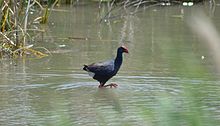
Rare Purple Swamp Hen brings flocks to RSPB Minsmere in Suffolk


Calamon Común.JPGIt normally resides in the swamps of Southern Europe and Africa but has decided the lagoons of Minsmere in Suffolk are more to its liking. A 'wild' Purple Swamp Hen has never been seen in the British Isles before but it's showing itself several times a day at the RSPB reserve.

More than a thousand birdwatchers have come from across the country to see the bird, which is about the size of a chicken and looks like a fancy coloured moorhen.

Continued .. 

Monday, 1 August 2016

Can the Queen stop world's worst swan? Angry bird sinks squadron of model boats


Eight hand-built boats, with a combined worth of £15,000, have been destroyed by the swan so far.

July 21, 2016 15:59 BST

A destructive swan's relentless targeting of model boats has prompted one enthusiast to beg the British Queen for help in dealing with the dangerous bird. The mute swan is known to patrol Needham Lake, Suffolk, attacking ducks and geese thought to be on its stretch and smashing up eight model boats so far – some of which are worth up to £15,000 ($20,000).

In a throwback to medieval times – technically, the British Crown owns all unmarked mute swans – one boat owner, who had had two of his models attacked, went so far as to write to Queen Elizabeth II urging her to take action.

He told the East Anglian Daily News "I wrote to the Queen telling her the swan is a menace and I would like him to be moved on if possible... I would like to be able to boat in peace."

Treasurer of the Gripping Valley Model Boat Club, Cliff Galsworthy told the paper that the swan is a "menace": "He attacked my boat nearly straight after I put it in. I have spent about 10 full days trying to repair it. It took about six months to build and he just smashed it to pieces."


Sunday, 15 November 2015

Shot Long Melford peregrine falcon released back into wild

1 November 2015

A shot and wounded bird of prey has been released back into the wild after a year of rehabilitation work on a wing and foot.

The peregrine falcon was found in Long Melford, Suffolk and vets removed six pieces of lead shot from her.

She has been nursed back to flying condition at the Raptor Foundation near St Ives, Cambridgeshire.

Simon Dudhill, foundation manager, said: "This release was better than we could have imagined - she'll be fine."

The bird was found by a member of the public near a stream in August 2014 and the foundation said it had taken hundreds of hours of work to get her ready for her return to the wild.

"The biggest problem was the pellet that was in the toe - and at that stage we didn't know if that foot, which is needed to catch prey, would ever work again," said Mr Dudhill.

"We will do all we can to combat this evil, for want of a better word, of people shooting these birds."

Upon release, the bird flew above a neighbouring field and immediately chased a pigeon.
She failed to catch it, but the centre said she was later spotted carrying a dead one.